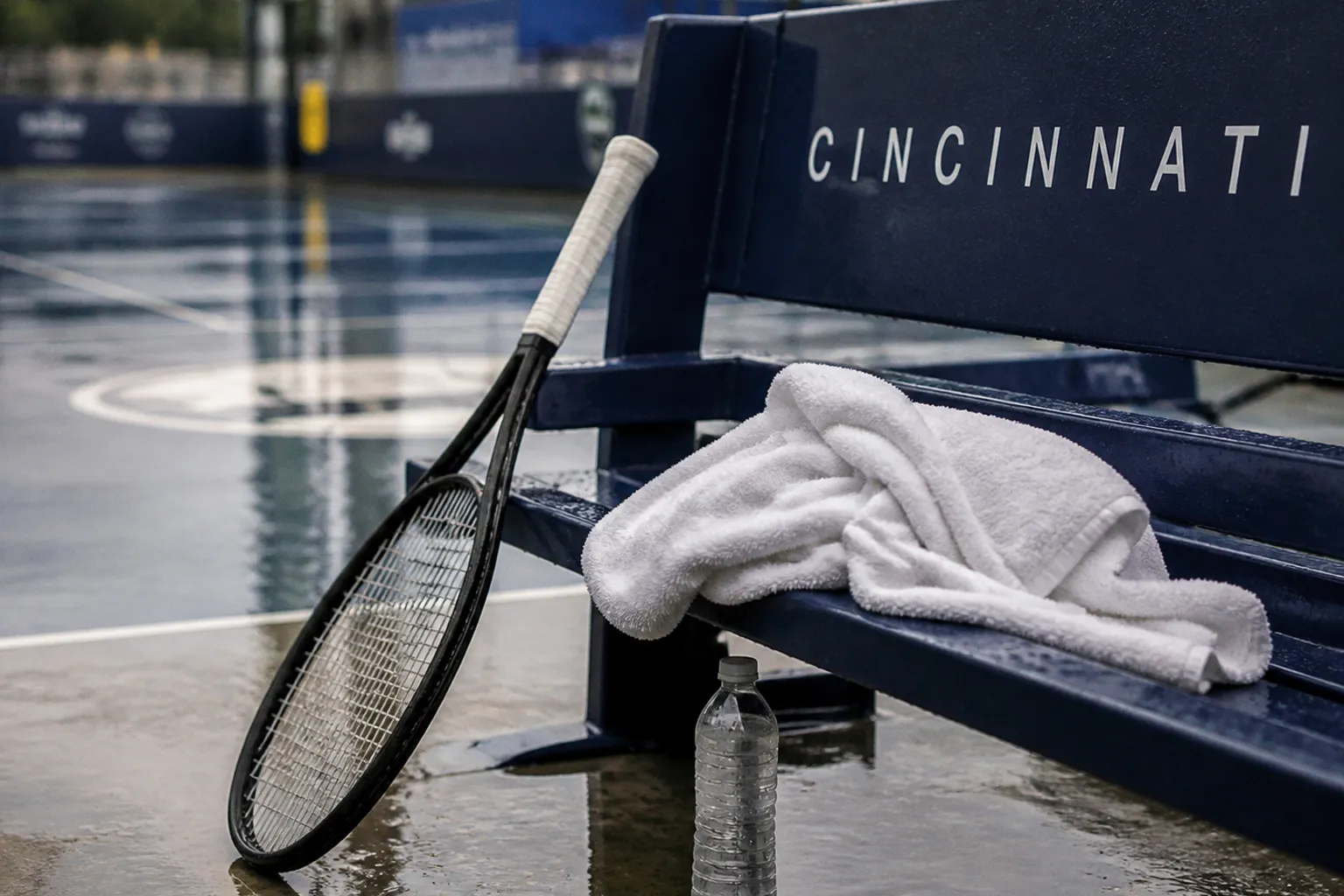
The defeat was not a mysterious tactical ambush so much as a visible physical unraveling: Djokovic led by a set, then began bending over between points and struggling to recover in Ohio’s heat and humidity. For a player using Cincinnati to gain matches before the US Open, the warning is uncomfortable rather than complicated.
The match turned when Djokovic’s body did
The opening set suggested routine business. Djokovic moved through it without apparent difficulty, taking it 6-2. But from early in the second set, the match became an exercise in attrition, and Djokovic was losing that contest before Tirante had fully taken control.
While leading 6-2, 2-1, Djokovic called for the physio and doctor. He vomited into a towel and had his blood pressure checked, then continued to play at roughly half-speed for much of the match. Between points, he repeatedly squatted or bent over, trying to catch his breath. The facade of control did not survive the conditions.
That matters tactically because Djokovic’s game depends on making opponents play one more ball, then one more after that. It is a form of psychological taxation. But the calculation changes when the player absorbing the load cannot reset between points. His court position deteriorated, his movement became limited, and the match stopped being about extracting errors from Tirante. It became about surviving the next exchange.
Tirante did not need to manufacture a miracle. The 25-year-old Argentine stayed strong, using a major serve and a powerful forehand to push Djokovic behind the baseline. Against a player already compromised by the conditions, that was enough pressure. The second and third sets followed at 6-4, 6-4, with Tirante converting the opportunity that had appeared in front of him.
Tirante’s breakthrough was built on refusal
The result is the biggest win of Tirante’s career, and it also underlines a curious feature of his record: according to The Guardian, the world No. 50 now has a 4-1 mark against top-10 opponents. That is not the profile of a player overawed by the name across the net.
The important detail is not that Tirante defeated Djokovic while Djokovic was struggling. It is that Tirante remained stable enough to keep applying pressure when the match’s hierarchy began to wobble. Top players often recover when an opponent’s level drops. Tirante instead kept the geometry of the point uncomfortable: serve hard, use the forehand, hold Djokovic deep, and let the physical problem compound.
That is where the psychological friction of the match sat. Djokovic had the reputation, the first-set lead, and the expectation of a controlled opening-round appearance. Tirante had the simpler assignment: stay present while the icon in front of him began to unravel. Tennis is cruelly efficient in such moments. The player under pressure does not need to lose his temper; he only needs to lose a fraction of his recovery, a step of court position, or the confidence to extend the rally.
Djokovic’s own explanation was similarly stark. He said the conditions had been affecting him for the last couple of years, particularly when it was hot and humid. He also said he had expected a difficult day, but that nerves and match pressure made the problem worse. That is less an excuse than a description of cognitive load: the body is struggling, the opponent is still attacking, and every point becomes an argument with the forecast.
Cincinnati was supposed to provide momentum
Djokovic has increasingly treated non-Grand Slam events as preparation around the larger targets. The source notes that he has prioritized Grand Slam tournaments and the Olympics at this stage of his career. He had reached the Australian Open final and the Wimbledon semi-final, but before Cincinnati he had not reached the quarter-finals in any of his three non-Grand Slam appearances this season, compiling a 2-3 record across Indian Wells, Rome, and Cincinnati.
That context makes the loss more relevant than a single bad afternoon. Djokovic entered Cincinnati looking for match practice before the US Open. Instead, he leaves with the same old problem: finding his rhythm quickly in New York after a stop-start hard-court buildup. His recent Grand Slam results remain strong, with a semi-final or better in six of his last seven appearances, but the contrast is becoming harder to ignore. The facade of decline is not there; the results at the majors still argue against it. The friction lies in how much strain is required to reach that level, and how little margin remains when the conditions turn hostile.
Djokovic also indicated that he hoped to return to Cincinnati, though he suggested it looked less likely. For now, the practical lesson is plain: this was not merely a shock defeat to a lower-ranked opponent. It was a match in which heat, humidity, pressure, and Tirante’s sustained serving power aligned to expose the narrow space between Djokovic’s preparation and his Grand Slam standard. In Cincinnati, that space was enough for an unfamiliar name to walk through.