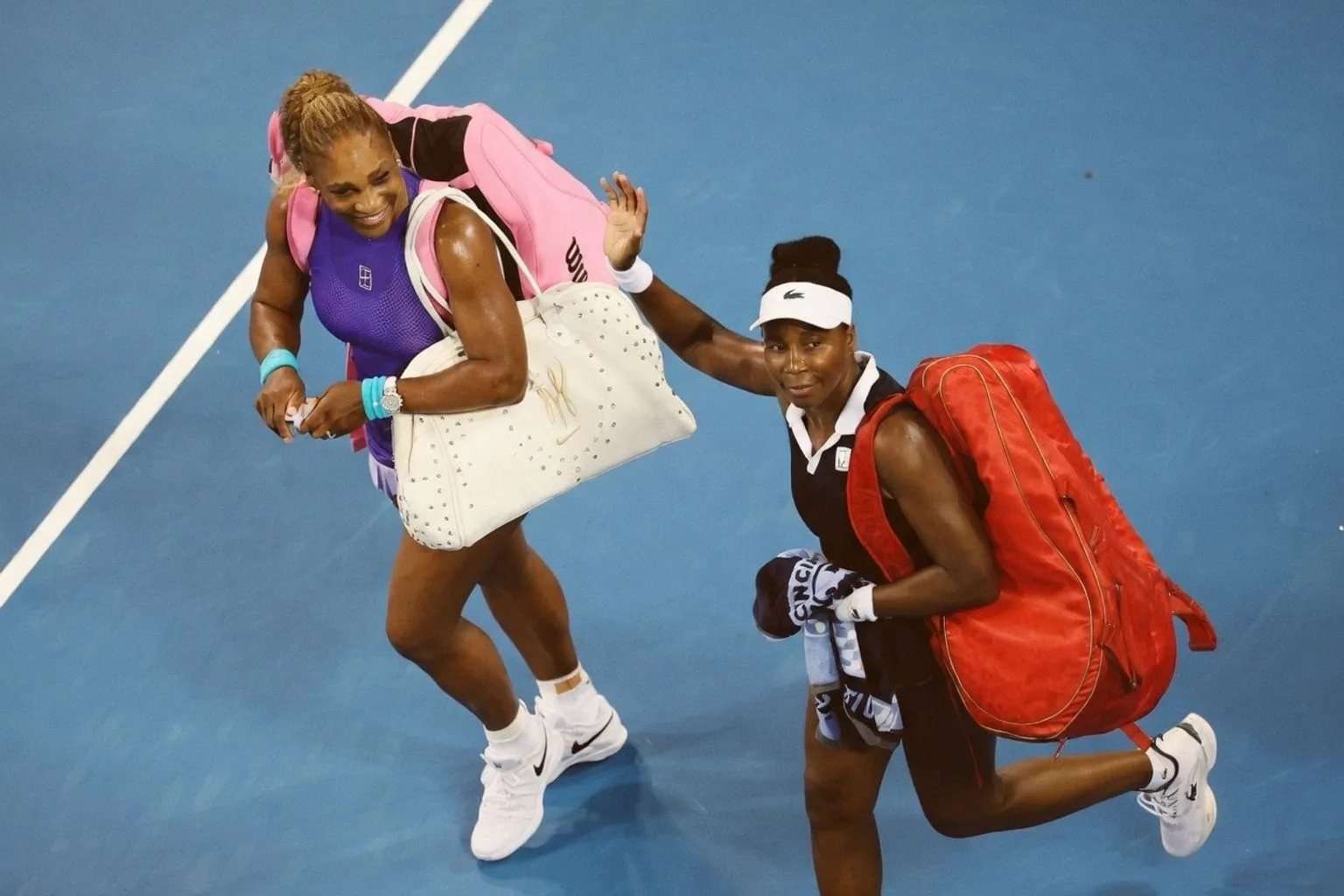
Their appearance matters beyond the familiar weight of their names: it is the latest stage in Serena’s return to competitive tennis and another test of whether the sisters’ partnership can become more than a single occasion.
A return built on unfinished rhythm
The Williams sisters arrived in New York after coming close to a comeback victory at the Cincinnati Open, the final major tune-up before the U.S. Open. They recovered from a 6–0 deficit in the match tiebreak against Peyton Stearns and Marta Kostyuk, but lost 6–2, 1–6, (10–8).
That narrow ending gives the U.S. Open reunion its proper texture. This is not simply a ceremonial return to a familiar court. Venus and Serena are trying to recover the timing, movement, and shared instincts required by doubles after a long absence from the format. Venus has described their partnership as one in which they eventually find their way back to each other, with grace and encouragement helping them regain their stride.
The history behind that process remains unusually substantial. Together, the sisters have won 14 Grand Slam doubles titles and three Olympic gold medals. Their singles record adds 12 Grand Slam championships between them—seven for Serena and five for Venus. Those numbers explain the attention, but they do not remove the physical problem in front of them: a partnership built over decades still has to reassemble itself point by point.
Serena’s comeback has moved from possibility to court time
Serena’s return to the singles court at Wimbledon had already marked a significant change. She entered the main draw as a wild card after almost four years away and lost to Maya Joint in three sets. The result did not diminish the significance of the appearance, which became one of the defining moments of the tournament.
The path back had been gradual. After her name appeared in the tennis anti-doping testing pool last December, Serena publicly denied that she was returning. In January, she left the possibility open during an interview on Today. In February, she posted a video of herself practicing serves—the first time she said she had done so since 2023.
Reentering the testing pool also meant accepting tennis’ whereabouts requirements, including the possibility of random drug testing and the obligation to remain in a specified place for an hour each day. It was a practical sign that a comeback was no longer merely hypothetical. Her later appearance as a wild card made that shift visible on court.
The surface matters, too. Serena’s first event back was Queen’s, a grass tournament, and grass has long been central to her competitive identity. She won Wimbledon seven times in singles and became closely associated with the low-bouncing, fast-moving conditions of the All England Club. The U.S. Open offers a different physical setting, but the question remains similar: how much of her old timing can be summoned after such a long interruption?
What to watch beyond the scoreboard
The immediate result is only one part of this return. The more revealing signals are whether Venus and Serena choose to play together again, how long the partnership lasts, and whether this appearance becomes a brief reunion or the beginning of a wider schedule.
There is also a separate question around their media obligations. Several lower-confidence reports said the sisters skipped a post-match U.S. Open news conference, with subsequent commentary focused on possible fallout and a reported fine. Because those reports are based on snippets rather than full source material, the details should be treated cautiously rather than as settled fact.
For now, the clearest conclusion is on the court: after four years away from the U.S. Open, the Williams sisters have returned to Arthur Ashe Stadium together. The significance lies not in pretending the old conditions remain untouched, but in watching how much shared rhythm, competitive tension, and physical trust can still be rebuilt.