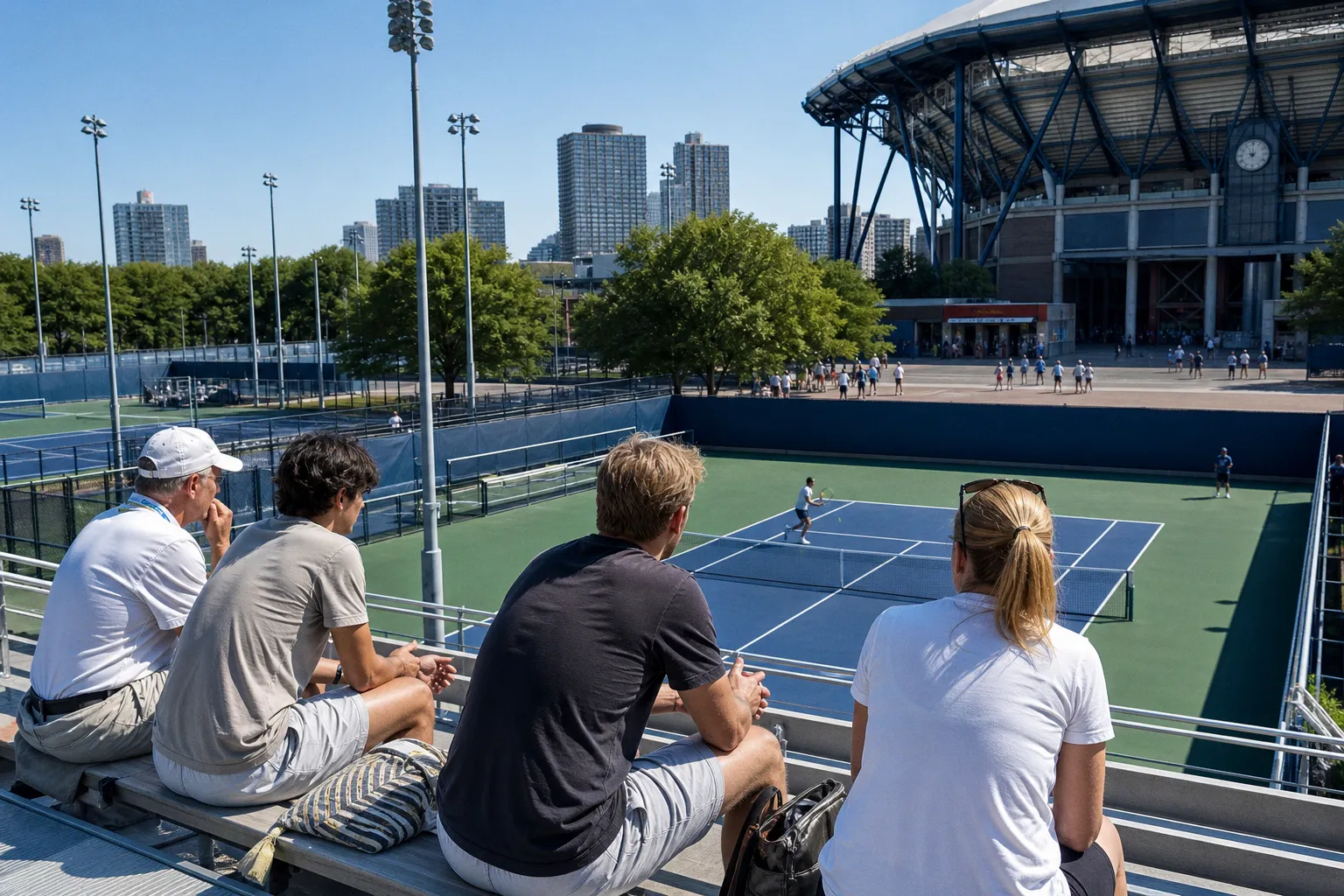
The U.S. Open rolls into New York on Sunday with the Billie Jean King National Tennis Center as the stage, and according to The New York Times' annual preview, the field is unusually wide open — not because the talent is thin, but because the supposed top dogs are wobbling in fascinating, very different ways. Carlos Alcaraz defends a title he hasn't played enough to feel ownership over. Jannik Sinner, the world No. 1 in men's tennis, won't play at all. Aryna Sabalenka is the WTA's No. 1 by ranking and not by recent evidence.
Sabalenka and the Quiet Unraveling
There is an argument that Sabalenka has the field exactly where she wants it. There is also an argument that the field has Sabalenka exactly where it wants her. The recent evidence points one direction. She hasn't reached a semifinal since late March. Her losses since the start of the clay season have carried a specific, recurring texture — failing to close when victory was within reach at both Madrid and the French Open. That is not a slump a player sleeps off. That is someone losing trust in the tactical variety that previously rescued her in tight matches, and quietly losing the awareness of how to counter what's coming back at her.
The WTA's top ten has tightened into something Sabalenka can no longer bully. Every player in that group holds either a Grand Slam title or a WTA 1000 crown, meaning the world No. 1 is no longer surrounded by pretenders. She is surrounded by champions who have, by now, catalogued exactly how to unsettle her when the scoreboard tightens. Carrying the ranking without the form to enforce it is, by definition, a different sport from the one she played twelve months ago.
The Structural Levers
Elena Rybakina's left Achilles is doing far more than deciding her own week. A healthy Rybakina likely sails into the second week under relatively smooth conditions. But she is in direct competition with Sabalenka, Coco Gauff, and Jessica Pegula for the No. 1 ranking, and a semifinal run by Rybakina would mathematically lock the top spot regardless of what the other three accomplish. One joint. One outcome. One ranking reshuffled.
The men's draw is its own kind of attrition. Alcaraz returns from a four-month absence with a right wrist that has to be trusted on every forehand. Sinner's right knee has ruled him out entirely. Alexander Zverev, fresh off a French Open title, and the 24-time Grand Slam champion Novak Djokovic now face a draw missing its two heaviest shadows. Everyone ranked three through twenty has been handed an invitation to stop behaving like a guest in someone else's tournament.
The Supporting Cast and What to Actually Watch
Then there is the human furniture of every major — the veterans chasing one last run, the home-soil favorites feeding off New York noise, the rising talents taking their first swings on the loudest courts of the year. The preview frames these as feelgood storylines. They rarely arrive that clean. They tend to come attached to early-round losses against names nobody circled on the bracket. Watch the body language in the first set. It tells you who came to compete and who came to be seen competing.