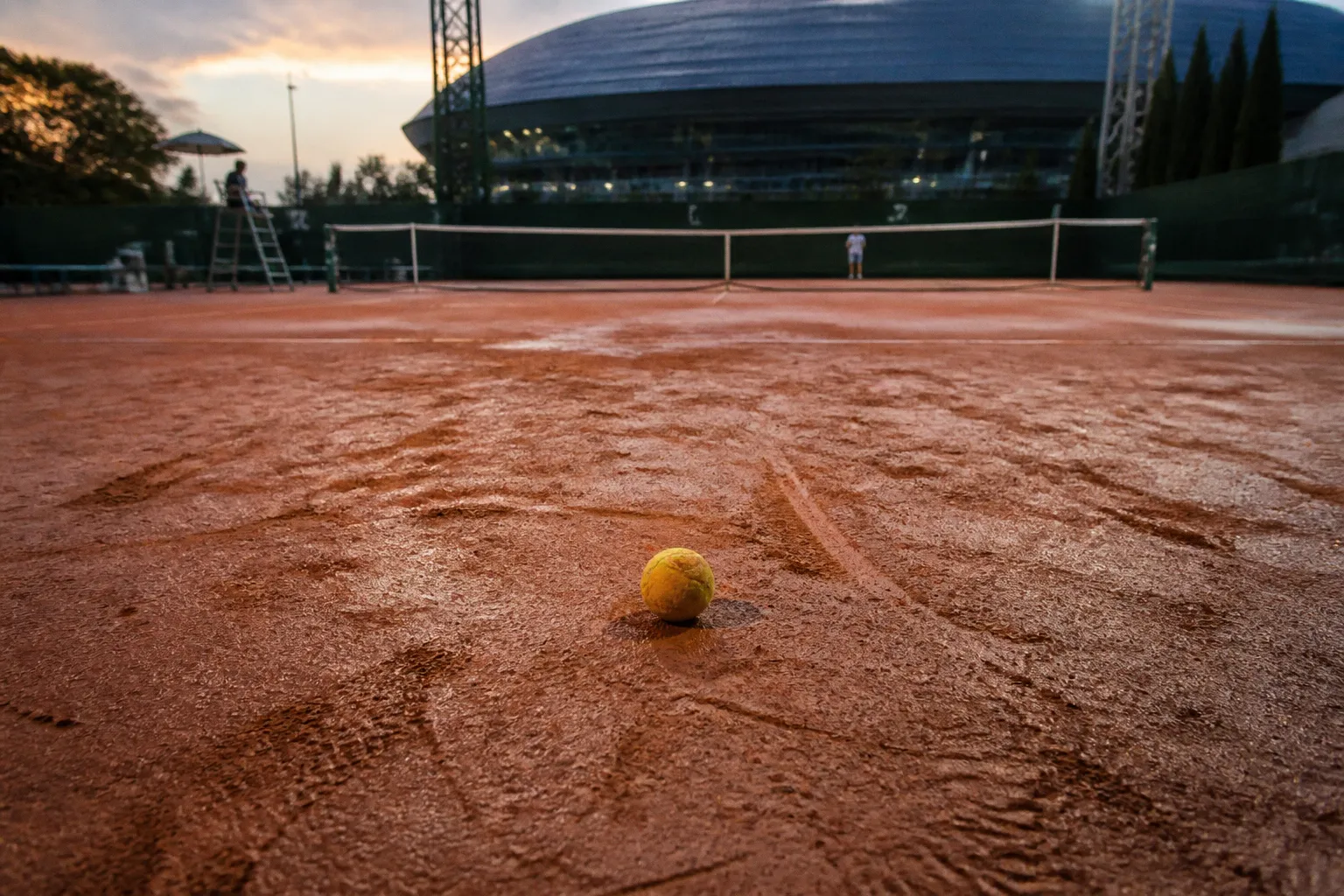
The figure is useful because it removes one of tennis's persistent errors: treating individual points as permanent evidence.
A champion loses points constantly. The match is not decided by the number of failures. It is decided by what happens in the interval before the next ball.
That interval lasts about 20 seconds. The average point lasts roughly eight. At elite level, this creates a structural problem. Players spend more time alone with the last point than they spend executing the next one. Against a dominant rival, the pause becomes a calculation chamber. The player reviews the miss, predicts the next miss, and changes the shot before the opponent has done anything.
This is the mental cost of dominant tennis rivalries. The rival is not only occupying the opposite baseline. The rival is altering the decision-making process.
The 20-second trap: Why tennis solitude breeds mental spiraling
Tennis provides no continuous action to conceal poor decisions. In football, basketball, or hockey, a player can remain inside the flow of play while recovering from an error. In tennis, the point ends. The player walks to a towel, adjusts the strings, changes the balls, or stands at the baseline waiting for the next serve.
The court goes quiet. The previous point remains available for inspection.
That is not a minor feature of the sport. It is part of the competitive mechanism. An eight-second exchange can produce twenty seconds of interpretation. The player must determine whether the mistake was technical, tactical, or random. Against a normal opponent, this can remain a limited review. Against a dominant rival, every error is assigned a larger meaning.
A missed backhand is no longer only a missed backhand. It becomes evidence that the opponent's forehand is too heavy, that the return position is wrong, or that the match is moving toward its expected result. The player begins to compete with the scoreline and with the historical record at the same time.
The sequence is usually visible in court position:
1. The player starts behind the baseline to gain reaction time.
2. The deeper position reduces the quality of the first strike.
3. The weaker first strike gives the dominant rival an earlier contact point.
4. The rival controls the direction of the rally.
5. The player interprets that control as confirmation of the original fear.
6. The next return begins from an even more defensive position.
This is not a mysterious decline. It is a feedback loop between perception and geometry.
A player who receives at the baseline has more distance from the opponent's contact point. That distance may create time, but it also concedes court position. The return lands shorter. The opponent enters the court. The player then has fewer options on the next ball and begins to protect against the worst outcome rather than execute the best available pattern.
The pause between points is not empty time. Against a dominant rival, it is where tactical errors acquire psychological weight.
The distinction matters. Fear-based tennis does not always look passive. A player can hit hard while still making defensive decisions. The issue is not raw racket speed. It is the location of the contact point, the height over the net, the direction chosen under pressure, and whether the player is attempting to create a problem or merely avoid an immediate one.
Fear of failure versus the opponent: Deconstructing the losing record block
Andy Murray described the central fear in these matchups with unusual precision: "In tennis, it is not the opponent you fear, it is the failure itself, knowing how near you were but just out of reach."
The statement identifies the losing record mental block without reducing it to a slogan. The problem is not simply that one player has beaten another several times. The problem is that each new match contains the memory of the previous near-miss.
A player chasing an established rival is often not trying to win the entire match at the opening point. The actual objective becomes narrower and less useful: avoid the error that previously changed the match, avoid the short ball that allowed the rival to attack, avoid the double fault at 30–30. The player's attention moves from construction to prevention.
That changes shot selection.
An aggressive player normally accepts a defined level of risk. A forehand taken at the correct contact point may have a high RPM and a clear target, even if the margin above the net is limited. Under pressure against a dominant opponent, the same player may add height, reduce racket-head speed, or select the crosscourt direction without enough penetration. The shot remains technically sound. It becomes tactically irrelevant.
The losing record has entered the point.
The Djokovic–Nadal rivalry offers a clear example of how records can shape interpretation. They played 46 matches between 2006 and 2015. From 2006 through 2010, Nadal held a 16–7 record. Those numbers do not prove a permanent psychological block. They do show that the matchup carried a stable competitive pattern over a substantial period, with Nadal repeatedly establishing the terms of engagement.
For Djokovic, the relevant question was not whether the record existed. It was whether the record dictated the next decision. A player can accept a historical disadvantage as information and still play the point in front of him. Or he can treat the record as a forecast and begin adjusting before the rally has started.
The difference appears in small technical choices:
- Return position moves several steps back, not because the serve has changed, but because the player expects the next ball to be difficult.
- A down-the-line change is delayed until the rally is already lost in court position.
- The player targets the centre of the court to reduce error exposure, but gives the rival a predictable ball.
- A break point is played as a special event rather than as a normal point with a different score.
- The second serve becomes a delivery mechanism for survival instead of the start of an attack.
These are not clinical diagnoses. They are observable changes in tactical behaviour. The available evidence supports analysis of decision-making. It does not support claims about long-term psychiatric damage or private psychological conditions.
The myth of physical parity: Why emotional regulation defines the elite
Novak Djokovic stated the basic problem directly: "Tennis is a mental game. Everyone is fit, everyone hits great forehands and backhands."
At the top of the sport, physical parity is not complete. Serve speed, lateral recovery, reach, endurance, and contact quality still vary. But those differences often become insufficient to explain the decisive points. The players can all produce a heavy forehand. They can all defend a corner. They can all return a second serve with pace.
The separation then moves to regulation.
Djokovic also identified the key trait of top champions as the ability to not stay in those emotions for too long after setbacks. The useful word is not emotion. It is duration. A bad point is unavoidable. A bad point that occupies the next three points is a tactical event.
The player who loses a rally at 15–15 has several options. He can identify the technical cause and retain the original plan. He can make a small adjustment to the return position. Or he can widen the adjustment until the entire structure changes. He retreats on the return, slows the first ball, protects the open court, and attempts to make the rival miss.
The last option is the most expensive because it transfers initiative without requiring the opponent to earn it.
How the spiral appears on court
| Match phase | Controlled response | Fear-based response |
|---|---|---|
| After a missed forehand | Repeat the pattern with a defined margin | Reduce racket-head speed and aim without a clear target |
| Opponent serves wide | Move early and accept a shorter swing | Stand back and return from a compromised contact point |
| Break point | Use the established serve-plus-one pattern | Choose a lower-risk serve that becomes predictable |
| Long rally | Take the ball at the planned apex | Retreat behind the baseline and surrender court position |
| After losing a set | Recalculate the return and first-ball pattern | Treat the set as confirmation of the historical record |
A champion's mindset under pressure is therefore not a permanent state of confidence. It is the ability to prevent one result from dictating the next decision. Federer's career numbers illustrate the scale of the task. Winning 54% of individual points is compatible with winning nearly 80% of matches. A player can lose more than 45% of the points and still control the match across the relevant sequences.
The score does not require dominance on every ball. It requires selection of the points that determine service games, sets, and match direction. The player who treats every lost point as a structural crisis has misunderstood the mathematics of tennis.
The rival becomes a court-positioning problem
Dominant rivals are often discussed through personality and status. The more useful analysis starts with the court.
Consider a baseline exchange. The attacking player wants an early contact point, a ball above a manageable height, and enough court penetration to force a defensive reply. The opponent wants to delay that contact, absorb pace, and return the ball with sufficient depth to prevent entry.
Against a rival with a stronger head-to-head record, the inferior player may begin by conceding these conditions. The player stands deeper to deal with the expected pace. The first strike is then made from a lower-quality position. The rally becomes a sequence of recovery shots. The player is still moving well. The tactical problem is that movement is being used to repair an initial concession.
This is where the idea of rivalry scar tissue in tennis becomes too vague if it is treated as an invisible substance. There is no need to invent an internal injury. The scar tissue can be located in repeated choices:
- a serve directed to the opponent's strength because the player does not trust the alternative;
- a return hit safely to the middle when the opponent is vulnerable in the first two shots;
- a refusal to close the net after creating a short ball;
- a defensive lob selected from a position that required a drive;
- a second-serve return made with excessive margin despite a known opportunity.
The dominant rival does not need to force every one of these decisions. The player can produce them independently.
That is the main burden of a repeated matchup. The rival's previous success becomes part of the court map. Certain zones appear dangerous before the ball arrives. Certain patterns are rejected before they are tested. Tactical memory becomes tactical restriction.
Rafael Nadal stated the issue in direct terms: "Losing is not my enemy, fear of losing is my enemy." The distinction is operational. Losing a point is an outcome. Fear of losing changes the inputs that produce the next outcome.
Economic anxiety and the burden of the top 1% hierarchy
The psychological burden of chasing a dominant rival is not confined to the baseline. Professional tennis is a sharply stratified economic system. The top 1% of players collect roughly 60% of total ATP prize money and 51% on the WTA tour.
Those figures do not establish a direct cause between income distribution and a specific player's mental state. They do establish the structure around the match. The difference between a champion and an established challenger is measured not only in ranking points and trophies. It can affect coaching resources, travel conditions, recovery support, media attention, sponsorship value, and the length of a viable career.
A match against the dominant player therefore carries multiple forms of exposure. The challenger is judged against the scoreboard, the previous head-to-head record, and the commercial hierarchy represented by the opponent. Every failure is more visible because the rival is already a reference point for the sport.
This can produce a narrow type of performance pressure. The player is not merely attempting to win. The player is attempting to prove that the competitive gap has been misread. That objective is too large for a single point. It encourages overinterpretation of every exchange.
The top player has a different burden. A favourite may become conservative for opposite reasons. The expected result turns ordinary errors into reputational threats. The champion starts protecting status rather than creating advantage. Dominance can therefore produce two forms of defensive tennis: the challenger avoids losing, while the favourite avoids appearing vulnerable.
The technical symptoms may overlap. Both players can shorten swings, select predictable targets, and retreat from the intended contact point. The difference is in the source of the restriction. One is responding to the opponent's status. The other is responding to the expectation attached to his own.
Beyond the baseline: How champions reset after losing 45% of their points
The most durable champions do not eliminate negative sequences. They control their duration.
Federer's 54% point-winning rate makes the principle measurable. A player who wins just over five points in ten across a career will lose frequently inside matches. The elite skill is not the prevention of all errors. It is the refusal to convert a normal loss of one point into a change in identity, court position, and shot selection.
A reset is not a motivational gesture. It has components that can be observed:
1. The player returns to the intended receiving position.
The location is chosen according to the opponent's serve and the planned return, not according to the result of the previous rally.
2. The first-ball pattern remains available.
If the plan is a wide serve followed by a forehand into the open court, one missed execution does not automatically justify a different pattern.
3. The player identifies the error at the correct level.
A late contact point requires a technical adjustment. It does not require abandoning the direction of the shot.
4. The score is separated from the quality of the decision.
A well-constructed point can be lost. A poorly constructed point can be won. The result alone is incomplete information.
5. The next point begins without a prediction.
The player cannot control whether the rival serves an ace, clips the line, or produces a clean winner. He can control the starting position and the first decision.
This process is especially important against a rival who has already established a pattern of superiority. A losing record creates a temptation to seek a complete tactical solution before the match has supplied enough evidence. The player changes return position, rally height, serve direction, and court depth at once. The result is not adaptation. It is noise.
The effective response is narrower. Change one variable. Observe the result. Preserve the elements that still produce a usable contact point. A dominant rival should force precision, not theatrical reinvention.
The same logic applies to coaching changes and career arcs. A player who repeatedly loses to one opponent may require a different return geometry, a new serve-plus-one sequence, or a revised position in extended rallies. He does not automatically require a new identity. The data from the matchup must determine the adjustment.
What the rivalry actually measures
A dominant rivalry measures how quickly a player can return from interpretation to execution.
The opponent's reputation matters because it changes the perceived value of each point. The head-to-head record matters because it supplies a plausible forecast. Financial inequality matters because it enlarges the consequences attached to the result. The scoreboard becomes one measure among several. The challenger is also being measured against career trajectory, sponsorship perception, and the historical weight of the head-to-head ledger.
The mental cost of dominant tennis rivalries is therefore not a single problem with a single solution. It is the accumulated weight of every small decision made before a ball is struck. The dominant rival wins not by being physically overwhelming on every exchange but by becoming part of the opponent's decision tree.
Champions who manage this burden treat the rivalry as a series of points, not a verdict. They play the next ball rather than the next match. They separate the score from the quality of the decision. They refuse to let the rival's reputation dictate their own tactical choices.
This is the work that happens between points, between matches, and between tournaments. It is rarely visible. It is the reason the same rival can dominate for years and then lose to the same opponent who finally stopped calculating and started playing.