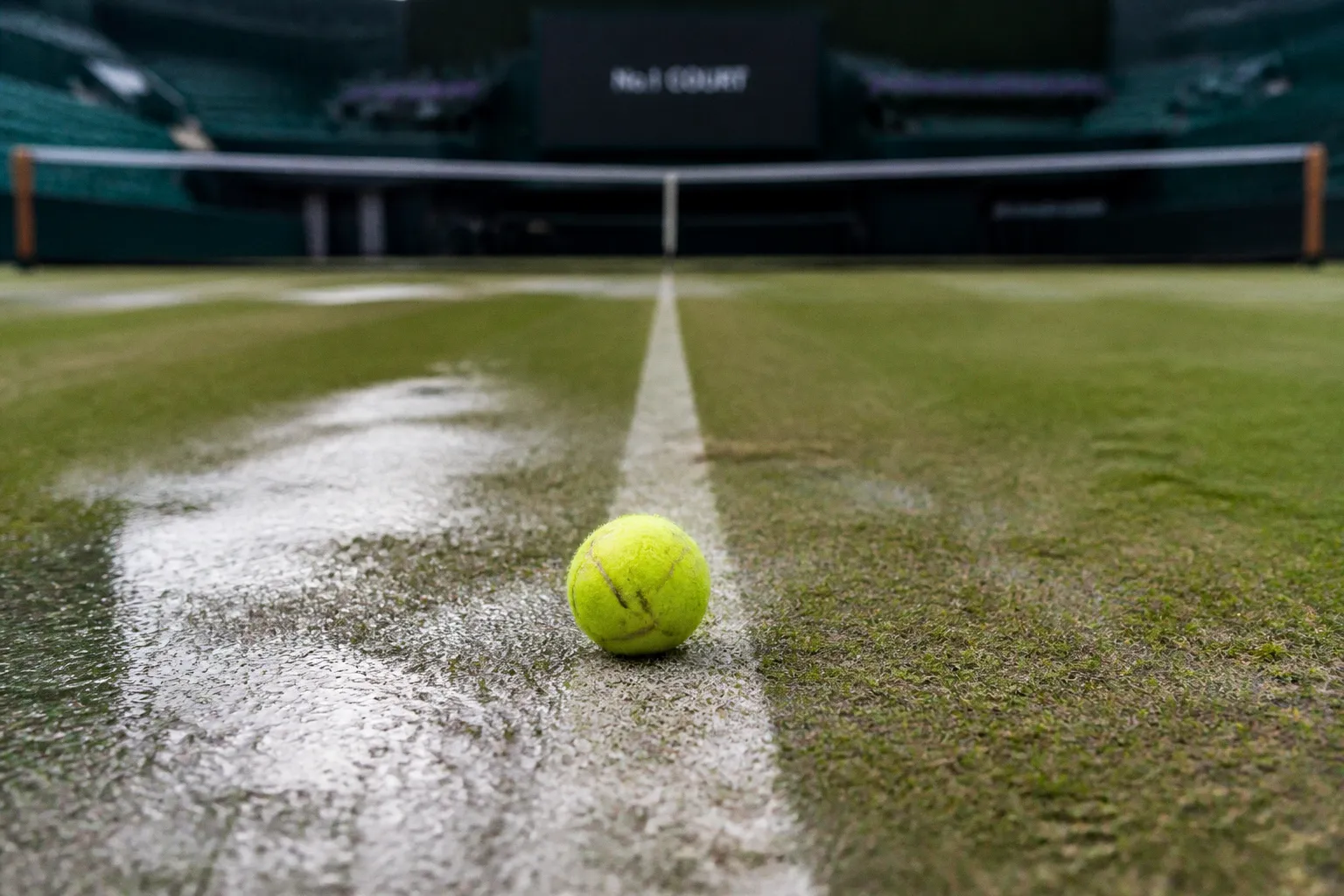
A scoreboard that refuses to be polite
The scoreboard, however, reads Djokovic 7-6(5), 1-6, 7-6(4), 4-6, 13-12(3) in four hours and fifty-seven minutes — the longest singles final in Wimbledon history.
The dissonance between the aggregate box score and the trophy is not a statistical quirk. It is the entire story. Federer won 218 points to Djokovic’s 204, yet Djokovic won the match. The two facts do not cancel each other out. They describe two different levels of tennis: the broad accumulation of points and the narrow sequence in which a championship is actually decided.
The easy post-match explanation was that Federer had simply let the match slip. That phrasing turns a tactical defeat into a character flaw. It makes the result sound like a failure of nerve, as if the match had been safely stored in Federer’s pocket until he reached into it and found nothing there.
What happened on Centre Court was more architectural. Federer built a match around patterns that were efficient, familiar, and often successful. Djokovic did not need to destroy that structure from the first point. He needed to identify where it repeated itself, wait for pressure to make repetition expensive, and stand in that place when the final points arrived.
This is where the language of break point statistics in tennis becomes inadequate. A conversion percentage tells us what happened to the point. It does not, by itself, tell us why the point became vulnerable, which pattern preceded it, or whether the same tactical decision had already been exposed several times before the scoreboard finally punished it.
The Paradox of Aggregate Dominance: 218 Points Won vs. The Final Score
The aggregate numbers — the ones that pad the Sunday night graphic and survive into Monday’s recap — tell a story that is true and still incomplete. Federer won 218 points. Djokovic won 204. Federer hit 25 aces to Djokovic’s 10. Federer won 78.7% of his first-serve points and 51.3% of his second-serve points. He saved 5 of the 8 break points Djokovic created against him.
By the standards of total production, Federer was the better player. He served more freely, won more points overall, and created more pressure on Djokovic’s serve. If the final had been decided by a running total, Federer would have taken the trophy back to Switzerland.
The match does not care about the running total. Tennis has no provision for winning by accumulated excellence. It has sets, games, and points, each with its own hierarchy. A point at 15-0 and a point at 40-15 are both counted once in the statistical record, but they do not carry the same tactical weight. A comfortable hold at 30-0 can help a player’s aggregate numbers. A single point at break point can redirect an entire set.
The final therefore has to be read as a sequence problem rather than a sum. Federer’s fourteen-point advantage was spread across a match that lasted nearly five hours. Djokovic’s advantage was concentrated in the points that closed sets, protected breaks, and kept the fifth set alive. The scoreboard is not a tally of every good thing a player did. It is a record of which player controlled the decisive junctions.
That is why aggregate dominance in tennis can be so misleading. It describes the level a player sustained across the whole afternoon, but not necessarily the quality of his decisions at the moments when the match changes shape. A player can win more returns, more rallies, and more total points while losing the small number of points that determine whether those gains become a lead.
Federer’s performance was not empty dominance. He did not fluke his way to 218 points. He played enough good tennis to win most ordinary exchanges. The problem was that the final was not made of ordinary exchanges. Djokovic kept forcing the match into a series of high-value decisions, then made Federer answer with patterns that had become increasingly legible.
Federer did not lose the total. He lost the sequence.
The distinction matters because it changes the diagnosis. If the problem is nerves, the proposed solution is psychological: be calmer, trust the swing, close the match. If the problem is predictability, the solution is tactical: change the serving geometry, alter the first strike, and make the returner solve a different problem before the score reaches 40-15.
Federer’s afternoon contained plenty of evidence for the second diagnosis.
Serve Direction and the Cost of Predictability Under Pressure
The serve-direction numbers are stark. Federer sent 52% of his serves toward Djokovic’s forehand, 47% toward the backhand, and only 1% toward the body. Djokovic’s distribution against Federer was less concentrated: 45% to the forehand, 50% to the backhand, and 5% toward the body.
The 1% body rate is the line that should be circled first.
On Centre Court grass, the instinct to use the wide or body-adjacent lanes is understandable. The court rewards a clean first strike, and Federer’s serve had enough quality to make a heavily repeated pattern look safe for long stretches. A serve toward the forehand can still be effective if it is fast, well placed, and followed by a strong first ball. A serve toward the backhand can still produce a short return even against one of the best backhands in tennis.
But the body serve exists precisely to interrupt that calculation. It denies the returner a full forehand or backhand swing. It compresses the decision. It changes the spacing between the receiver and the baseline, the shape of the return, and the server’s next shot. It is not automatically better than a corner serve. Its value comes from making the corner serve less predictable.
Federer’s body rate suggests that he was barely asking Djokovic to solve that problem. The forehand and backhand lanes carried almost the entire burden of the serving strategy. Once Djokovic understood that the body was not a serious possibility, he could prepare for the two familiar directions without paying much of a guessing tax.
That is the central point in tennis serve direction tracking: the useful statistic is not simply where the serve landed. It is how many different problems the returner was forced to prepare for. A serve pattern can be statistically successful and tactically narrow at the same time. Federer’s 78.7% first-serve points won shows that the serve worked often. It does not show that the serve remained difficult to anticipate at the highest-pressure moments.
Djokovic’s own profile was not perfectly balanced, nor did it need to be. He directed 50% of serves toward Federer’s backhand and 45% toward the forehand, with 5% to the body. That body percentage is small, but it keeps the receiver from treating the middle of the court as a dead zone. The threat does not have to appear often to influence the returner’s starting position and preparation.
Federer, meanwhile, was facing a server who offered more variation while returning a server whose choices were becoming easier to map. That asymmetry can remain hidden inside a strong first-serve percentage. It becomes visible when the score tightens and the returner no longer needs to guess.
The grass made the issue sharper. Low bounce and quick contact reward a returner who has already selected the correct response. Djokovic did not need a long warning period between Federer’s toss and his own swing. He needed a reliable read. Once the serve direction had been narrowed, the return began earlier in the point than the statistics show.
This is why the 78.7% first-serve figure should not be treated as a complete verdict on Federer’s serving. It measures the outcome of first serves. It does not measure the cost of using the same tactical solution repeatedly. Federer was winning first-serve points, but he was also giving Djokovic a stable map. The map mattered most when the point carried a championship inside it.
The second-serve number, 51.3%, is revealing in a different way. A second serve exposes the server’s relationship with risk. It asks whether the server can create uncertainty without giving away control. Federer was still effective, but the margin was smaller. That smaller margin gave Djokovic more opportunities to step into the return, move the rally toward a preferred pattern, and make the server play the next shot under pressure.
The issue was not that Federer served badly. He served well enough to win more total points. The issue was that his best recurring solutions were also his most readable ones.
Predictability is not the same as weakness
A predictable serve does not have to be slow. A predictable approach does not have to be poorly executed. A predictable return does not have to be technically flawed. Predictability is a tactical condition: the opponent knows what is likely to happen before the shot is played.
At ordinary scores, that condition may not cost much. The server can still hit through the returner, or the returner can still miss. At break point, the same condition becomes more expensive because the receiver can commit earlier and the server has fewer safe places to hide.
Federer’s serve-direction profile did not make every point identical. It made the decision tree smaller. Djokovic did not have to defend every possible first strike. He had to prepare for a limited set of familiar ones, and he was good enough to turn that preparation into leverage.
The point of a body serve is not to win every time. It is to make the next wide serve less obvious.
The 40-15 Collapse: Deconstructing the Final Championship Points
At 8-7 in the fifth set, Federer stood at 40-15 on his own serve. Two championship points. Two opportunities to finish the longest Wimbledon singles final in history.
The word collapse is often used as if it explains the scene. It does not. It compresses two different points into one emotional event. The first championship point and the second championship point were not the same problem, and neither should be confused with Djokovic’s break points earlier in the match.
The first championship point ended with Federer’s forehand missed wide. That is the useful description. It identifies the shot and the outcome without inventing a margin that the record does not establish. Federer attempted to take control of the exchange and failed to keep the ball inside the court. There is no need to turn the miss into a near-miracle of geometry. The important fact is that the forehand went wide at the moment when Federer needed one more ball to stay within the match’s safest structure.
The second championship point developed differently. Federer approached the net, and Djokovic responded with a forehand passing shot that beat him. The point was not merely a spectacular act of Djokovic improvisation. It was also a tactical exchange in which Federer chose a familiar route and Djokovic recognized the route early enough to attack it.
This is where the final points connect to the earlier serve-direction argument. Federer had repeatedly built points through recognizable first-strike patterns: serve, establish the forehand, move forward when the opening appeared. The pattern was successful across the match. It also meant that Djokovic had seen the structure before the most important moment arrived.
The approach itself was not indefensible. Federer had won 13 of 15 serve-and-volley points across the full match. Moving forward on grass remained a legitimate way to shorten the rally and prevent Djokovic from settling into a baseline exchange. But a legitimate tactic can still become predictable in its timing. If the approach appears only after the same sequence has already been established, the net is no longer an ambush. It becomes the expected next stage.
Djokovic’s passing shot did not prove that Federer should never have come forward. It showed something more precise: the approach had to be connected to variation in the points before it, not simply repeated as the familiar conclusion to a familiar sequence.
The two championship points therefore reveal different vulnerabilities:
1. The first point exposed margin management. Federer chose a forehand that attempted to take the point on his terms and missed wide.
2. The second exposed pattern recognition. Federer moved forward through a route Djokovic had already seen, and Djokovic produced the passing shot required by that route.
3. Neither point was a Djokovic break point. They were championship points on Federer’s serve, and they belong to a separate part of the match’s arithmetic.
4. Neither point can be used to rewrite the full break-point record. Federer converted 7 of 13 break points, while Djokovic converted 3 of 8. Those figures describe break opportunities, not the two chances Federer held to win the match at 8-7, 40-15.
The distinction is not pedantic. It is the difference between analyzing a match and turning it into a morality tale. Federer did not fail to convert two break points that decided the final. He failed to close two championship points on his own serve. Djokovic did not win those points by converting break chances. He survived them, then broke the game open.
The scoreboard moved because Djokovic won the next four points of the game. The statistical record should preserve that sequence rather than replace it with a simpler story about a player who somehow misplaced a pair of opportunities.
Tie-break Efficiency and the Failure of the Net Game
Three tie-breaks were played in the match, and Djokovic won all three. Federer won none.
That correction matters because the tie-breaks are not a side note to the final’s arithmetic. They were the places where Djokovic repeatedly converted a level contest into a set advantage. Federer could dominate long stretches and still arrive at the narrowest part of the set without a tie-break win to show for it.
Across the three tie-breaks, Federer won only 1 of 2 net points. Across the full match, he won 13 of 15 serve-and-volley points. The contrast is not enough to prove a complete tactical theory. The tie-break sample is small. But it is large enough to identify a tension in Federer’s decision-making. He was highly effective when approaching behind favorable conditions, yet he did not turn the net into a consistent pressure point when the sets narrowed into tie-breaks.
Serve-and-volley on grass is not a decorative reference to an older version of tennis. It is a way to compress the point. The server takes the return away from the baseline, shortens the number of available shots, and asks the opponent to produce a passing shot before the rally has settled. When the approach is well timed, Djokovic is denied the opportunity to build the patient geometry that makes him so difficult to dislodge.
But the tactic carries variance. A successful approach can make the point look inevitable. A failed approach leaves the server exposed in the most visible part of the court. The answer is not to approach on every short ball. It is to make the opponent uncertain about when the approach will appear.
Federer’s 13-of-15 full-match result suggests that he selected his net attacks carefully. That is a strength, but it can also become a limitation. If the server only comes forward when the point already looks favorable, the net game confirms the existing pattern rather than changing the opponent’s expectations. The approach becomes a reward for having already won the exchange, not a tool for disrupting the exchange before Djokovic takes control.
The 1-of-2 tie-break figure is more revealing because the tie-break strips away some of the comfort provided by a long match. There is less time to wait for a perfect opening. The returner is more alert to the score, the server’s tendencies, and the value of a single short ball. A net approach that is merely good in a normal game may need to be disguised better in a tie-break, because Djokovic has fewer reasons to retreat from his preferred reading of the point.
The broader issue is not that Federer lacked a net game. It is that the net game did not consistently alter the match’s tactical temperature when Djokovic had the most leverage. Federer was excellent at finishing points that had already tilted in his favor. Djokovic was better at surviving the moments in which Federer needed to create a new problem.
The tie-breaks exposed that difference. A player can post a high serve-and-volley success rate while still failing to use the net as a pressure system. The first number describes execution after the decision has been made. The second asks whether the decision itself appeared often enough, early enough, and unpredictably enough to change the returner’s preparation.
Quantifying the Gap: Why Break Point Conversion Rates Masked Tactical Vulnerabilities
Federer converted 7 of 13 break points. Djokovic converted 3 of 8. On the surface, that comparison favors Federer decisively. It is one reason the final can look irrational when reduced to a conventional match report: the player with the better break point conversion rate also won more total points, more aces, and more first-serve points, yet left Wimbledon without the title.
The answer is that break point conversion rates describe opportunities after they have been created. They do not explain the distribution of those opportunities, the score at which they appeared, or the tactical process that produced them.
A break point at 0-40 is not the same environment as a break point at 30-40. A break point created by three return winners is not the same as one created by a loose second serve and a neutral rally. The box score places them in the same column. The player experiences them as different problems.
Federer’s seven conversions show that he was capable of taking advantage when Djokovic’s service game became vulnerable. Djokovic’s three conversions show a lower rate, but the number cannot be separated from the way he protected his own serve and kept sets moving toward tie-breaks. If a player avoids giving the opponent many chances and then wins the decisive tie-break, a modest break point conversion percentage can coexist with match control.
This is the weakness in treating break point statistics in tennis as a complete explanation. The figures are outcome statistics. They are useful, but they are late-stage statistics. By the time a break point appears, many tactical decisions have already narrowed the possibilities:
- where the serve was directed;
- whether the returner was given a body serve to consider;
- whether the first ball came to the opponent’s strength or weakness;
- whether the server changed the height, speed, or spin of the rally;
- whether the approach to the net arrived as a surprise or as the expected final step.
Those details shape the break point before the score announces it.
Federer’s 7-of-13 conversion rate is therefore not evidence that he solved Djokovic’s pressure patterns. It is evidence that, on seven occasions, he finished points well enough to take a break. Djokovic’s 3-of-8 rate is not evidence that he was the less effective player in important moments. It is evidence that he needed fewer successful conversions because he repeatedly used other routes to keep Federer from gaining a set advantage.
The final also demonstrates why tennis tactical patterns under pressure cannot be inferred from percentages alone. Pressure does not simply reduce a player’s technical level. It increases the value of information. The player who has a clearer idea of what is coming can swing earlier, move earlier, and accept a smaller margin. The player who has become easier to read must either execute at a higher level or change the question.
Federer often chose execution. He trusted the serve that had carried him through the match, the forehand that had produced control, and the approach that had worked when the opening was clean. That trust was rational. It was also vulnerable once Djokovic had enough evidence to predict the next stage.
A more varied strategy would not have guaranteed victory. A few body serves would not automatically have won the fifth set. A different approach pattern would not have erased Djokovic’s passing shot. Tactical analysis is not a search for one magical alternative. It is an attempt to identify where the opponent’s preparation became too comfortable.
The numbers point toward that comfort:
| Match layer | Federer | Djokovic | What it reveals |
|---|---|---|---|
| Total points won | 218 | 204 | Federer sustained the higher overall level |
| Aces | 25 | 10 | Federer generated more free points |
| First-serve points won | 78.7% | — | Federer’s primary serve was highly effective |
| Second-serve points won | 51.3% | — | The margin narrowed when the first serve disappeared |
| Break points converted | 7 of 13 | 3 of 8 | Federer finished more break opportunities |
| Tie-breaks won | 0 | 3 | Djokovic controlled every set decided by a tie-break |
| Serve-and-volley points won | 13 of 15 | — | Federer’s net execution was strong when the approach was favorable |
The table does not resolve the paradox. It clarifies it. Federer was better in several categories that describe sustained production. Djokovic was perfect in the category that decided the three sets sent to a tie-break.
That is the cold math of the final. Not that one player was secretly poor, and not that the other was mysteriously immune to pressure. The match was decided by the relationship between a player’s strengths and the opponent’s ability to read them at the exact moment those strengths had to produce a result.
Federer’s serve was good enough to win the majority of the points it reached. It was not varied enough to remain fully opaque. His forehand was good enough to control the exchange. On the first championship point, it missed wide. His net game was good enough to win 13 of 15 attempts. It did not give him a tie-break win, and on the second championship point Djokovic read the approach and passed him.
These are not contradictions. They are different scales of analysis.
The most misleading sentence one can write about the match is that Federer lost despite playing better. It sounds fair, but it leaves the crucial question untouched: better at what? Federer was better across the broad sample. Djokovic was better at turning the narrow sample into a result.
That distinction applies beyond this final. When studying tennis serve predictability on break points, the goal is not to punish a player for repeating a successful serve. Repetition is often the foundation of elite tennis. The goal is to locate the point at which repetition stops being efficiency and becomes information for the opponent.
Federer reached that point against Djokovic. The pattern did not suddenly become bad. It became known.
And once a pattern is known, the pressure is no longer evenly distributed. The server must hit the familiar option perfectly. The returner only needs to be ready for it. At 8-7, 40-15, that difference was enough to keep the match alive. In the tie-breaks, it was enough to keep Djokovic ahead.
The final score is therefore less mysterious than it first appears. Federer won more tennis in the aggregate. Djokovic won more of the points that required a decision to be hidden, changed, or executed under maximum consequence.
The lesson is not that break point math replaces watching the match. It is that the math tells us where watching should become more exact. Count the points, then study the patterns that produced them. Track serve direction, but ask what the receiver was allowed to expect. Record conversion rates, but separate the opportunity from the sequence that created it.
A championship is not won by the player who accumulates the most evidence of quality. It is won by the player who controls enough of the final sequence. In 2019, Federer had the stronger aggregate case. Djokovic had the better map of the pressure points.
The trophy followed the map.