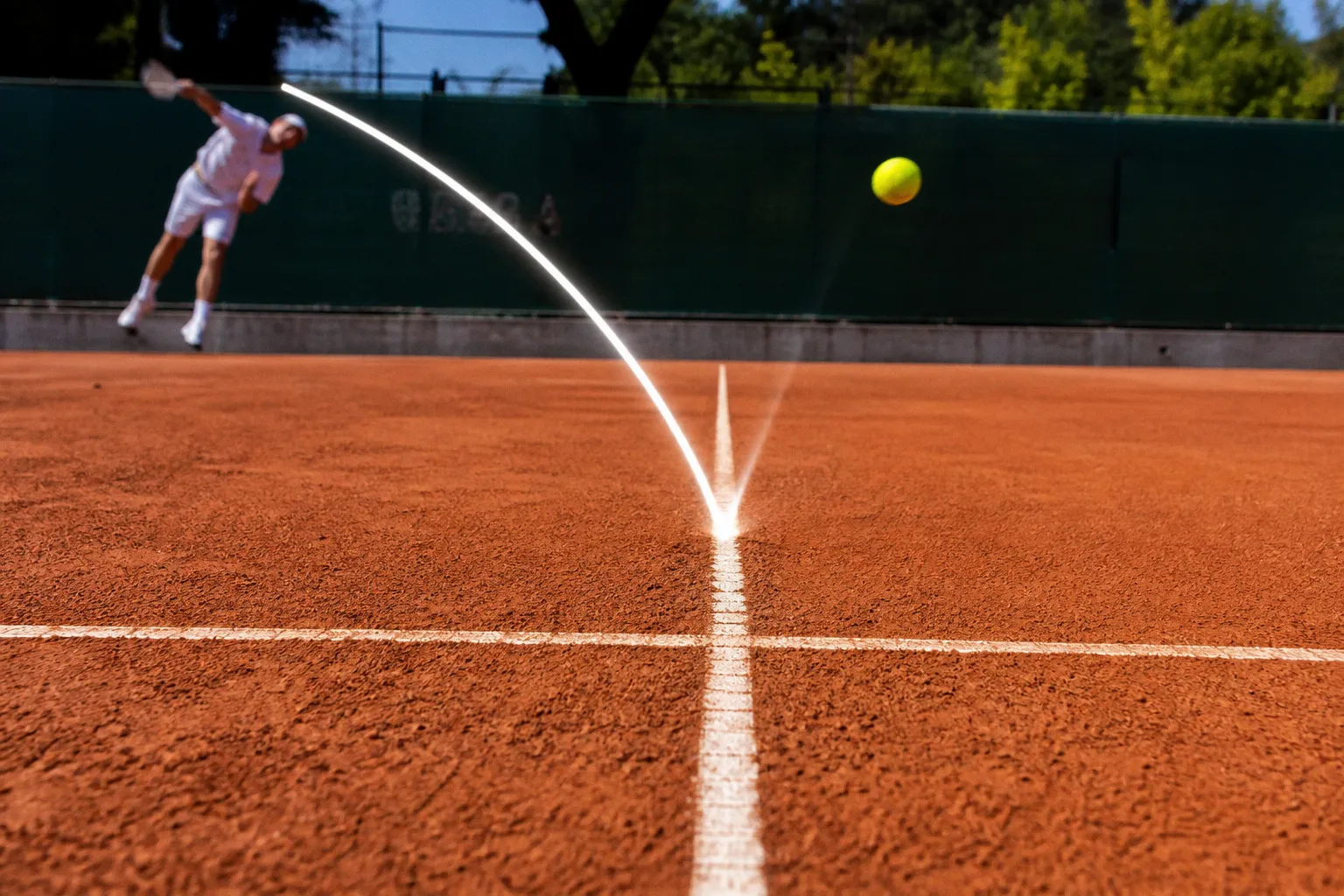
The server is not simply trying to begin the point with pace or disguise; the real objective is to make the return predictable enough that the first attacking forehand arrives before the rally has properly formed.
This is the logic of the serve plus one—the serve and the immediate shot that follows it treated as a single tactical unit. The pattern matters because the first four shots still contain an extraordinary amount of professional tennis. Data from the 2019 Grand Slam tournaments showed that 59% of rallies ended within one to four shots. At the Australian Open, the figure reached 67%. The point, in other words, is often decided while the court is still carrying the first pressure of the serve.
The four-shot reality: why modern tennis is won early
A rally that ends after two, three, or four shots does not necessarily look dramatic. There may be no long exchange, no visible contest of endurance, no sequence of changing angles that makes the tactical structure obvious. A serve draws a short return, a forehand is struck into the open court, and the point disappears. Yet that apparently simple exchange contains several decisions:
1. Where the serve was sent.
2. How much time and court position the returner retained.
3. Which reply the server expected.
4. How quickly the server recognized the available space.
5. Whether the first groundstroke was used to finish, to open, or merely to protect the advantage.
The serve-plus-one pattern begins with the assumption that the serve creates a specific type of return rather than a completely open situation. A wide serve may pull the returner beyond the singles sideline and leave the opposite corner exposed. A serve into the body may jam the swing and produce a shorter ball without moving the receiver far from the centre. A serve down the T can reduce the angle of the return and allow the server to step into the next forehand with a cleaner geometric relationship to the court.
This is why serve efficiency cannot be reduced to ace counts or first-serve percentage. A serve may be effective because it wins immediately, but it may also be effective because it produces the kind of return that the server has rehearsed and can attack with minimal hesitation. The second shot is not an afterthought. It is where the first shot becomes a tactical argument.
The serve creates the first imbalance; the plus-one shot decides whether the imbalance becomes territory.
The 59% figure from Grand Slam play should not be misunderstood as proof that every professional point is settled by the server’s first forehand. Some points end on the serve, some on the return, and some after a short exchange in which neither player has yet assumed complete control. Nor does the number establish that the first four shots matter more than every longer rally. It shows something more precise: the opening geometry of the point is disproportionately important, and modern players are trained to exploit it before the court settles into a neutral pattern.
The first groundstroke is a positional decision
The language of “plus one” can make the second shot sound automatic—serve here, forehand there—but the strongest players are not executing a rigid two-shot formula. They are reading the quality of the return. A soft, central reply invites a different forehand from a deep return struck through the middle. A return that lands near the sideline may tempt the server into an unnecessary angle. A ball that arrives at shoulder height can be attacked aggressively, while a lower ball may require a heavier, safer trajectory.
The tactical unit therefore has two layers:
- The planned layer: the serve placement is chosen partly for the return it is expected to produce.
- The reactive layer: the plus-one shot is adjusted to the actual return, its depth, height, speed, and direction.
Players who appear to be serving and immediately dictating are often doing something more exact. They are narrowing the opponent’s possible responses before the ball leaves the racket. The returner may still have several technical options, but only a few of them preserve court position and time.
Mapping the service box: wide, body, and T
One useful way to understand serve-plus-one tennis is to divide the service box into three equal target zones: wide, body, and T. This is not a complete description of serving, because spin, speed, height over the net, and the receiver’s stance remain crucial. But the three-zone map gives the pattern a clean geometric foundation.
The server’s choice of zone changes the likely shape of the return and, with it, the location from which the plus-one shot will be played.
| Serve target | Immediate pressure on the returner | Typical tactical consequence | Main risk for the server |
|---|---|---|---|
| Wide | Stretches the receiver laterally and opens space on the opposite side | Creates the classic open-court forehand, often into the vacant corner | A sharp return angle can pull the server off balance or expose the next ball |
| Body | Compresses the receiver’s swing and limits comfortable extension | Encourages a shorter, more central return that can be attacked early | The receiver remains near the centre and may redirect with control |
| T | Reduces the return angle and can jam the receiver’s movement across the court | Allows the server to step into the next shot with a compact court geometry | A clean return through the middle can neutralize the intended advantage |
The wide serve is visually obvious because it changes the shape of the court. The returner moves away from the centre, and the server has a large area to target. But the body serve is often more tactically valuable than its modest appearance suggests. It removes the receiver’s preferred swing path, forces an adjustment in the smallest possible amount of time, and can produce a reply that is neither wide nor deep enough to punish the server.
The T serve works through a different kind of economy. By sending the ball toward the centre line, the server limits the returner’s available angle. The receiver may still hit hard, but the return has fewer natural pathways. A server who is prepared to move forward after the delivery can meet the next ball in a more stable position, particularly when the return comes back through the middle rather than into an open corner.
The zones are therefore not three buttons with three guaranteed outcomes. Their value depends on the relationship between placement and the server’s next movement. A wide serve hit without a clear plan can create a difficult, low-percentage forehand. A body serve followed by hesitation may give the receiver time to recover. A T serve that lands without enough penetration may simply offer the returner a comfortable ball.
The returner’s stance changes the map
The service box is fixed, but its tactical meaning is not. A returner standing several metres behind the baseline gives the server a larger target area but may also create more time to swing. A returner positioned close to the baseline can take the ball early, yet may be more vulnerable to the body serve and to a delivery that moves sharply away.
This is where the cold mathematics of the pattern become physical. Court position determines the time available; time determines the quality of the return; the quality of the return determines whether the server can play the plus one from inside the baseline or is forced to defend behind it. The same serve placement can produce entirely different outcomes against two returners because their starting positions, contact points, and recovery habits alter the geometry before the ball is struck.
Shot tracking data can describe these relationships with increasing precision, but the figures still need to be interpreted through movement. A serve that produces a short return is not equally useful if the server reaches it late, contacts it low, or must hit across the body. The location of the ball is only one part of the event. The location of the player at contact is the other.
The big V: anatomy of the most frequent ATP pattern
The most frequently played serving pattern identified in ATP match data is the big V. Its structure is straightforward: the serve pulls the opponent wide, and the plus-one shot is directed toward the open corner on the opposite side. The name comes from the shape created by the ball’s path and the server’s response—the serve moves one way, the next shot travels across the court, and the two lines form a broad V around the receiver’s position.
It is easy to describe the big V as an elementary pattern, but its success depends on the details surrounding it.
The serve must move the receiver far enough from the centre to create meaningful space. It must also leave the server in a position from which the next forehand can be struck with balance. The plus-one shot then has to travel through the open court with enough depth or angle to prevent a comfortable recovery. If any part of the sequence is weak, the pattern loses its force:
1. The serve is too central. The receiver can return without surrendering enough court.
2. The serve is wide but not penetrating. The returner reaches the ball early and creates a sharp angle.
3. The server recovers too slowly. The open court exists in theory, but the ball arrives before the server can use it.
4. The plus one is too ambitious. A narrow angle turns a high-percentage opening into an unforced error.
5. The shot is directed to the wrong space. The server follows the visual movement of the receiver rather than attacking the court the receiver has left.
The big V is the most frequently played pattern, but frequency should not be confused with the highest win percentage. It is common because it is legible, repeatable, and available to many different serving styles. A player does not need the biggest serve on tour to use it. Placement, disguise, recovery speed, and the quality of the first forehand can produce the same structure at different levels of power.
The pattern is also more complicated on the ad side than on the deuce side because the server’s preferred forehand, the returner’s backhand position, and the direction of the next ball interact differently depending on the handedness of both players. A right-handed player serving wide on the ad side, for example, may create a familiar forehand opportunity into the open court, while a left-handed player can reverse the most natural sequence. The pattern remains conceptually similar, but the body mechanics and preferred contact points change its practical value.
Why the forehand dominates the plus one
The serve plus one is strongly associated with the forehand because the forehand usually gives the server greater reach, more rotational freedom, and a broader range of attacking directions. A server can often move around the backhand corner after the delivery, especially when the return is short or central, and use the forehand to take control of the point.
This does not mean the backhand is irrelevant. A backhand plus one can be the correct answer when the serve draws a return into that side, when the player prefers to keep the ball crosscourt, or when a two-handed backhand allows an early contact point against a particular trajectory. But the basic tactical ambition remains the same: use the serve to make the next shot more comfortable for the server and less comfortable for the receiver.
The forehand’s dominance is therefore not just a matter of power. It is a matter of geometry. The player wants to meet the ball in a position that permits the largest number of useful outcomes—crosscourt pressure, down-the-line acceleration, a heavy ball into the opponent’s weaker wing, or a shot that drives the receiver backward without requiring an extreme angle.
Developmental trajectories: how junior tennis evolves toward short-point dominance
The serve-plus-one pattern is not simply an advanced professional invention. It becomes more visible as players mature because their serves gain speed and placement, their returns become more demanding, and their first groundstrokes acquire enough weight to end points earlier.
Research on junior development between the ages of 12 and 18 found that the share of rallies lasting under four shots increased from 46% to 58% among boys and from 50% to 55% among girls. These figures describe a shift in point structure as much as a shift in athletic ability. Older juniors do not merely hit harder; they create and recognize short-point opportunities more consistently.
Several physical changes contribute to that development:
- A faster serve reduces the returner’s preparation time and increases the chance of a defensive reply.
- Greater height and reach can improve the angles available on both serve and first forehand.
- Improved lower-body strength helps the server recover from the delivery and move into the next shot.
- More stable racket-head speed allows a player to attack short returns without abandoning control.
- Better anticipation makes the transition from serve motion to court movement less wasteful.
Yet a junior who learns only to serve hard and swing at the next ball is not learning the complete pattern. The point is to understand why a serve creates a particular ball. Players need to see the court as a sequence of spaces: the space they remove from the returner, the space they leave open, and the space they can reach before the opponent recovers.
This is why development coaches often divide service targets and study the next shot as carefully as the serve itself. A player may discover that the wide serve produces the most obvious open court but also the most difficult next contact, while the body serve produces fewer spectacular winners and more manageable short returns. The best tactical choice depends on the player’s movement and stroke identity, not on an abstract hierarchy of serve locations.
Short points do not eliminate physical tennis
The growth of short rallies does not mean that conditioning has become secondary. The opening four shots may determine many points, but the physical demands of repeating the pattern can be severe. The server has to deliver, recover, accelerate, brake, and strike again—often with little time to organize the body between contacts.
Across a long match, the difference between a clean plus-one movement and a late one can accumulate. A player who lands the serve off balance may still reach the next ball in the first set, when the legs are fresh. Later, the same transition can produce a cramped forehand, a shorter ball, or a defensive reply that reverses the original advantage.
The physical environment of the court also matters. Surface speed, ball height, atmospheric density, and the amount of friction underfoot all influence the time available between the serve and the plus one. On a faster court, a modestly placed serve may be enough to force a weak return because the ball skids through the contact zone. On a slower surface, the server may need more variation, heavier spin, or a more deliberate second shot to prevent the returner from resetting.
That is why serve-plus-one analysis cannot be separated entirely from court conditions. The pattern is geometric, but the geometry is not drawn on a neutral board. It lives in a physical environment that changes the bounce, the recovery step, and the margin available to both players.
The best serve-plus-one players are not rushing toward the next shot; they are arriving there before the returner can make the court whole again.
Reading the pattern through match data
Serve-plus-one statistics become useful when they retain the sequence rather than flattening it into isolated totals. A first-serve percentage tells us how often the initial delivery lands in. An ace count tells us how often the point ends immediately. A break-point record tells us something about performance under pressure. None of these alone explains whether a player is consistently creating a playable first forehand.
A more revealing analysis asks connected questions:
- Where was the serve targeted?
- Was the returner moved, jammed, or simply denied a clean angle?
- How deep did the return land?
- From what court position did the server strike the plus one?
- Which wing did the server use?
- Did the plus one produce a winner, a forced error, a neutral ball, or a defensive exchange?
- Was the server’s advantage maintained on the following shot?
This sequence is particularly important when comparing players with different styles. A heavy server may win many points directly and have fewer visible plus-one opportunities. A placement-based server may rely on the second shot more often because the serve creates a shorter return without ending the point. A left-handed server may produce a different distribution of patterns from a right-handed player even when their first-serve percentages are similar.
The available research does not establish exact winning percentages for every combination of serve direction and return trajectory across modern Hawk-Eye datasets. Nor does it provide a complete player-by-player comparison of serve-plus-one success on clay, grass, and hard courts. That restraint matters. The temptation in tennis analytics is to convert a useful tactical pattern into a single universal number, but the pattern is too dependent on surface, opponent, handedness, court position, and execution quality for that kind of shortcut to be reliable.
The better use of data is to reveal repetition. If a player repeatedly serves wide, receives a short return, and takes the forehand from inside the baseline, that is a tactical identity. If another player uses the body serve to generate a central ball and then attacks behind the receiver’s recovery movement, the statistical signature will look different even if both players win a similar number of opening points.
The returner’s counter-pattern
A tactical pattern becomes meaningful only when the opponent is trying to break it. The returner can resist the big V by standing farther to the side, taking the ball earlier, or choosing a return direction that prevents the server from reaching the preferred forehand. A return through the middle may deny the server an obvious open-court angle. A deep crosscourt return may force the plus one to be played from behind the baseline rather than inside it.
The receiver can also alter the geometry before the serve is struck. A change in return position may invite the server to target a different zone. A more aggressive stance can threaten to take the ball early, but it may expose the body to a serve that jams the swing. A deeper stance can protect against pace and create more time, but it may surrender court position and make the following groundstroke more difficult to defend.
The server is therefore not solving a fixed diagram. Both players are continuously redrawing the available space. A successful serve-plus-one sequence is often the result of a small advantage in anticipation: the server has recognized the likely return direction, while the returner is still completing the movement created by the serve.
Beyond the serve: the pattern as a tactical unit
The deepest value of the serve plus one is that it changes how we read the point. Instead of treating the serve as an isolated event and the rally as something that begins afterward, it places the transition between them at the centre of analysis. The server’s intention is visible in the relationship between the first two shots.
This also explains why a missed plus one can be more damaging than an ordinary groundstroke error. The player has already earned a favourable situation through the serve, and the second shot is the moment when that advantage should be converted. Missing it may not simply cost a point; it may reveal that the chosen serve and the intended follow-up were not connected closely enough.
At the same time, the pattern should not become a mechanical command. Serve wide and hit opposite is not a substitute for reading the ball. The strongest players preserve a hierarchy of decisions:
1. Create the return you want. Select the serve according to the opponent’s position, preferred return wing, and likely response.
2. Recover with purpose. The first movement after the serve determines whether the next ball is attacked from balance or reached as an emergency.
3. Read the actual return. Do not strike the pre-planned forehand if the return has changed the situation.
4. Use the largest useful target. The best plus one is often not the most spectacular angle, but the shot that keeps the opponent under pressure while preserving the server’s court position.
5. Expect the next ball. A successful plus one often produces a defensive reply rather than an immediate winner, and the point may still require one more controlled attack.
This is where professional tennis separates itself from the simplified diagrams used to explain it. The serve plus one is a pattern, but not a script. It gives the player a framework for making the next decision under pressure, and it gives the analyst a way to connect serve placement, movement, contact position, and rally length.
The cold mathematics are persuasive: 59% of Grand Slam rallies in the 2019 data ended within the first four shots, and the Australian Open reached 67%. But the numbers become truly instructive only when we return to the court and see what they contain—the friction of the first step, the tension in a hurried return swing, the fraction of space opened by a wide serve, and the controlled acceleration of the forehand that follows.
The serve plus one is not merely a fashionable phrase for aggressive tennis. It is the geometry of modern point construction, compressed into two shots and governed by everything that happens between them. A server wins the opening exchange not by hitting the serve and then beginning again, but by making the first groundstroke part of the serve before the ball is ever tossed.