Twelve months earlier, on the same tournament grass, Goran Ivanišević and Pat Rafter had turned the championship match into an extended net-rushing contest: chip-and-charge returns, half-volley pickups, reflex exchanges, and the kind of instinctive movement forward that defined an entire tactical generation.
Something shifted between those two finals. It was not simply a change in the players’ temperaments, rackets, or coaching philosophies. The surface beneath them had changed too — and with it, the reward structure of grass-court tennis.
The important qualification is that this was not a single, openly declared order to make Wimbledon slower. The available account is more ordinary and, for that reason, more revealing: the All England Lawn Tennis Club changed its grass composition to improve durability, following research from the Sports Turf Research Institute. The playing consequences appear to have extended beyond maintenance. They altered the bounce, the timing, and eventually the tactical vocabulary of the tournament.
The 2001 Turf Transition: From Fescue Mix to Pure Ryegrass
In 2001, the All England Lawn Tennis Club completed a multi-year conversion of its championship courts from a blend of 70% perennial ryegrass and 30% creeping red fescue to 100% perennial ryegrass. The stated objective was durability: a turf composition capable of surviving the impact of modern professional tennis without breaking into bare or visibly damaged patches during the second week.
The decision was informed by research from the Sports Turf Research Institute in Bingley. That is what the evidence establishes. It does not establish that STRI dictated the playing conditions at every major grass-court tournament in Britain, or that the change formed part of a wider centrally directed plan for British tennis. Wimbledon’s own conversion is the relevant story.
A few distinctions matter because the popular version of the story tends to compress several different changes into one. The grass height itself did not change. The AELTC maintained an 8-millimeter cut for championship play from 1995 through the conversion. The visible height of the court therefore remained constant. What changed was the species composition of the turf and, more subtly, the way the grass interacted with the soil beneath it.
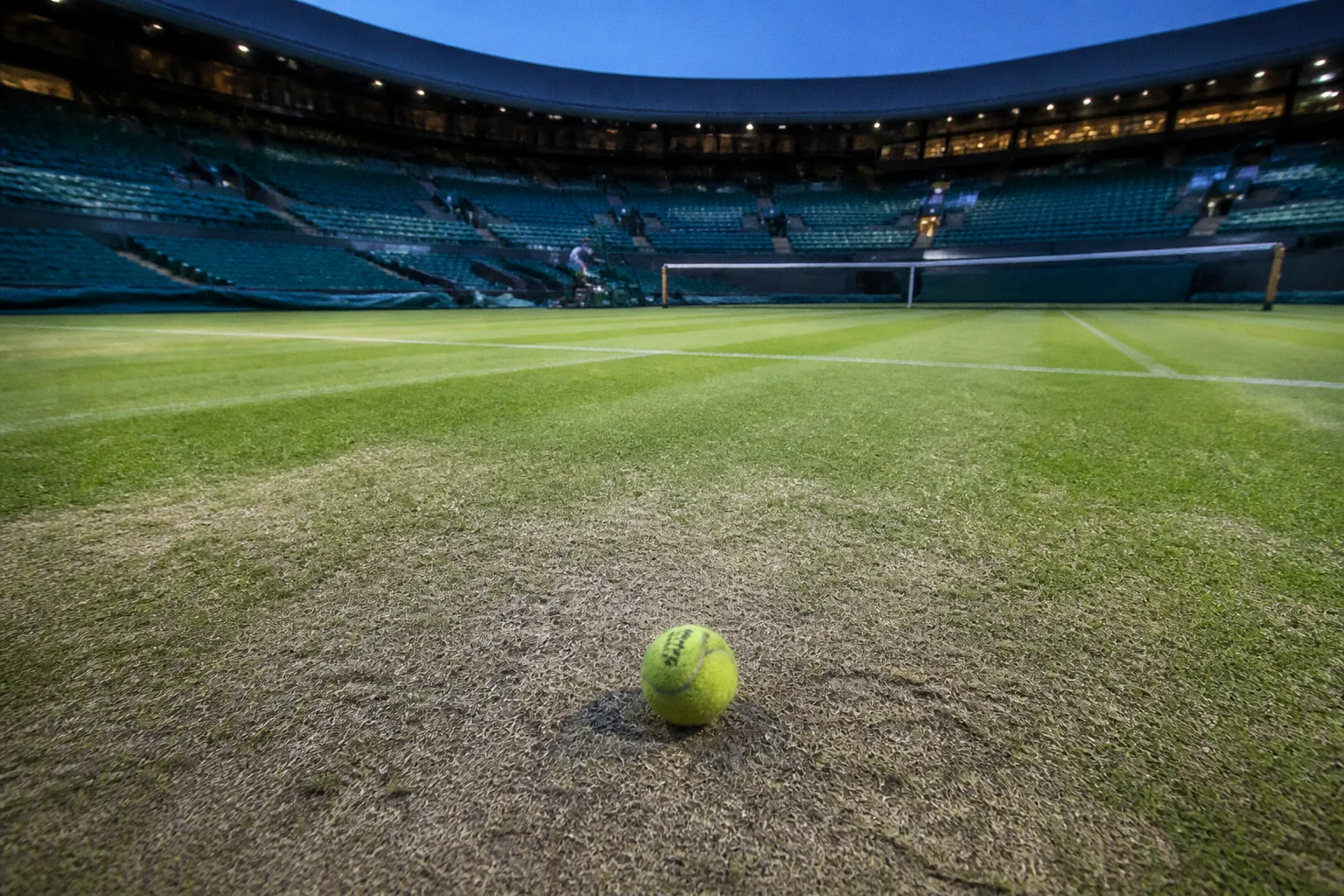
The old mixture contained creeping red fescue, a fine-leaved grass associated with a thinner and more delicate sward. Perennial ryegrass is more robust. Its root system is denser and more effective at occupying the soil profile. That makes it better suited to repeated wear: the hard braking, sliding, pivoting, and concentrated traffic that professional tennis imposes on a court.
The trade-off, or at least the unintended consequence suggested by the later playing characteristics, was that a more durable surface could also become firmer as the tournament progressed. The new turf held together better. The soil beneath it responded differently. A court that resisted visible wear did not necessarily preserve the same bounce profile as the older blend.
That distinction is central to the question of Wimbledon grass speed. The court may not have become slower in the simplistic sense of a stopwatch measurement applied to every serve. It may have become less friendly to the low, skidding, immediately attacking ball that made serve-and-volley tennis so efficient.
The ryegrass transition altered the bounce not by changing the height of the cut, but by changing the ground the ball met after it landed.
Eddie Seaward, Wimbledon’s long-serving head groundsman during the conversion, estimated that the switch changed ball response time by roughly one-tenth of a second. That figure should be treated as an estimate of a playing effect, not as a complete causal model of Wimbledon’s tactical evolution. It does not tell us that every player lost exactly the same amount of time, or that the volleyer and returner gained and lost matching portions of the same window.
It does, however, suggest why the change could matter. A serve-and-volley player does not need the ball to be slow in the abstract. He needs it to remain low enough, and predictable enough, for the first volley to arrive before the returner has fully organized the next shot. A slightly higher or more stable bounce changes that sequence. It gives the returner a more comfortable strike zone and makes the volleyer solve a different problem at the net.
The difference is small in isolation. At championship level, small differences are often the entire argument.
The Physics of the Bounce: Soil Compaction and Response Time
The romantic version of grass-court tennis revolves around the blades: the low cut, the clean green surface, the sensation that the ball is skimming across a thin layer of living fabric. But the blades are only the visible part of the court. The more consequential story sits underneath.
Wimbledon’s court subsurface is approximately 25% clay, and the behavior of that clay-loam mix affects how the ball responds after contact. As players pound the baseline over the course of a fortnight, the soil becomes firmer. Foot traffic concentrates in predictable zones. The surface loses some of the cushioning and irregularity associated with softer ground. The ball comes off it with a response that is higher and, in many situations, more repeatable.
The transition to pure perennial ryegrass appears to have accelerated or reinforced that process. The denser root system changed how the turf occupied and held the soil profile. The result was not a dramatic transformation visible from the stands. It was a series of small physical differences accumulating across the court and across the tournament.
Wimbledon’s pace is a soil story wearing a grass costume.
That is why the phrase “the courts slowed down” is useful only if handled carefully. It describes the experience of players and spectators, but it can blur several variables:
- the speed of the ball immediately after the bounce;
- the height and predictability of that bounce;
- the degree of skid available to a low serve or slice;
- the time a returner has to set up for a passing shot;
- the amount of wear a court develops from the first Monday to the second Sunday;
- the ability of a player to keep an attacking position after serving.
A surface can feel slower to an attacking player even when some shots still travel quickly. If the ball rises into a more comfortable hitting zone, the returner can take a larger swing. If the bounce becomes more predictable, the defender can prepare earlier. If the surface loses some of its old skid, the server’s first volley becomes less of an emergency interception and more of a conventional exchange.
For a player such as Pat Rafter in 2001, that was a manageable but meaningful change. His serve was flat, his first volley instinctive, and his touch at net exceptional. He could adapt to a less forgiving bounce better than most. But adaptability is not the same as immunity. A player whose strategy depends on arriving at the net before the opponent can attack is affected whenever the returner receives a cleaner, more stable ball.
The timing argument also needs precision. At 130 mph, the relevant flight from the baseline area to the service-line area is about 0.31 seconds. A response-time estimate of roughly 0.1 seconds is therefore a substantial portion of that short exchange, but it should not be converted into a neat percentage of tactical advantage. Nor does it prove that the volleyer’s decision window shrank by exactly the same amount that the returner’s opportunity expanded.
The better way to describe it is as a redistribution of difficulty. The volleyer has less room to rely on reflex and court position alone. The returner has a better chance of making a controlled first decision. That does not guarantee a break of serve or a passing-shot winner. It simply makes the attacking player pay more often for the same forward move.
At the net, that payment is decisive. Serve-and-volley tennis is not built on one spectacular volley. It is built on a chain of small advantages: the serve forces a short reply, the approach begins immediately, the split-step arrives at the right moment, and the first volley lands low enough to prevent a clean counterattack. Change the bounce at one link in that chain and the whole pattern becomes less automatic.
The Vanishing Art of Serve-and-Volley: A Statistical Decline
The 2001 men’s final remains the clearest contrast. Ivanišević and Rafter played a form of tennis in which moving forward was not an occasional surprise but the organizing principle. Their serving patterns, returns, and positioning were built around taking the net away from the opponent.
That does not require the stronger claim that either player followed every first serve. The match is better understood as an extensive serve-and-volley contest, not as a sequence in which every first serve produced an identical movement pattern. Players vary their choices according to score, serve location, return position, and confidence in the next ball. The point is not universal behavior. The point is tactical dominance: the net was where the match was expected to be won.
By contrast, the 2002 final between Lleyton Hewitt and David Nalbandian produced no serve-and-volley points. That statistic tells us something important about the match’s tactical shape. It does not establish how many times Nalbandian approached the net for other reasons, nor does it justify assigning an exact net-approach total to him. A zero serve-and-volley figure is not a complete census of every movement toward the net.
The contrast still feels stark because the two finals were close enough in time to expose a genuine change in emphasis. Hewitt returned from deep behind the baseline and absorbed pace with the stability of a player whose game was designed around retrieval and counterpunching. Nalbandian could strike the ball early and redirect it without accepting the risks of constant forward movement. Grass had not become clay, but the tactical distance between the surfaces had narrowed.
By 2018, serve-and-volley accounted for roughly seven percent of points at Wimbledon, compared with a figure near one-third in the early 2000s. Those numbers are not a complete explanation of the decline, but they give the change a scale. The attacking style did not vanish because players collectively forgot how to volley. It became a less reliable investment.
| Feature | Earlier grass-court pattern | Post-transition pattern |
|---|---|---|
| Court response | Lower and more variable in the older blend | Higher and more predictable as the firmer profile developed |
| First-strike strategy | Frequent movement forward after serving | More selective approaches and greater emphasis on the next baseline ball |
| Returner’s task | Survive a low, fast exchange before the volley | Use the cleaner bounce to build a passing shot or counterattack |
| Rally structure | Short points shaped by serve, return, and first volley | Longer exchanges with more time for defensive recovery |
| Serve-and-volley share | Near one-third in the early 2000s | Roughly seven percent by 2018 |
| Main tactical risk | Staying back and allowing the server to control the net | Moving forward and giving the returner a more manageable target |
The decline was therefore statistical and strategic at the same time. A net approach is valuable only when it produces a better position than staying back. If the return arrives higher, with more time and less skid, the server’s advantage at the net diminishes. The volleyer may still win the point, but the margin that once made the decision obvious has narrowed.
That is why the change was especially damaging to specialists. A player who had built an entire identity around first-strike tennis could not simply replace the strategy with a decade of baseline repetition. The modern returner had become more comfortable taking the ball early, more capable of generating topspin, and better equipped to pass from positions that earlier grass players might have considered defensive.
Pat Rafter retired eighteen months after the 2001 Wimbledon and was twenty-nine. His physical problems were real, and it would be too simple to treat his retirement as a surface-change story. Still, the timing captures the historical tension. The generation that mastered serve-and-volley was aging just as the conditions rewarding that style were becoming less generous.
Mark Philippoussis, another major serve-volley presence of the early 2000s, faced the same narrowing tactical window. His serve could still produce immediate damage, but a powerful serve alone did not restore the old geometry. The returner had more ways to make the first ball playable, and the volleyer had fewer points in which the approach felt inevitable.
The sport did not need a meeting or a formal decision to move in this direction. Players copy what works. Coaches train the patterns that produce repeatable results. Juniors develop on surfaces and with equipment that make baseline defense more attractive. Over time, a small change in the court becomes a change in the player pool, and a change in the player pool makes the original style look increasingly eccentric.
Durability Over Speed: The Groundskeeping Mandate
It is important to be precise about what the AELTC prioritized. The available evidence points to durability and consistency of the playing surface, not to an established institutional order to eliminate serve-and-volley tennis.
Modern professional tennis places enormous mechanical stress on grass. Players stop harder, change direction more violently, and bring footwork patterns from clay and hard court onto a surface that has less tolerance for repeated traffic. Heavy serves and sliding baseline movement concentrate wear in places that older generations used differently. A turf blend that survived earlier Wimbledon conditions could struggle under the athletic demands of the contemporary game.
Fescue was the more delicate component of the old mixture. Its fine leaves could be damaged by the repeated mechanical load, leaving bare or worn areas as the tournament progressed. Ryegrass offered a more durable answer. It held the court together more effectively and helped Wimbledon maintain the visual and operational consistency expected of a global event.
That is not a trivial consideration. A tournament cannot treat its court as a static piece of scenery. The surface must remain playable through changing weather, thousands of points, intense foot traffic, and a fortnight of scrutiny from television cameras. A damaged court creates one set of sporting complaints. A court whose bounce changes dramatically from week one to week two creates another. Durability is not merely cosmetic; it is part of competitive fairness.
The tactical consequences may nevertheless have exceeded the narrow maintenance brief. The switch was made for agronomic reasons, but agronomic decisions are never sealed off from sport. Grass species affect root structure. Root structure affects soil behavior. Soil behavior affects the bounce. The bounce affects the return. The return affects whether the server moves forward.
That is a causal chain, not proof of intention.
The AELTC’s stated explanation can therefore be true without being complete as an account of what happened to the game. The club may have been trying to preserve a usable, resilient court rather than to suppress tactical variety. Yet once the new surface rewarded a different kind of return and baseline exchange, players responded to the incentives in front of them. No deliberate slowdown agenda is required to explain the result.
A maintenance decision can have sporting consequences without having been designed as a sporting decision.
This is where the Wimbledon debate often becomes too moralistic. One side imagines a hidden institutional plan to modernize the tournament at the expense of its traditions. The other treats the grass composition as a purely horticultural matter with no meaningful effect on play. Both positions are too clean.
The more credible interpretation sits between them. Wimbledon needed a stronger surface because the game had changed. The stronger surface then helped reinforce the very style of tennis that had made the old blend less sustainable. Durability and tactical transformation were not competing stories in which only one could be true. They were linked outcomes of the same period of professional change.
There is also a difference between preserving a surface and preserving a style. The AELTC could reasonably prioritize the former. It was not obliged to freeze tennis in the tactical form of the 1990s. But the result was that the tournament’s public identity remained attached to serve-and-volley history while the physical conditions increasingly favored a broader, more baseline-oriented game.
That contradiction is part of Wimbledon’s modern character. The tournament still presents itself as the temple of grass-court tennis, but “grass-court tennis” no longer means one fixed tactical language. It can mean a fast first serve, a short exchange, and a bold approach. It can also mean a long rally, a heavy cross-court forehand, and a defender recovering from several feet behind the baseline.
The old version has not been erased. It has been demoted.
Beyond the Blades: Why Modern Rallies Last Longer
The modern Wimbledon rally is not solely a product of grass species. It comes from several forces working in the same direction: a firmer and more compacted soil profile, a higher and more predictable bounce, and racket technology that allows baseline defenders to retrieve and redirect balls that earlier generations might have accepted as winners.
A contemporary baseline player using polyester strings and a modern frame can generate heavy topspin while still absorbing the pace of a first strike. That equipment does not create the surface’s response, but it makes the response more useful. If the ball rises into a reliable hitting zone, the returner has both the time and the tools to turn defense into offense.
The tactical culture has adapted accordingly. Players are taught to return from positions that would once have looked excessively conservative on grass. They are comfortable extending a rally until the server gives up the net or misses the next attacking ball. The first response to a serve is no longer always a desperate attempt to keep the ball low enough to prevent a volley. It can be the beginning of a planned baseline exchange.
This changes the meaning of aggression. In the old Wimbledon geometry, aggression often meant moving forward immediately. In the newer geometry, aggression can mean taking the return early, driving the next ball deep, and using a sequence of heavy groundstrokes to make the eventual approach inevitable. The attacking player has not disappeared; the attack has moved.
The 2019 final between Novak Djokovic and Roger Federer illustrates the distance traveled. At four hours and fifty-seven minutes, it became the longest singles final in Wimbledon history. Its length was not caused by one factor, and it would be excessive to claim that the 2001 turf conversion alone made such a match possible. Player styles, physical preparation, racket technology, and the scoring circumstances all mattered.
But the match was also a surface product. The court allowed extended defensive sequences, repeated recovery, and baseline exchanges in which neither player had to force an immediate move forward. Federer’s serve-and-volley instincts remained visible, yet they operated inside a game that no longer automatically rewarded the old transition. The skill survived; the environment around it had changed.
That is the larger history of the wimbledon grass speed change history. It is not a simple line from fast to slow. It is a shift from one kind of difficulty to another.
Earlier grass demanded instant adjustment to a low and sometimes awkward bounce. The attacking player had to read the serve, close the distance, and control the first volley before the returner could establish balance. Modern Wimbledon asks a different set of questions. Can the server create enough damage to prevent a full return? Can the returner turn a higher bounce into a deep, heavy ball? Can either player maintain court position through several changes of direction? Can the first attacker survive the longer exchange after the initial advantage has been neutralized?
The answer to why did Wimbledon slow down the grass is therefore not that someone necessarily set out to slow it down. The stronger claim is not supported by the available facts. The more defensible explanation is that Wimbledon changed its turf to withstand modern play, and the resulting surface conditions altered the incentives that govern modern play.
That distinction matters because intention and effect are different categories. A groundskeeping choice can be made to protect the court and still change the sport played on it. A tournament can pursue durability without openly choosing baseline tennis. Players can then make rational adjustments that, over time, produce exactly that result.
The serve-and-volley specialist has not been banned from Wimbledon. He has been placed in a less forgiving economy. The risk is higher, the returner is better prepared, and the first volley no longer arrives against the same low, unstable ball that once made immediate net position so powerful. A player can still serve, follow, and win — but the strategy now requires more disguise, more variety, and a stronger baseline game behind it.
That is why the old style feels absent even when its techniques remain. The sport did not forget the volley. It stopped organizing the whole point around it.
The grass at Wimbledon today is physically different from the grass Roger Federer first encountered in 1998. The exact relationship between turf composition, compaction, bounce, and court speed is too complicated for a single slogan. Still, the historical pattern is hard to miss: a change made to improve durability coincided with a higher, more predictable response and a rapid decline in the tactical dominance of serve-and-volley tennis.
Wimbledon did not necessarily choose between spectacle and operational simplicity. It chose a surface that could survive the modern tournament. The spectacle then changed around that choice.
The temple of grass-court tennis is still standing. It simply no longer speaks the old language fluently.