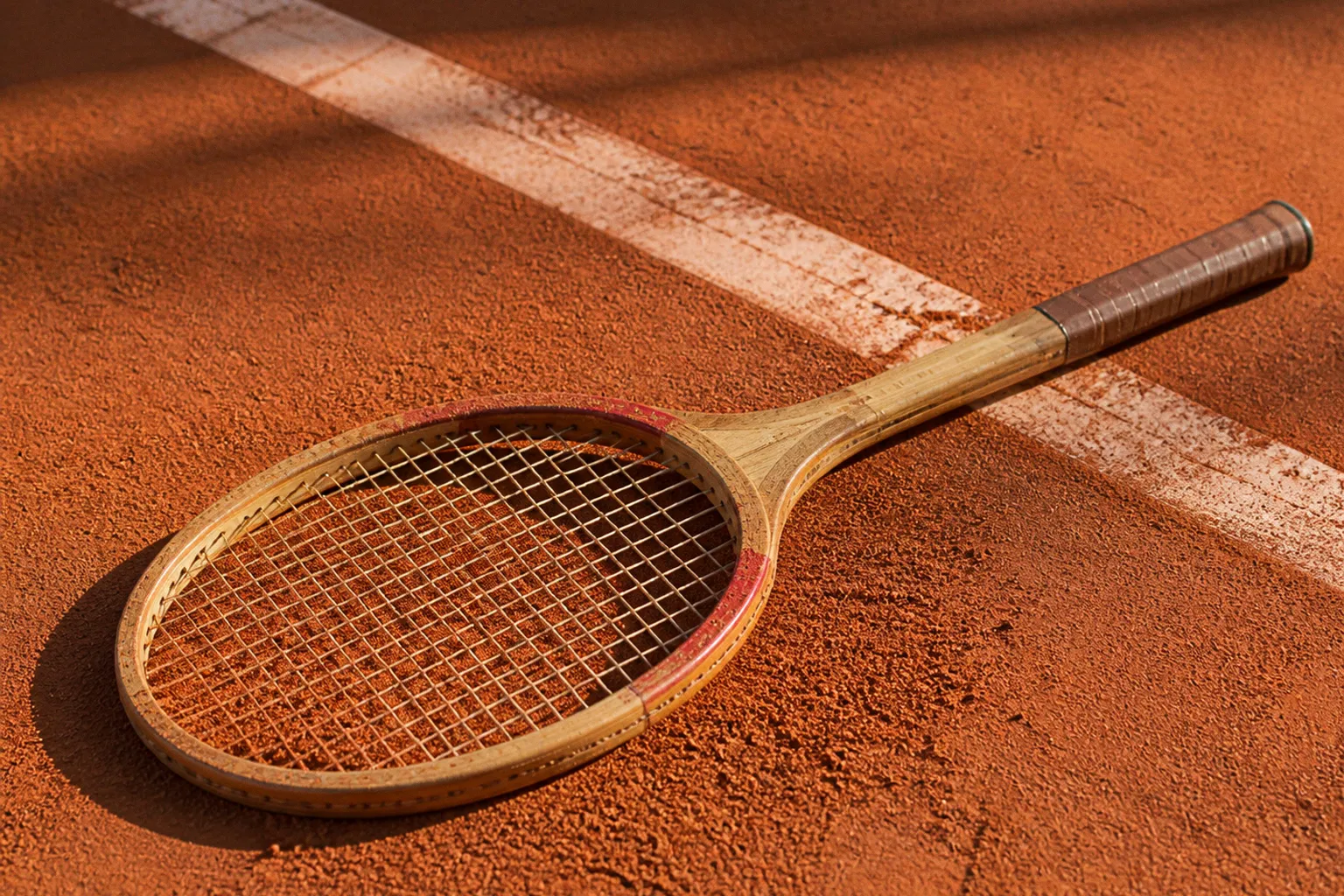
Mastering Contact: Using Vintage Wood Rackets for Timing
Traditional wooden frames usually measure between 60 and 70 square inches—far smaller than the midplus and oversized rackets most players use today—and that reduced hitting area turns an ordinary rally ball into a precise question: did the strings meet the ball cleanly, or did the swing merely pass near it?
The answer arrives through the hand before it appears in the shot. A centered strike feels solid and immediate; an off-center contact produces vibration, torsion, and a small but unmistakable loss of authority. That physical honesty is the reason vintage wooden tennis racket training still interests modern players. It is not a nostalgic replacement for graphite equipment, and it is not a shortcut to more power. Used carefully, it is a way to make timing visible again—to restore friction to a game in which modern technology often smooths over small technical errors.
The physics of the 70-square-inch frame: why size matters
The wooden racket’s first lesson is geometric. When the head is only 60 to 70 square inches, the usable center of the string bed becomes a much more demanding target than the broad contact zone of a contemporary racket. The difference is not merely visual. A larger modern frame can preserve depth and stability when contact drifts slightly toward the edge; a traditional wooden frame makes the same mistake more apparent, and often more uncomfortable.
This is why playing with wood tennis rackets can sharpen the player’s awareness of preparation long before it improves any particular stroke. The racket does not allow the ball to disappear into a generous area of forgiving response. The player must arrive with the racket face organized, the body balanced, and the swing moving through the ball rather than searching for it at the last instant.
The most useful way to understand the small head is not as a punishment but as an instrument of magnification. It enlarges the consequences of small errors:
- A racket face that opens slightly at contact sends a more obvious signal through the hand.
- A contact point that moves too far behind the body produces a weaker, less stable strike.
- A rushed backswing leaves less time to position the racket beneath the ball.
- A lazy recovery step becomes visible because the next contact is suddenly out of reach.
- A head that moves during contact gives away the mistake through vibration rather than allowing the modern frame to conceal it.
The wooden racket therefore works best when the player treats it as a diagnostic tool. It is not asking for a different version of tennis so much as exposing the mechanical foundations beneath the modern version.
During the 1960s and 1970s, when traditional wooden frames dominated the sport, players developed their timing within these narrower physical margins. That historical context matters. The racket technology did not merely accompany the style of the era; it helped shape the rhythm of preparation, the compactness of certain swings, and the premium placed on clean movement into the ball. One should not turn that history into a simple claim that wood produced superior technique. But it is fair to say that the equipment demanded a more exact relationship between footwork and contact.
A wooden racket does not make the ball better—it makes the moment of contact harder to ignore.
Tactile feedback and the anatomy of a clean strike
There is a particular quality to a centered strike with wood: a brief, dense solidity, almost as if the racket has stopped being an object in the hand and become a direct continuation of the arm. That sensation is not decorative nostalgia. It is useful feedback.
Modern graphite rackets are designed to provide stability, speed, and access to power across a wide range of contact points. Their construction and larger head shapes can make imperfect contact playable, which is one of the great achievements of contemporary equipment. But the same forgiveness can blur the distinction between a clean strike and a merely serviceable one. A player may finish a drill with good pace while still arriving late, contacting too far from the body, or allowing the racket face to wander.
Wood removes some of that ambiguity. When the ball meets the center, the frame feels composed. When it does not, the racket communicates the error through vibration and a loss of tactile weight. Over time, this gives the player a more exact internal map of the string bed. The question is no longer simply whether the ball went in. It becomes whether the ball left the racket from the intended place, with the intended face angle, and under control of the intended swing path.
That distinction is central to tennis sweet spot training tools. A good tool should not merely make a player miss. It should help the player understand what a clean contact requires. A wooden racket can do this, although it should not be treated as identical to a purpose-built sweet-spot pointer or another specialized training device. The wooden frame has its own substantial mass, balance, and swing behavior, and those properties affect the exercise.
A simple progression can keep the feedback useful:
1. Begin with cooperative feeds. Drop feeds or gentle hand feeds give the player time to organize the feet and racket face without adding unnecessary ball-speed pressure.
2. Search for the center rather than maximum pace. The goal is a firm, quiet contact, not a heroic finish or a ball struck with excessive force.
3. Repeat from a fixed contact zone. Keeping the feed predictable allows the player to notice how small changes in spacing affect the strike.
4. Add movement gradually. Once the centered contact is recognizable, introduce one lateral step, then a recovery step, while preserving the same attention to the racket face.
5. Return to the modern racket and compare sensations. The contrast is part of the lesson. The graphite frame should feel more generous, but the player should carry the cleaner timing into it.
The head must remain quiet through this work. That does not mean freezing the body or making the stroke rigid. It means preventing unnecessary head movement from disturbing visual tracking and spacing. The player still turns, loads, rotates, and follows through, but the eyes and head remain sufficiently stable to monitor the ball’s trajectory into the smaller target.
Weight, balance, and the myth of modern spin
The most important caution in vintage wooden tennis racket training is mass. Some classic frames are not merely smaller than a modern racket; they are dramatically heavier. The Bancroft Bjorn Borg Autograph, for example, is recorded at up to 14.3 ounces, or approximately 405 grams, with a swingweight of 375. Those are substantial figures, and they change the exercise from a simple accuracy drill into a demanding negotiation with inertia.
Static weight is what the racket registers on a scale. Swingweight describes how heavy it feels in motion—how much resistance the player encounters when accelerating and redirecting the frame. A racket with high swingweight asks for earlier preparation because once the swing begins, changing its path becomes more difficult. It also places greater demands on the shoulder, forearm, and trunk when the player tries to create speed late.
This is where the retro tennis racket swing timing exercise can be valuable. The player learns that preparation is not an aesthetic preference but a physical necessity. If the racket is heavy and the head is small, there is little room for a last-second correction. The body must recognize the ball early, establish the hitting zone, and allow the racket to arrive with structure.
Yet the same resistance makes long sessions questionable. The available research and technical discussion do not establish whether extended practice with heavy wooden rackets improves modern racket-head speed over time, nor do they provide a settled biomechanical account of how acceleration changes before and after such drills. Fatigue can also distort technique. A player who begins compensating with the wrist, lifting the shoulder, or shortening the follow-through may be rehearsing tension rather than timing.
The distinction between a wooden racket and a light sweet-spot training pointer is therefore essential:
| Training object | Main physical demand | Best use | Primary caution |
|---|---|---|---|
| Traditional wooden racket | Small head, high mass, distinctive balance | Contact discipline, preparation, footwork, tactile feedback | Can alter swing timing and create fatigue |
| Modern graphite racket | Larger hitting area, greater access to power and spin | Full-speed technical and tactical play | May conceal small contact errors |
| Specialized sweet-spot pointer | Deliberately reduced contact target with purpose-built handling | Short accuracy and center-contact drills | Does not reproduce the mass or balance of a wooden frame |
Wood also changes the conversation about spin. Modern graphite frames offer much greater access to power and heavy topspin, particularly through their lighter construction, string patterns, and broader response characteristics. A wooden racket lacks those technological advantages. It is harder to generate the same modern levels of pace and spin, but that does not mean topspin was impossible on wood. Players of the wooden era shaped the ball with the equipment available to them; the limits were significant, not absolute.
For training purposes, the point is not to imitate a 1970s forehand with a frame from that period. It is to separate the parts of the stroke that depend on equipment from those that depend on the player. The racket can restrict power, but it can also clarify spacing, sequencing, and contact. Those qualities remain relevant when the player returns to graphite.
The 15-minute protocol: integrating wood into modern practice
The most sensible place for a wooden racket is at the beginning of practice, in a short interval that wakes up the player’s attention without asking the body to carry an unfamiliar load for too long. Coaches and players commonly recommend using a small wooden frame or another sweet-spot training tool for roughly 10 to 15 minutes before transitioning back to a standard modern racket.
That duration matters because the exercise is about precision, not endurance. The player should finish with heightened awareness rather than a tired arm and compromised mechanics. A useful session can move through three phases.
Phase one: establish the center
Start with compact forehands and backhands from a stationary position, using a controlled feed. The swing should remain comfortable and abbreviated enough that the player can identify the quality of the strike. There is no need to chase pace. Listen through the hand for the difference between the frame meeting the ball in its center and the frame being twisted by an edge contact.
At this stage, the player is learning the dimensions of the racket. The body begins to understand how far the ball must be from the torso, how early the preparation must occur, and how little benefit comes from forcing the finish after the contact has already gone wrong.
Phase two: make the feet responsible
Add small lateral movements—first one step, then two—and feed the ball into a repeatable pattern. The intention is to make footwork carry the racket into position. Reaching with the arm is tempting because the wooden head is unforgiving, but reaching only moves the error farther from the body’s center.
The player should look for a sequence in which the feet settle before the strike, even if that settling lasts only a fraction of a second. Clean footwork is not necessarily elaborate footwork. In this drill, it is the ability to arrive with enough balance that the racket can travel through the ball without being recruited as a rescue device.
Phase three: transfer the lesson
After the wooden segment, return to the modern racket and begin with the same feeds. The first few contacts may feel unusually easy. That contrast is useful, provided the player does not mistake comfort for permission to become careless. Keep the head still, preserve the earlier preparation, and aim for the same centered relationship between body, ball, and racket.
A compact wooden racket practice can therefore look like this:
- Three to five minutes: stationary contact with gentle feeds.
- Three to five minutes: controlled lateral movement and recovery.
- Three to five minutes: transition to the modern racket while preserving the same contact-point discipline.
The exact division is less important than the principle: short exposure, clear purpose, immediate transfer. The wooden racket should sharpen the first minutes of modern practice, not replace the equipment used for the actual demands of a contemporary match.
A server can adapt the same idea, though with greater caution. Short, half-speed service motions may help reveal whether the player is organizing the racket early and meeting the ball at a stable height. Full-power serving with a very heavy vintage frame is a different matter, because the load and timing are more severe. The training value lies in controlled coordination, not in forcing a historical object to perform a modern ballistic task.
Refining footwork through the lens of vintage resistance
The deepest benefit of the wooden racket may have little to do with the racket head itself. It lies in the way the frame makes footwork unavoidable.
Modern tennis is often described through its visible outcomes—rotation, racket-head speed, spin, court position—but every outcome still depends on the body reaching the right place at the right time. When the racket has a small head and high swingweight, the player cannot easily solve a poor position with a frantic wrist adjustment. The feet must begin earlier, the first step must be decisive, and the recovery must preserve enough time for the next ball.
This gives the exercise a historical resonance without turning it into a reenactment. The player is not pretending to inhabit an earlier era of tennis. Instead, the equipment allows a glimpse of the physical economy that earlier players had to respect. There was less room for improvisation at the edge of contact, and the structure of the stroke had to be built before the ball arrived.
For a modern baseline player, several patterns become especially clear:
- Late preparation is expensive. The racket’s mass exposes the cost of beginning the forward swing after the ball has already entered the hitting zone.
- Spacing controls the quality of contact. Too close and the racket cannot travel freely; too far and the player reaches for the ball.
- Recovery is part of the stroke. A beautifully centered forehand is not enough if the player is stranded afterward, unable to organize for the next shot.
- The still head supports the moving body. Stable visual tracking helps the player judge the smaller target without stiffening the swing.
- Compactness creates time. The player does not need a tiny modern forehand, but a controlled preparation reduces the temptation to rush.
This is also why wooden racket practice can be valuable for players who already possess considerable power. Strong hitters sometimes solve timing problems with speed. A heavy frame removes that escape route. It asks whether the ball was struck well before asking how hard it was struck.
There is a quiet discipline in that demand. The wooden racket does not reward theatrical effort. It rewards a body that has organized itself, a racket face that has arrived with conviction, and a player willing to notice the difference between a shot that travels and a shot that was truly under control.
What the wooden racket can—and cannot—teach
A vintage frame can teach contact precision, but it cannot reproduce the complete behavior of a modern racket. The two equipment categories differ in head size, mass, balance, stability, power, and spin response. A player should therefore resist simple transfer claims. Better contact with wood does not automatically mean a faster modern swing, and a successful wooden-racket drill does not prove that the player’s match mechanics have been transformed.
The value is more specific and, for that reason, more dependable. Wood can make the player attend to the first principles of striking:
1. See the ball early enough to prepare. The racket’s resistance makes late decisions difficult.
2. Move the body into the contact zone. The arm should not be asked to compensate for poor positioning.
3. Keep the racket face organized. A small error becomes physically legible.
4. Meet the ball with a stable structure. Centered contact feels different from contact that merely survives.
5. Carry the discipline back to graphite. The modern racket should expand the player’s options, not relax the player’s standards.
The exercise also teaches restraint. A 14.3-ounce frame with a recorded swingweight of 375 is not a neutral extension of the arm. It is an imposing training object, and its feedback must be interpreted within that context. If the forearm begins to tighten, the shoulder loses freedom, or the player’s timing deteriorates under fatigue, the session has moved beyond its useful purpose.
That boundary is part of responsible practice. The wooden racket should not be romanticized into a cure-all, and it should not be treated as a badge of technical seriousness. Its strengths are concrete: a smaller target, pronounced tactile feedback, greater resistance, and a direct demand for footwork. Its limitations are just as concrete: altered swing timing, restricted access to modern power and spin, and a heavier physical burden than most current rackets.
The old frame in a modern practice
There is a reason these rackets continue to attract attention long after the wooden era has passed. They preserve a kind of material conversation with the game. The grain, the weight, the narrow head, and the vibration of a miss all return the player to the physical terms of tennis—friction against the ball, tension in the strings, balance through the feet, and the small interval in which preparation becomes contact.
Used for 10 to 15 minutes, a wooden racket can make that interval more distinct. It can ask the player to arrive earlier, watch more steadily, and move with enough precision that the racket does not have to repair the body’s mistakes. Those lessons belong to no single era. They survive the passage from wood to graphite because they are not technological lessons at all. They are lessons about attention.
The best vintage wooden tennis racket training is therefore brief, deliberate, and followed by a return to modern equipment. The purpose is not to play contemporary tennis with yesterday’s limitations. It is to bring a little of yesterday’s honesty into today’s easier, faster, more forgiving frame—and to remember that even the most advanced racket cannot create a clean contact for a player who has not arrived in the right place.