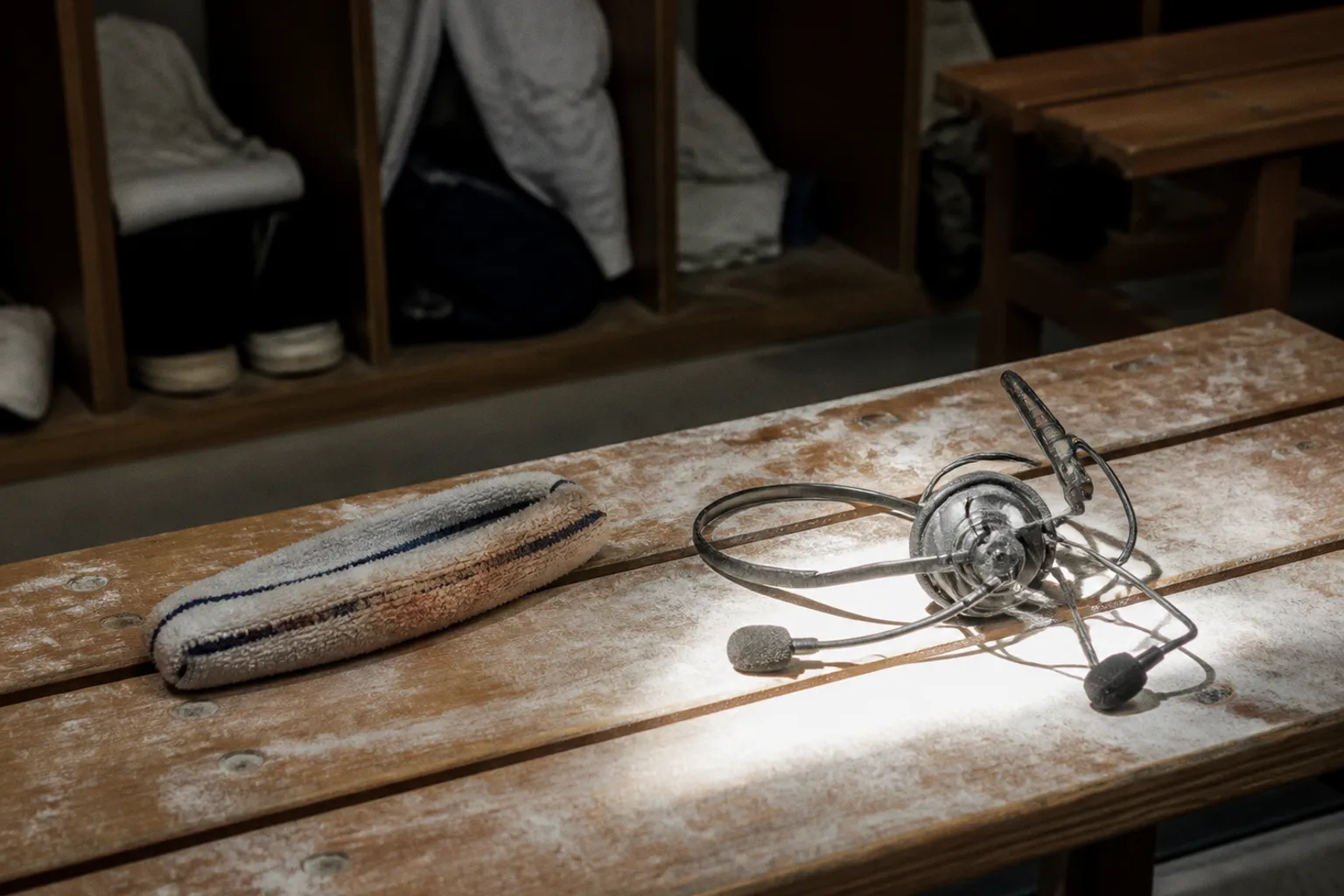
When you want a reference point for psychological collapse at the elite level, you eventually arrive at June 10, 1984, and a courtside headset that became part of the history of the match.
Two sets up. A 42-match winning streak. The most dominant season of John McEnroe's career, and one of the most extraordinary seasons men's tennis had seen. Then a piece of broadcast equipment — a headset worn by a cameraman near the court — became the focus of an outburst that changed the emotional balance of the French Open final.
This is the story of how McEnroe lost to Ivan Lendl at Roland Garros: not because a piece of equipment literally changed the score, but because a moment of noise, production chatter, anger, and public confrontation gave the match a new shape. The final did not turn on one magical tactical adjustment. It turned through a sequence in which McEnroe's attention moved away from Lendl, and Lendl was able to occupy the space that opened up.
The Unstoppable Force: McEnroe's 82-3 Season and the 42-Match Streak
To appreciate what McEnroe brought to Court Philippe Chatrier that afternoon, you have to understand the absurdity of his 1984. He finished the year 82-3, won 13 singles titles, and arrived at the French Open final riding a 42-match winning streak. The numbers are familiar now, but they still resist ordinary description. This was not simply a player in form. It was a season in which McEnroe seemed to have reduced losing to an occasional administrative error.
His tennis made that authority look natural. The serve was disguised rather than merely fast. The first volley appeared before the opponent had finished processing the serve. His hands could turn an awkward ball into an attacking opportunity, and his movement on clay was more effective than the stereotype of the impatient serve-and-volleyer suggested. McEnroe did not need to dominate every rally. He needed to make the rally feel temporary.
There was a particular economy to his best tennis. He could take time without appearing to hurry, and he could change direction with a wrist movement that made a technically difficult shot look like an afterthought. On clay, where points were expected to stretch and the surface seemed to reward patience, McEnroe's touch allowed him to shorten the argument. He attacked not only with pace but with uncertainty. Lendl could be preparing for a heavy exchange and suddenly find himself dealing with a low slice, a wrong-footing angle, or a volley struck from an awkward position.
Lendl arrived from a very different emotional landscape. He had already lost four previous Grand Slam finals. He was not an unknown challenger, and he was not short of experience. But he had repeatedly reached the final stage of a major without taking the last step. The question surrounding him was no longer whether his game was good enough to win a Grand Slam. It was whether he could remain intact when the match demanded that he do so.
That made the opening two sets especially brutal. McEnroe won 6-3, 6-2. He disrupted Lendl's rhythm, took the ball early, and used his variety to prevent the match from settling into a comfortable baseline pattern. Lendl's power and repetition were supposed to make the final a long examination. Instead, the examination seemed to be ending before it had properly begun.
McEnroe's advantage was not only on the scoreboard. He appeared to be playing from a position of psychological surplus. Lendl was the player who had to solve a problem. McEnroe looked like the player who had already solved it.
Then Lendl held to open the third set. McEnroe held to make it 1-1. Somewhere around that changeover, a problem involving a courtside broadcast headset drew McEnroe's attention away from the match.
The headset did not alter the score. It altered the architecture of McEnroe's concentration.
The Third Set Turning Point: When Broadcast Audio Met Courtside Rage
The mechanism was ordinary enough to be easy to dismiss. A television cameraman positioned near the back of the court was wearing a headset to communicate with the broadcast operation. Audio was apparently leaking through the equipment. McEnroe became aware of an American broadcaster's voice and of production discussion connected to the trophy ceremony and camera coverage.
That detail mattered because of its timing. The final was still in progress, and McEnroe had just won the first two sets. The broadcast operation, at least in the sound that reached him, seemed to be dealing with what would happen after the match. The practical explanation may have been simple: television crews prepare for different possible endings, and production work continues while the players compete. But McEnroe did not experience it as neutral production work. He experienced it as an intrusion into the competitive space.
He walked toward the cameraman, took hold of the headphones, and shouted into the microphone. The scene became visible to the stadium in a way the original sound leak had not been. A private technical problem became a public confrontation.
That distinction is central to the incident. Before the outburst, McEnroe had a distraction. After it, he had an event.
His confrontations with officials had always carried a kind of tactical logic, even when they became excessive. The chair umpire was part of the contest's authority structure. Challenging that authority allowed McEnroe to turn frustration into pressure, to make the umpire and the opponent feel the force of his attention. The cameraman was different. The cameraman was not deciding whether a ball was in, whether a point should be replayed, or whether a code violation should be issued. There was no obvious competitive leverage in the confrontation.
McEnroe's anger therefore had nowhere useful to go. The outburst could not change the call, repair the headset, or remove Lendl from the baseline. It could only consume attention and alter the way the crowd understood the moment.
This was the essential contrast between the players. McEnroe's intensity was a source of extraordinary tennis, but it was also closely tied to his sense of the environment. He played with feel, instinct, improvisation, and emotional charge. Lendl's game was more deliberately repeatable. His strength lay in returning to familiar patterns: the preparation, the footwork, the heavy groundstroke, the next ball.
The headset incident did not affect both players in the same demonstrable way. Its confirmed impact was on McEnroe's attention and conduct. Lendl's exact awareness of the cause of the disturbance is less clear, and it would be too neat to pretend that he consciously diagnosed the moment as it happened. What can be said is simpler: Lendl was still there, still playing, and the match began to offer him more opportunities than it had offered him earlier.
| Parameter | McEnroe in the final | Lendl in the final |
|---|---|---|
| Primary strength | Variety, anticipation, touch, and attacking instinct | Repetition, physical pressure, and baseline discipline |
| Competitive advantage | A fast-moving emotional and tactical rhythm | The ability to return to established patterns |
| Risk | Disruption could pull attention away from the next point | Previous final defeats created a heavy background of pressure |
| Match position after two sets | In control and apparently close to the title | Two sets down but still able to extend the contest |
| What the incident exposed | How closely his best tennis was tied to concentration | How valuable a stable process could become in a changing match |
The table is not a diagnosis of two personalities. It is a way of describing the match's central tension. McEnroe had more control of the opening. Lendl had a game that could survive the loss of that control.
The Anatomy of an Outburst: Confronting the Cameraman at 1-1
The important part of the episode is not the exact duration of the walk, the precise length of the confrontation, or any invented measurement of what happened to McEnroe's serve afterward. The footage and the broad account of the match do not require that kind of precision. The meaningful sequence is visible without a stopwatch: McEnroe noticed the audio, approached the cameraman, took the headphones, shouted, returned to the court, and continued playing a final that was no longer emotionally identical to the one he had been dominating.
At 1-1 in the third set, the match was still open. McEnroe had not thrown away a lead. He had not suddenly forgotten how to serve or volley. But concentration in tennis is not a fixed possession that remains untouched until a player makes a technical mistake. It is an allocation of attention. A player can spend it on the next return, the wind, the bounce, the opponent's position — or on a piece of equipment and the people responsible for it.
The confrontation made the distraction harder to contain because McEnroe gave it a public shape. He did not merely hear something and reset. He investigated it, challenged it, and made the stadium part of the investigation. When he returned to the baseline, the interruption was no longer external. It had become part of the match's atmosphere.
That is where the famous-meltdown version of the story can become too simple. The headset did not function like a button that turned McEnroe from brilliant into incapable. The decline was more likely to be cumulative and situational. Lendl had two sets to work with as evidence that his first plan was not enough, and he now had a match in which McEnroe's attention was less securely fixed on him. A player as accomplished as Lendl did not need a theatrical collapse. He needed the contest to remain alive.
The third set ended 6-4 for Lendl. That score did not erase the opening two sets, but it changed the final's grammar. McEnroe was no longer moving toward the trophy in a straight line. Lendl had established that the match could be extended, and extension was exactly where his game became more dangerous.
The signs of a shift were not necessarily spectacular. A serve can lose its intended location without losing all of its speed. A volley can sit up slightly rather than fly into the net. A player can arrive a fraction late, choose the more ambitious option, or spend too long replaying the previous point. None of those moments needs to be catastrophic. In a Grand Slam final, they accumulate.
McEnroe's game depended on reducing the opponent's time and choices. When his first strike became less decisive, Lendl had more chances to make the next ball. When Lendl had more chances, the match moved toward his preferred rhythm: physical, repetitive, and increasingly difficult to escape.
This is also why the incident should not be treated as a complete explanation for the result. Lendl did not win because McEnroe became a different species of player. He won because he stayed close enough to the match for the pressure to move back across the net. The headset was a trigger and a symbol. It was not a mechanical cause in the way a damaged racquet or an injury might be.
The distinction matters when discussing famous tennis meltdowns in history. A meltdown is rarely a single emotional explosion followed by an automatic defeat. More often, the visible outburst is the point at which several pressures become legible at once. The player is still capable of winning, but the match has become more expensive to play. Each point now carries the weight of the previous interruption. Each response is judged against the image of the player who seemed to be in control.
McEnroe was especially vulnerable to that kind of narrative because his tennis and his temperament were so visibly connected. His anger was not a private inconvenience hidden from the match. It was part of the performance, part of the rhythm, and sometimes part of the intimidation. When the anger stopped serving the tennis, everyone could see the change.
The Parisian Shift: How the Crowd Turned on the American Icon
The French Open crowd had never quite known what to do with McEnroe. He was not Björn Borg, whose clay-court identity had become inseparable from Roland Garros. He was not Guillermo Vilas, whose endurance and history on the surface made him a natural figure of Parisian affection. McEnroe was an outsider with extraordinary touch and a famous temper, a player who could enchant the crowd with one hand and challenge its patience with the other.
That ambiguity mattered. A crowd does not need to dislike a player in order to turn against him. It only needs to decide that the player has crossed a line the crowd recognizes as important. Confronting a working cameraman, even in response to a genuine equipment problem, gave the audience a different story to follow. The disturbance was no longer only about McEnroe's concentration. It was also about his treatment of someone who was not competing against him.
The reaction at Roland Garros became part of the pressure around the match. Encouragement for Lendl grew as the Czech remained in contention. The stadium's emotional balance shifted away from McEnroe, who had entered the final as the overwhelming force, and toward Lendl, who had been two sets down and was now making the contest credible again.
It would be too strong to claim that the entire crowd changed its allegiance in one perfectly measurable instant. Crowds are not machines, and the final was not transformed by atmosphere alone. But McEnroe was playing in a more difficult emotional environment after the confrontation than before it. The audience was no longer simply watching a champion's expected coronation. It was watching an unsettled favorite and a challenger who had found a way to stay present.
That distinction between hostility and pressure is important. Lendl did not need every spectator to become his partisan. He needed McEnroe to feel the stadium as another source of friction. Once the crowd became part of the story, every pause and reaction around the court could be interpreted as confirmation that McEnroe had lost the room.
The player who had been operating with authority now had to manage more than Lendl's serve and groundstrokes. He had to manage the memory of the confrontation, the audience's response, and the suspicion that the match was slipping away. Those tasks do not appear in the scoreline, but they affect the space in which the scoreline is produced.
Lendl's response, as far as the match itself shows, was not theatrical. He kept returning the ball, kept extending exchanges, and kept asking McEnroe to win the next point rather than rely on the authority of the first two sets. The longer the final continued, the less useful the earlier narrative became. A 42-match winning streak could explain why McEnroe had arrived as the favorite. It could not win the next game for him.
By the time the fourth set reached its decisive stages, the match belonged to a different kind of competition. The question was no longer whether McEnroe could produce the better tennis. He had already demonstrated that he could. The question was whether he could restore the concentration and command with which he had begun.
The fourth set went to Lendl 7-5. That was not a clean collapse from McEnroe, nor was it a comfortable progression for Lendl. It was a set shaped by the altered terms of the final: the underdog no longer had to imagine a comeback, and the favorite could no longer assume that superior early tennis would be enough.
The Aftermath: Lendl's First Major and the End of a Perfect Run
The final score — 3-6, 2-6, 6-4, 7-5, 7-5 — records a comeback, but it does not explain the texture of it. Lendl did not merely wait for McEnroe to disappear. He survived the worst of the opening, remained close enough to take advantage of a changing match, and imposed the kind of sustained pressure that made every additional game more significant.
The fifth set continued the same argument. McEnroe was still close enough to win; Lendl was still required to finish the job rather than admire the comeback. At that stage, the match had moved beyond the simple contrast between inspiration and discipline. Both players had to operate under the accumulated pressure of the afternoon. Lendl had to close out a final he had once seemed certain to lose. McEnroe had to recover a level of command that had been present at the beginning but was no longer available on demand.
For Lendl, the title was the breakthrough that had eluded him through four previous Grand Slam finals. The victory did not prove that he had suddenly become immune to pressure. It proved that he could carry the pressure long enough to finish a major final, even after losing the first two sets to the best player in the world.
There is no need to assign him a later confession or a specific lesson he supposedly articulated about the match. The result itself makes the point. Lendl's game did not require the final to feel comfortable. It required him to keep returning to its basic demands: move, strike, recover, repeat. Once McEnroe's authority weakened, that process became increasingly difficult to disrupt.
For McEnroe, the defeat remained a strange interruption in an otherwise immaculate season. He went 82-3, won Wimbledon and the US Open, and collected the other major titles associated with his extraordinary year. The French Open final was the one result that resisted the logic of the season. He had dominated so much of 1984 that the loss in Paris invited a search for a single explanation.
The headset became that explanation because it was vivid. It gave the collapse a prop, a sound, and a moment that could be replayed. But the object itself was never the whole story. The equipment did not beat McEnroe. The cameraman did not take a service game from him. The leaked audio did not hit a passing shot.
The headset became consequential because it exposed McEnroe's central paradox: his volatility was not separate from his genius. The emotional sensitivity that made him so alert to the court also made him vulnerable to anything that seemed to violate the court's boundaries. He could read a point faster than almost anyone, but he could also become trapped in an argument about what belonged inside the point.
That is why the incident has lasted. It is not merely a curious story about television technology at a tennis tournament. It is a compact illustration of how elite matches turn. A player begins with the authority to define the terms. An interruption challenges that authority. The player responds in a way that makes the interruption larger. The opponent does not need to create the original problem; he only needs to remain ready when the problem changes the match.
The incident also complicates the language of collapse. McEnroe did not surrender immediately after confronting the cameraman. He continued to compete through a five-set final. Nor did Lendl win simply because the American became distracted. Lendl had to make his own comeback real, point by point, against a player whose level had been almost untouchable for much of the season.
The better reading is not that McEnroe lost because of a headset. It is that the headset incident became the clearest visible marker of a shift that involved concentration, atmosphere, momentum, and Lendl's refusal to leave the match.
The famous object is easy to remember. The difficult part is remembering that Lendl still had to win the points.
What the Incident Really Explains
The phrase McEnroe 1984 French Open headset incident suggests a neat chain of cause and effect: the headset appeared, McEnroe lost his temper, and the title slipped away. Tennis is usually less obedient than that. A match can have a defining image without having a single defining cause.
The headset explains why the final's emotional temperature changed so visibly. It shows the moment when McEnroe's attention became externalized, when a sound near the court became more important than the next ball, and when his response made the disturbance impossible to treat as background noise.
It does not explain every unforced error, every long exchange, or every decision in the last two sets. It does not erase Lendl's tactical persistence. It does not turn the French Open final into a morality play in which temperament alone defeats talent.
What it does offer is a way to understand the particular fragility of McEnroe's game. His tennis was built on immediacy. He saw possibilities early and acted before the point settled into predictable patterns. That gift demanded a sharp connection between perception and response. When his attention was pulled into a confrontation that had no sporting solution, the same sensitivity became a liability.
Lendl, by contrast, could make the match feel repetitive in the best possible sense. He could return to the work. The score might be alarming, the crowd might be noisy, and the opponent might appear to be playing from another level, but the next task remained recognizable. That quality did not make him immune to pressure. It gave pressure somewhere to go.
The 1984 final is therefore best remembered as a contest between two kinds of control. McEnroe controlled the opening through improvisation, speed, and touch. Lendl eventually controlled the conditions by extending the match until those advantages were less decisive. The broadcast headset was caught between them: an external interruption that became an internal problem for one player and an opportunity for the other.
That is why the episode belongs in any serious account of famous tennis meltdowns history, but also why it should not be reduced to a cautionary tale about bad temper. The incident is compelling precisely because the line between brilliance and instability was so thin. McEnroe's anger was not an alien force that invaded an otherwise calm champion. It was part of the same emotional system that powered his finest tennis.
At Roland Garros, that system stopped working cleanly. Lendl noticed the opening in the only way a player truly can: by continuing to play. The title did not change hands because a headset possessed magical power. It changed hands because one player's concentration became harder to recover, while the other player's game remained available to him.
And once the final reached that point, the 42-match streak was no longer a shield. It was another piece of history McEnroe had to carry onto the court.