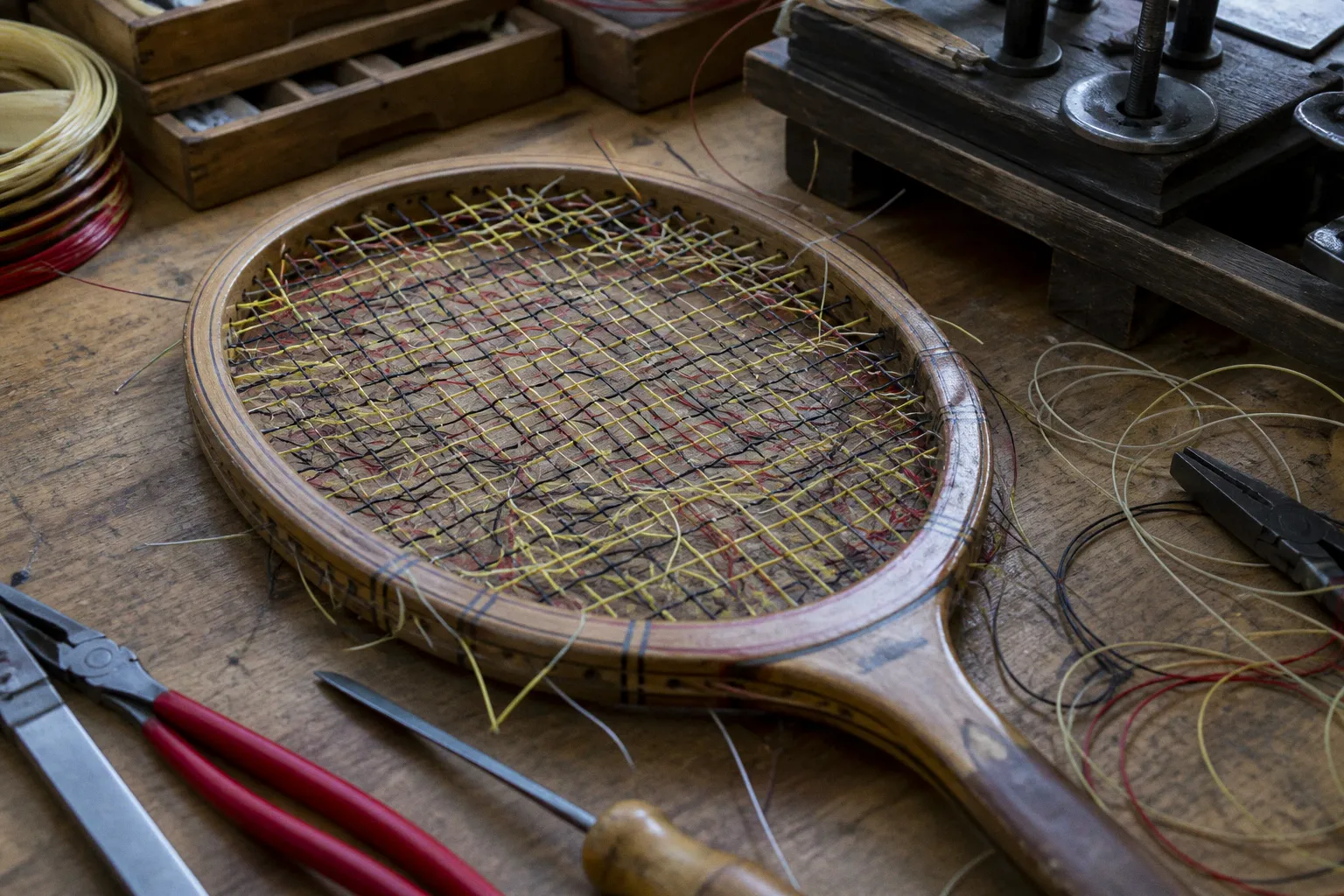
The spaghetti racket did not look like the beginning of a revolution. Its most radical feature was hidden in the string bed: instead of the familiar single interwoven pattern of mains and crosses, it used two layers of main strings, kept apart by only five or six pairs of horizontal crosses and fitted with hollow plastic tubing to reduce friction. The result was a racket that could send the ball away with extraordinary spin and, just as importantly, with a trajectory that the opponent could not reliably read.
The invention appeared in 1971, the work of Werner Fischer, a West German horticulturist and amateur tennis player. Six years later, this improbable piece of equipment had become the center of a professional controversy so severe that the International Tennis Federation introduced what is generally regarded as the first official equipment ban in modern tennis history. The spaghetti racket ban in tennis history was not a footnote about unusual gear. It was a moment when the sport had to decide whether its rules governed only the court and the scoring—or also the physical behavior of the racket itself.
The horticulturist’s invention: Werner Fischer’s radical design
A conventional tennis racket depends on a controlled relationship between strings. The mains run vertically, the crosses horizontally, and the two sets are woven into one surface. When the ball strikes that surface, the strings move, stretch, and return energy in a relatively predictable way. Players adjust racket angle, swing path, and contact point within that system, and opponents learn to interpret the resulting ball.
Fischer’s design disturbed that relationship. The spaghetti racket’s two layers of main strings were not woven together in the ordinary manner. The horizontal strings were sparse—only five or six pairs rather than the roughly twenty cross strings associated with a standard racket—and plastic tubes were used to keep friction between the string elements to a minimum. One known construction involved 154 pieces of hollow, spaghetti-like tubing, which gave the invention its enduring name.
The purpose was not simply to create more power. The essential change was in how the strings interacted with the ball. On a conventional racket, the mains and crosses restrain one another. Their friction helps keep the string bed stable, even as the ball bites into it. In the double-strung system, the main strings could move more freely. At impact, they were able to slide and then snap back with unusual force, imparting heavy topspin without requiring the same kind of exaggerated low-to-high swing that later became familiar with modern polyester strings.
That distinction matters. The racket did not merely reward a player who already possessed a great topspin stroke. It altered the mechanical threshold for producing spin in the first place. A player could strike the ball with a motion that looked comparatively ordinary and still send it away with a violent rotation, a dipping flight, or a bounce that seemed to belong to a different match.
The problem was not that the racket made every shot perfect. It was that it introduced uncertainty into a game built on reading patterns. A ball might clear the net with a plausible trajectory and then drop sharply. It might arrive at a familiar height but kick away from the receiver. The opponent was not only facing the player’s technique; he was facing a string bed whose behavior had been designed to make the ball less obedient.
The spaghetti racket did not just add spin—it loosened the old agreement between a player’s swing and the ball’s behavior.
The design also exposed a boundary that tennis had not yet needed to define. Rackets had always evolved, of course, from wood construction and natural gut toward new materials and different shapes. But those changes generally refined the existing logic of the game. Fischer’s system questioned whether a racket could be considered acceptable if its central advantage came from making the ball’s response unusually difficult to anticipate.
There was no modern equipment-testing culture ready to absorb that question. The professional game had rules governing the court, the net, the ball, and the general dimensions of the racket, but the specific architecture of the string bed had not yet become a matter of urgent regulation. The invention existed in that gap—technically possible, commercially intriguing, and not clearly prohibited.
The 1977 US Open: Michael Fishbach’s unlikely upset
The spaghetti racket entered public consciousness in a particularly combustible setting: the 1977 US Open. Michael Fishbach, ranked around 200th in the world, attracted attention after stringing his own racket from memory, based on a frame associated with Australian player Barry Phillips-Moore. The construction was improvised in spirit but not harmless in effect. Once the racket reached tournament competition, its strangeness became visible through the scoreline.
Fishbach upset higher-ranked opponents including Stan Smith and Billy Martin. Those victories were not proof that the racket had made him invincible. They were more unsettling than that. They suggested that an unfamiliar piece of equipment could disrupt the normal hierarchy of professional tennis, particularly when opponents had no experience of reading its ball flight.
At the highest level, players are accustomed to gathering information quickly. They watch the opponent’s grip, shoulder rotation, racket face, and swing speed. They recognize whether a forehand is being driven flat, brushed with topspin, or carved with slice. They also understand how a particular court surface modifies the shot: clay slows and grips, grass skids and shortens the available reaction, hard courts offer a more legible compromise between pace and bounce.
The spaghetti racket inserted another layer into that reading process. The opponent might correctly identify the swing and still misjudge the ball because the racket changed what that swing produced. A returner could prepare for a conventional shot and find the ball arriving with a different arc, a different dip, or a more aggressive kick after the bounce.
This is why the episode carried such cultural force. Tennis has always been open to equipment innovation, but professional competition depends on a shared understanding of cause and effect. A player who changes grip or swing changes the match through skill. A racket that changes the consequences of an otherwise familiar motion raises a harder question: where does the player’s advantage end and the apparatus begin?
Fishbach’s appearance did not create the controversy on its own. It made the controversy impossible to ignore. The racket was no longer an eccentric experiment in the hands of a horticulturist and amateur player. It had become a competitive instrument in a major tournament, visible to players, officials, and spectators who could see that something about the ball was behaving differently.
The Aix-en-Provence incident: breaking Vilas’s 53-match streak
The sharper rupture came later in 1977 at the Raquette d’Or tournament in Aix-en-Provence. Ilie Nastase used a double-strung racket against Guillermo Vilas in the final, and the match became inseparable from the equipment controversy.
Vilas arrived with an extraordinary clay-court record behind him: a 53-match winning streak on the surface. That streak had accumulated through the qualities that made him one of the defining clay-court players of his era—heavy left-handed groundstrokes, relentless depth, physical endurance, and an ability to make long rallies feel like a gradual tightening of a vice. On clay, where the ball usually gives a player more time to read and respond, Vilas had built an entire competitive identity around controlling the shape of the point.
The double-strung racket disturbed that control. Nastase’s shots carried the kind of spin and unpredictability that made ordinary anticipation unreliable, and Vilas eventually walked off the court in protest. The match became a symbol of the dispute because it placed an unusual racket against one of the most recognizable forms of clay-court mastery. It was not merely an upset between two players. It seemed to pit an established understanding of tennis against an invention that had arrived from outside the sport’s accepted technical vocabulary.
The atmosphere around the match has sometimes encouraged exaggeration. The important point is not that the racket transformed every shot into an unplayable weapon, or that it made conventional technique irrelevant. Rather, it created enough uncertainty to undermine the normal tactical exchange. A great returner can cope with pace; a great clay-court defender can cope with height and length. But a ball whose rotation and bounce do not correspond cleanly to the opponent’s visible swing places a different kind of pressure on the body.
The receiver begins to hesitate. The racket face opens or closes by a fraction. Contact moves backward. The feet arrive late. A defensive ball lands shorter than intended, and the next shot becomes an attack. In tennis, chaos does not need to look spectacular. Often it appears as a series of small failures in timing—an awkward block, a late adjustment, a ball struck from the wrong height.
The controversy also exposed the sport’s attachment to continuity. Vilas’s winning streak represented an established order: the clay court as a place of stamina, repetition, and accumulated authority. The spaghetti racket did not simply defeat a famous player; it threatened to make the meaning of that authority less stable. If the ball could be made to behave outside the usual expectations, then the history of the surface could no longer be separated from the engineering of the frame.
On clay, where endurance had long been treated as a form of truth, the double-strung racket introduced doubt at the point of contact.
The physics of chaos: why the double-stringing system defied control
The physics of the spaghetti racket is easier to understand through friction than through the vague language of “extra power.” The ball compresses against the strings, and the strings deform around it. With a conventional interwoven string bed, the mains and crosses are linked by their intersections. That network resists movement and helps return the strings toward their original position after impact.
The spaghetti system reduced the restraining effect of those intersections. Its sparse cross-string arrangement and plastic tubing allowed the main strings to move with far less friction. When the ball was brushed rather than struck flat, the strings could be displaced more substantially and then recoil. That recoil contributed to the ball’s rotation.
The exact rotational speed produced in professional play is not established here, and it would be misleading to attach a precise figure to a racket whose construction could vary from one frame to another. The broader mechanical principle, however, is clear: a less restrained string bed can increase the interaction between racket motion and ball rotation. It can also make that interaction less uniform from shot to shot.
That last quality was central to the racket’s notoriety. Modern equipment is valued partly for consistency. Players want to know what a particular swing will produce under familiar conditions. String tension, gauge, material, racket head size, and frame stiffness can all be adjusted, but the purpose of the adjustment is usually to make performance more repeatable.
The spaghetti racket moved in the opposite direction. It offered an advantage through instability. Its very lack of a conventional woven surface allowed the ball to leave the racket with a response that was harder to predict. The player using it might gain an unfamiliar weapon, while the opponent lost the visual and tactile references that made professional tennis manageable at speed.
Several elements of the design worked together:
- The two layers of main strings created a string bed unlike the single interwoven surface used in ordinary rackets.
- The minimal horizontal cross strings reduced the number of points at which the mains were held in place.
- The plastic tubing limited friction between the moving parts of the system.
- The resulting string movement helped generate heavy rotation and unusual changes in trajectory.
- The unfamiliar bounce transferred the uncertainty from the racket to the court, where even a small difference in spin could alter height, pace, and direction after impact.
The court surface amplified those effects. On clay, a heavily spinning ball can grip the surface and jump away at an uncomfortable angle, while the slower pace gives the receiver more time to become aware that the shot is behaving strangely. That extra time does not always help. It can make the wrong expectation more deeply established before the bounce breaks it.
On faster courts, the problem would take a different form. A skidding or dipping ball could reduce the margin for a compact return, especially when the receiver was already preparing for conventional timing. But the 1977 controversy became especially vivid through the image of Vilas and the clay court—a player whose game was built upon making the surface legible, confronted by equipment that made the ball’s relationship with that surface less familiar.
It is tempting to describe the spaghetti racket as an early form of the spin revolution that later reshaped professional tennis. The comparison has some value, but it should be handled carefully. Modern polyester strings and contemporary racket frames produce spin through a much more stable and technically integrated system. Players develop their strokes around that equipment, and the resulting ball is demanding without appearing mechanically arbitrary.
The spaghetti racket belonged to a different category. It was not simply a more advanced version of the same tool. It was an attempt to gain a competitive edge by reducing the friction and regularity that had defined the accepted string bed. The distinction explains why its career was so brief. Tennis could accommodate more spin; it was less willing to accommodate spin that seemed to arrive through an equipment loophole.
The October 1977 ruling: codifying the modern racket
The fallout from Aix-en-Provence forced the governing body to act. In October 1977, the International Tennis Federation officially banned the spaghetti racket and codified rules concerning racket dimensions and the arrangement of the strings. The regulations required a single interwoven string pattern, closing the opening through which Fischer’s design had entered professional competition.
The timing matters. The ban did not precede the controversy; it followed the public exposure created by Fishbach’s US Open run and Nastase’s match against Vilas. Tennis first encountered the problem in competition, then attempted to write a rule capable of describing why the problem was unacceptable.
That sequence has remained important in the history of tennis equipment. Governing bodies often regulate after innovation has already revealed a weakness in the rulebook. The racket is legal until its competitive consequences become too visible to ignore. By the time officials intervene, players have already felt the difference in their hands and in the bounce across the net.
The ruling also established a principle beyond the specific fate of the spaghetti racket. Equipment could not be judged solely by its outward dimensions or by whether a player could physically hold and swing it. The internal arrangement of the string bed mattered because it shaped the ball’s behavior. Tennis was beginning to recognize that fairness could be affected by friction, rebound, and trajectory just as directly as by racket length or head size.
In that sense, the ban was both conservative and modernizing. It was conservative because it preserved the familiar relationship between stroke and response. It was modernizing because it acknowledged that the technology of tennis required active governance. The sport could no longer assume that tradition would regulate innovation by itself.
The episode also explains why the spaghetti racket remains more memorable than many successful pieces of equipment. Most technological changes disappear into the game once players learn how to use them. They become part of the background: a new material, a different frame profile, a more efficient manufacturing method. The spaghetti racket never had time to become ordinary. Its competitive life was too compressed, its behavior too disruptive, and its connection to a famous winning streak too vivid.
By 1978, the central question had been settled. The professional game would permit development, but not every development. A racket could help a player shape the ball; it could not fundamentally destabilize the shared expectations that allowed one player to read another.
What the racket left behind
The spaghetti racket did not change tennis by becoming popular. It changed tennis by making an unspoken rule visible.
Before 1977, the string bed could be treated as a technical detail—important to players, perhaps, but peripheral to the sport’s public history. After Fischer’s invention, the string pattern became part of the conversation about competitive legitimacy. The racket demonstrated that a small alteration in the physical relationship between strings could travel outward into tactics, court positioning, return technique, tournament results, and even the interpretation of a winning streak.
Its story also belongs to the history of tennis as a material culture. The sport is often narrated through champions, surfaces, rivalries, and scores, yet every match is mediated by objects: the ball, the racket, the strings, the shoes, the court itself. Change one of those objects and the meaning of a familiar action can shift. A forehand is never only a forehand; it is also the product of tension, grip, friction, flex, and the surface waiting on the other side of the net.
That is why the 1977 racket ban remains a useful lens through which to view later equipment debates. The questions return in different forms: How much spin is a stroke, and how much is a string? When does innovation deepen the game, and when does it evade the skills the game is meant to measure? How much unpredictability can a professional sport absorb before spectators and players stop sharing the same understanding of what has happened?
There are no simple answers, but the spaghetti racket offered a decisive one for its own moment. The ITF did not ban experimentation as such. It banned a particular double-stringing system because its reduced friction and unusual construction made the ball behave outside the accepted tactical grammar of the time.
The frame now belongs to tennis lore—a strange, brief intervention created by a horticulturist, carried into the spotlight by an unlikely-ranked player, and made historic through the collapse of one of clay court’s great winning streaks. Its legacy is not that it represented the future of tennis. It is that it revealed how quickly the future can arrive in the wrong shape.
The modern game still pursues spin, speed, and control, but it does so within a framework that preserves a readable connection between the player’s movement and the ball’s response. That balance is easy to overlook when it works. The spaghetti racket made it impossible to overlook when it did not.