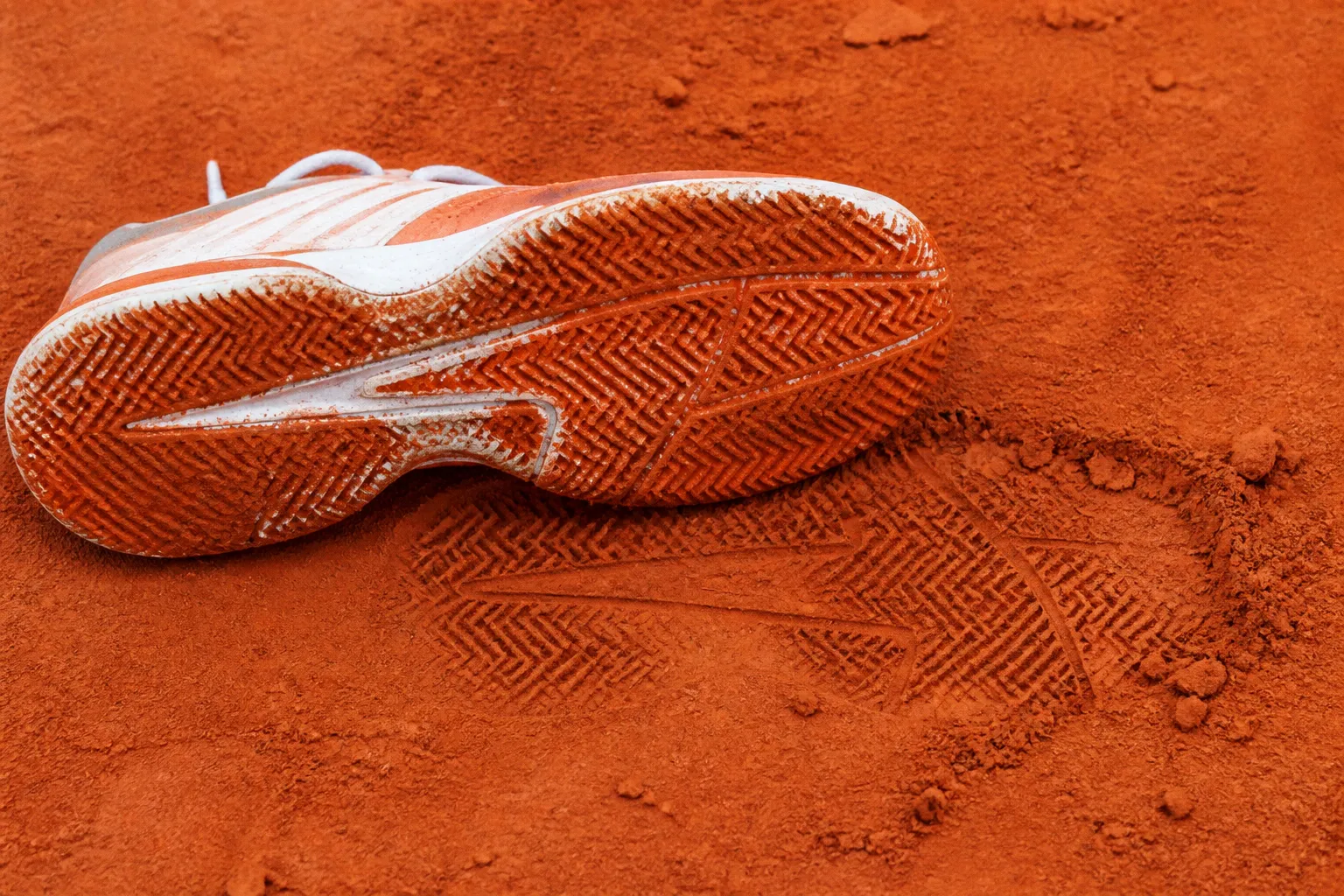
The red courts at Roland Garros are not made of natural clay. Beneath the thin brick-colored surface lies an engineered structure roughly 80 centimeters deep: drainage stones, crushed gravel, clinker, white limestone, and finally a top dressing of crushed red brick only 1 to 2 millimeters thick. What players call clay is, in physical terms, a carefully maintained mineral system built to control water, traction, bounce, and the speed of every exchange.
That construction helps explain why the French Open feels so different from the other Grand Slam tournaments. The court does not merely slow the ball. It changes how a point is assembled — how much time a defender has, how much patience an attacker needs, and how a player’s feet must negotiate the tension between grip and release. The story of the Roland Garros clay court layers and speed begins beneath the players’ shoes, long before the first ball is struck.
The myth of the clay: why the surface is actually crushed brick
The word “clay” has survived because it describes the appearance, tradition, and playing character of the surface rather than its literal composition. At Roland Garros, there is no natural raw clay earth forming the court. The familiar red tone comes from finely crushed brick, spread as a very thin finishing layer over the structural material below.
That detail matters because the surface is not simply a soft ground on which a tennis court has been painted. It is closer to a layered piece of civil engineering, designed to remain playable through the long French spring and the physical demands of a Grand Slam fortnight. The red particles provide the visible identity of the court and contribute to the friction beneath the ball and the player, but they work in partnership with the deeper layers.
The origin of red clay courts reaches back to Cannes in 1880, when the Renshaw brothers used crushed terra cotta powder to cover grass courts that were suffering under heat. The solution was practical before it became ceremonial. The red material helped protect the grass, and in time it became associated with a distinct style of tennis — one built around extended rallies, deliberate construction, and the visible trace of movement.
At Roland Garros, that tradition has been refined rather than preserved in a frozen form. The courts still look like the courts of the clay season, but their composition is controlled with far greater precision. The surface must drain properly, support repeated sliding, hold a consistent bounce, and recover from the daily abrasion caused by thousands of steps and ball impacts.
Roland Garros clay is not loose earth beneath a line-marked rectangle; it is a calibrated surface whose history remains visible in every red mark left by a sliding foot.
The top brick dust is extraordinarily thin. At 1 to 2 millimeters, it is not a deep blanket of red material into which the players sink. Instead, it forms the final contact layer of a much deeper construction. That is why court maintenance is so exacting: a small shift in distribution can affect how the ball comes through the court and how confidently a player can change direction.
The anatomy of the 80-centimeter foundation
The French Open red clay composition is best understood from the bottom upward. Each layer performs a separate task, and the court’s behavior depends on their relationship rather than on any one ingredient.
| Layer | Approximate depth or role | Why it matters |
|---|---|---|
| Drainage stones | Foundation layer | Allows water to move away from the playing area rather than pooling beneath it |
| Crushed gravel | At least 30 cm | Provides the principal load-bearing and drainage base |
| Clinker | 7–8 cm | Coal residue incorporated into the engineered structure beneath the playing surface |
| Crushed white limestone | 6–7 cm | Forms a stable intermediate layer above the deeper foundation |
| Crushed red brick | 1–2 mm | Creates the visible playing surface and helps shape traction, slide, and ball response |
Together, these layers reach approximately 80 centimeters in depth. The measurement is easy to overlook because the eye sees only the red finish, yet the depth is central to the court’s identity. The surface needs enough structure beneath it to remain stable under movement while still offering the particular give associated with clay-court tennis.
The drainage stones and gravel are not decorative or incidental. A tournament court has to deal with water quickly and predictably, especially in a season when rain can interrupt play and return the court to service only after careful preparation. The deeper foundation gives moisture somewhere to go. Without that movement, the upper layers would become unstable, and the court would lose the consistency that professional players depend on.
Above the gravel sits a layer of clinker, or coal residue, measuring approximately 7 to 8 centimeters. Over that comes 6 to 7 centimeters of crushed white limestone. These materials form the transitional body of the court — the part that the spectator never sees but that helps determine whether the upper surface remains firm, even, and playable.
The red brick layer is the most visible and the most frequently renewed, but it should not be mistaken for the whole court. When a player slides into a wide forehand corner, the shoe is interacting with the upper dressing while the stability of the movement depends on the structure below. A successful slide is not simply a matter of wearing the right shoe. It is a conversation between the player’s weight, the court’s friction, the moisture in the surface, and the stability of the layers beneath.
The physics of the slide: what a CPI of 21 tells us
The Court Pace Index, or CPI, gives a way to describe how quickly a court plays. Roland Garros has an approximate CPI of 21, placing it in the Slow category. Grass is commonly associated with a much faster range — approximately 37 to 43 — while hard courts sit around 40 to 45 in the figures available for comparison.
The number is not a complete description of a match. It does not tell us who will win a rally, how windy the afternoon will be, or whether a player is moving particularly well. But it offers a useful physical reference: at Roland Garros, the ball generally loses more forward speed through the court than it would on a faster surface, while the bounce tends to rise higher.
That combination changes the geometry of professional tennis.
A serve that might produce a short reply on a quicker court can be returned with more time available. A heavy forehand has room to work through the exchange, but it also gives the opponent a chance to defend, shape the ball, and recover. The point often becomes less about the first clean strike and more about whether a player can keep applying pressure without giving away balance or court position.
The high bounce is equally important. Players who strike the ball from a comfortable height can use the court to generate depth and shape. Heavy topspin becomes especially valuable because the ball rises sharply after landing, forcing the opponent to meet it higher or retreat behind the baseline. A flatter ball can still be effective, but it must be struck with enough precision to avoid sitting in the opponent’s preferred contact zone.
The slow pace does not make tennis passive. It makes the consequences of construction more visible. A player may have to create the opening several times before the point is truly won. The court rewards patience, but not patience without intent. Defensive retrieval alone rarely carries a player through a deep draw; the best clay-court competitors defend with the understanding that the next ball must alter the rally’s balance.
Footwork becomes part of the tactics rather than a separate athletic skill. On a hard court, a player may brake abruptly and push away from a fixed base. On clay, the same movement can become a controlled release into a slide. The player must read the court early, lower the center of gravity, and decide whether to continue moving through the shot or to stop and recover. A late decision often produces a late contact point, and the court will not rescue a player who arrives without structure.
Moisture, friction, and the changing face of a match
Tennis clay court moisture absorption is often discussed as if moisture simply makes the court better or worse. The reality is more delicate. Water changes the relationship between the particles at the surface and therefore affects traction, sliding, ball response, and the time needed for the court to settle after rain.
A damp court can feel more compact and offer a different kind of grip. A drying surface may gradually become less uniform if the water has not distributed evenly. The condition of the top dressing, the weather, and the work of the grounds crew all contribute to the experience underfoot. Exact daily changes in friction cannot be reduced to one fixed number, which is why players and tournament staff pay close attention to the court itself rather than relying only on a general forecast.
The atmosphere of Roland Garros is therefore partly meteorological and partly material. A cool, heavy morning does not ask the same questions of the court as a bright afternoon. The ball, the brick dust, and the player’s shoes are in constant contact with conditions that shift during the day. The scoreboard records the result, but the surface records the argument that produced it.
Annual renewal: the 88,000-pound ritual of maintenance
Around 88,000 pounds — approximately 40 metric tons — of crushed broken brick are brought in each year to refresh the Roland Garros courts for the French Open. That figure gives scale to a process that can appear almost delicate when viewed from the stands. The red surface looks thin and fine, yet maintaining it across a major tournament requires a substantial supply of material and a disciplined routine.
The purpose is not to bury the existing court beneath a new layer. The top dressing must remain thin, distributed, and consistent. Court crews manage the material so that wear does not create pockets with noticeably different behavior. Areas near the baseline and service boxes receive particular attention because they absorb the repeated patterns of professional play: the first step after a serve, the recovery behind the baseline, the explosive movement into the forehand corner, and the final slide toward a short ball.
A clay court is marked by use in a way that hard courts and grass courts are not. The red dust shows where a player has braked, pushed, or lost balance. It also reveals whether the court is receiving the same kind of attention across its entire surface. Lines need to remain clear, the upper material needs to be redistributed, and the court must be kept in a condition where a player can trust the next step.
That trust is a tactical resource. A competitor who believes the court will hold can commit to a long slide and take the ball earlier. A competitor who senses unevenness may shorten the movement, arrive cautiously, or give up a fraction of court position. At the highest level, that fraction matters. Professional tennis is built from margins, and the surface is one of the margins.
The visible red layer also carries the emotional continuity of the tournament. Each year’s court is newly prepared, but it belongs to a much older tradition. Maintenance does not erase history; it is how the history remains playable. The court survives by being renewed.
From Cannes to Paris: how a practical solution became a tennis identity
The story that begins with crushed terra cotta in Cannes in 1880 eventually becomes part of the larger history of the French Open and the global clay season. Red clay courts came to represent more than a method of protecting grass. They created a recognizable playing environment, one in which time, bounce, and movement combine to reward a particular kind of intelligence.
Roland Garros gives that environment its most concentrated form. The tournament’s identity is inseparable from the red surface, but the surface is not merely a color or a backdrop. Its slow CPI, high bounce, layered foundation, and sensitivity to moisture impose a physical logic on the draw. Players arrive with different games, but all of them must negotiate the same material conditions.
That is why the court can expose a mismatch between reputation and readiness. A player may possess a formidable serve but find fewer free points. A powerful hitter may discover that the first attack is not enough. A quick defender may become dangerous because the court gives that defense time to turn into offense. The clay does not create these qualities from nothing, but it amplifies some and asks others to become more complete.
The qualifying draw feels this physical reality with particular force. Players fighting for a place in the main event do not have the luxury of easing into the tournament’s rhythm. They must manage long matches, demanding recovery, and the specific strain of sliding repeatedly on a surface that rewards commitment but punishes poor preparation. Even before the famous courts fill with the largest names in the sport, the ground is already testing the field.
At Roland Garros, the court slows the ball so that the player’s decisions become easier to see — not simpler, but more exposed.
The engineering beneath the court also explains why the tournament atmosphere feels so grounded. There is less of the immediate, polished finality that a fast surface can produce. Points breathe longer. Footprints remain for a while. A rally leaves evidence in the red dust, and the court appears to remember the pressure placed upon it.
Reading Roland Garros from the ground up
To understand how Roland Garros clay is made is to understand why the tournament asks different questions from the rest of the Grand Slam calendar. The surface is not natural clay, yet it has a strongly natural rhythm: moisture alters its feel, weather changes its density, and the players’ movement leaves marks that must be worked back into order.
The five-layer construction provides the court’s hidden stability. The thin crushed-brick finish gives it its color and immediate character. A CPI of approximately 21 places it firmly among the slowest major playing surfaces, while the high bounce opens space for spin, recovery, and extended tactical exchanges. Annual renewal with roughly 40 metric tons of brick ensures that the court can continue to offer that character year after year.
What we call clay, then, is really a collaboration between engineering and tradition. Beneath every sliding foot is a structure built to drain, support, compact, and respond. Above it is a red surface thin enough to look fragile but demanding enough to shape the strategies of the world’s best players.
The French Open is played on that contradiction — a court that appears simple from a distance and becomes more intricate the closer one looks. Its history is not only in the trophies or the champions. It is in the gravel below, the limestone above it, the brick dust at the surface, and the friction that turns a long rally into a test of judgment, balance, and endurance.