Two years later, Zheng Qinwen defeated Donna Vekic at 2:15 a.m., the latest finish recorded for a women’s match at the tournament.
These were not isolated scheduling errors. They were evidence of the same operating logic. Arthur Ashe Stadium is built for prime-time tennis. The session begins at 7:00 p.m. The audience arrives after work, the broadcast occupies the evening window, and the match is expected to continue until its conclusion.
The problem is that tennis has no fixed duration. A three-set match can finish quickly. A five-set contest can pass midnight before the next match has even begun.
That collision between a fixed programme and a variable sport is the substance of the US Open night sessions schedule controversy. The tournament wants a reliable evening product. The player needs a credible recovery window. The current system provides neither consistently.
The 1975 Experiment: How Night Tennis Transformed Arthur Ashe Stadium
Night sessions were introduced at the US Open in 1975. The decision expanded access for working spectators and gave television a concentrated evening event. It also changed the tournament’s understanding of its most important court.
The stadium did not create night tennis. It made the idea repeatable on the scale the US Open wanted.
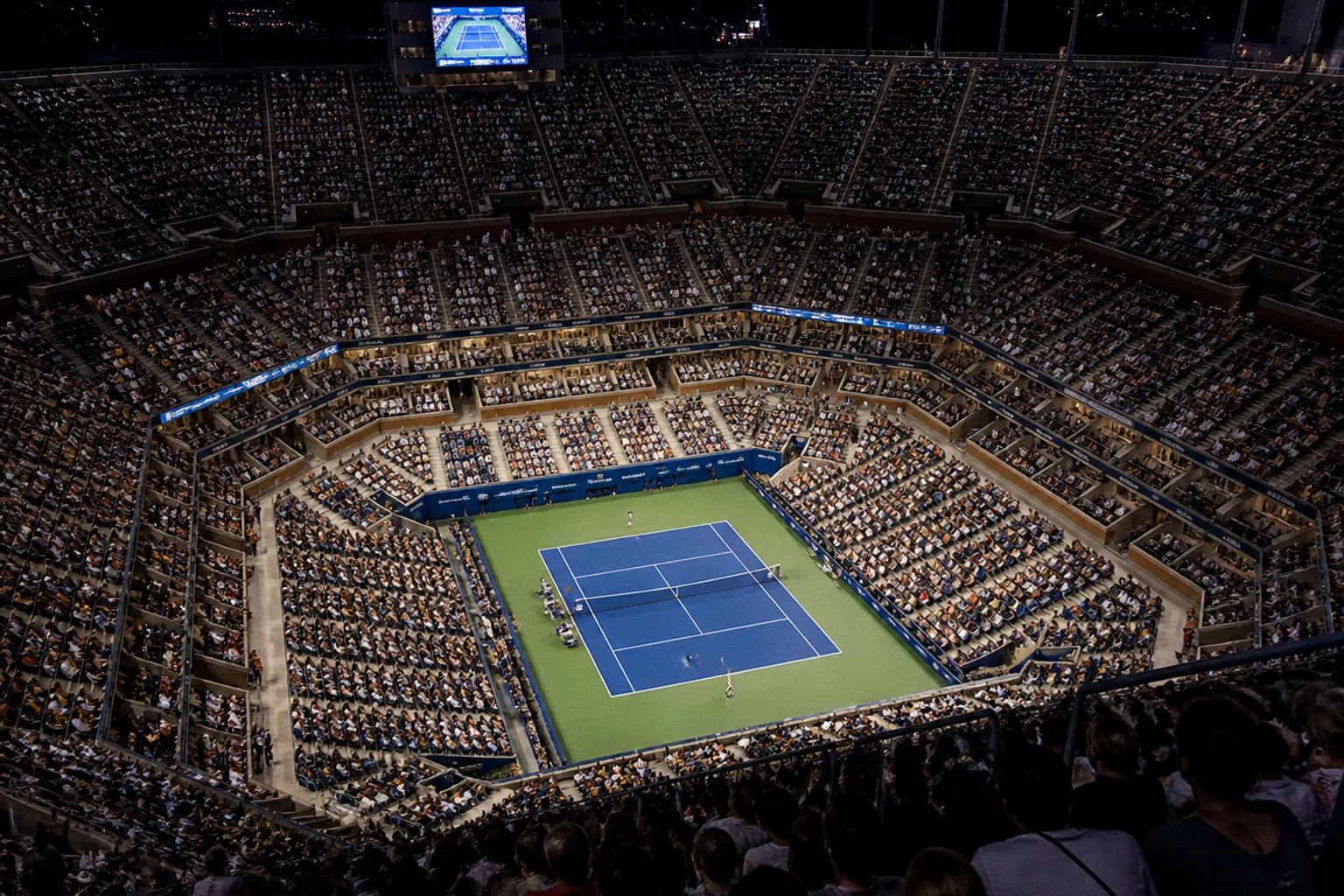
Arthur Ashe Stadium became a physical expression of the policy. Its large capacity and enclosed bowl turned a tennis match into a single evening performance. Day sessions distribute attention across the grounds. Night sessions concentrate it. The court, audience, television production, hospitality operations and arena staff all operate around a small number of premium matches.
That concentration is the night session’s commercial and atmospheric strength. Almost everyone in the stadium is there for the same sporting event. The sound is not scattered among several courts; it gathers in waves. Every break point, disputed call and momentum shift arrives with immediate force.
The conditions are not identical to daytime tennis merely because the surface is unchanged. Artificial lighting changes how players read the ball. Temperature, humidity and the heavier feel of the ball can alter tosses, bounce and court coverage. Under pressure, those small differences become tactical. A server may search for more pace, while a returner looks to shorten the exchange.
The scheduling cost is structural. A night session typically contains two matches, and the first determines the start of the second. If the opening contest lasts four hours, the advertised start of the following match no longer functions as a reliable timetable. If that match is also extended, the following day begins with a player who has left the court only a few hours earlier.
This is not a question of whether a match is exciting. The problem is that the order of play has too little slack to absorb normal variation.
The night session does not run late because tennis has failed to keep time. It runs late because a variable sport has been fitted into a fixed evening programme.
A grandstand crowd can accommodate uncertainty. A professional athlete’s recovery routine cannot.
The Midnight Threshold: Analyzing the 2:50 a.m. Record and Its Aftermath
The Alcaraz–Sinner quarterfinal in 2022 exposed the schedule because the match was competitive across five sets and ended at 2:50 a.m. The lateness was not produced by poor tennis. It was produced by two players extending a high-level contest through the available time.
That distinction matters. Organisers can discourage slow play, but they cannot remove the duration created by long rallies, repeated deuce games, momentum changes or a deciding set. A tennis match does not run to a broadcast clock. The clock records what the contest has already consumed.
The record also exposed a weakness in the usual defence of the schedule. The tournament can publish an accurate start time for the session, but it cannot guarantee the actual start of the second match. The first match determines the second. The second then determines the player’s recovery window and influences the following day’s order of play.
The 2024 tournament supplied further evidence. Zheng Qinwen’s victory over Donna Vekic finished at 2:15 a.m., the latest recorded women’s match finish at the US Open. In the same edition, Aryna Sabalenka and Ekaterina Alexandrova began at 12:08 a.m. and finished at 1:48 a.m., the latest-starting women’s match in tournament history.
The difference between the two records is revealing. A late finish and a late start create different forms of damage. The first punishes the player already competing and delays everyone afterward. The second forces a fresh contest to begin after midnight, disrupting preparation before a single point has been played.
The sequence showed more than a single outlier. The tournament produced several forms of lateness within the same edition: an exceptionally late start, an exceptionally late finish and a widening gap between the advertised session and the match that actually occurred.
That is what the phrase US Open late night matches should describe. It is not merely an inconvenience for spectators or television audiences. It identifies a recurring interaction between match length, court allocation, broadcast priorities and the absence of a firm finish boundary.
Governance vs. Spectacle: Why Grand Slams Resist Tour-Wide Curfews
In January 2024, the ATP and WTA jointly introduced scheduling guidelines for tour events. They included a cap of five matches per court per day and a restriction on starting matches after 11:00 p.m. The measures did not govern Grand Slam tournaments in the same way because the Slams operate under independent management.
That distinction is central. A tour-wide standard can shape regular events, but the US Open controls its own schedule and commercial model. It is not bound to apply the ATP and WTA rule automatically. It can adopt a similar policy, adapt it to the tournament or operate without it.
The Grand Slam environment also creates different pressures. A Masters 1000 event must protect the continuity of its draw, but the US Open must also manage a large stadium audience, a global broadcast window and a limited supply of marquee courts. Night matches in Arthur Ashe Stadium have commercial value because they place prominent players and compelling contests inside a concentrated evening slot.
A mandatory curfew would therefore involve more than player welfare. It would affect ticketing, broadcast planning, hospitality, staffing, suspended matches, court allocation and the expectations attached to tickets. What begins as a playing standard becomes an operational policy for the entire event.
The available models each distribute that uncertainty differently:
| Scheduling model | Primary advantage | Primary failure point |
|---|---|---|
| Fixed 7:00 p.m. night session | Clear ticketing and broadcast structure | The second match can begin deep into the night |
| Hard 11:00 p.m. curfew | Predictable recovery and court closure | An unfinished match may need interruption or relocation |
| Flexible court relocation | Preserves the match and relieves the main court | Audience, broadcast and player logistics become more complicated |
| Two-match session without a hard cap | Maximises use of premium court time | Recovery depends on the duration of the previous match |
| Earlier evening start | Creates more room for long matches | Moves away from the conventional prime-time window |
The tension is not between tradition and reform in the abstract. It is between two operational definitions of success.
For the organiser, success may mean that the principal match remains in Arthur Ashe Stadium and is delivered to the evening audience. For the player, success requires the next match to be played at a time that permits a credible recovery process. Both objectives are rational. They cannot always be met through the same court allocation.
Andy Murray criticised the arrangement and described post-midnight finish times as amateurish. The underlying point was technical rather than theatrical: a professional competition should not leave the timing of one player’s next recovery cycle entirely dependent on the duration of an unrelated match on the same court.
The Human Toll: Sleep Deprivation and the 2024 Relocation Policy
A match ending after midnight does more than remove several hours from a calendar. It rearranges everything that should happen afterward.
The player must complete the on-court routine, satisfy media obligations, receive treatment, eat, travel and begin the transition toward sleep. The next match may require a return to the site during the following afternoon. A compressed timetable reduces the room for any of those processes to function normally.
Sleep deprivation at the US Open is therefore not an abstract medical concern. It is a scheduling variable affecting footwork, reaction time, decision quality and tolerance for repeated high-intensity efforts. Its influence is strongest in matches decided by small margins.
A returner operating late on a hard court needs precise visual tracking and early recognition of serve direction. A defender spending time several metres behind the baseline must repeat accelerations, decelerations and recovery steps. A first-strike player depends on stable contact points when trying to end the point before the rally becomes physically costly.
Fatigue does not change the rules. It changes the probability of executing the usual patterns.
The most important phase is not always the opening game. Problems can accumulate from the middle of the second set onward, when recovery between points becomes less complete and the margin for error narrows. A player may still produce a peak serve or a clean forehand. The difficulty lies in repeating that quality.
A late finish can also create an unequal preparation schedule. The player completing a match at 2:15 a.m. may face an opponent who finished during the afternoon. Both arrive under the same tournament rules, but they do not arrive with the same physiological timetable. That difference is not visible on the scoreboard.
Several variables determine how seriously the next performance is affected:
| Variable | Effect on the player | Tactical consequence |
|---|---|---|
| Match duration | Extends court load and delays recovery | Reduced capacity for repeated high-intensity exchanges |
| Finish time | Compresses the interval before the next activity | Less time for sleep, treatment and preparation |
| Five-set format | Increases variance in duration and demand | The order of play becomes difficult to protect |
| Court position | Requires repeated movement over long points | Fatigue appears in recovery steps and defensive transitions |
| Serve-return precision | Depends on visual timing and stable contact points | More short balls, return errors and second-serve exposure |
| Opponent’s schedule | Can create unequal recovery windows | Advantage may arise from rest rather than play |
The common response is to describe a tired player as lacking focus. That is imprecise. Focus is only one component. Slower recovery between points, less efficient court coverage and a wider error margin on previously routine balls are more direct mechanisms.
Even a small decline in movement efficiency can affect close games. A slight reduction in racquet-head speed can turn a neutral ball into a short one, changing the geometry for the opponent. The player does not need to collapse for the schedule to matter.
Before the 2024 tournament, US Open Tournament Director Stacey Allaster announced a policy giving referees discretion to move an unstarted evening match to another court if it had not begun by 11:15 p.m. The policy applied to Arthur Ashe Stadium and Louis Armstrong Stadium.
This was a practical response because it acknowledged that the main court could become a bottleneck. It also recognised that a match does not have to be abandoned merely because the preferred stadium has stopped operating as a predictable starting environment.
But discretion is not the same as a mandatory rule.
A referee must weigh several competing considerations:
- whether an alternative court is available;
- whether the match has broadcast commitments;
- whether both players can complete the required preparation;
- whether spectators can follow the relocation;
- whether the alternate court offers acceptable conditions;
- whether moving the match creates a later problem elsewhere.
The policy applies to matches that have not started. It cannot erase a late finish and does not guarantee relocation every time the 11:15 p.m. threshold is reached. It is a start-time safeguard, not a finish-time ceiling.
That distinction remains essential. A match already approaching midnight at 2:50 a.m. cannot be protected by moving its successor. To address only the start of the next match is to treat the visible symptom rather than the underlying scheduling structure.
The policy should therefore be judged by its operation rather than its announcement. If a first match has consumed most of the session and the second has not begun, relocation can prevent Arthur Ashe Stadium from becoming the sole determinant of the player’s next day. If the alternate court is unavailable or the broadcast package cannot move, the discretion may produce little practical change.
Beyond the Revenue: Can the US Open Balance Tradition and Recovery?
The Arthur Ashe Stadium night atmosphere is a genuine competitive asset. The enclosed bowl concentrates noise. A full crowd under lights gives every hold, break point and momentum shift immediate public weight. Players enter an environment in which hesitation can be heard and pressure arrives sooner than it might on a secondary court.
That atmosphere can alter tactics. Players may accept additional risk in search of a decisive first strike, or use an aggressive return position to shorten exchanges and reduce the opponent’s time to exploit the conditions. Between-point routines become more important because the player must also regulate external stimulus.
None of this is the scheduling hazard. The hazard begins when the stadium’s value is treated as sufficient reason to preserve its primacy regardless of the hour.
A player can be assigned to the largest court because the match has audience value, then be required to play the next round with a recovery interval that would not exist under a more resilient order. The entertainment value is then purchased with the athlete’s preparation time.
The comparison with Wimbledon is useful but incomplete. Wimbledon has an 11:00 p.m. curfew, while every tournament must operate within its own court inventory, lighting arrangements, regulations and commercial commitments. A US Open curfew could not simply be transplanted. It would require decisions about matches in progress, ticket expectations, broadcast obligations and the allocation of courts the following day.
Tradition should not be confused with a fixed starting hour. At the US Open, the meaningful tradition is the concentration of major matches in an electrifying evening setting. That objective does not require two matches to remain in the same stadium regardless of the first match’s duration.
The tournament can preserve the theatre while changing who absorbs the uncertainty:
1. Retain the evening session but reduce dependence on the second match. The first contest should not automatically determine the location and start time of the second.
2. Use relocation as a defined operational trigger. The 11:15 p.m. policy is strongest when the alternative court, player preparation and broadcast arrangements can be completed without creating another bottleneck.
3. Build more slack into the order of play. Scheduling should account for the possibility of a long contest rather than treating the standard duration of each match as a certainty.
4. Preserve marquee matches without overloading the main court. A single premium event each evening could protect the atmosphere while reducing the number of players exposed to the two-match delay.
5. Separate the spectator promise from the player’s recovery promise. Ticketing and broadcast schedules require clarity, but clarity about a session’s start does not require the tournament to pretend that every subsequent match will begin on time.
A hard curfew would provide the clearest recovery boundary, but it could also create the greatest disruption when a match is unfinished. A system with no boundary protects the programme but transfers all delay to the players. Relocation occupies the useful middle ground because it acknowledges the court as a finite resource.
The 11:15 p.m. policy indicates that the US Open accepts the existence of that limit. The 2:50 a.m. record demonstrates why a start-time threshold cannot be the final answer. A player already deep into an extended match still needs the schedule to account for the possibility that the match will last.
Night tennis at the US Open is not inherently unfair or dangerous. It becomes hazardous when the tournament’s fixed entertainment format is allowed to impose an open-ended recovery cost. Arthur Ashe Stadium can remain the cathedral of the evening session without becoming the clock by which every athlete’s sleep is measured.
The electric atmosphere is worth preserving. So is the professional credibility of asking the best players to perform after midnight and then blaming fatigue when close games turn on small differences. The schedule has to absorb the variance of tennis rather than export all of it to the person holding the racquet.