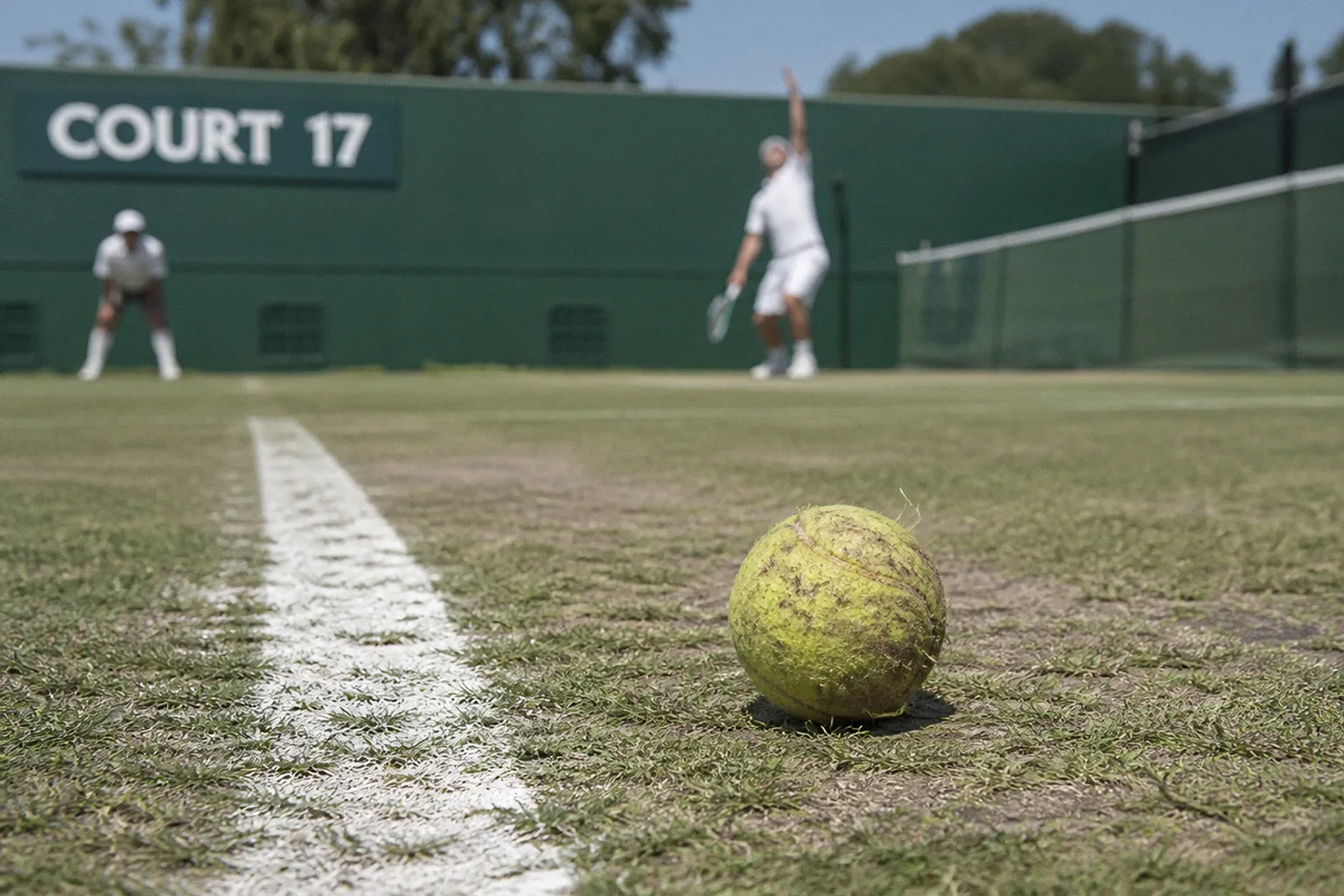
It is a compressed tournament in which a single poor service game can remove a player from the Wimbledon schedule before the main draw has even been made.
The setting sharpens the contrast. Roehampton is approximately three miles from the All England Lawn Tennis Club, but it operates on a different scale. The Wimbledon Qualifying and Community Sports Centre, formerly the Bank of England Sports Centre, has 18 match courts, eight practice courts and a Show Court with 808 seats. It is close to the tournament without being part of its visible theatre.
That separation defines the competition. The players are working on Wimbledon grass. They are not yet inside Wimbledon.
The Bank of England legacy: a venue frozen in time
Roehampton does not reproduce the architecture of the All England Club. There is no Centre Court axis, no sequence of manicured public spaces leading towards the championship courts, and no stadium structure designed to concentrate attention on a single match. The venue is functional. Its purpose is to process a large qualifying field across a limited number of days.
That function is visible in the court distribution. Eighteen match courts allow the men’s and women’s singles draws to move simultaneously, while eight practice courts absorb the warm-up demand from 256 players. The site is a working system. It has to handle match scheduling, practice allocation, recovery, officiating and spectators without the visual hierarchy of the main tournament.
The result is a different form of tennis atmosphere. At the All England Club, the court is presented as the centre of the event. At Roehampton, the court is one unit inside the event’s operating structure. A spectator can move between matches and encounter several levels of the draw in a short period. A player can finish on one court and disappear into the wider site without the transition being recorded by a large audience.
This changes how the qualifying competition is perceived. The main draw is built around arrival: players enter a recognised space, walk towards a known court and become part of a global broadcast. Roehampton is organised around selection. The site identifies which players have the physical and technical stability to continue.
Grass courts expose this distinction. The surface reduces the time available between the opponent’s contact point and the next defensive decision. The returner has less time to read the serve, set the racket face and choose a target. The server has less time to recover after the first ball because a low-skidding reply can reach the baseline before the usual recovery pattern is established.
A player who relies on long rallies has less room to impose that structure. A player with a heavy topspin forehand may find that the ball’s post-bounce behaviour is less reliable than on clay. A player with a compact backhand block, a controlled first strike and a stable volley pattern can gain disproportionate value from three or four technically clean shots.
This is not an aesthetic preference. It is a distribution of points.
Roehampton is not a smaller Wimbledon. It is a separate selection mechanism operating on the same grass.
The geometry of 18 courts
The defining tactical fact of qualifying is not only that there are 128 players in each singles draw. It is that the draw is distributed across 18 match courts while players attempt to repeat the same high-risk patterns three days in succession.
The court numbers matter less than the court rotation. A player may be placed on a court with a larger viewing area, then move to a smaller court with a different background and sightline. The match conditions can appear similar from a distance while producing different visual inputs. On grass, the returner’s ability to identify the ball early has a direct effect on contact height and timing.
A serve that is manageable on one side of the court may become more difficult when the background changes. So may the return. The player is not only solving the opponent’s serve placement. The player is solving the relationship between ball speed, court surface, visual contrast and available reaction time.
The tactical priorities are therefore narrow:
- The first two shots carry greater weight. The server’s first ball and the returner’s first reply determine whether the point becomes a short exchange or a neutral rally.
- Return position must be deliberate. Standing deep may create more time after the bounce but can surrender control of the next ball. Standing close can disrupt the server’s rhythm but increases the penalty for a misread.
- The contact point cannot drift. On a low surface, a late contact often produces a defensive slice or a short ball rather than a neutral rally ball.
- The second serve is exposed. A short or central second serve can be attacked before the server establishes court position.
- The first volley must be uncomplicated. The player does not need a spectacular finish. The correct target is usually the space that removes the opponent’s clean passing angle.
Grass qualifying rewards repeatable geometry. The player who can serve wide, cover the most probable reply and finish the next ball has a simpler point pattern than the player searching for a winner from an unstable position.
The same applies to the return. A returner does not need to produce constant aggression. A deep block through the middle can be sufficient if it prevents the server from opening the court. The aim is to reduce the opponent’s first-strike options, not to produce a highlight.
Court position is a sequence
The most common analytical error in grass-court tennis is to describe court position as a fixed location. It is not. It is a sequence that changes after every contact.
A server may begin behind the baseline, land inside it after the serve, move towards the centre in response to the return and then hold a position close enough to threaten the next ball. A returner may start several metres behind the baseline, move forward through the return and then retreat only if the server has generated depth.
The important question is not where a player stands. It is what the player can cover from that position.
A returner too far behind the baseline may have time but lose the ability to attack the server’s second shot. A returner too close may force a rushed contact and concede a short ball. On grass, both errors are magnified because the bounce does not reliably restore time.
The qualifying courts create a repeated test of this positioning. The player must adjust not once, but across three matches. A tactic that produces a positive result in the opening round may be less effective against a better first serve or a heavier body serve in the next.
This is why grass-court tennis qualifying often appears volatile while remaining structurally predictable. The points are short, but the tactical causes are clear. An early break can come from two return errors, one missed first volley and a single serve aimed into the opponent’s preferred contact zone. The scoreboard shows four points. The geometry shows a pattern.
The intimacy of the Roehampton experience
The spectator capacity at Roehampton is limited. In 2025, daily attendance was set at 3,500. For the 2026 event, that figure rises to 4,000, with pre-purchased tickets priced at £20. The numbers explain the venue’s atmosphere more accurately than any description of charm or tradition.
The site does not need to create the density of a Grand Slam main draw. Its audience is distributed across the courts. Show Court 1 seats 808 spectators, with eight accessible seats. Court 2 holds 552. Courts 3, 5 and 17 each hold 276. These are modest capacities by major tournament standards, but they are sufficient to make a qualifying match visible without converting it into a stadium performance.
That proximity has analytical value. A spectator can see the mechanics of a match without the distance imposed by a large arena. The serve trajectory is easier to follow. The returner’s starting position is clear. The movement between the first and second shot can be read as a tactical sequence rather than absorbed as general noise.
The lack of scale also changes the sound profile. There is less delay between the ball strike and the reaction from the stands. A player’s service routine is not surrounded by the same acoustic space as it is on a main championship court. Small disruptions become more apparent: a late ball call, movement behind the baseline, a practice court nearby, a shift in crowd concentration from one court to another.
None of this is decisive on its own. Professional players are trained to isolate the point. But the qualifying environment removes some of the visual and acoustic insulation associated with the main draw. The player is working in a live operational site, not a single-purpose arena.
The distinction is particularly sharp for lower-ranked players and those returning from injury. They are not entering Wimbledon as established participants. They are trying to earn the right to be placed in the main draw. Their ranking may provide an entry route into qualifying, but it does not provide a protected position inside the tournament.
The venue therefore produces a precise form of pressure. A player can be close to Wimbledon in geographical terms while remaining three wins away in competitive terms. The distance is 4.8 kilometres. The tactical distance is much greater.
The three-match gauntlet
The qualifying draw contains 128 players in both the gentlemen’s and ladies’ singles competitions. Sixteen main draw positions are available in each event. The structure is a knockout sequence, not a league. One match establishes survival. The next determines whether the first result had any value.
There are no spare matches in which to correct a poor start. The player cannot lose one round and recover through a secondary path. The draw is a binary filter.
A simplified view of the route looks like this:
| Stage | Competitive condition | Tactical demand |
|---|---|---|
| First qualifying round | 128 players begin; half remain | Control the opening exchange and avoid donating short points |
| Second qualifying round | 64 players remain; 32 advance | Adjust to opponent quality without abandoning the serve-plus-one pattern |
| Final qualifying round | 32 players remain; 16 qualify | Sustain first-serve quality, return discipline and movement under fatigue |
| Main draw | 16 qualifiers enter the Wimbledon singles draw | Convert qualifying patterns against a higher-ranked opponent |
The route is difficult for a reason that the raw arithmetic understates. A player does not need merely to win three matches. The player must maintain a narrow technical margin across them.
On grass, a narrow margin can be the difference between a first serve landing at a useful height and a second serve being attacked. It can be the difference between reaching a volley in balance and arriving with the racket below the contact point. It can be the difference between a return landing deep enough to neutralise the point and a return sitting inside the server’s preferred strike zone.
A qualifier’s tactical plan must therefore be robust against variation. It has to survive an opponent with a bigger serve, a left-hander who changes the return geometry, a player who takes the ball early, or a counterpuncher who turns rushed aggression into passing opportunities.
The most stable pattern is usually built around three controls:
1. Serve direction. The server needs to move the returner before attempting to control the next ball. Serving repeatedly into the same zone gives the returner an increasingly clear contact point.
2. Recovery line. After the serve, the server must cover the probable return rather than move automatically towards the centre. The correct recovery position depends on the serve angle and the opponent’s return tendencies.
3. Return depth. The returner’s first objective is to prevent an immediate attack. Depth through the middle often has higher value than an ambitious angle that creates an unforced-error margin.
The player who wins qualifying is not necessarily the one with the highest peak level. The player needs enough serve quality to protect short games, enough return quality to create pressure on second serves, and enough movement control to avoid giving away cheap points.
Why the first round is not the easiest
The opening round carries a particular tactical hazard. Players arrive with limited current information about the opponent on that surface. A ranking can indicate broad level. It does not indicate how the player serves on grass, where the player stands to return, or whether the player is comfortable taking the ball before the apex of the bounce.
The first set can therefore become a process of data collection conducted under score pressure. A player may need several games to identify whether the opponent prefers a body serve, a wide serve or a serve down the middle on important points. By then, a break may already have determined the set.
This is where compact patterns outperform improvisation. The player who has a clear default return position, a defined response to a short second serve and a reliable first-volley target can begin with a usable structure. The player who waits for the match to reveal its tactical logic may lose the time required to make an adjustment.
In qualifying, the first round is not the point at which a player can spend a set becoming comfortable. It is the first of three elimination problems.
The draw does not reward a player for having a Wimbledon level. It rewards the player who can reproduce that level on demand, three times.
Grass-court tennis without the Wimbledon filter
The main draw places grass-court performance inside a larger production. The venue, the crowd and the broadcast all reinforce the idea of a major event. Roehampton strips away much of that framing.
What remains is the surface.
The grass is not a neutral background. It changes the relative value of serve speed, serve placement, return depth, anticipation and low contact. It also changes the cost of poor movement. A player who arrives late cannot always recover through height and spin. A defensive ball may remain low and short. The opponent can take it early.
This makes the qualifying competition a useful environment for identifying which players have a transferable grass pattern and which players are relying on a broader hard-court or clay-court template.
A clay-court specialist may prefer time after the bounce and use height to move the opponent away from the baseline. That pattern is less secure when the ball stays low and the opponent takes it on the rise. A hard-court baseliner may adapt more easily, but only if the player changes the return position and reduces the length of the backswing on low contacts.
The essential adjustment is not to hit harder. It is to make decisions earlier.
That applies to the rally ball as well as the serve. On clay, a player may construct an opening with several cross-court exchanges before changing direction. On grass, the same sequence can allow the opponent to step inside the baseline and remove the available time. The player must recognise when the neutral rally has ceased to be neutral.
A useful tactical distinction is between court coverage and court occupation. Court coverage is the ability to reach the opponent’s ball. Court occupation is the ability to take space before the opponent can use it. Grass rewards the second. A player who reaches every ball but remains behind the baseline may still lose control of the point.
The qualifying venue makes this visible because spectators are close enough to observe the full movement chain. The critical error is often made before the shot that appears to lose the point. A returner stands too deep. A server recovers too far towards the centre. A player fails to close the net after producing a short reply. The final missed pass is only the last event in the sequence.
A separate tournament with the same destination
Roehampton’s separation from the All England Lawn Tennis Club is often treated as a logistical detail. It is more significant than that. The qualifying venue creates a separate tournament identity while feeding directly into the most recognisable event in tennis.
Players compete at a site approximately three miles from the main club. They use grass courts. They pursue Wimbledon entry. Yet they do so under a different spectator model, a different spatial structure and a different relationship with the tournament’s public image.
That separation is likely to remain part of the qualifying experience for the immediate future. The exact timing of any official relocation to the main All England Club site has not been established, with future development plans subject to planning processes and judicial reviews. The current fact is simple: Wimbledon qualifying continues at Roehampton.
The debate over the future site should not obscure the competitive value of the present one. Roehampton has enough courts to stage the draw efficiently. Its capacity remains limited enough to preserve proximity. Its distance from the main club keeps qualifying visibly distinct from the championship itself.
The venue’s limitations are also part of its function. It does not offer the full scale of the main draw because it is not designed to do so. It is designed to reduce a large field to 16 players per singles event. That is a statistical task expressed through grass-court tennis.
The spectator comes away with a clearer view of the process. A professional match is not only the final exchange or the most visible court. It is the accumulated management of contact points, recovery lines, service patterns and error margins. At Roehampton, those elements are exposed before the Wimbledon brand absorbs them.
The raw reality of Roehampton grass
The Wimbledon qualifying draw is often described through its proximity to the main event. The more accurate description is its distance from it.
A field of 128 becomes 16. Each player must win three consecutive matches. Eighteen match courts handle the competition. Eight practice courts support it. A daily audience of 4,000 is enough to create proximity but not enough to manufacture the scale of the main tournament. Show Court 1 holds 808 spectators, while several other courts hold fewer than 300.
These details define the experience more effectively than a narrative about tradition. Roehampton is a working grass-court laboratory. It tests whether players can make early decisions, protect the second serve, control the first two shots and sustain court position through an elimination draw.
The main draw begins at the All England Club. The route to it begins elsewhere, on courts where the margins are smaller and the setting is less forgiving. The data points to a clear conclusion: qualifying does not identify the player with the most attractive game. It identifies the player whose tactical structure remains intact across three matches on a surface that reduces time and exposes every late decision.