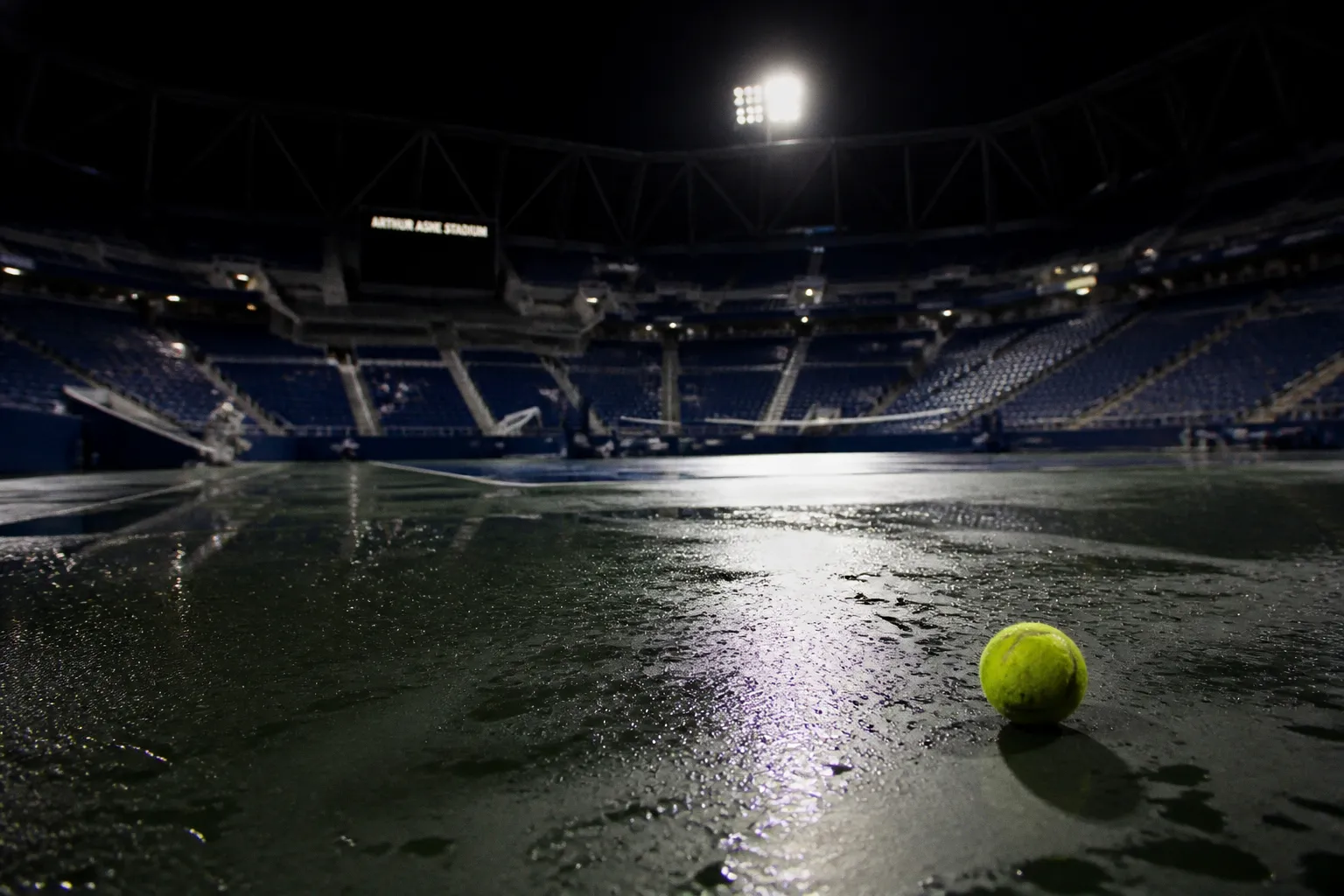
By the time it ended, roughly fifteen hours had passed since the opening match of the day session began at the stadium. The Arthur Ashe Stadium crowd — those who remained — applauded. The scoreboard recorded the time. The USTA recorded another successful night-session product. Tennis recorded a scheduling failure that it has still not resolved.
Two years later, the pattern returned. Alexander Zverev defeated Tomás Martín Etcheverry at 2:35 a.m. Qinwen Zheng finished Donna Vekić at 2:15 a.m., after their quarter-final began at 12:08 a.m. These were not freak accidents produced by one unusually long match. They were predictable results of a format built around a fixed evening window, two matches on the same court, and the assumption that the second contest can absorb whatever delay the first one creates.
That is the central problem in the US Open night sessions debate. The late finish is treated as an unfortunate spectacle, an anecdote for the next morning. But the scheduling mechanism behind it is deliberate. The tournament has made a commercial choice: preserve the evening ticket, the primetime broadcast slot, and the drama of a packed Ashe crowd, even when the second match is pushed into the part of the night when recovery, concentration, and ordinary sleep become competing concerns.
The Economics of No Curfew
The US Open introduced night-session tennis in 1975. The commercial idea was simple: extend the useful hours of a major stadium by selling a second session after the daytime programme. The evening crowd bought a separate ticket, broadcasters received a premium window, and the tournament gained another highly visible occasion in the same venue.
Arthur Ashe Stadium, with a capacity of more than 23,000, is not merely a court. It is the tournament’s largest stage and one of its most valuable broadcast settings. The night session combines several products at once:
- a premium ticketed experience;
- a reliable evening slot for American television;
- a concentrated atmosphere that does not exist on the outer courts;
- hospitality and corporate inventory built around a fixed start time;
- a recognisable piece of the US Open identity.
That combination makes the second match difficult to move and even harder to cancel. A court transfer may protect the players, but it also changes the experience promised to ticket holders. A delay may be sensible from a sporting perspective, yet awkward for a broadcaster that has built its evening around a particular match. A hard stoppage would create the cleanest rule, but it would also make the night session less predictable as a commercial package.
This is why the USTA has historically resisted an absolute curfew. The issue is not that tournament officials fail to understand the problem. It is that every solution carries a visible cost. A match moved away from Ashe loses the most valuable atmosphere. A match stopped and resumed the next day complicates tickets, television, practice schedules, security, and the entire order of play. A shorter session may protect the calendar while making the product less attractive.
The argument for a curfew, however, does not require pretending that the commercial cost is negligible. It requires asking which cost the sport is prepared to accept. At present, the US Open places the disruption on the players and the following day’s schedule. The audience sees an unforgettable finish; the tournament avoids an immediate break in its evening product. The burden is simply transferred to a part of the system that is less visible on television.
The US Open has no hard curfew because its current model treats player exhaustion as a scheduling buffer.
The two-match night session is the crucial detail. A single evening match can begin late without automatically creating a second delayed match behind it. With two matches, the first contest controls the start time of the second. A five-set battle, a medical timeout, a long changeover sequence, or a tense final set can push the headline match deep into the night before the players have even walked onto court.
That is why moving one match at 11:15 p.m. can help at the margins but cannot solve the underlying problem. It deals with the location of a match, not the structure that produces the delay.
The 2:50 a.m. Threshold: When Athletic Performance Meets Exhaustion
The concern about late finishes is not simply that players feel tired. Professional tennis already demands fatigue management: long matches, repeated accelerations, high-impact decelerations, travel between rounds, and the need to recover quickly enough to train and compete again. A match that ends near 3:00 a.m. changes the timetable of everything that follows.
The player does not leave the court at the final point and go directly to sleep. There is a press conference, treatment, rehydration, food, transport, and the gradual process of bringing the body down from competition. The exact sequence varies, but the practical point does not: a 2:50 a.m. finish makes an ordinary night’s recovery almost impossible. The first meaningful period of rest may not begin until well after the match has ended.
Sleep deprivation affects reaction, mood, decision-making, and physical recovery. Tennis is particularly exposed because the sport demands repeated explosive movements while also asking players to make fine tactical judgments under pressure. A player returning a serve is not only using the eyes and legs; they are processing speed, spin, court position, score, wind, and the opponent’s patterns. Fatigue does not reduce the match to a simple contest of physical strength. It changes the quality of the decisions that make elite tennis possible.
The damage also extends beyond the two players who finish late. Their next opponents may prepare for a match without knowing whether the delayed players will be able to practise normally. Coaches and support teams have to revise training plans. Tournament officials have to decide whether a player can reasonably be placed in an early slot. Practice courts become more congested because a late finisher may need a shorter, later session rather than a conventional morning hit.
A Grand Slam draw is a chain. Compress one link and the pressure travels through the rest of it.
The impact is not identical for every player. A late finish before a day off is different from a late finish before the next round. A three-set match is different from a five-set match. A player who spends hours treating an existing physical problem faces a different recovery challenge from one who finishes without medical intervention. But scheduling rules should be designed around foreseeable risk, not around the hope that every late match will be short and uncomplicated.
The 2024 examples show how extreme the gap can become:
| Match | Finish or start time | What it illustrates |
|---|---|---|
| Zverev vs. Etcheverry | Finished at 2:35 a.m. | A second night match can run deep into the following morning |
| Zheng vs. Vekić | Began at 12:08 a.m. and finished at 2:15 a.m. | A quarter-final can be placed in a time slot normally associated with the end of play |
| Alcaraz vs. Sinner, 2022 | Finished at 2:50 a.m. | A long five-set match can turn the following day into a recovery problem |
The Zheng–Vekić quarter-final was particularly revealing. This was not an early-round match filling a spare court. It was a contest with a place in the final four at stake, and it began after midnight because the preceding match had consumed the evening. The players did not choose that start time. The draw did not produce it by itself. It was the result of placing two high-stakes matches inside one fixed session and allowing the first to determine when the second could begin.
The most obvious answer is to stop describing these finishes as isolated drama. They are scheduling outputs. If the tournament repeatedly puts the second match in a position where it can begin after midnight, then a post-midnight start is not an accident. It is one of the possible normal outcomes of the format.
The 2024 Shift: Evaluating the USTA’s New Referee Discretion Policy
In 2024, the USTA introduced a limited adjustment to the way late evening matches could be handled. The tournament referee was given discretion to move an unstarted second match from Arthur Ashe Stadium — or the last scheduled match on Louis Armstrong Stadium — if it had not begun by 11:15 p.m., subject to the practical conditions surrounding the move.
That is a useful acknowledgement, but it is not a curfew. It does not establish a firm point at which play must stop, nor does it guarantee that an unstarted match will leave the main stadium. It gives the referee an additional option after the schedule has already begun to fail.
The distinction matters. A curfew is a rule known in advance by players, coaches, broadcasters, spectators, and tournament staff. Discretion is a case-by-case intervention. It may prevent one match from beginning at 12:30 a.m., but it leaves the same incentives in place for the next evening.
The policy’s limitations are structural:
1. It applies to an unstarted match. If the second match has already begun, the discretion to move it does not provide a solution to the eventual finish time.
2. A move is operationally complicated. The alternate court needs the necessary officials, ball crew, security, lighting, broadcast equipment, and player facilities. The later the decision is made, the harder it becomes to organise cleanly.
3. The television product remains part of the decision. The most valuable match may be the one the broadcaster and tournament most want to keep on Ashe, particularly during the latter stages of the event.
4. The ticketing promise is affected. A spectator who purchased an Ashe night-session ticket bought access to that stadium, not merely to a match somewhere on the grounds.
5. The two-match template remains intact. The policy changes where a delayed match might be played. It does not change why the delay occurs.
The adjustment should therefore be judged as a pressure valve rather than a redesign. It may reduce the number of extreme starts. It may also create a more visible mechanism for the referee to respond when the first match runs long. But it cannot guarantee that players will avoid the late-night finishes that made reform necessary in the first place.
The ATP and WTA have separately argued for earlier night-session starts and for preventing matches from beginning beyond a defined late-hour threshold. Those recommendations are meaningful because they recognise the problem as a tour-wide player-welfare issue. They are also limited because Grand Slam tournaments control their own scheduling and are not simply another week on the professional calendar.
The US Open can acknowledge the recommendations without adopting their strongest implications. That is precisely why guidance without enforcement tends to produce incremental changes. The tournament may improve its discretion while retaining the commercial architecture that created the controversy.
An 11:15 p.m. court-shift option is a concession to the problem, not a settlement of it.
A more serious reform would need to begin earlier in the day. The evening session cannot be assessed in isolation from the day session, court allocation, match order, and the number of matches that a stadium is expected to carry. If the tournament wants a meaningful late-start limit, it must accept that some matches cannot remain attached to a fixed ticketed court simply because they were originally placed there.
That could mean using alternate courts before the situation becomes critical, setting an earlier decision point, or scheduling only one match in the most commercially sensitive evening slots. Every version would reduce flexibility somewhere. That is not an argument against reform. It is the price of making the rule real.
Broadcast vs. Biology: The Conflict Between TV Slots and Circadian Rhythms
The tension is often presented as a conflict between television and player welfare, but that description is too simple. Television does not create the five-set match. The broadcasters do not control every interruption or decide how long a rally lasts. What television does is give the tournament a reason to protect a particular time window and a particular venue.
The evening broadcast wants continuity. The tournament wants the marquee players on the main court. Ticket holders want the match they expected to see. All of those interests are legitimate. The problem begins when the schedule treats the first match as if it had a reliable endpoint.
Tennis does not offer that reliability. A match can be over in under two hours or continue for more than four. The more important the match, the less sensible it becomes to assume that it will fit neatly inside a television slot. A schedule built on fixed entertainment windows is therefore at odds with a sport whose duration is deliberately uncertain.
This is one reason the US Open night session atmosphere is so powerful. The crowd is concentrated, the lighting changes the visual character of the court, and the late hours create the feeling that the match exists outside the ordinary day. The tournament has made a virtue of New York’s appetite for staying out late. The noise, celebrity presence, music, and sense of occasion are part of the event’s identity.
But atmosphere can disguise cost. The crowd may experience a 1:00 a.m. start as an adventure. The players experience it as a shift in their preparation, nutrition, warm-up, sleep, and next-day recovery. A spectator can leave the stadium and return to a hotel or apartment. A player must still perform the same high-speed work under conditions that the schedule has made abnormal.
The answer is not to remove night tennis altogether. Night matches are one of the best parts of the US Open, and the atmosphere is not a superficial extra. The answer is to stop treating the atmosphere as evidence that the timetable is working. A full stadium does not prove that the players have been scheduled responsibly. It proves that the product remains attractive even when the underlying logistics are strained.
The broadcast question also has a practical answer: broadcasters can be given a protected evening window without being promised that every match will remain on the same court until the end. A late match can move. A second match can be delayed to the next day. A single-match session can be sold as a complete occasion rather than as a double-header whose second half may begin after midnight.
Those options would require the tournament to share the inconvenience instead of placing it almost entirely on the athletes. They would also force broadcasters and ticketing departments to be more flexible. That is precisely why they have been difficult to implement.
The Grand Slam Divide: Comparing Flushing Meadows to Wimbledon’s Silence
The four Grand Slams do not operate under one common scheduling philosophy. Their differences are not only cultural. They are built into the venues, local regulations, broadcast traditions, court infrastructure, and commercial models.
| Tournament | Evening format | Late-play framework | Main scheduling pressure |
|---|---|---|---|
| Australian Open | Evening sessions on the major courts, with the order and number of matches varying by day | No equivalent of Wimbledon’s absolute 11:00 p.m. stop; heat policies and daily scheduling are major constraints | Heat, long matches, and the demands of a packed summer programme |
| Roland-Garros | A single featured night match on Philippe-Chatrier was introduced in 2021 | No Wimbledon-style universal curfew; the roof and floodlights allow play after dark, while the single-match format limits the domino effect | Weather, clay-court match length, daylight history, and the controlled night-session format |
| Wimbledon | No conventional night session | A mandatory 11:00 p.m. local curfew, including on the Centre Court schedule | Tradition, local restrictions, and a firm boundary on late play |
| US Open | A prominent two-match night-session model on Arthur Ashe, with evening programming on other major courts | No hard curfew; the 2024 referee-discretion rule offers a limited option to move an unstarted late match | Broadcast windows, ticketed sessions, and the commercial value of the main stadium |
Wimbledon remains the clearest counterexample to the idea that a Grand Slam must accept any finish time produced by a long match. Its 11:00 p.m. curfew is a real limit. The 2018 Djokovic–Nadal semi-final, for example, was suspended because of the Wimbledon curfew and completed the next day. The interruption was disruptive. It altered preparation and forced the tournament to carry a major match across two evenings. Wimbledon accepted that disruption because the boundary was part of the event’s operating identity.
The point is not that Wimbledon has solved every scheduling problem. It has not. Rain, long matches, court availability, and the compressed final stages of the tournament can still create difficult decisions. But the curfew gives officials, players, and the public a rule that does not depend on whether the match remains commercially attractive at 11:30 p.m.
The Australian Open is a less direct comparison than it is sometimes made out to be. Melbourne also permits very late finishes and has faced its own criticism over matches extending into the early morning. But its scheduling problems are shaped by a different set of constraints, especially extreme heat and the way the daily order of play is adjusted around it. The major courts do host evening programmes, and the format is not simply a single-match equivalent of the US Open night session. The comparison therefore cannot rest on the claim that Melbourne avoids late finishes because it sells only one night match.
The more useful distinction is that the Australian Open has different priorities and different tools. Heat policies can suspend play or affect when matches begin. The tournament has also adjusted start times and scheduling practices over time. Those measures do not eliminate the late-night problem, but they show that the local environment changes the shape of the debate. Melbourne is not New York with a different skyline.
Roland-Garros is also more complicated than the old picture of play ending when the light disappears. Philippe-Chatrier now has a roof and floodlights, and the tournament has staged a featured night match since 2021. The evening programme is generally built around one match rather than the US Open’s two-match Ashe template. That difference is decisive. A long first match does not push a second scheduled night match into the early morning because the featured session is not designed as the same kind of double-header.
Clay also changes the rhythm of the day. Longer rallies and extended games can produce lengthy matches, but the French Open’s night-session structure contains the scheduling spillover more effectively than the US Open’s. The lack of a Wimbledon-style hard curfew still leaves room for late play, yet the single-match format makes the consequences more contained.
Flushing Meadows stands apart because it combines several pressures at once: a major night-session culture, two matches on the largest stadium court, no absolute stop time, and a broadcast economy that treats the late window as part of the show. That combination is not inevitable. It is a design choice.
What the Scheduling Debate Actually Demands
The USTA’s position is commercially rational. That is also why it is difficult to defend as a complete sporting policy.
There is nothing irrational about protecting a premium stadium session or preserving a valuable television window. A Grand Slam is a huge operation, and its finances support the players, staff, facilities, qualifying events, and broader development work. The argument for reform cannot simply pretend that every commercial consideration is illegitimate.
But commercial rationality is not the same as sporting legitimacy. When the schedule repeatedly produces 2:00 a.m. finishes and after-midnight starts, the tournament has to account for the predictable consequences. It cannot call those consequences unforeseeable simply because the exact match length was unknown.
The 2024 referee-discretion policy is a modest step because it recognises that an unstarted match may need to be moved. It may spare some players the worst version of the US Open late night. It does not remove the incentive to keep the main court full, and it does not create a dependable limit on when a match may begin.
A credible reform would have to address several points at once:
- The start time of the evening session. A later opening may create more room for the day programme, but it also moves the entire night deeper into the night. The question is not simply whether the first match begins at 7:00 or 7:30; it is whether two matches can reasonably fit behind that start.
- The number of matches assigned to the stadium. A two-match session offers value to spectators but creates a direct dependency between the first and second contests.
- The decision point for moving a match. Waiting until a match is already close to midnight leaves little practical time to organise a transfer.
- The treatment of the next round. A player who finishes at 2:50 a.m. should not be placed into an early subsequent slot merely because the draw requires a match to be played.
- The division of inconvenience. Broadcasters, ticket holders, and the tournament should absorb some of the disruption that players currently absorb almost entirely.
The goal does not need to be a rigid rule that stops every match at the same minute. Tennis is too unpredictable for that kind of neatness. But the sport can establish a presumption against beginning a new match after a defined time, publish the conditions for a court move, and guarantee meaningful recovery when a player has been kept on court into the early morning.
The underlying choice is now visible. The US Open night session is a spectacular piece of theatre because the tournament has made the night part of its identity. Its atmosphere is real, and so is its appeal. But the atmosphere should not be used to excuse a schedule that treats the human body as the most adjustable part of the production.
The 2:50 a.m. finish was not a random failure. It was the system functioning according to its incentives. The same is true of a quarter-final that begins at 12:08 a.m. The question is not whether New York can stay awake. It plainly can. The question is whether the tournament should continue asking elite athletes to organise their recovery around a commercial timetable that has no reliable stopping point.
Wimbledon has chosen a hard boundary. The Australian Open manages a different set of pressures without offering a simple single-match comparison. Roland-Garros has contained the night-session problem through a one-match format and a different venue history. The US Open has chosen the most expansive version of the spectacle.
That choice can be changed. Until it is, the late-night finish will remain less a dramatic exception than an advertisement for the priorities built into the schedule.