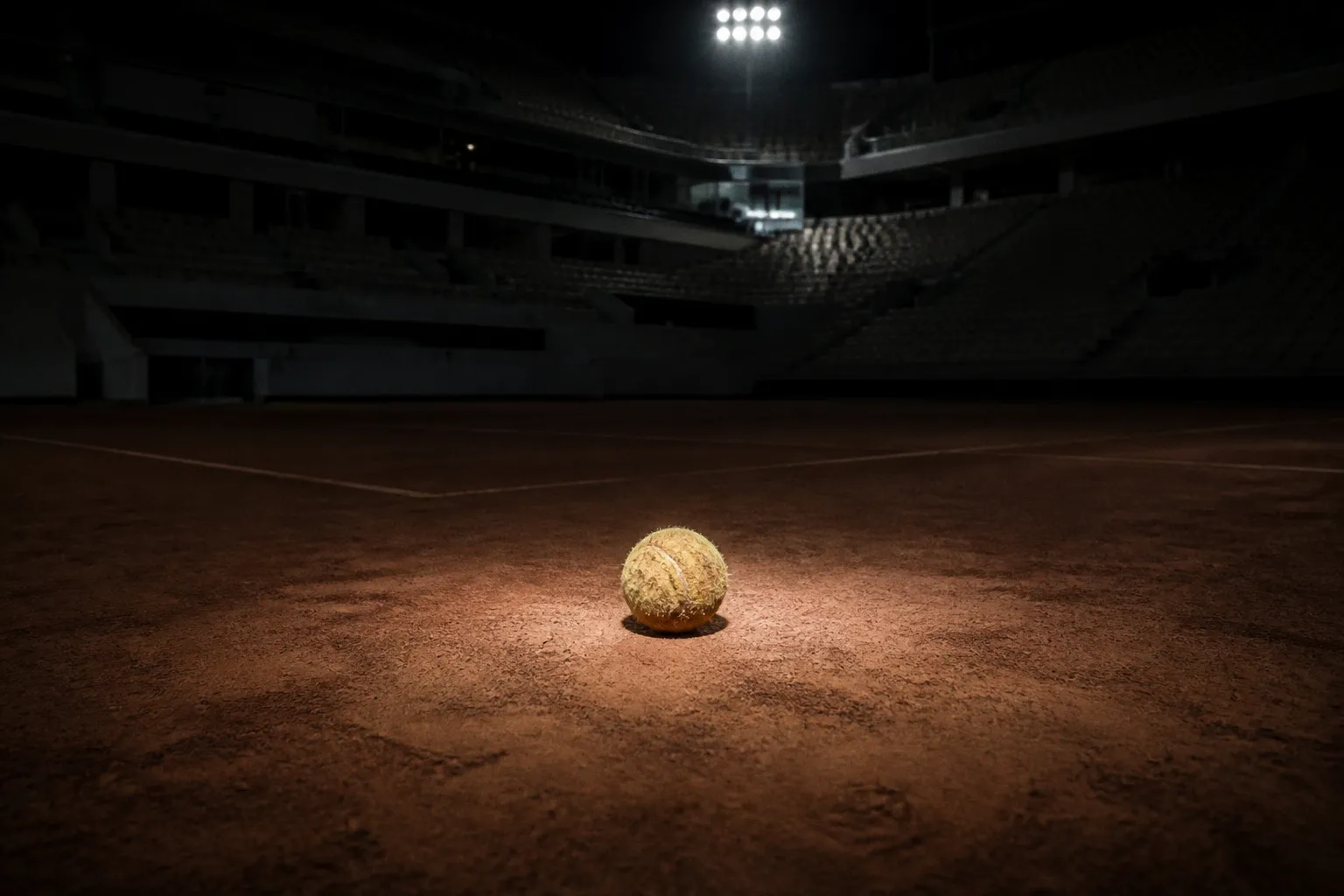
The crowd had thinned to the stubborn and the caffeinated. The corporate boxes that had been draped in sponsor logos at the start of the evening were now vacant. What remained was a tennis match that had outlasted the city hosting it — a spectacle stretched beyond its own logic, asking questions the tournament organizers would rather not answer.
This is what Roland Garros sold itself in 2021 when it installed floodlights on its main court: a chance to push clay-court tennis into prime time, to compete with the broadcast appetite of football and Formula 1, and to monetize a surface through the lens of an evening spectacle. Five editions later, the project has produced significant commercial returns, a handful of marquee finishes, and a creeping sense that something fundamental has been fractured in the tournament’s atmosphere.
The question is not whether night sessions work. By the metrics the federation cares about, they emphatically do. The question is what they have cost the soul of the place — and whether the commercial gains can justify an experience that increasingly asks players and spectators to adapt to the schedule rather than the other way around.
The 3:08 a.m. threshold: when tennis becomes an endurance test
Let’s talk about what actually happens to a tennis player when a match enters its fourth hour and the stadium clock reads somewhere around 2 a.m. Djokovic versus Musetti, on June 2, 2024, is now the reference point: a contest that began around 10:30 p.m. and concluded at 3:08 a.m., the latest finish in French Open history.
The scoreline mattered less than the fact that the match happened at all. Tennis at this hour is not simply a longer version of tennis at 2 p.m. It is an attrition exercise layered on top of an already draining surface.
Clay-court tennis is built on patience, on the cognitive load of constructing points across twenty-shot rallies, and on the mental stamina required to outlast an opponent who refuses to make the first mistake. Under floodlights at 2 a.m., that mental architecture begins to wobble. Decision-making slows. Shot selection narrows. The body, deprived of its natural cues for rest, defaults to survival patterns rather than tactical patterns. The match becomes about who collapses last rather than who plays best.
This is not a romantic question about whether tennis looks beautiful under lights. It is a question about the conditions under which elite competition is being staged. Circadian rhythms do not disappear because a tournament has sold a television slot. Core body temperature changes in the early morning hours, alertness falls, and reaction time becomes more difficult to maintain. For athletes whose performance depends on fractions of a second in split-step timing and shot anticipation, those changes are not marginal. They alter the competitive equation.
The brain is not built for elite competition at this hour, and the players know it. So do the coaches. They also know that a player who finishes at 3 a.m. does not merely lose one night of sleep. The match affects the next day’s recovery, the following practice session, the preparation for the next round, and the wider tournament rhythm. At Roland Garros, where a deep run already demands repeated matches on a physically punishing surface, the cost accumulates quickly.
This is the part the broadcasters do not show. The highlight reel of a 3 a.m. finish captures the drama of a final set, but it cannot convey the cognitive unraveling of the previous two hours. It cannot show what happens to the preparation for the next round, or how much of the following day becomes an exercise in restoring a body that was asked to compete against its own clock.
The press conference room often tells a different story from the broadcast. Fatigue, disorientation, and frustration at a schedule that pushed competition into the physiological margins are more visible there than in the carefully edited package of heroic points. The cynical read is that the federation understood precisely what would happen to late matches and structured the schedule to maximize the spectacle anyway.
The match at 3 a.m. is not a triumph of endurance — it is a confession that the schedule has become a hostage to broadcast expectations.
The deeper issue is structural. Unlike daytime sessions, where Court Philippe-Chatrier can offer up to three matches across the day, the night session features only a single scheduled match. That single match starts late, runs long, and produces extreme finishes with predictable regularity. There is no scheduling slack. If the match itself becomes a five-set contest, the night session has nowhere to go except deeper into the night.
The floodlights were supposed to create flexibility. In practice, they have created a bottleneck with no exit valve.
Other tournaments have managed this differently. The US Open, which pioneered night sessions at the Grand Slam level, schedules two matches on Ashe in the evening. That creates a built-in buffer and spreads the risk of delay across a longer window. Roland Garros chose the single-match model, and the consequences were not difficult to foresee.
The choice also changes the character of the competition. A night session at the US Open can feel like a sequence: one match establishes the mood, the second becomes the headline. At Roland Garros, the entire evening is placed on one match. If the contest is short, the product can feel underfilled. If it is long, the product becomes an endurance test for everyone still inside the stadium. The same design that creates scarcity also creates fragility.
Day versus night: the structural gap
The contrast between the two formats is not subtle, and it is worth laying out clearly:
| Element | Daytime session | Night session |
|---|---|---|
| Matches scheduled | Up to 3 on Philippe-Chatrier | 1 on Philippe-Chatrier |
| Start time | Late morning or afternoon | Around 8:30 p.m. |
| Typical finish | Before midnight | Frequently past 1 a.m., sometimes past 3 a.m. |
| Crowd profile | Season-ticket holders, connoisseurs, locals | Corporate hospitality, tourists, casual evening spectators |
| Lower-bowl occupancy | Sustained throughout | Visible drop after the marquee set or late in the match |
| Transit option at finish | Metro still operating | Metro closed as weekday service winds down near 1 a.m. |
The night session is not a more atmospheric version of the day session. It is a different product, marketed as the same event. And it is the second product that the federation has chosen to invest in.
Daytime matches on Philippe-Chatrier benefit from the energy of a crowd that arrived early and settled in for the duration. There is a rhythm to a full day session. The opening match warms the court and the audience, the middle match builds momentum, and the main event arrives with the stadium already humming. People have had time to find their seats, argue over the line calls, buy food, and become part of the same temporary community.
The night session has no such accumulation. It begins cold, with a crowd still finding its seats, and ends late, with spectators depleted by logistics and fatigue. The arc is flatter, and the atmosphere reflects it. Even when the tennis is excellent, the crowd has less time to develop a collective identity around the match.
That difference matters on clay. The surface rewards patience, repetition, and a willingness to stay emotionally engaged through long stretches in which neither player appears to be taking control. A crowd that has spent hours watching the court can appreciate those shifts. A crowd arriving for one headline event is more likely to judge the evening by whether the match immediately produces drama.
The night session also makes the tournament more dependent on the perceived value of the player on court. During a daytime session, a less familiar player can benefit from being part of a larger programme. Spectators may discover a game they did not come to see. With one match carrying the entire evening, the audience is more likely to treat the player as the product. If the name is not sufficiently large, the atmosphere starts at a disadvantage.
This is one reason the night session can feel less like a festival and more like a broadcast window. The festival is built through accumulation. The broadcast window is built around a single asset.
The gender imbalance in prime time scheduling
Of the approximately sixty night-session matches broadcast on Philippe-Chatrier from the launch of the format through the 2024 editions, fifty-six featured ATP players. That is the relevant frame for the statistic. It should not be presented as a complete count for every edition through the later reference period, because future scheduling and the final shape of the format remain unsettled.
Even within that limited frame, the imbalance is difficult to dismiss as an accident. It is a statement about who the federation believes should headline the evening product, and it carries implications that go well beyond the daily order of play.
The criticism has come from inside the locker room. Ons Jabeur has been among the more vocal voices questioning the imbalance. Iga Swiatek, the world’s best clay-court player for much of this period, has discussed her preference for daytime sessions in terms of maintaining a normal sleep schedule and preserving recovery rhythms. The point is not that every player wants the same start time. The point is that the institution has treated the men’s match as the natural default for prime time, while the women’s game is asked to prove that it belongs there.
Notice what happens in the framing. The women are positioned as a scheduling complication, or as a risk to the television proposition, rather than as one of the reasons the evening product might be compelling in the first place. The institutional response has been to accept the hierarchy as natural instead of recognizing it as a choice someone is actively making.
The commercial logic is straightforward. The federation made an early calculation that ATP matches, particularly those featuring recognizable names such as Djokovic, Alcaraz, or Sinner, would drive higher television ratings. Prime time was aligned with that assumption. Whether it holds in every case is a separate question. Sabalenka, Swiatek, and Rybakina have demonstrated enormous drawing power, and the women’s game has no shortage of matches capable of carrying a major evening audience.
But the structural decision was made, and for several editions it was repeated often enough to become part of the tournament’s identity.
The psychological texture of this imbalance deserves more attention than it usually receives. A women’s match placed at 11 p.m. sends a particular message about the sport’s hierarchy. It tells the players, the viewers, and the sponsors in the building that the women’s game is the undercard. For a tournament that prides itself on equality in prize money, the night-session schedule quietly undermines that principle on a daily basis.
This is not resolved by pointing out that a women’s match may occasionally receive the headline slot. Equality is not a matter of producing an isolated counterexample. It is also about whether the competitive and commercial burden of prime time is distributed as a normal part of the tournament, rather than granted as a special event.
Other Grand Slams have not solved this problem entirely, but they have at least placed women’s matches in marquee evening slots with greater regularity. Roland Garros has been among the most lopsided examples. That distinction is especially awkward on a surface where the women’s draw contains some of the tournament’s most recognizable specialists and some of the sport’s most tactically rich matches.
A prime-time slot is not just a television slot. It is an institutional vote on whose tennis is worth rearranging the night for.
There is also a practical contradiction. Late starts are physically demanding for everyone, but the scheduling consequences are not distributed evenly. A player who prefers daytime conditions may be forced into a night match because the night session is treated as the premium appointment. A player who does receive the slot then faces the same recovery problem as the men: a match that begins late, can stretch beyond midnight, and may distort preparation for the next round.
The question is not whether women’s tennis should be protected from prime time. It is whether prime time should be designed in a way that makes it compatible with the players who are expected to supply the spectacle.
Corporate voids: why the best seats often sit empty
Walk into Court Philippe-Chatrier during a night session and look down. The lower bowl — the prime seats closest to the court, the ones with the best sightlines and the highest price tag — often displays a troubling pattern: neat rows of unoccupied chairs surrounded by the visible infrastructure of corporate hospitality.
The ticket has been sold. The body has not arrived.
What you are looking at is the gap between the consumer product and the corporate product, and the night-session format magnifies it.
Daytime tennis at Roland Garros draws a particular crowd: connoisseurs, locals, season-ticket holders, and people who have planned their day around watching tennis rather than fitting tennis into a broader evening. They show up. They stay. They watch the undercard and the main event with the same attention.
The night session attracts a different demographic. There are corporate clients entertained in hospitality boxes, tourists who want the spectacle of seeing a star under the lights, and casual fans who treat the evening as a night out. None of those groups is inherently illegitimate. The problem is the atmosphere that results when the people with the best seats are also the people most able to leave whenever the evening becomes inconvenient.
A late match exposes the weakness. Once a marquee name falls behind a set, once the match moves beyond the last convenient train, or once the hospitality obligation has ended, the lower bowl begins to empty. The stadium remains technically occupied, but the visual and acoustic impression changes. The crowd is no longer a single body responding to the match. It is a collection of separate decisions about whether the event is still worth staying for.
The federation is aware of this dynamic. Yet the format persists because the corporate hospitality revenue attached to those seats is significant, and because broadcast partners prefer the look of a partially filled Philippe-Chatrier to the alternative of scaling back the schedule. The cynicism here is structural: the federation is selling atmosphere to sponsors while simultaneously hollowing out the actual atmosphere inside the stadium.
The empty seat is not necessarily a failure of ticket sales. It is a feature of a pricing model that values access over attendance.
This matters for the players in ways the federation rarely acknowledges publicly. Tennis is a feedback sport. Players feed off the energy of a crowd, adjust their intensity based on audible reactions, and draw motivation from the sustained presence of an engaged audience. A full stadium does not guarantee a great match, but it changes the emotional conditions in which the match is played.
When the lower bowl is conspicuously empty and the upper bowl is half full of distracted spectators checking their phones between games, the feedback loop weakens. The match becomes a studio performance rather than a competition. The result is a product that looks fine on television and feels hollow to anyone inside the arena.
Television can conceal this. A camera finds the loudest section, cuts to a close-up, and avoids lingering on the vacant rows. The viewer receives the impression of a full, attentive stadium. Inside Philippe-Chatrier, the absence is harder to edit out. The architecture of the court makes empty seats visible. The floodlights illuminate the players beautifully. They also illuminate the gaps.
The economics are straightforward enough: a corporate box generates revenue that a single occupied seat cannot match. But the trade-off is real. A Philippe-Chatrier that is sold out on paper and half-empty in practice is a stadium performing the theatre of fullness without the substance of it.
That is not only an aesthetic problem. It changes who feels that the night session belongs to them. A fan who has paid heavily for a seat but cannot stay until the end because of transport is being sold a different experience from the guest in a nearby hotel or the client whose journey home is arranged for them. The tournament calls both experiences premium. They are not equivalent.
Logistical friction: the midnight commute from Philippe-Chatrier
Now imagine you are the fan who actually stayed until the end. Djokovic and Musetti have played their final point at 3:08 a.m. You are exhilarated, exhausted, and standing outside Philippe-Chatrier in the small hours of a Parisian June.
The metro has stopped running. Weekday service in Paris winds down around 1 a.m. You have three options: an expensive taxi, a long walk toward a hotel across the city, or a wait for the first trains at dawn.
This is the part of the night-session experience that the federation does not put in its marketing materials. The tournament is held in one of the world’s great capital cities, a city with a transit system that, by design, does not operate through the night. The organizers have made the calculation that fans will absorb this inconvenience in exchange for the spectacle of evening tennis.
For some, that calculation works. For many, it does not.
The friction is more than practical. It is psychological. When a fan leaves the stadium at 1:30 a.m. knowing that the match may run for another ninety minutes, the experience shifts. They are no longer watching tennis in the round. They are watching tennis in a way that requires them to leave before it finishes.
The atmosphere inside the stadium becomes something for the committed and the wealthy, who can afford a taxi or a hotel nearby. Everyone else gets a truncated version of the event they paid to see.
A tournament can reasonably argue that no sporting event can guarantee a convenient finish. Tennis is not a timed game. A close match will always create uncertainty, and clay-court matches are particularly capable of expanding into long, demanding contests. But that argument only goes so far. The risk is not an accidental by-product of the event. It is built into a format that starts a single match around 8:30 p.m. and gives it the entire evening.
The late finish is therefore not an exceptional inconvenience. It is the predictable outcome of the product design.
The tournament runs eleven night sessions across the two weeks, and each one carries the same logistical risk: a tight match that pushes past the metro window, leaving thousands of fans to make difficult decisions about when to leave. The federation has not solved this problem because solving it would require either limiting the schedule or subsidizing transport infrastructure, neither of which fits neatly into the commercial model.
So the friction persists, and the fans absorb it, and the festival of tennis that Roland Garros once aspired to be becomes a more stratified experience.
A stadium that empties before the final point is a stadium that has lost the argument with its own schedule.
Consider what this does to the crowd composition over time. Fans who cannot afford late-night taxis or nearby hotels stop buying night-session tickets altogether. The audience skews wealthier and more corporate. The atmosphere thins further. The feedback loop reinforces itself: fewer engaged fans mean less energy, which gives casual attendees less reason to stay, which produces an even quieter final hour.
The night session is slowly selecting for an audience that is less invested in the tennis and more invested in the occasion.
There are ways to reduce the problem without pretending that every match can finish on time. Clearer transport information would help. So would a serious late-night mobility plan, whether through dedicated shuttles, coordinated taxi access, or a more explicit warning that the ticket does not guarantee a practical journey home. None of these measures would solve the underlying scheduling problem, but they would acknowledge that the fan experience continues after the final point.
At present, the burden is largely invisible to the tournament because it is carried away from the cameras. It is carried by the person comparing taxi prices outside the gates, by the fan deciding whether a final set is worth missing the last train, and by the local resident arriving home long after the event has disappeared from the broadcast.
The Amazon Prime effect: balancing revenue and tradition
The night sessions exist because Amazon Prime Video pays for them to exist. The streaming platform holds the exclusive French broadcast rights for prime-time matches at Roland Garros, a deal that represents one of the federation’s most valuable commercial relationships. Without Amazon, there is no comparable business case for the floodlights. Without the floodlights, there is no night session. The arrangement is the entire reason this conversation is happening.
This is not inherently a problem. Broadcast revenue funds prize money, tournament operations, and infrastructure upgrades that have transformed Roland Garros over the past two decades. The federation has every right to monetize its product aggressively. A major tournament that refuses to adapt to the economics of modern sport will eventually find itself outbid for attention.
The problem is what the monetization has cost.
The traditional atmosphere of Roland Garros was built on a particular rhythm: afternoon sessions that crested at twilight, evening matches that finished at a civilized hour, and a sense that the tournament respected the city hosting it. The night sessions have introduced a different rhythm, one shaped by live-broadcast scheduling and the commercial reality that prime-time programming commands premium value.
The federation made this shift deliberately, and it has paid off in viewership. What is less clear is whether the tournament itself is better for it.
The tension is not unique to Roland Garros. Across professional sport, the pull between commercial broadcast requirements and the lived experience of attending an event has become one of the defining conflicts of the era. Stadiums are redesigned for television angles. Kickoff times are shifted for distant audiences. Tennis matches are placed in slots dictated by the broadcaster rather than by the conditions that produce the best tennis.
Roland Garros is simply one of the clearest examples of a sport reshaping itself around the camera rather than around the court.
The cynical reading is that Roland Garros has traded its atmosphere for subscription numbers. The more generous reading is that the tournament has expanded its audience and modernized its product. Both readings contain some truth. A night session can produce an extraordinary visual and emotional experience. The lights change the colour of the clay. The shadows alter the geometry of the court. The crowd feels closer to the players, and a long rally under a dark Paris sky can carry a particular charge that daytime tennis does not reproduce.
The problem is not that the night session has no atmosphere. It is that the atmosphere is conditional. It depends on the match being sufficiently important, the players being sufficiently famous, the spectators being able to stay, and the broadcast demands not pushing the evening into absurdity. A product that requires all those conditions to align is not as robust as the marketing suggests.
There is also a difference between adding an evening dimension to Roland Garros and allowing the evening dimension to reorganize the tournament. The first can be an enrichment. The second turns the old rhythm into an inconvenience that must be justified.
As things stand, the format should not be treated as permanently settled. The arrangements beyond 2027 remain open to change, and future scheduling decisions or broadcast-contract developments could alter the balance between the single-match night session, player welfare, gender equity, and the practical needs of spectators. There is a commercial incentive to preserve the evening window, but that does not make every detail of the current model inevitable.
That uncertainty matters because the tournament still has choices. It can adjust the number of night sessions, reconsider the single-match structure, distribute prime-time opportunities more evenly, or treat transport as part of the event rather than as the fan’s private problem. None of those changes would require Roland Garros to abandon broadcast revenue. They would require the federation to admit that revenue is not the only measure of whether the format works.
A night session should create a new form of Roland Garros, not strip away the qualities that made the old one valuable. The clay, the late light, the long rallies, the sense of a tournament unfolding in a city rather than inside a television schedule — those are not obstacles to modernization. They are the asset.
The 3:08 a.m. finish was memorable because it was dramatic. It was also revealing. It showed what happens when a match is asked to carry the weight of a commercial format that has no room for delay, no serious answer to the last train home, and too little concern for what the players’ bodies can sustain.
Roland Garros night sessions are not broken because tennis under lights is inherently false. They are broken when the lights become more important than the conditions beneath them. Until the tournament treats atmosphere as something created by players and spectators — rather than something that can be packaged, priced, and broadcast on demand — the night session will remain an impressive spectacle with a hollow centre.