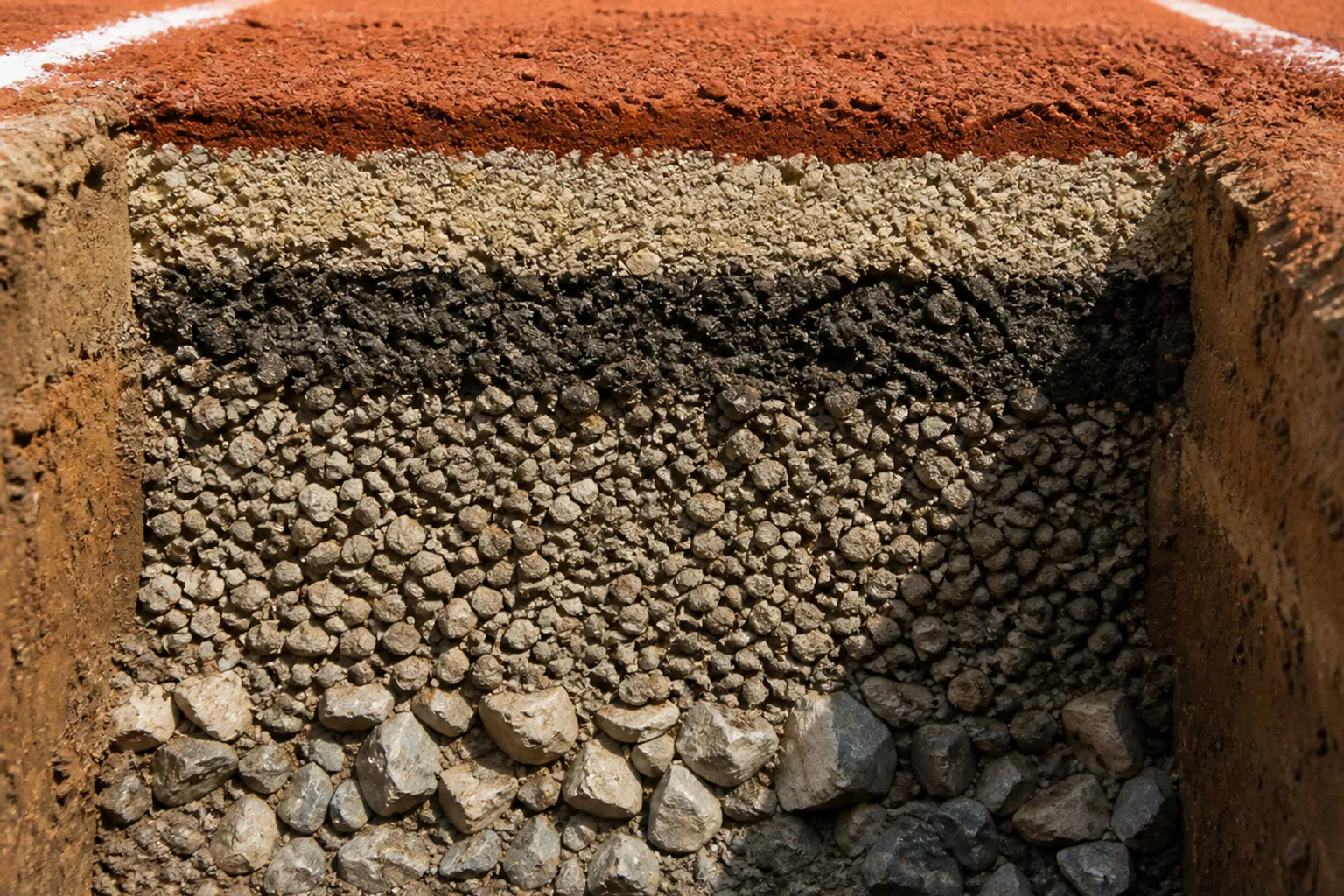
It catches the shoe, permits the slide, records the ball’s mark, and changes the rhythm of a rally through the smallest shifts in friction and moisture. Beneath that thin ochre skin lies an engineered structure approximately 80 centimeters deep—less a bed of natural soil than a carefully maintained geological assembly.
That distinction matters. The French Open clay court composition is not simply earth spread over a hard base. It is a layered system of crushed brick, limestone, clinker, gravel, and stone, each material assigned a particular task. The famous Roland Garros character—the long exchange, the visible mark, the measured recovery after a wide ball—begins below the players’ feet, in strata that spectators rarely see.
The myth of natural soil: engineering the ochre surface
Clay tennis has always carried an earthy reputation. The word suggests loose ground, dust, and a surface shaped by weather rather than construction. At Roland Garros, however, the red court is a highly managed technical environment. There is no deep layer of natural clay beneath the baselines, no thick deposit of soil responsible for the court’s color or behavior. The visible material is crushed red brick dust, traditionally made from house bricks or terra cotta.
Its thickness is surprisingly slight. The ochre layer measures only around 1 to 2 millimeters, which is enough to alter traction and make the court’s familiar marks visible, but not enough to constitute the court in any conventional sense. The red dust is the final working surface of a much deeper structure. It is renewed and redistributed before the tournament, then continually disturbed by sliding feet, ball impact, watering, brushing, and the long daily traffic of competition.
This is why a clay court can look delicate while remaining structurally substantial. The color belongs to the uppermost dust. The behavior belongs to the relationship between all five layers.
The crushed brick performs several jobs at once:
- It gives the court its distinctive red-orange appearance, the visual signature that separates Roland Garros from the green of Wimbledon or the blue hard courts of the US Open.
- It provides the loose, granular contact through which players slide rather than stopping abruptly.
- It allows the ball to leave a readable mark, making disputed calls more tangible and giving the court a visible memory of each exchange.
- It can be refreshed and worked without dismantling the deep foundation beneath it.
That final point is central to the court’s seasonal rhythm. The surface is not treated as a finished object. It is maintained as a living working layer, repeatedly adjusted so that its friction, moisture, and compactness remain within a playable range.
A player does not experience the specification sheet as a list of materials. They experience it as a fraction of a second: whether the outside foot holds through a change of direction, whether a defensive slide continues cleanly, whether the racket can be prepared before the next heavy topspin ball arrives. The court’s construction is translated into timing.
At Roland Garros, the red clay is not the court so much as the court’s final, visible argument—a millimeter of dust supported by decades of drainage, compression, and care.
The foundation: drainage and stability in the deep layers
The lower part of the Roland Garros clay court layers is built for a problem that has little romance but enormous sporting consequences: water must move through the court without destroying its shape.
The bottom two layers contain at least 30 centimeters of crushed gravel over a foundation of larger stones. Their main function is drainage. Rain must be carried away through the structure rather than left sitting beneath the playing surface, where it could soften the court unevenly, create unstable patches, or encourage the upper layers to crack as they dry.
A clay court’s surface is particularly sensitive to uneven moisture. The issue is not simply whether the court is wet or dry. It is whether moisture is distributed consistently from one end of the court to the other, and whether the surface can recover after watering or rain. A court with poor drainage may appear playable in one area while remaining heavy or unstable elsewhere. That inconsistency reaches directly into movement: one slide extends, another catches; one bounce rises cleanly, another loses its shape.
The gravel and stone foundation therefore provides the court with its quietest form of reliability. It does not create the red color, and it does not produce the visible slide. It creates the conditions in which the upper layers can do their work without being undermined from below.
The depth is significant. The five-layer construction totals approximately 80 centimeters, or about 2.5 feet. Only the upper strata are regularly reworked, while the deepest gravel and stone layers are replaced on a much longer cycle—roughly every 20 to 25 years. This difference in maintenance schedules reveals the court’s hierarchy:
| Layer or material | Approximate depth | Primary function |
|---|---|---|
| Crushed red brick dust | 1–2 mm | Playing surface, color, visible ball marks, granular traction |
| Crushed white limestone | 6–7 cm | Structural stability beneath the sliding layer |
| Clinker | 7–8 cm | Moisture absorption and retention |
| Crushed gravel | At least 30 cm | Drainage through the lower court |
| Larger stones | Foundation beneath the gravel | Deep structural support and water movement |
The numbers are modest on the page, but they describe a court in which the surface is constantly negotiating between firmness and release. Too much looseness and the player’s foot travels farther than expected. Too much compaction and the court begins to feel less forgiving, with the slide shortened and the landing more abrupt. Beneath both sensations lies the foundation’s ability to keep the material evenly supported.
This is one reason the court cannot be understood through color alone. Two surfaces may both be red and both be called clay, yet their movement can differ markedly according to the depth, grading, moisture behavior, and maintenance of the layers beneath the top dust.
The clinker core: managing moisture beneath the dust
Between the limestone bed and the deep drainage layers lies a 7 to 8 centimeter layer of clinker. The material is described as coal residue or volcanic slag, and its role is unusually important for a surface whose character depends so heavily on moisture.
Clinker absorbs and retains water. That function helps prevent the upper layers from drying too quickly and cracking. The court must be capable of holding enough moisture to remain coherent, but not so much that it becomes soft, clogged, or slow to drain. The clinker layer sits within that tension, acting as a moisture buffer beneath the playing surface.
For players, the consequences appear in the relationship between the court and the weather. A dry clay court can become dusty and loose, with more surface material moving underfoot. A well-watered court generally offers a different kind of contact—more connected, more compact, and often more demanding of the legs because the shoe remains engaged with the surface through longer movements. The exact feel depends on preparation, atmospheric conditions, and the court’s ongoing maintenance, but the underlying principle remains stable: water is not an incidental nuisance on clay. It is part of the court’s operating system.
That is why the atmosphere at Roland Garros cannot be separated entirely from the material under the players. Rain delays, cool mornings, dry afternoons, and periods of heavy play each alter the court’s immediate condition. The construction does not eliminate those changes. It makes them manageable.
The clinker layer also helps explain why the court’s surface cannot be judged by a single glance. A court may appear dry at the top while still retaining moisture beneath. Conversely, fresh watering may darken the red dust without producing a uniformly different playing response across the entire court. The surface is a vertical system, and its behavior depends on how those layers exchange water.
For a player, this affects more than the length of a rally. Moisture influences the confidence of the first step, the distance of a recovery slide, and the margin available when defending outside the singles line. It changes the physical cost of the point. On a surface that rewards patience, those costs accumulate quietly: another lunge, another braking step, another recovery from a position that would be more difficult on a faster court.
This is also why the traditions of clay-court tennis are inseparable from practical movement. The heavy topspin, the willingness to defend from deep behind the baseline, and the emphasis on constructing a point through repeated changes of direction are not merely stylistic customs. They belong to a surface that offers time while demanding a particular relationship with friction.
The limestone bed: creating the sliding surface
The layer beneath the red brick dust is made from 6 to 7 centimeters of crushed white limestone. It is not the visible surface, but it is one of the materials most responsible for making the famous slide possible.
The top brick layer must be loose enough to permit controlled movement, yet supported well enough that the court does not behave like a field of scattered grit. Limestone provides the structural bed beneath it. It helps stabilize the upper material and gives the player’s foot something consistent to meet as the slide begins.
Sliding on clay is often described as though it were simply a matter of reduced grip. That is incomplete. A good clay slide is a sequence of controlled friction: the foot makes contact, the body continues forward or laterally, and the player manages the release through the ankle, knee, hip, and trunk. The surface must allow the shoe to travel, but it must also provide enough resistance for the player to slow down and recover.
The limestone layer contributes to that consistency. It does not make every court identical, nor does it dictate every movement outcome, but it supports the thin brick surface so that the player is not sliding over an unstable pocket of material. The distinction is crucial. Uncontrolled slipping is an error of contact. A clay-court slide is a technique made possible by predictable contact.
This is where the engineering becomes visible in the match. A player who trusts the surface can defend wider, commit more fully to a low outside ball, and recover with the racket already prepared. A player who does not trust it—because the court is changing, drying, softening, or breaking apart beneath the feet—must shorten the movement and preserve balance. The difference may be only a few inches, but those inches can decide whether the next ball is struck from inside the court or from a compromised position.
The limestone bed also gives the surface a degree of resilience under repeated play. Roland Garros hosts long matches in which the same zones receive thousands of impacts: the center of the baseline, the service boxes, the areas around the singles sidelines, and the recovery corridors behind each corner. A court’s upper dust may be redistributed constantly, but the layers below must remain coherent through that pressure.
Why the ball mark matters
The visible mark left by the ball is one of clay’s most recognizable features, and it is more than a ceremonial detail. The crushed brick surface records the point of impact, allowing officials and players to inspect whether the ball touched the line. The mark is a physical trace of the ball’s contact with the court—a brief piece of evidence produced by the material itself.
Its presence also reveals how thin the surface is. The ball does not sink deeply into a thick bed of earth. It disturbs the fine upper dust and exposes the interaction between the brick particles and the layer beneath. The mark is therefore both delicate and informative: a small disruption in a carefully maintained surface.
There is something fitting in the way clay makes the court’s judgments visible. On a hard court, the line call is largely electronic or instantaneous. On red clay, the impact remains on the ground for a moment longer. The court participates in the decision without becoming an authority separate from the rules.
The annual ritual: refreshing 40,000 kilograms of brick dust
The visible surface at Roland Garros is renewed each year with around 40,000 kilograms of crushed red brick dust—approximately 88,000 pounds across the facility. The quantity is a reminder that the iconic color is not self-sustaining. It must be restored, redistributed, brushed, and integrated into the court before the tournament begins.
The annual work focuses on the upper layers. The brick dust and limestone are reworked each year, while the deep gravel and stone foundation remains in place for roughly two to two and a half decades before replacement. This is not a complete reconstruction every spring. It is a careful renewal of the part of the court that receives the most direct punishment from shoes, balls, weather, and maintenance equipment.
The process has a particular material logic. Fine particles must be spread evenly. The surface must be prepared so that the lines remain clear and the court does not develop subtle variations in texture. Moisture must be managed, the upper layers must be settled, and the playing areas must be kept coherent through the tournament’s daily schedule.
The work is repetitive by necessity. There is no single dramatic intervention that creates the Roland Garros surface. Its character emerges from many modest operations performed at the correct moment:
1. The upper brick layer is refreshed so that the court regains its consistent color and granular contact.
2. The limestone beneath is reworked to preserve the stable bed that supports movement and sliding.
3. Moisture is managed through the layered structure, with clinker helping the upper court resist rapid drying and cracking.
4. The surface is brushed and maintained between matches, redistributing material and keeping heavily used zones playable.
5. The deep foundation is preserved over the long term, because the gravel and stone layers are structural components rather than annual cosmetic material.
The distinction between renewal and replacement is worth holding onto. Much of professional tennis is presented through moments of speed—serve velocity, recovery time, the sudden change of direction that opens the court. Clay maintenance moves at another scale. The surface is prepared through gradual adjustments, and its reliability depends on respecting the materials rather than forcing them into a uniformity they cannot provide.
That work is especially demanding during a tournament in which the court must absorb a succession of matches with different physical signatures. Some players slide aggressively and leave broad scuffs near the baseline. Others take the ball early and spend more time inside the court. Heavy topspin drives repeatedly strike the same regions, while defensive exchanges pull the players toward the corners. The surface must remain recognizable through all of it.
How the layers shape the tactics of Roland Garros
The engineering of the court does not determine a match by itself. Players bring their own movement patterns, ball shapes, and tactical preferences. Yet the layered construction establishes the conditions in which those decisions become effective.
A deep, well-drained foundation supports a surface that can remain playable after weather changes. The clinker moderates moisture beneath the upper layers. The limestone provides stability for the sliding zone. The brick dust creates the visible, granular contact that defines the court. Together, they produce a surface that tends to reward the player who can manage time, balance, and repeated physical effort.
That influence appears in several familiar tactical patterns:
- The first step becomes a technical event. The player must read not only the direction of the ball but also the moment at which the foot will release into a slide.
- Recovery is part of the stroke. A wide defensive ball is not complete when it is struck; the player must control the landing and return to a viable position.
- Spin has room to work. The court gives the rally time to develop, allowing height, rotation, and depth to accumulate pressure rather than ending every exchange immediately.
- Court position carries a physical price. A player pulled outside the singles court may be able to reach the ball, but the next recovery requires a measured interaction with the surface.
- Patience is muscular rather than abstract. Long rallies test the legs, hips, and lower back as much as they test shot selection.
The court also changes the emotional texture of an error. A ball that lands long leaves a mark of its own in the mind of the player, but a missed slide or delayed recovery can expose how closely tactics depend on trust in the surface. At Roland Garros, the player is never entirely separate from the ground. Every attacking position has a recovery consequence. Every defensive choice asks whether the body can brake, turn, and launch again.
This is why the red dust has remained central to the tournament’s identity even as tennis has become faster, more powerful, and more technologically precise. The surface preserves a demand for negotiation. It gives the player time, but not free time. It offers a slide, but not an escape from balance. It slows the ball while intensifying the work required to build and finish a point.
The famous clay-court advantage is not softness. It is time converted into labor—time to reach the ball, and labor to do something meaningful with it.
A court built in layers, experienced as one surface
The Roland Garros clay court layers are easy to overlook because tennis presents them as a single red plane. From the stands, the court seems uniform: ochre dust, white lines, a net dividing the rectangle. At ground level, it is more exacting. The top brick layer is measured in millimeters. The limestone is counted in centimeters. The clinker holds moisture. The gravel carries water downward. The larger stones bear the deeper structure.
Each layer is hidden by the one above it, yet each contributes to what the player feels. The court’s friction is not contained in the dust alone. Its resilience is not located in the foundation alone. The character of the surface emerges from the contact between materials and from the daily attention required to keep that contact stable.
There is also a historical continuity in this method of working with crushed terra cotta. In 1880, William and Ernest Renshaw were among the first to use crushed terra cotta to cover courts that were losing their condition. The modern Roland Garros surface is far more engineered, but the principle remains recognizable: a playing court can be made more usable, more durable, and more distinctive through carefully prepared mineral material rather than natural ground.
That continuity helps explain the surface’s particular authority in the sport. Roland Garros does not merely host tennis on red clay. It stages tennis through a material tradition that has been refined into an exact construction. The result is a court that remembers its origins without behaving like an artifact.
The next time a player slides into the corner and rises with the racket already set, the movement can be read in two ways. It is a technical skill—trained, rehearsed, and individualized. It is also a response to the court beneath it: one to two millimeters of brick dust, supported by limestone, clinker, gravel, and stone.
The red surface is thin. The conditions it creates are not.