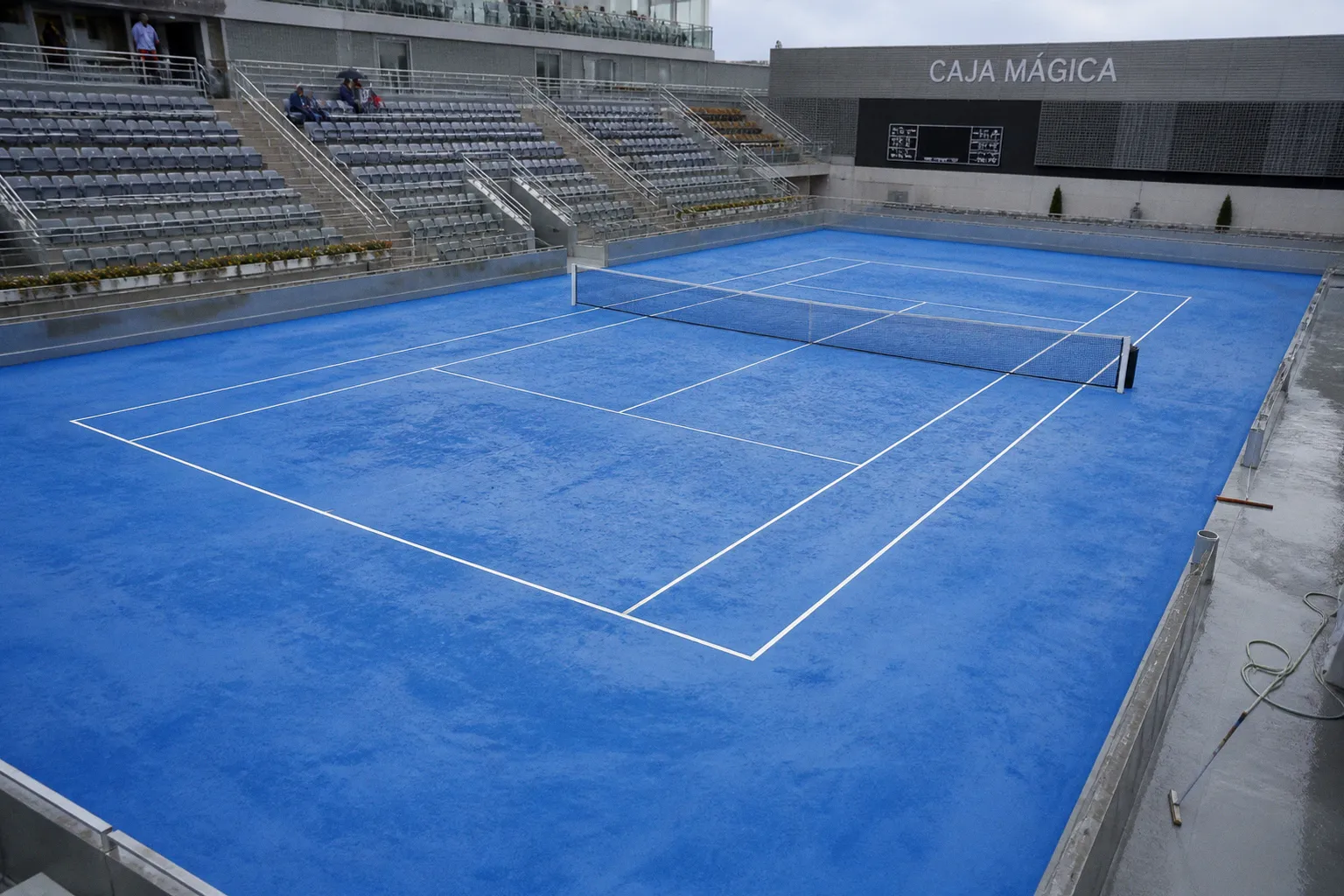
He had lost to Janko Tipsarević in the quarterfinals, and the result became one of the defining moments of Madrid’s brief and disastrous experiment with a court designed to look better on television than it felt beneath a player’s shoes.
The substance of Djokovic’s criticism was not simple anger. It was diagnosis: a complaint about bounce, rhythm, and the impossibility of trusting a court that had been re-engineered for cameras rather than for the people sliding across it. Tennis history would remember the 2012 Mutua Madrid Open as a one-week experiment in surface betrayal. What the broadcasts framed as a cosmetic upgrade, the athletes experienced as a renegotiated contract with the ground under their feet.
The Vision of Ion Țiriac: Aesthetics Over Athletics
Tournament owner Ion Țiriac personally championed the replacement of traditional red clay with a dyed blue surface, ostensibly to improve television contrast against the optic-yellow ball. It was, in Țiriac’s framing, a presentation upgrade. The ball was the star of the broadcast; why not retune the canvas?
The rationale was not entirely foolish. The yellow ball did stand out sharply against the blue court. On screen, the contrast was immediate and unmistakable. Madrid looked different from every other clay event on the calendar, and difference is a valuable commodity in a crowded sports broadcast. A tournament wants an identity. Țiriac gave Madrid one in a single visual decision.
But the decision also revealed a particular kind of show-business logic: the assumption that tennis is primarily a viewing product and only secondarily a sport with physical constraints. The court was treated as a background before it was treated as a mechanical system. That distinction mattered.
A tennis surface is not a neutral stage. It governs how a player brakes, how the shoe releases, how the ball rises, and how much time exists between the bounce and the next decision. Change the colour and you may change very little. Change the preparation process required to achieve that colour, and the whole equation can shift.
The deeper irony is that Madrid in 2012 was not an experimental outpost trying to find an identity. It was the 11th men’s Masters edition and the fourth women’s Premier Mandatory event. The tournament already had institutional weight, a significant field, and a place in the clay-season sequence leading toward Roland Garros. This was not a small event with permission to improvise at the margins. It was an established stop on the professional calendar.
That an event of this stature could be reskinned so radically tells you something about the asymmetry between broadcast ambition and player welfare. The product people had won the budget meeting. The athletes would discover the result on their knees.
Madrid wanted a new visual identity. The players received a new movement problem.
The Physics of Failure: Salt, Surface, and the Skating-Rink Effect
Blue clay was not inherently more slippery simply because it was blue. The pigment itself was not the whole story, and reducing the controversy to colour misses the important part. What broke Madrid in 2012 was the preparation process layered on top of the colour change.
To produce the saturated, television-friendly surface, the courts were treated and dried in a way that diverged from the familiar red-clay routine. Salt was used to draw out moisture and help set the colour. The result looked vivid, but the playing characteristics became hostile to the controlled slide that defines high-level clay-court movement.
This is the part that can be difficult to understand from a television angle. Sliding on clay is not a desperate loss of balance. It is a trained movement: a player accelerates, lowers the centre of gravity, releases the outside foot, and lets the body carry through the shot while the surface absorbs speed. The slide is not an interruption to the stroke. It is part of the stroke.
At Madrid, that sequence became unreliable. The foot could fail to release when the player expected it to, or release too abruptly. A player who had practised thousands of slides into a backhand corner could no longer trust the timing of the plant. The problem was not that movement became impossible in every exchange. It was that movement became inconsistent, which is worse for an elite athlete trying to make decisions at full speed.
Clay-court tennis is a kinetic conversation between footwork, slide, plant, and rebound. Remove predictability from any one of those elements and the entire decision tree upstream begins to wobble.
Approaching a ball, a clay specialist makes constant micro-calculations: how far to extend the run, when to start braking, how much margin to leave on the pass, whether the ball will sit up high enough to attack, and whether the recovery step will be available after contact. These calculations are rarely conscious in the ordinary sense. They are built into the player’s movement vocabulary through repetition.
When the slide does not slide, those calculations have to be recomputed in real time. The result is hesitation. At the elite level, hesitation looks like an unforced error. It looks like a player spraying forehands he normally paints, arriving late to a ball he usually reaches comfortably, or refusing an aggressive recovery step because the court has stopped offering reliable information.
From the upper deck, it can look like a sudden loss of form. From inside the player’s body, it is closer to vertigo.
Three breakdowns defined the surface’s week:
- The slide lost its reliability. Players whose movement was built around controlled deceleration could not always predict how the shoe would interact with the court.
- The bounce became harder to read. Reports from the tournament described a court that could produce awkwardly high rebounds in some areas and lower, skidding responses in others, depending on conditions and maintenance.
- The tactical burden increased. Players had to spend more attention on staying balanced and less on constructing points. A surface that takes mental bandwidth away from tactics changes the match before the first pattern develops.
The point is not that every rally on blue clay was unplayable. Some players adapted better than others, and professional tennis is full of competitors capable of adjusting to imperfect conditions. The point is that the adjustment was not a normal tactical challenge. Players were not simply deciding whether to stand closer to the baseline or hit through a slower court. They were trying to understand whether the floor would support the next movement their game required.
That is a very different kind of uncertainty.
A traditional clay court asks a player to use the surface. Madrid asked players to negotiate with it. The distinction explains why the tournament produced such a sharp reaction from the top of the men’s game.
The controversy also exposed a basic truth about court speed: it cannot be judged by colour alone. A blue court may appear faster on screen because the ball is easier to track and the rallies look cleaner. But the speed of a tennis court is a compound experience. It includes the pace of the bounce, the height of the rebound, the amount of grip available during braking, and the time a player needs to recover after a shot.
If the ball travels quickly but the player cannot decelerate predictably, the surface is not simply fast. It is unstable. That distinction is why the Madrid debate became less about visual novelty and more about whether the court could support professional movement at all.
Voices of Dissent: Why Nadal and Djokovic Threatened a Boycott
Djokovic’s objection was not that he had lost. It was that the court had made ordinary clay-court movement impossible to trust.
The two highest-profile critics of the blue clay were also the players with the most to lose from surface disruption. Rafael Nadal, the King of Clay, exited in the third round to Fernando Verdasco — a respectable opponent, but one Nadal on red clay would normally be expected to manage through patience, weight of shot, and relentless topspin.
Instead, the match became a referendum on footing. Nadal’s game is not built around hitting a brilliant shot and waiting for the court to do the rest. It depends on repeated movement: opening the court, recovering, stretching, sliding into position, and using the extra time created by clay to turn defence into pressure. If the player cannot move with confidence, the famous forehand is no longer connected to the system that makes it dangerous.
Nadal’s criticism after the match was therefore mechanical rather than theatrical. His concern was that compromised movement compromised the stroke itself. A player cannot load properly into a forehand if the lower body is uncertain. He cannot defend the next ball if the recovery foot does not behave as expected. On a normal clay court, the slide allows a player to arrive late and still construct a shot. On an unreliable one, arriving late can mean arriving without a stable base at all.
Djokovic’s defeat came on May 11, when he lost to Janko Tipsarević in the quarterfinals. That correction matters. The match was not a third-round exit, and it did not take place on May 10. Djokovic had already advanced beyond the opening stages of the draw; his defeat came in the quarterfinal round, as the controversy was moving toward its most visible phase.
The date also helps restore the shape of the tournament. Madrid’s blue-court dispute was not simply a story attached to one player’s early elimination. By the time Djokovic left the event, the surface had become a central subject before the tournament had reached its final weekend. His quarterfinal loss gave the complaints from the men’s locker room an especially loud platform, but it did not create the problem.
For Djokovic, the defeat was less about the opponent than about the effect of the court on timing and confidence. His game depends on extraordinary balance: the ability to absorb pace, change direction, and turn defence into attack from positions that would leave most players stranded. That balance is not just a matter of flexibility. It is a relationship with the floor.
When the court refuses to provide a consistent answer, the player must protect against the surface as well as the opponent. The most elegant movement becomes guarded movement. The body begins to anticipate failure. That is enough to change a match.
Both Nadal and Djokovic publicly threatened to boycott future editions of the Madrid Open if the blue surface remained. This was not an empty gesture. Skipping Madrid would have meant surrendering ranking points, prize money, and an important competitive week before Roland Garros. The tournament occupied a valuable place in the clay season, and the players were not casually rejecting it.
Their willingness to make the threat nevertheless showed how seriously they viewed the conditions. The message to the tournament was blunt: a Masters event could not demand that players accept a court they considered unsafe or fundamentally unfit for the style of tennis it was supposed to host.
| Player | Madrid 2012 result | Main concern | Public response |
|---|---|---|---|
| Novak Djokovic | Lost to Janko Tipsarević in the quarterfinals on May 11 | Unpredictable bounce and unreliable movement | Threatened not to return if the blue surface remained |
| Rafael Nadal | Lost to Fernando Verdasco in the third round | Compromised movement and disabled sliding mechanics | Threatened not to return if the conditions continued |
| Roger Federer | Won the title, defeating Tomáš Berdych | Adapted more successfully to the court’s demands | Did not threaten a boycott |
The asymmetry in that table deserves attention. Djokovic and Nadal were the dissenters, but they were also the players whose games were most physically dependent on classical clay-court mechanics. Federer’s flatter movement patterns, shorter takebacks, and preference for taking the ball early gave him a structural advantage on a surface where the long slide was unreliable.
That does not make Federer’s title illegitimate. He still had to execute, and Tomáš Berdych was not a decorative finalist. But it does reframe the optics. The player whose game suffered least from the surface won the tournament. The two players most visibly punished by the conditions were the ones making the loudest objections.
Read that as you will.
The Champion’s Perspective: Federer’s Mastery Amidst the Chaos
Roger Federer did not threaten a Madrid boycott in 2012. He also did not publicly endorse the blue clay. What he did was win his 20th ATP World Tour Masters 1000 title, equalling Nadal’s record at the time, and his 74th career ATP title overall.
The final against Berdych was played on a surface that had spent the week alienating much of the draw. Federer treated the conditions as a variable to be managed rather than an existential threat. That distinction is central to understanding his success.
There is a particular kind of competitive psychology in Federer’s run that is worth separating from the easy narrative of effortless adaptation. His movement vocabulary is built on economy rather than spectacle. He does not slide the way Nadal slides, dragging the back leg into the ball in a controlled skid. Federer tends to make earlier decisions: take the ball sooner, shorten the exchange, redirect rather than recover through a long defensive sequence.
On a clay court that punished the extended slide, those default mechanics became, almost by accident, an efficient toolset. While Nadal was being asked to rediscover how to move, Federer was reducing the number of movements the court could disrupt.
That is not the same as saying Federer found the court easy. An unreliable bounce remains an unreliable bounce. It can damage a first-strike pattern, distort the timing on a return, or turn a comfortable approach into a defensive scramble. Federer simply had more ways to avoid making the surface the centre of every point.
Berdych’s game exposed the other side of the problem. He depended on clean ball-striking, a stable hitting zone, and consistent timing. He had moments in the final, particularly when he found the backhand down the line, but the court’s unpredictability introduced enough variance to interrupt his normal patterns.
Federer’s 3–6, 7–5, 7–5 victory was not a clinical demolition. It was a survival exercise performed by a player whose game architecture was unusually well suited to a hostile canvas. The trophy was real. The path to it was a study in opportunism dressed up as mastery.
That distinction matters because unusual conditions often produce a misleading champion’s narrative. The winner becomes proof that the court was playable. But adaptability is not the same thing as validation. A surface can reward one player’s habits while undermining the basic contract expected by the rest of the field.
The women’s tournament offered a similar contrast. Serena Williams won the title with a victory over Victoria Azarenka, navigating the same broad questions about movement and timing that had troubled the men. Her serve and first-strike patterns were less dependent on prolonged clay-court exchanges than those of many opponents, giving her a way to shorten points and limit the number of uncertain transitions.
The pattern held across both draws: the player whose game required the least faith in the slide was best positioned to survive the experiment. Tennis does love a pattern, even when the pattern is on a court nobody asked for.
Federer’s victory also complicated the usual argument that a controversial surface must be impossible for everyone. It was not impossible. It was playable in the narrowest competitive sense: matches could be completed, points could be won, and a champion could be crowned. But professional standards cannot stop at whether a technically gifted player can survive a week.
The more useful question is whether the surface allows the field to express its games without adding an avoidable mechanical hazard. A court that rewards early striking and punishes the traditional clay-court slide may produce compelling highlights. It may even produce a high-quality champion. That does not mean it has produced a fair version of clay-court tennis.
The Aftermath: Why the ATP Banned the Blue Surface Forever
By the time the trophies were lifted, the verdict was effectively drafted. The ATP did not permit blue clay to return to the men’s tour after the Madrid experiment. The surface was not merely abandoned as a one-off curiosity or quietly removed from the calendar. Its use was prohibited in ATP competition, closing the door on a return to blue courts at that level.
Madrid went back to red clay the following year and has stayed there since. The tournament continued, and the Caja Mágica remained an important stop on the calendar, but the blue experiment became a closed chapter almost as quickly as it had been introduced.
The reasons for the rejection were structural:
1. Player safety and footing. The preparation methods used for the blue surface produced conditions in which players could not rely on the normal relationship between shoe, slide, and recovery. That is a fundamental problem for a professional court, not a matter of taste.
2. Consistency of play. A tournament surface must behave predictably across the court and from match to match. Reports of inconsistent grip and awkward bounces undermined the shared assumptions on which professional movement is built.
3. Competitive legitimacy. If a surface advantages certain movement patterns while disrupting the defining mechanics of clay-court play, the tournament is no longer testing players under conditions the calendar has led them to expect.
4. The limits of cosmetic innovation. Better television contrast is not enough to justify a change that interferes with braking, recovery, and stroke production. A court can be visually distinctive without becoming mechanically foreign.
The phrase “banned forever” is useful as shorthand, but the real story is more practical than theatrical. The ATP did not need to make blue clay a permanent villain. It simply needed to decide that the experiment had failed its basic test and should not be repeated.
That decision also established a boundary for tournament innovation. Tennis has always changed its presentation: new arenas, new broadcast angles, new court layouts, new scheduling ideas. But the playing surface sits closer to the athlete than any camera or branding package. Its colour can be altered; its physical behaviour cannot be treated as decoration.
The Madrid Open controversy therefore survives because it was not merely an argument about blue versus red. It was an argument about who gets to define the conditions of professional sport. The tournament had wanted a court that would read clearly on television. The players needed a court that would answer clearly to their feet.
Those demands are not automatically opposed. In Madrid, they were handled as though they were. The visual result was memorable, but the sporting cost was immediate: uncertain slides, disputed bounces, disrupted tactics, and two of the leading players in the world openly questioning whether they would return.
The experiment failed not because tennis cannot tolerate novelty. It failed because the novelty reached into the machinery of play. A new colour became a new preparation method; the preparation method became a new movement problem; the movement problem became a question of safety and competitive trust.
Federer won the title, and that result belongs in the record without an asterisk invented after the fact. But the champion’s adaptability could not rescue the surface’s design. Madrid 2012 demonstrated that a court may look perfect from the broadcast tower and still be wrong where tennis is actually played: under the player’s feet, at the exact instant when balance becomes a shot.
The blue clay disappeared. The lesson did not.