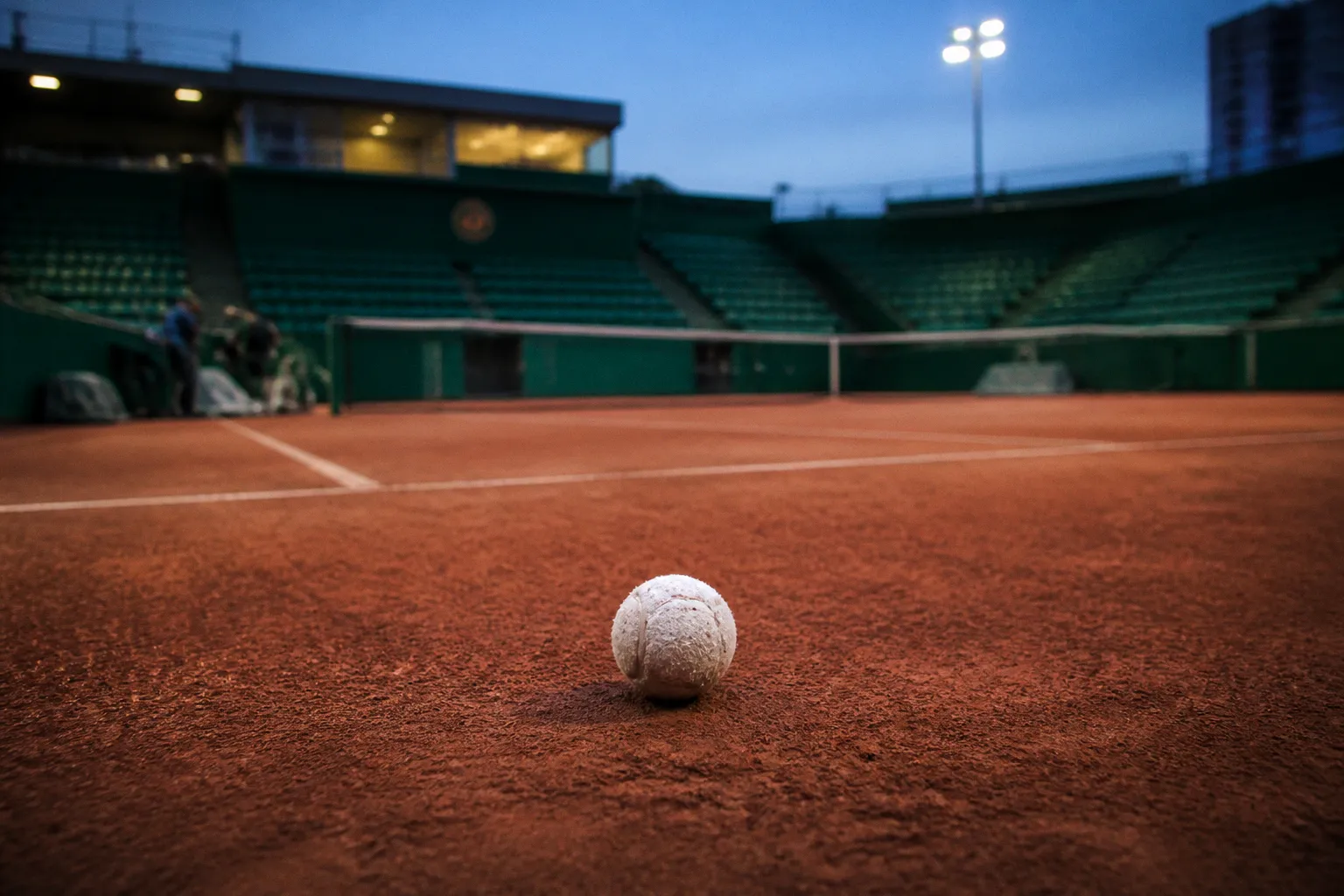
For most of tennis history, the ball was not yellow. It was white—or, in some earlier settings, black—and on the grass courts of Wimbledon that pale sphere belonged so completely to the visual grammar of the game that its disappearance required more than a rule change. It required a change in the way tennis was seen.
The transition from white tennis balls to optic yellow began with the demands of color television. The International Tennis Federation introduced optic yellow into the rules in 1972, after visibility research showed that the brighter color carried more clearly through the limitations of broadcast images. Wimbledon, however, held to its traditional white ball for another fourteen years. Its final men’s championship match played with white tennis balls came in 1985, when Boris Becker defeated Kevin Curren. In 1986, the All England Club finally adopted optic yellow.
That interval is the real story—not simply why tennis balls changed from white to yellow, but why Wimbledon resisted a change that other tournaments had already accepted, and what the old ball reveals about the relationship between tennis, technology, and the physical atmosphere of the court.
The era of the ghostly sphere: tennis before color television
The older tennis ball was not merely a different color. It belonged to a different visual environment.
From the late nineteenth century until 1972, official tennis balls were primarily white or black, with white the standard choice on grass courts such as Wimbledon. The ball’s dimensions and weight were already tightly defined: an official ball measured between 6.54 and 6.86 centimeters in diameter and weighed between 56.0 and 59.4 grams. Those specifications governed the bounce, the pace, and the familiar resistance of the ball against the strings—but color remained part of the court’s wider visual arrangement rather than a question of broadcast engineering.
On a grass court, white carried a particular kind of presence. Against the dense green of the playing surface, it appeared clean and legible to a spectator in the stands. The contrast was strongest when the ball stayed low, skimming just above the turf, its movement defined by the brief flash between one stroke and the next. The eye could follow it through the physical space of the court: across the baseline, past the net, into the compressed geometry of a volley exchange.
That experience was not identical for everyone. A spectator sitting high in the stands, a line judge positioned several yards from the action, and a viewer watching through a television set did not receive the same ball. The stadium offered depth, peripheral context, and the continuous movement of players around the ball. A television image reduced all of that into a smaller frame, with different lighting, different contrast, and a more fragile relationship between object and background.
This distinction became increasingly consequential in the 1960s, when television began to change the scale and reach of professional tennis. Wimbledon was already being broadcast in color on BBC2 by 1967, under the direction of David Attenborough in his role as a BBC2 broadcast executive. Color brought new life to the court, but it also exposed a stubborn technical problem: a white tennis ball could lose definition against the changing tones of the grass, the clothing, the lines, and the glare of the image.
The old ball had been designed for the eye in the stadium. The new ball would be designed, at least in part, for the eye passing through a camera.
The white ball was not obsolete on the court; it was becoming unreliable between the court and the screen.
There is a tendency to describe this history as though the yellow ball arrived simply because television wanted a more attractive image. The reality is more physical. A ball in flight is a small object moving rapidly through a field of competing tones. Its visibility depends on contrast, lighting, speed, background, and the quality of the image carrying it elsewhere. Once tennis became a major television sport, the ball’s color became part of the sport’s infrastructure.
The 1972 ITF rule change and the rise of optic yellow
The International Tennis Federation officially introduced optic yellow tennis balls into the rules in 1972, following research into their visibility on color television. The change did not erase white tennis balls from the laws of the game, and it did not immediately force every tournament to abandon tradition. It created a new standard that answered the emerging needs of the broadcast era.
Optic yellow was not chosen because tennis had suddenly become brighter or more modern in spirit. It was chosen because the color remained more visible as the ball traveled across a television image. The distinction matters. The ball was not being redesigned to alter the game’s tactics; its diameter, mass, felt covering, and rebound still had to remain within the established boundaries. The change was intended to preserve the viewer’s ability to see the existing game.
That is one of the quiet ironies of equipment history. A change can be made in the name of continuity. The yellow ball was introduced so that a television audience could continue to perceive the speed, height, and direction of a rally with greater clarity. It was a technical intervention designed to keep the sport recognizable.
The difference between the older white ball and the newer optic yellow ball can be understood through the environments in which each had to work:
| Feature | White tennis balls | Optic yellow tennis balls |
|---|---|---|
| Historical period of dominance | Late nineteenth century to the early 1970s | Introduced into ITF rules in 1972 and later adopted across professional tennis |
| Primary visual setting | Stadium spectators and natural court surroundings | Stadiums as well as color television broadcasts |
| Relationship to grass | Strong contrast for spectators, especially on traditional grass courts | More consistent visibility through broadcast images and changing backgrounds |
| Regulatory status today | Still technically permitted under ITF rules | Universally used in professional play |
| Cultural association | Traditional Wimbledon, white clothing, and pre-broadcast tennis | Modern professional tennis and the global television era |
The optic yellow ball also changed the emotional texture of televised tennis. It was easier to locate immediately, especially during fast exchanges, and its movement seemed more continuous because fewer moments disappeared into the background. That did not make the game faster. It made the speed more available to the viewer.
The tennis ball remains a compact object, but professional tennis is built around the eye’s ability to register compact objects under pressure. A returner must read the serve from a small toss and a fraction of a swing. A spectator must read the rally through changing angles and bodies. A broadcast must preserve that information across a screen. The yellow ball answered the last of these demands without changing the formal dimensions that shaped the first two.
Wimbledon’s standoff: tradition against the broadcast lens
Wimbledon did not adopt the optic yellow ball in 1972. It continued using traditional white tennis balls until 1986, creating a fourteen-year gap between the ITF rule update and the tournament’s eventual transition.
The delay is often treated as an act of simple nostalgia, and tradition certainly mattered. Wimbledon’s identity was unusually tied to visible continuity: grass courts, white clothing, restrained presentation, and the ceremonial weight of the Championships themselves. The ball belonged to that arrangement. Its color sat within the same visual world as the players’ clothing and the court’s carefully maintained surface. To alter it was not to replace an isolated piece of equipment; it was to disturb one of the tournament’s most recognizable details.
Yet tradition at Wimbledon has never been entirely separate from technology. The tournament adopted new materials, new court preparation methods, changing racket construction, improved broadcasting, and evolving forms of spectator access over time. What makes the ball so revealing is that the change could be seen so easily. A technical adjustment inside a racket frame might pass unnoticed. A change in the color of the object that every spectator follows is impossible to hide.
Wimbledon’s white ball therefore occupied an unusual position. It was perfectly legible to people inside the stadium, particularly against the green grass, but it was less dependable for the television audience that had become central to the sport’s reach. The tournament had to negotiate between the court as a physical place and the court as a reproduced image.
The official ball partnership also carried its own historical continuity. Slazenger has been the official ball supplier for Wimbledon since 1902, linking the ball used at the Championships to more than a century of institutional memory. That relationship helps explain why equipment changes at Wimbledon rarely feel like ordinary substitutions. The ball is part of the tournament’s material history—felt, rubber, seam, color, and all.
The precise internal reasoning behind the All England Club’s decision to wait until 1986 is not fully documented in the available record. What can be established is the sequence: optic yellow entered the ITF rules in 1972, other tournaments increasingly adopted it, Wimbledon retained white, and the Championships moved to yellow only after the 1985 edition.
The delay is best understood not as a rejection of television, but as a measured resistance to letting the broadcast image dictate the appearance of the court. Wimbledon accepted television while refusing, for a time, to let television become the final authority over tradition.
That distinction has become harder to maintain in modern sport. Today, the professional game is continuously shaped by camera angles, replay systems, lighting requirements, sponsor visibility, and the demands of global distribution. In the earlier period, the white ball offered one last visible boundary between the live court and the mediated court.
The 1985 finale: Boris Becker and the last white ball
Boris Becker’s victory over Kevin Curren in the 1985 Wimbledon men’s final was the last final at the Championships played with white tennis balls. The detail is easy to overlook beside the larger story of Becker’s breakthrough, but it gives the transition a precise historical edge. The old ball did not disappear in an abstract season. It was present in one of the tournament’s defining matches, then absent from the next year’s final.
Becker’s 1985 victory already carried the energy of a changing sport. He was a teenager, an explosive serve-and-volley player, and a figure whose athletic intensity seemed entirely suited to the increasingly global television culture around professional tennis. Yet the ball beneath that match still belonged to an older Wimbledon—a white object rising against the green court, moving through a visual tradition that had survived the arrival of color broadcasting but not its full consequences.
There is no need to turn the final into a symbolic reenactment. The historical fact is strong enough. The match marked the end of an era because the object in play was about to change, not because the players understood themselves as standing at a technological threshold. Sports history often works this way. The meaning of an event becomes clearer after the equipment, rules, or habits surrounding it have moved on.
For viewers today, the 1985 final can seem visually unfamiliar. The image quality is different, the clothing and camera work belong to another period, and the white ball can appear almost restrained beside the brilliant optic yellow used now. But the unfamiliarity is instructive. It reminds us that what feels natural in tennis is usually the result of accumulated decisions.
The ball’s color affects the viewer first, but it also belongs to the player’s sensory world. Players track the ball against the court, the seats, the sky, and the opponent’s body. They judge its rotation and trajectory through small changes in surface and light. A white ball on grass creates one kind of visual field; an optic yellow ball creates another. The rules preserve the ball’s size and mass, but the environment of perception has changed.
Becker’s final was therefore not the last moment when a white tennis ball existed. White remained permissible under ITF regulations, and older balls continued to survive in memory, collections, photographs, and the visual record. It was the last men’s Wimbledon final played within the tournament’s traditional white-ball era.
That is a narrower statement than saying white balls were banned, and it is a more useful one. The history is not a clean replacement of one legal object by another. It is the story of a standard becoming dominant because it worked better within the conditions of modern professional sport.
Becker’s 1985 Wimbledon final was not the last time tennis knew a white ball; it was the last time Wimbledon placed that ball at the center of its most visible ritual.
What remains of the white ball
Optic yellow is now universal in professional tennis, but white tennis balls have not vanished from the rules. The ITF still recognizes both yellow and white as permissible colors. In practice, professional tournaments use optic yellow because the competitive and broadcast systems of the modern game have been built around it.
That technical survival matters because it prevents the history from being reduced to a simple story of prohibition. The white ball was not declared illegitimate. It became culturally and practically marginal. The distinction is familiar across tennis: an older racket may remain playable even after graphite frames dominate; a traditional grip may remain legal even after new materials change the feel of the handle. The object can survive while the world around it stops being organized for its use.
Vintage white tennis balls now carry a different kind of information. They belong to the history of tennis fashion, broadcast design, court maintenance, and spectatorship as much as to the history of equipment. Seen in photographs, they make the older game feel quieter—not necessarily slower, and not necessarily less athletic, but less intensely optimized for immediate visual transmission.
The white ball also helps us recover the physical texture of Wimbledon before its television image became so familiar. It draws attention back to the grass itself, to the low contrast of a traditional court, to the friction between ball and surface, and to the way light changes the legibility of an object moving through the air. Tennis is often discussed through rankings and records, but its history is also contained in these small material decisions.
A ball’s color can seem like a minor detail until it changes. Then it becomes a record of what the sport has begun to value.
In the white-ball era, the court was primarily a place to be watched from within or near the grounds. By the time yellow became standard, the court was also an image carried into homes, replayed in slow motion, enlarged by camera lenses, and judged by viewers who might never stand on grass at Wimbledon. The transition did not diminish the physical reality of tennis. It made that reality available to a much larger audience—but through a screen whose limitations had to be taken seriously.
The court as image, and the image as history
The white tennis balls history at Wimbledon is ultimately a story about translation. The ball had to travel from racket to racket, from court to spectator, and from spectator’s view into the television frame. Each stage introduced its own demands. The ITF’s 1972 rule change acknowledged that the broadcast image was no longer a secondary record of the match. It had become one of the places where the match existed.
Wimbledon’s fourteen-year holdout gave the older visual language a final life. It preserved the white ball through a period when color television was already reshaping the sport, allowing tradition and technical necessity to remain in tension rather than resolving the question immediately. The 1985 final then became an accidental closing bracket: Becker and Curren played the last men’s Wimbledon final with white balls, and the following year the optic yellow era began.
That is why the story continues to matter. It is not only about a color change. It is about how professional tennis negotiates the friction between the material court and the public image of the court—between grass, felt, glare, and atmospheric density on one side, and the requirements of the camera on the other.
The optic yellow ball won because it made the modern game easier to see. The white ball remains memorable because it belonged to a game whose visual identity was formed before television could claim so much of the court. Both are legal; only one still defines the professional scene. In that small difference lies a broader lesson of tennis history: tradition rarely disappears at the moment technology arrives. More often, it holds its ground for a while, visible in every rally, until the conditions of watching have changed too completely for the old object to remain at the center.