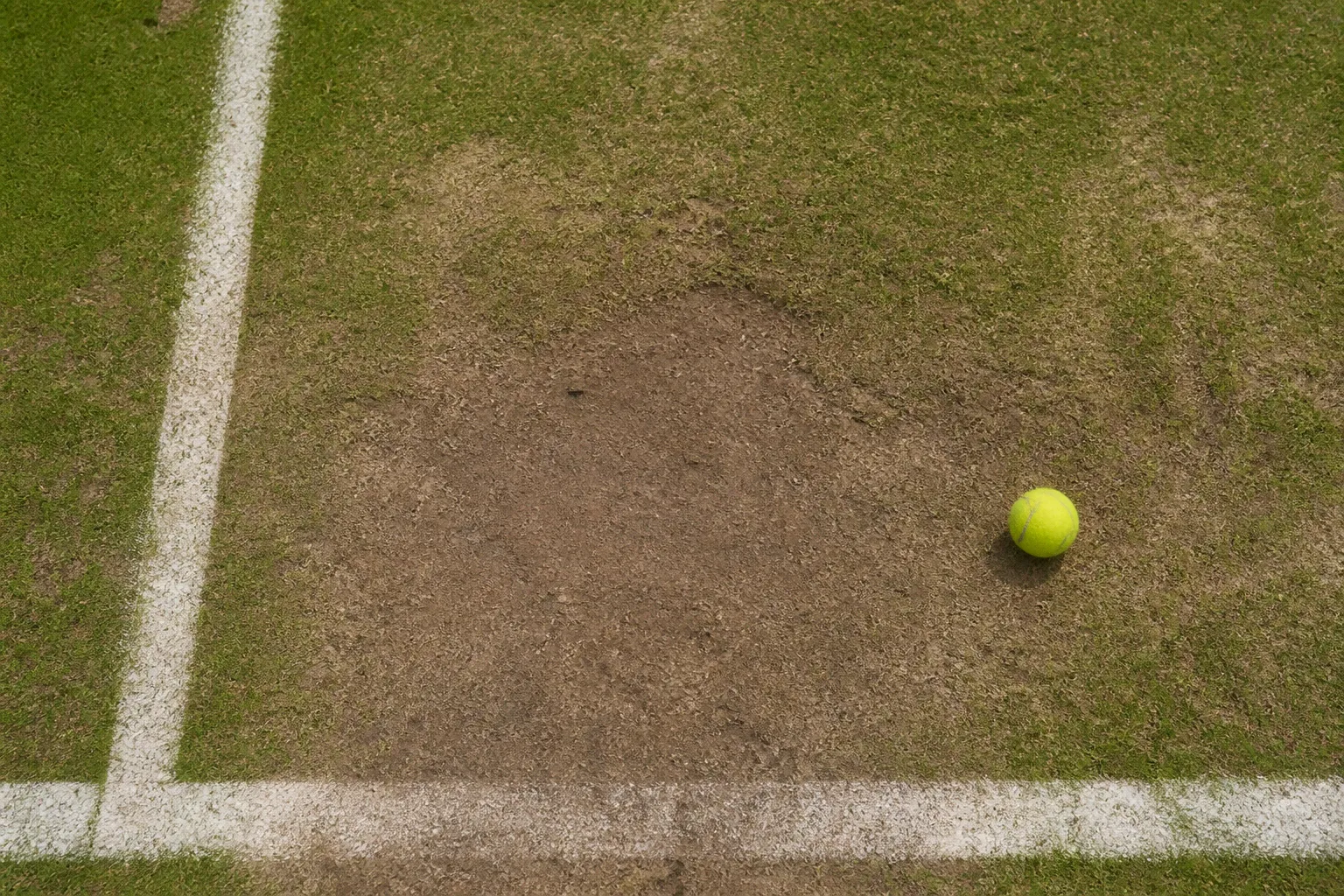
They begin with a dense, closely cut layer of perennial ryegrass—8 millimeters high, firm beneath the blades, and slick enough to keep the ball low and quick. By the second week, the areas behind the baselines have been subjected to thousands of sudden stops, split steps, recovery movements, and lunges, and the green surface begins to give way to exposed soil.
That change is not merely cosmetic. Wimbledon grass court wear patterns alter the friction under a player’s feet, the pace of the ball after the bounce, and the degree of trust a competitor can place in a familiar stroke. A slice that skids through fresh turf may sit up more heavily on worn ground. A hard, flat serve may still arrive with the authority associated with Centre Court, but the first groundstroke can meet a surface that is no longer behaving uniformly from one end of the baseline to the other.
The court is still grass, but it is no longer only grass. Its later-round character is produced by the interaction of living turf, compacted soil, weather, and human movement—an accumulation of small physical facts that eventually becomes part of the tournament’s tactics.
The Evolution of the Surface: From Fescue Mixes to 100% Ryegrass
Since 2001, Wimbledon’s courts have been sown with 100 percent perennial ryegrass. Before that change, the surface used a mixture of 70 percent ryegrass and 30 percent creeping red fescue. The move was made to improve durability under the particular demands of championship tennis, not to create a deliberately slower court.
That distinction matters because the visual transformation of the grass can encourage an easy but misleading conclusion: if the court becomes browner and more worn, then the tournament must have changed its speed by changing the grass. The actual picture is more exact. The switch to perennial ryegrass was intended to help the courts withstand play while preserving their established performance characteristics. The surface evolves during the fortnight because of wear and compaction, not because Wimbledon has quietly turned the grass into another kind of court.
The grass is cut to 8 millimeters, a height established as optimal in 1995 alongside the finalization of specifications concerning ball compression. At that length, the blades provide the polished green appearance associated with Wimbledon, but they are not the principal reason the ball bounces at one height rather than another. The soil beneath them carries much of that responsibility.
The court’s preparation therefore begins below the visible surface. Rolling and compaction determine the firmness of the ground, while moisture and weather affect how that firmness behaves over the course of a day. The blades contribute to the initial contact—the familiar slickness, the ability of a skidding ball to stay low—but the depth and quality of the rebound are largely governed by what lies beneath.
This is one of the reasons Wimbledon’s surface has such a distinct historical rhythm. It is prepared to offer a particular kind of grass-court tennis, yet it is also expected to survive the physical pressure of a modern draw, in which many players now construct points from behind the baseline rather than finishing them at the net.
Wimbledon’s grass is not a fixed stage. It is a surface that records the tournament as it happens—first in green, then in friction, then in the compacted soil of the baseline.
The Mechanics of the Bounce: Soil Compaction Versus Blade Height
On fresh grass, a well-struck ball can travel through the court with a clean, low acceleration after the bounce. The turf is slick, and the ball’s contact with the surface is brief. Slice backhands are particularly revealing here: when the ball arrives with underspin and meets intact grass, it tends to stay low, move quickly through the court, and force the receiver to bend deeply into the next shot.
This is the traditional grammar of a fast grass court. The serve is rewarded, the first volley remains a credible threat, and the returner has less time to establish a comfortable rally position. But even on day one, the grass itself is only one part of the equation. Soil hardness, compaction, rolling, moisture, and atmospheric conditions all influence the response.
As the court wears, the relationship changes. In the most heavily trafficked sections, the blades are damaged or disappear altogether, leaving the ball to meet a more exposed and compacted layer of soil. The bounce can become medium-high and slower, and it may lose the clean uniformity of fresh turf. The difference is not a simple progression from fast to slow across the entire court. It is a redistribution of behavior between zones.
A player may encounter one kind of response near the service line and another behind the baseline. A shot struck from a comfortable height may be returned differently when it lands on a patch where the grass has thinned, the soil has hardened, or the ground has been affected by changing weather. The uncertainty is often more consequential than the average pace. Elite players can adjust to a slower court; they are less comfortable when the same length and trajectory produce subtly different rebounds on consecutive points.
Several physical elements converge in the bounce:
- Fresh turf produces a slicker contact and a lower, quicker rebound, particularly noticeable on slice and skidding groundstrokes.
- Exposed baseline soil tends to create a higher and slower response, with a greater possibility of uneven bounce.
- Compacted ground gives the ball a firm platform, while changes in moisture can alter how that platform feels across the day.
- The ball’s incoming spin and speed determine how strongly the surface difference is expressed; heavy topspin and low slice do not react in the same way.
- The location of the landing becomes increasingly important as wear concentrates around the areas players use most.
It is tempting to describe the change as damage, but that word is too blunt for what happens in a professional tournament. The worn areas are not simply defective versions of the opening-day court. They are the accumulated result of movement patterns, court preparation, weather, and tactical history. The court becomes less pristine, but more legible—if one knows how to read it.
Shifting Footprints: How Modern Baseline Play Erodes the Turf
The most revealing change in Wimbledon’s wear patterns is not only how much grass disappears, but where it disappears.
During the serve-and-volley era of the 1980s, heavy foot traffic was concentrated in the forecourt, particularly inside the service line. Players served, followed the ball forward, and repeatedly planted in the areas from which they would close points at the net. The court’s visual evidence reflected that style: the front portion bore the burden of the game.
Modern grass-court tennis places a different load on the surface. Players still move forward when the point allows it, but the dominant patterns are built around the baseline. Returns are struck from deep positions, rallies are extended with heavy topspin, and each player may perform dozens of lateral recovery movements before the point ends. The repeated stress falls at and behind the baseline, where the feet brake, pivot, and push away again.
That is why Wimbledon baseline dirt bounce is tied so closely to the tactical evolution of the sport. The deterioration is not random. It follows the geography of contemporary tennis.
A player recovering from the deuce-court corner may cross the same strip of turf repeatedly, dragging the outside edge of a shoe through the grass while trying to regain position. The next movement can be a violent plant behind the baseline, followed by a lateral push toward the opposite side. Over a match, and then over many matches, those actions compress and abrade the surface in a narrow band.
The court staff monitor this process rather than waiting for the wear to become obvious to the eye. At Wimbledon, live grass cover is assessed with a point quadrat tool in high-wear positions behind the baselines and below the “T” on the main show courts. The measurement is a quiet counterpart to the drama of the match: while the players are reading the opponent’s shoulder and racket face, the grounds team is reading the density of the turf itself.
The result is a court that increasingly mirrors the way players occupy it. The baseline is no longer just a line from which points begin. It is a working platform—one that receives the force of every split step and every emergency change of direction.
What the worn zones tell us
The pattern offers a useful way to understand the match beyond the scoreboard:
1. A narrow band behind the baseline indicates repeated braking and recovery. Players are not simply standing there; they are absorbing force and redirecting it almost continuously.
2. Wear beneath the “T” reflects the importance of the central recovery position. Even when the ball is sent wide, players often return toward this area before the next exchange.
3. More limited forecourt damage reflects the reduced frequency of classic serve-and-volley movement. The net remains tactically important, but it no longer receives the same daily traffic as it did in earlier eras.
4. Uneven wear can reward players who adjust their spacing. A competitor who notices that a particular landing area is sitting up may change height, spin, or target rather than striking every ball with the same geometry.
5. Surface knowledge becomes part of court craft. The best grass-court players do not merely remember whether Wimbledon is fast; they sense which parts of the court are still fast today.
The Second-Week Transition: From Slick Skids to Uneven Soil
The first week of Wimbledon often carries the cleanest expression of the tournament’s grass. The court is green, the lines are sharply visible, and the ball seems to leave the surface with a particular economy—low, swift, and slightly impatient. A player who gets underneath the ball can keep it beneath the opponent’s preferred striking zone, while a well-timed approach can still compress the point before the defender has settled.
By the second week, the court has become more complicated. The baseline dirt is visible, but visibility is not the same thing as predictability. A ball landing on bare soil may bounce more slowly and higher than one landing on intact grass, yet the practical effect depends on the ball’s speed, spin, angle of descent, and the exact condition of the patch beneath it.
This is why the phrase “grass court tennis wear second week” should not be understood as a simple forecast that every match will become slower. The court does not transform evenly, and the tournament’s weather can modify the result. What changes most clearly is the balance between the original low-skidding response and the later, more variable bounce of worn areas.
For a returner, the difference can appear in the first few feet after contact. A serve that would normally stay below the shoulder may rise enough to permit a more aggressive return. For a baseline player, a forehand that would have slid through the court on day one may now arrive at the opponent’s racket with less urgency. For a player relying on short slices, the altered contact can reduce the knife-edge effect that makes the shot so awkward on fresh grass.
The tactical consequences are subtle but cumulative:
- Serve placement remains central, but the value of the first groundstroke may shift. A server can no longer assume that every short ball will stay equally low after the bounce.
- Topspin may become more useful in worn zones. A higher rebound can give the shot additional weight, especially when the ball lands deep near the baseline.
- Slice requires more careful targeting. On exposed soil, it may sit up rather than skid, allowing the opponent to attack a shot that would have been defensive poison on fresh turf.
- Footwork becomes a reading exercise as much as a movement skill. Players must judge not only where the ball is going but what kind of surface will receive it.
- Net approaches depend on the quality of the ball before the approach. A player may still come forward, but the route is less automatic when the bounce behind the baseline has become less uniform.
The phrase “unpredictable” should also be handled carefully. It does not mean that Wimbledon becomes chaotic or that every worn patch produces a wild bounce. The court remains meticulously maintained. Rather, the later surface offers more variation than the opening-day turf, and at the highest level a small variation is enough to change the timing of a stroke.
The second week does not erase Wimbledon’s grass-court identity. It makes that identity more conditional—less about one universal bounce and more about knowing where the court has begun to change.
The player who benefits is not necessarily the one with the most elaborate tactical plan. Often it is the one who can make a quick physical adjustment without allowing the adjustment to become visible as hesitation: a fraction more space from the baseline, a different racket path, a return struck slightly higher over the net, a decision to attack the body rather than the corner.
The Court Beneath the Court
Because Wimbledon’s grass is so visually distinctive, spectators naturally follow the green surface first. Yet the most important changes are often occurring underneath it. The amount a ball bounces is primarily determined by the hardness and compaction of the soil, achieved through rolling, rather than by the grass blades alone.
That principle explains why two courts with similarly healthy-looking turf can still feel different to the players. A surface can appear smooth while carrying a distinct firmness beneath the ball. Conversely, a patch of visible wear may not produce a dramatic error on every contact. The relationship between appearance and performance is real, but it is not direct.
Weather adds another layer of atmosphere and density. Grass is a living material, and the soil responds to moisture and drying conditions. A court prepared with the same specifications can offer a different physical conversation as the day progresses. The ball, the strings, the player’s shoes, and the ground are all participating in a system that never remains entirely static.
This is also why the work of Wimbledon’s grounds staff is less about preserving a perfect photograph than about maintaining a playable, consistent court through a severe period of use. Fifteen permanent groundsmen and thirteen temporary staff work across the tournament operation, with approximately one ton of grass seed used each year for court renovation. The numbers suggest scale, but the essential task is more precise: preserve the character of the court while accepting that championship tennis will leave marks.
There is no contradiction between tradition and maintenance here. Tradition is not the absence of wear. It is the continuity of a surface whose materials, preparation, and rituals are understood well enough that it can endure change without losing its identity.
The Daily Lines: Titanium Dioxide and the Visible Geometry of Play
The court lines are redrawn daily using a transfer wheel marker and a white compound containing titanium dioxide. Wimbledon uses approximately 500 gallons of this line-marking compound annually.
The detail may sound peripheral beside the grass itself, but the lines give the worn surface its geometry. They divide the areas of the court where the ball must be judged, and they also make the movement patterns visible. The baseline becomes both boundary and evidence: a clean white edge laid over the section of turf most exposed to the modern game.
Daily marking is a practical ritual, but it also emphasizes the contrast between permanence and erosion. The lines are renewed; the grass is not reset. Each morning presents a court that has been prepared for another day, yet the marks of earlier play remain in the baseline, in the thinning turf, and in the subtly altered relationship between the player and the ball.
The compound itself is not a decorative flourish. Its application must be controlled so that the court remains legible without turning the lines into a disruptive surface feature. The transfer wheel gives the grounds team a repeatable method, allowing the geometry to be restored while the underlying court continues its gradual tournament-long transformation.
For the viewer, this work is almost invisible. That is part of its success. We see a crisp baseline and assume the court has been returned to its original order. But the green beyond it has already absorbed another day of competition, and the soil beneath the line carries a little more of the tournament’s pressure.
Reading Wimbledon Through the Bounce
A Wimbledon match can be analyzed through serve speed, return position, rally length, and net approaches, but the court adds another layer that the scoreboard cannot record directly. The same player may face a different tactical environment in the quarterfinals than in the opening round—not because the rules have changed, but because the surface has been physically rewritten by the movement of everyone who played before.
The most useful way to think about Wimbledon grass court wear patterns is not as a decline from perfect to damaged. It is a transition from a relatively uniform surface to a more articulated one. Fresh grass emphasizes the low, quick skid that has shaped the tournament’s image. Worn grass and exposed baseline dirt introduce a higher, slower, sometimes less even response. Soil compaction, weather, and the distribution of foot traffic decide how strongly that change is felt.
The court’s history is therefore present in its material condition. The shift from fescue to 100 percent perennial ryegrass tells one story—the story of durability and deliberate preparation. The movement of wear from the forecourt in the 1980s to the baseline today tells another—the story of changing tactics. The daily lines, renewed in titanium dioxide compound, draw a clean frame around both.
By the final days, Wimbledon is no longer offering players the untouched surface that opened the fortnight. It is offering something more revealing: grass shaped by modern tennis, soil hardened by repeated decisions, and a bounce that asks every competitor to remain attentive to the ground beneath the point. That is not a departure from the tournament’s tradition. It is the tradition continuing in physical form—one footstep, one skid, and one altered rebound at a time.