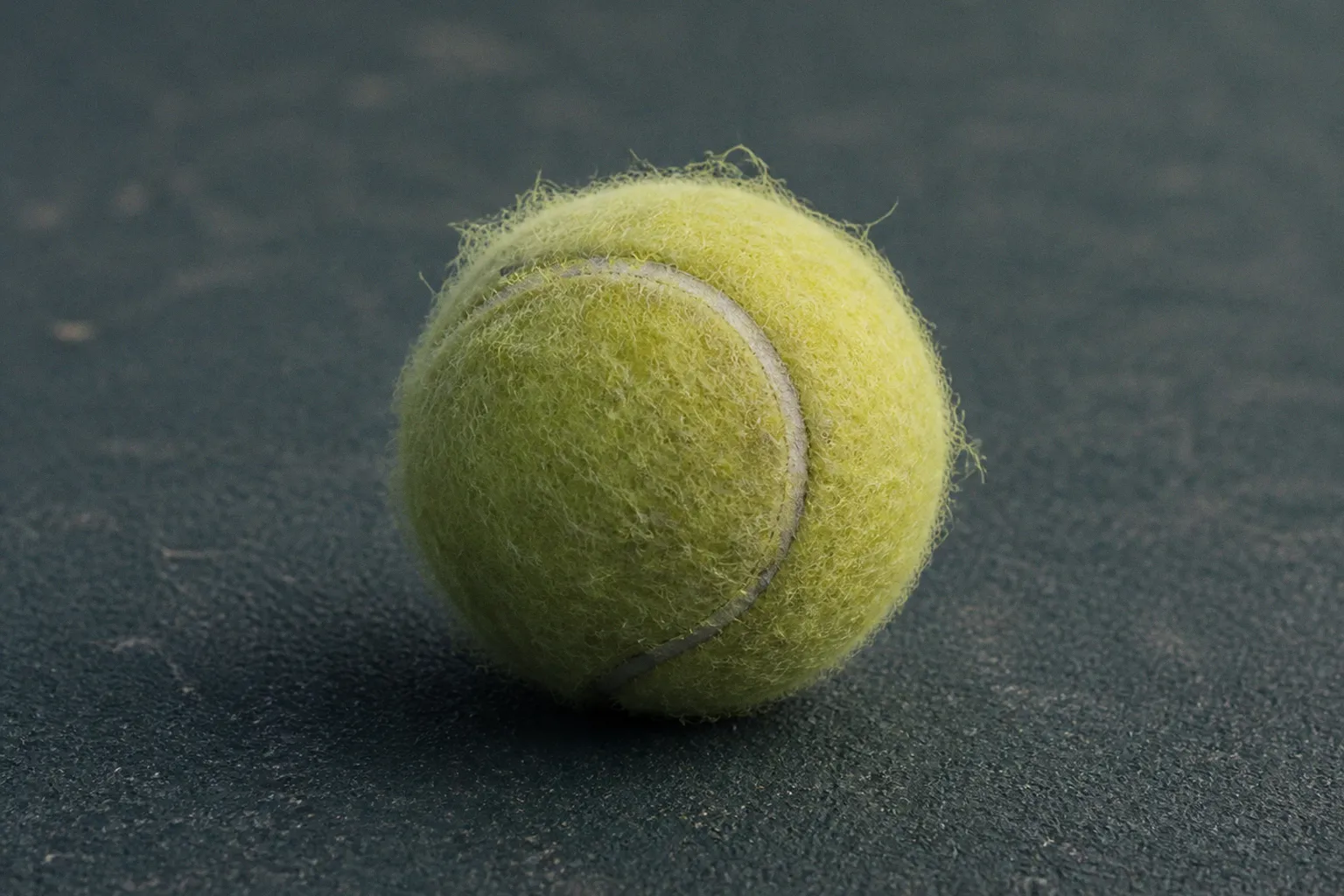
The opening set is played with balls that have already absorbed the five-minute warm-up. The first seven games then add repeated impacts, racket friction, court contact and compression. By the time the seventh game begins, the ball is no longer aerodynamically equivalent to the ball selected before the match. The next change arrives only after the game is complete. Fresh balls enter play for game eight.
This creates a defined material transition inside the set. The racket has not changed. The court has not changed. The player’s position has not changed. The ball has.
That is enough to alter the variables that govern the first shot: serve velocity, spin response, flight decay and bounce height. The effects are not uniform across players. A flat first serve, a heavy kick serve and a high-revolution forehand do not interact with felt degradation in the same way.
The seventh game is not a supernatural boundary. It is the final game before the ball’s aerodynamic condition is reset.
The aerodynamics of decay: how felt nap dictates drag
A tennis ball is a pressurised rubber sphere covered in woven felt. The felt is not decorative. It controls the boundary layer around the ball and therefore affects how quickly the ball loses velocity in flight.
The relevant variable is aerodynamic drag. It acts opposite to the ball’s direction of travel. A professional serve leaves the racket at a speed that can approach 150 mph. It does not reach the receiver at anything close to that speed. Air resistance removes a substantial part of its velocity. By the time the ball reaches the returner, the speed can be near 50 mph, depending on serve type, trajectory, spin, temperature, altitude and court position.
The felt modifies this loss.
A new ball has a relatively smooth, compact nap. Repeated impacts raise, compress and abrade the fibres. The surface becomes more irregular. The ball’s drag response changes with it. The effect is not simply that an old ball is slower in every phase of flight. The direction and scale of the change depend on the ball’s speed, spin and orientation.
The average drag coefficient measured for new tennis balls is approximately 0.507, with reported variation around that value. That coefficient is not a permanent property of every tennis ball. It is a working description of a particular ball condition under particular test conditions.
Free-flight measurements also produce drag coefficients roughly 15% to 20% lower than static wind-tunnel measurements. The reason is methodological. In free flight, the ball moves, rotates and presents a changing felt surface to the air. In a static test, the geometry and airflow are controlled differently. The number is therefore useful as a reference, not as a universal constant to insert into every serve calculation.
For match analysis, the practical point is simpler:
- A new ball has a different surface condition from a ball used through seven games and a warm-up.
- Felt degradation changes drag and the ball’s response to spin.
- The change is more relevant at high velocity, where aerodynamic forces have more time and distance to remove speed.
- The same ball can behave differently on a flat serve, a kick serve and a heavy topspin groundstroke.
- The player does not need to feel a dramatic difference for the trajectory to change by a tactically relevant amount.
The phrase “tennis ball fluff speed decay” is therefore imprecise if it suggests a single linear decline. Felt does not produce one fixed penalty that increases at the same rate after every rally. The ball’s condition evolves through contact with the racket and court. Its aerodynamic behaviour is conditional.
A worn ball may leave the racket with less pace. It may also respond differently to spin and travel through the air with a changed drag profile. The result is a different arrival point, not merely a lower number on the speed gun.
New balls versus old balls
| Parameter | New balls | Used balls after extended play |
|---|---|---|
| Felt surface | Smoother and more compact | Raised, compressed and worn |
| Aerodynamic drag | Lower in the conditions associated with fresh felt | Altered by increased surface irregularity |
| Serve response | Favours maximum initial speed | Can reduce the effectiveness of flat pace |
| Spin response | More predictable at high racket speed | More variable as felt and surface condition change |
| Bounce behaviour | Closest to approved specification | Can lose consistency as the ball degrades |
| Tactical value | Favours aggressive first-strike tennis | Can reduce speed and alter rally tolerance |
The table should not be read as a guarantee that every new ball is faster in every measurable phase. It describes the tactical preference expressed by professional servers: fresh felt offers the best chance of preserving serve speed and a predictable contact response.
The seven-game threshold is a rule built around accumulated damage
The ITF ball-change rule uses a first cycle of seven games, followed by changes every nine games. The opening cycle is unusual because it includes the pre-match warm-up. Players strike the balls before the score begins. That contact is counted in the physical life of the ball even though it is not counted in the scoreboard.
After the first change, the cycle extends to nine games. The ball is no longer exposed to the warm-up, so the rule treats the initial period differently.
The sequence is:
1. Fresh balls are used for the pre-match warm-up and the opening games.
2. The first change occurs after seven completed games.
3. New balls are introduced for the eighth game.
4. Subsequent changes occur after every nine completed games, subject to the competition’s operating procedures.
This creates a tactical asymmetry between the seventh and eighth games. The seventh is played with the most degraded balls of the opening cycle. The eighth begins with the freshest balls available.
The rule does not claim that a break is more likely in the seventh game. There is no basis here for assigning a universal break-point percentage to that specific game. It does establish a material event that coaches and players can anticipate.
A server who relies on a high first-serve speed may prefer the seventh game to be short. The reason is not psychological. Fewer points reduce the number of additional impacts before the scheduled change and limit the time spent operating with a ball at the end of its cycle.
A returner may assess the same condition differently. A slower or more heavily worn ball can reduce the value of the server’s first strike. It can also change the geometry of the return. If the serve arrives with less speed, the returner has more time to organise the racket face and move into the ball. That advantage is not automatic. The heavier or less responsive ball may also produce a less comfortable contact, especially on a high-bounce return or a body serve.
The relevant question is not whether old balls are good or bad. It is which player’s pattern depends more heavily on the properties being lost.
Ball changes do not reverse the tactical order of a match. They modify the cost of each shot inside that order.
Velocity loss in flight is not the same as loss of serve quality
A serve is a sequence of velocities and angles. The speed at racket contact is only the first measurement.
The ball leaves the strings at high velocity. Drag then acts throughout the flight. Gravity changes the vertical component. Spin alters the trajectory and the ball’s interaction with the air. The service box imposes a geometric constraint. The server must produce enough downward movement, clearance and lateral margin to make the ball land inside a small target.
Felt condition enters this calculation through drag and contact response.
A flatter serve depends on speed and a relatively direct trajectory. Its margin is often created by height over the net and a target close to the service-box line. A worn ball that loses more pace in flight can reduce the server’s ability to reach the target before the returner is ready.
A kick serve depends on a different balance. The server uses racket-head speed and spin to create vertical clearance and a high bounce. The ball’s felt condition affects the interaction between the strings and the surface, but the tactical outcome is not reducible to a single speed loss. A kick serve may remain effective because its purpose is not to maximise terminal velocity. Its value is to move the returner vertically and laterally.
A slice serve occupies another position. Its lateral movement is sensitive to spin and trajectory. The ball’s aerodynamic response can alter how sharply it bends and how quickly it arrives. But the serve is still evaluated by the returner’s contact point, not by the speed number alone.
This is where simplistic “old balls are slower” analysis fails. It treats a tennis serve as a projectile with one output. Professional serving is a controlled compromise among:
- racket-head speed;
- launch angle;
- spin rate;
- contact height;
- net clearance;
- landing depth;
- wide, body or T direction;
- expected return position;
- ball condition.
Shot-tracking systems are useful because they can separate these variables. A speed reading alone cannot show whether a player lost control at the contact point, changed the toss, added spin, or simply used a different target.
The ball’s flight can be described in terms of decay from the racket to the receiver. A serve that leaves at 145 or 150 mph may arrive near 50 mph after aerodynamic losses. That range is not a fixed conversion. It varies with trajectory and spin. A wide serve hit with more slice does not follow the same path as a flat serve directed down the T. A kick serve reaches the returner with another combination of speed, height and rotation.
The tennis ball aerodynamic drag coefficient is therefore relevant to tactical analysis only when connected to the shot’s full geometry. The coefficient is not a scoreboard statistic. It is one term in the system.
Court positioning determines who benefits from the change
The ball change matters most when it changes the time available for the next contact. Time determines court position. Court position determines the quality of the next shot.
A server with a high first-serve percentage and a short first-ball pattern uses fresh balls to create an immediate advantage. The objective is not necessarily an ace. It may be a return that lands short or arrives outside the returner’s preferred contact zone. The next forehand is then struck from inside the baseline, often before the defender can recover to a neutral position.
If the ball is slower through the air, the returner has a larger window to read direction and organise the swing. That can move the contact point forward. The returner may then block, drive or redirect the ball with more control.
But the change also affects the server’s response. A server who expects the returner to stand farther back may use the new balls to attack the body. A returner who moves forward may reduce the geometric value of a wide serve but increase exposure to the body serve. The tactical adjustment is therefore positional.
A useful court-level sequence is:
1. Serve selection. The server chooses between pace, spin and direction. Fresh balls increase the incentive to test the returner with speed.
2. Return position. The returner adjusts distance from the baseline according to expected arrival time and bounce.
3. Contact point. The player who reaches the ball earlier can strike farther in front of the body and direct the next shot with more options.
4. Recovery line. The shot’s depth determines whether the opponent can return to a neutral position.
5. Second contact. The first player to obtain court priority can use the altered ball condition again, usually with a high-percentage pattern rather than a speculative winner.
This is why the first ball after a change can be more significant than the change itself. Players have to recalibrate their timing. The new ball may leave the racket differently and arrive with a different speed profile. A returner who uses the same swing tempo may contact it late. A server who relies on a familiar toss-to-target relationship may discover that the ball travels through the service box with a different margin.
At professional level, the adjustment is usually small. Small does not mean irrelevant. A few centimetres at contact can move the ball from the centre of the racket face toward the frame. A slightly changed launch angle can turn a deep first serve into a shorter one. A marginally different bounce can move the opponent’s contact from waist height to shoulder height.
The scoreboard records the point. It does not record the altered contact point that made the point available.
Fresh balls favour specific serve profiles
Professional players select fresh balls before serving because the condition of the felt affects the first strike. The preference is strongest among servers whose patterns depend on maximum pace and immediate court compression.
That does not mean every server benefits equally.
Flat first-serve specialists
A flat serve has a narrow relationship between velocity and margin. The server wants high pace without losing the ball beyond the service line. Fresh felt can support the initial speed and reduce uncertainty in the ball’s flight.
The tactical benefit appears in two places:
- the ball reaches the receiver sooner;
- the server can hit a target with less need to trade pace for spin.
The returner’s response is then constrained by time. A shorter preparation window produces more blocked returns and fewer aggressive redirections.
Heavy-spin servers
A player who uses a high-spin first serve or kick serve may care less about absolute pace than about bounce height and location. Felt degradation still matters, but the tactical read is more complex. The ball’s surface condition affects the racket-ball interaction and the subsequent flight. The server may need to adjust racket-head speed or launch angle to maintain the same clearance.
A fresh ball can also make a high-spin serve more dangerous because the server can combine rotation with enough speed to prevent the returner from simply stepping forward.
Slice and body-serve patterns
A slice serve uses lateral movement and contact-point disruption. Its effectiveness depends on the returner’s position and the amount of time available to move the racket into the ball. A changed ball condition may reduce the apparent sharpness of the movement or alter the arrival speed.
The body serve is more tolerant of some velocity loss because its purpose is to attack the returner’s swing space. If the ball reaches the body with less pace, the returner may still be unable to create a full stroke. The server can therefore shift toward the body when the ball condition reduces the value of the wide target.
This is the central tactical distinction: ball degradation changes the returner’s time, but the direction of the advantage depends on where that time is removed from the point.
The bounce test explains why “dead” is not a casual description
Tennis balls are not approved on visual appearance alone. The ITF specifies mass, diameter and rebound characteristics.
An official ball has a standard mass between 56.7 grams and 58.5 grams. Its diameter falls between 65.41 millimetres and 68.58 millimetres. Those ranges are narrow enough to create a defined equipment class but broad enough to account for manufacturing variation.
The rebound test is more revealing. A ball dropped from 254 centimetres onto concrete must rebound within an approved range of approximately 135 to 147 centimetres. The ball therefore has to retain a controlled relationship between impact energy and rebound height.
That relationship changes with use. Felt wear is visible, but the internal rubber and pressure system also govern how the ball returns energy to the court. A ball that looks acceptable may still produce a different bounce from a fresh ball. A ball with raised felt may also interact differently with the court surface before the rebound reaches the player.
Bounce consistency matters because tennis players construct their contact point around an expected height. A deep ball that rises less than expected can force a player to bend and strike late. A higher or more elastic rebound can move the contact point upward and reduce the ability to drive through the court.
The physical specifications also explain why ball changes are standardised rather than left to player judgement. If officials changed balls whenever a player claimed that the bounce felt wrong, the competitive conditions would become impossible to control. The schedule creates a repeatable compromise between material decay and match continuity.
This is not a perfect reset. New balls are not identical to the balls used in the warm-up, and players do not begin every nine-game cycle with exactly the same physical conditions. Temperature, humidity, altitude and court surface remain active variables. The rule controls one major source of variation. It does not eliminate the rest.
The tactical impact is measurable, but not isolated
The ball change should be treated as a variable in match analysis, not as a single explanation for a result.
A player’s serve efficiency can change after the introduction of new balls. But the analyst must separate ball condition from the player’s tactical choices. A server may use more first serves after a change. A returner may move back. Rally length may shorten. None of those observations proves that felt degradation caused the change.
The correct method is comparative:
- compare first-serve speed before and after the scheduled change;
- compare first-serve percentage and unreturned-serve rate;
- track return position relative to the baseline;
- measure the opponent’s contact point where tracking data permits;
- separate flat, slice and kick serves;
- compare points played with a new ball against points played late in the cycle;
- account for score, surface, wind and server identity.
The unknowns matter. There is no universal player-by-player win percentage for the seventh game that can be applied across the tour. The ball change is not a deterministic trigger. It is a controlled change in equipment condition inside a tactical environment.
The strongest conclusion is narrower and more useful. Fresh balls increase the value of speed and precise first-strike execution. Degraded balls reduce the reliability of that advantage and can give the returner a longer preparation window. Spin, placement and court position determine which player converts the change into a point-level benefit.
The seventh game is therefore important because it closes the first material cycle. The eighth matters because it opens the next one. The scoreboard does not change automatically. The input conditions do.
Professional tennis remains governed by these small physical discontinuities. The ball loses felt. Drag changes. Velocity decays. Contact points move. The player who adjusts the geometry first gains the next available advantage.
That is the entire mechanism. No narrative is required.