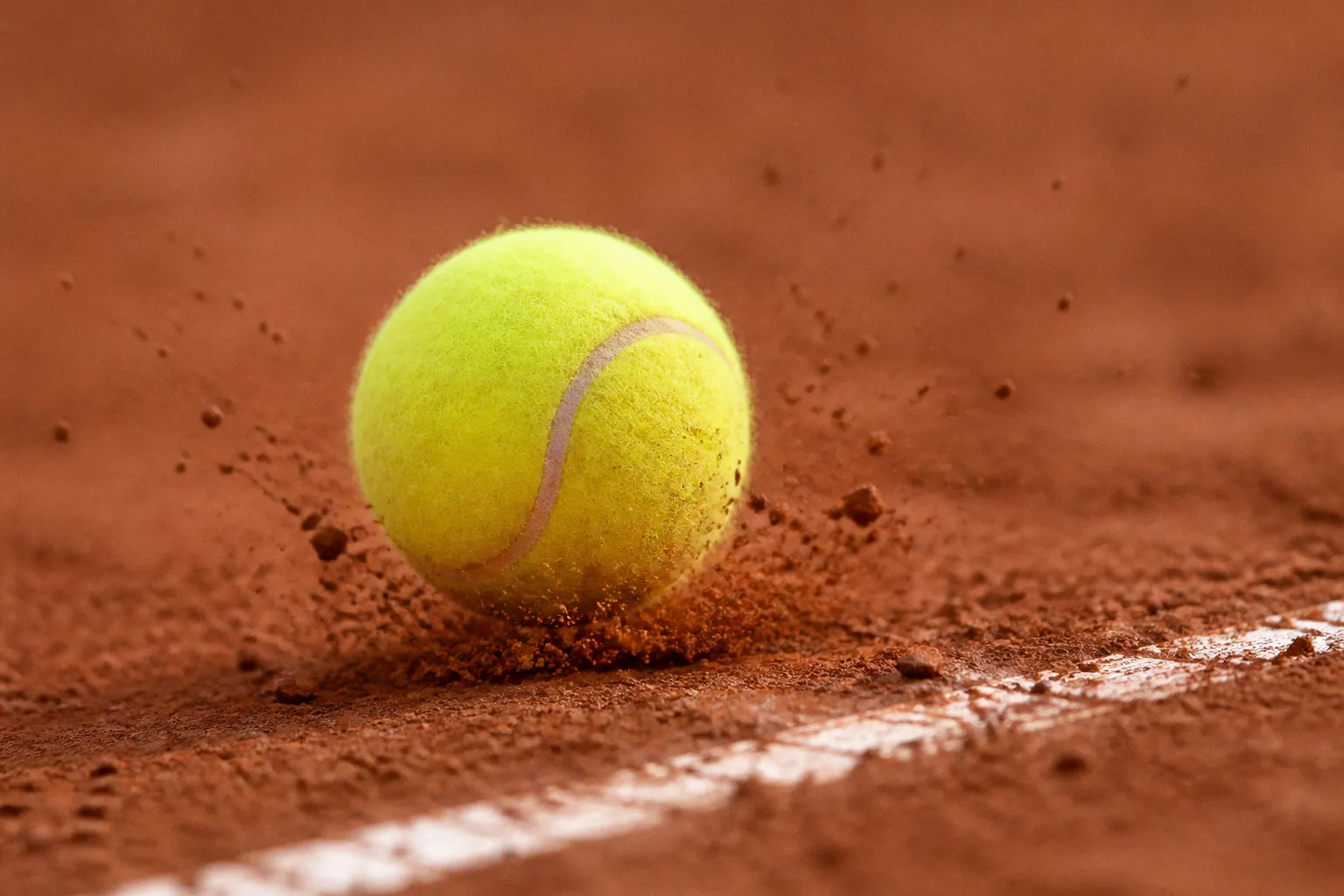
By the time it has crossed the net, struck the court, risen from the bounce, and travelled into the receiver’s hitting zone, the ball may be moving at roughly 55 mph—less than half the number displayed beside the server’s name.
That loss is not a single event. Atmospheric drag takes speed from the ball in flight; the court surface absorbs and redirects energy at the bounce; spin changes the angle and height of the rebound; and the remaining distance to the returner continues to drain velocity. This is the physical reason that a return position suited to a fast grass court can feel hopelessly late on clay, while a compact swing that survives on a slow hard court may be overwhelmed on a slick indoor surface.
The useful question is therefore not simply how fast the serve was struck. It is how much speed remains when the ball reaches the place where the returner must decide.
The 50% velocity gap: from racket to returner
The first number in a serve-speed discussion is usually the least useful one tactically. A radar gun records the ball’s peak velocity as it leaves the strings, before the air and the court begin their work. It describes the violence of the contact, but not the pace of the ball that the returner must actually read and control.
A mechanics breakdown associated with tennis analyst John Yandell gives a clearer sequence for an average 120 mph serve:
| Stage of the serve | Approximate ball speed |
|---|---|
| Immediately after racket contact | 120 mph |
| Before the bounce | 82 mph |
| Immediately after impact with the court | 65 mph |
| At the returner’s racket | 55 mph |
The sequence is striking because the ball loses speed both before and after the bounce. The court is not the only source of decay, and the bounce is not a clean reset. A serve enters the service box with substantial forward velocity, often combined with slice or topspin, and then gives away roughly 30% of its horizontal speed when it meets the surface. What remains is shaped by the court’s friction, elasticity, moisture, temperature, and the angle at which the ball arrives.
Across the whole path, the loss can approach 50% of the initial serve speed. That does not mean every serve follows the same curve. A flat first serve, a heavily kicked second serve, a serve struck into a colder atmosphere, and a serve landing on a dry clay court will not decay in identical ways. The exact contribution of spin on a newly resurfaced hard court, for example, varies considerably with the rate of rotation and the angle of attack.
But the broad physical principle holds: the returner is not facing the number on the scoreboard. The returner is facing the remainder.
A serve’s headline speed belongs to the server’s racket; the return belongs to the speed left after air, friction, and the bounce have taken their share.
This distinction matters most when comparing players across tournaments. Two servers may both register 120 mph, yet one may produce a far more difficult ball because the serve reaches the returner higher, closer to the body, or with more residual pace after the bounce. Conversely, a slower serve can be tactically effective if the surface strips away enough speed to deny the returner time for a full response.
The ball loses approximately 1 mph for every 2 to 3 feet it travels through the air at speeds between 50 and 150 mph. That estimate is necessarily broad—the atmosphere is not a fixed playing surface—but it explains why the distance between bounce and contact matters. A returner standing well behind the baseline gives the ball more time to slow, but also gives the server more opportunity to use the court geometry. A returner moving forward takes the ball earlier, before the final stage of atmospheric decay, and must therefore manage a faster, less forgiving object.
The best return position is not a universal distance from the baseline. It is a response to the speed that survives the journey.
Quantifying court friction: what pace ratings can and cannot tell us
Court speed is often discussed as though it were a single quality, but the surface is a compound physical system. Friction affects how much horizontal velocity disappears at impact. Restitution affects how much energy the ball retains and how lively the rebound feels. The roughness and depth of the surface influence the interaction with the felt of the ball, particularly when spin is involved.
In formal terms, two properties are especially useful:
- Coefficient of Friction, or COF, describes the resistance between the ball and the court during contact. Greater friction tends to remove more horizontal speed and to grip the ball more strongly.
- Coefficient of Restitution, or COR, describes how much of the collision energy is preserved in the rebound. A more elastic interaction produces a livelier return from the surface.
- Court Pace Rating, or CPR, is the ITF classification system used to describe court speed. Its formula is CPR = 100(1 - µ) + a(b - e), incorporating friction and rebound variables. Courts rated 45 or higher are classified as fast, while courts rated below 30 are classified as slow.
- Court Pace Index, or CPI, is associated with Hawk-Eye and shot-tracking environments, where court behaviour can be assessed through match conditions and ball movement. It should not be treated as a simple replacement for the ITF’s CPR scale; the two measures belong to related but distinct systems.
The practical value of these measurements is that they translate a vague impression—this court feels slow, that court feels quick—into a description of what the ball is doing. A slow court does not merely reduce the number of aces. It changes the amount of time a returner has, the height at which the ball arrives, and the amount of racket-head speed required to send the ball back with authority.
A fast court, by contrast, preserves more of the first-strike advantage. The serve travels through the court before the returner can establish a stable hitting position. A slight misread becomes a rushed block. A return aimed safely through the middle may still sit up for the server’s next shot because the returner has been forced to prioritise contact over direction.
The classification is useful, but it is never the whole match. Humidity, temperature, ball age, altitude, roof conditions, and the specific batch of balls all influence the lived pace of a court. Even on the same surface, a match can move from crisp and skidding to heavy and physically demanding as the balls lose their felt and the air becomes denser.
For that reason, surface labels should be read as tendencies rather than verdicts. Grass generally produces a low, fast exchange with limited time to organise. Clay introduces greater friction, more pronounced sliding, and a higher rebound, particularly when the ball carries topspin. Hard courts occupy a broad middle ground, and their behaviour can shift substantially according to acrylic composition, preparation, temperature, and maintenance.
The physics of the bounce: why horizontal speed vanishes
The bounce is where the serve’s original speed is converted into several competing forms of movement. Some energy remains in forward travel. Some is redirected upward. Some is absorbed by the surface and the ball. Some is altered by spin, which can either lengthen the rebound or pull it sharply across the court.
A ball arriving with backspin, sidespin, or topspin does not meet the surface in the same mechanical state as a flat serve. The frictional interaction between felt and court changes the direction of the ball’s movement and affects the shape of the rebound. On clay, the surface grips the ball more readily, often creating a higher bounce and taking more horizontal speed away. That can make the serve easier to reach while making the next phase of the point more demanding, because the returner must deal with height, rotation, and distance rather than pure pace.
This is why saying that clay is simply slow misses the important part. Clay removes speed, but it also gives the ball time to rise into a more forceful hitting zone. A heavy kick serve may arrive at a slower horizontal velocity and still be difficult because it climbs above the returner’s preferred contact height. The returner has gained time but lost comfort.
Grass produces the opposite tension. Its lower-friction interaction tends to preserve more forward speed and to keep the bounce lower. The returner may receive the ball at a manageable height but with less time to react. On a slick grass court, the first decision is often made before the body has completed its preparation: block, chip, or swing. There is not always enough time to choose an ambitious target.
The distinction between speed and difficulty is essential. A ball can be slower but harder to attack; it can be faster but easier to redirect if it arrives at a predictable height and angle. The returner’s task is therefore governed by the complete post-bounce profile:
- how much horizontal velocity remains;
- how high the ball rises before contact;
- whether the bounce carries away from or into the returner;
- how much spin changes the racket angle required;
- how much time remains before the ball reaches the preferred contact point.
This is also where television analysis can become misleading. A serve speed graphic tells us what happened at contact. It does not reveal the speed of the ball when the returner meets it, nor does it show how much of the difficulty came from the surface rather than the server’s initial velocity.
Return position is a calculation, not a habit
Returners often appear to have a fixed identity: one stands deep, one crowds the baseline, another steps inside the court only against second serves. At the highest level, however, positioning is less a matter of personality than of managing decay.
A player standing several metres behind the baseline may allow the ball to lose more speed before contact. This can make a powerful serve easier to block and can create a larger visual window for reading the direction. The cost is strategic: the returner concedes court position and may be forced to begin the rally from a defensive distance.
A player positioned on or just inside the baseline takes the ball earlier, before the later stages of speed loss. The return arrives sooner, and the server has less time to recover for the first groundstroke. But the returner must now absorb more of the serve’s remaining energy, often with a compact swing and a more exact contact point.
The surface changes the balance between these choices.
On faster courts
On grass or a fast indoor court, standing too far back can be a trap. The ball may remain low and penetrate through the court, while the server has enough time to move into the next shot. A returner who retreats in search of reaction time may find that the extra distance does not compensate for the lost court position.
The more effective adjustment is often modest rather than dramatic:
1. Read the server’s toss and shoulder line earlier, because late movement is punished.
2. Shorten the backswing and prepare the racket before the ball crosses the net.
3. Use the server’s pace rather than trying to manufacture a full groundstroke.
4. Protect the first contact point—especially against a body serve—before searching for a sharp angle.
5. Treat the return as the beginning of the point, not as an attempt to win it immediately.
The returner’s racket-head speed still matters, but on a fast court the central problem is often time. There may be enough energy in the ball already; the challenge is to organise the body before that energy arrives.
On slower courts
Slow clay and other high-friction conditions invite a different calculation. Because the surface removes more horizontal speed and can produce a higher rebound, the returner may have more time to create a fuller swing. But that does not make the serve harmless. The extra preparation is valuable only if the returner can handle the ball’s height and spin.
Physics research associated with Howard Brody showed that players need to increase racket-head speed by about 25% to compensate for the additional ball-speed loss on slow courts. The figure captures a point that is easy to overlook: a slow court does not remove the need for force; it changes where force must come from. The serve arrives with less direct penetration, so the returner must contribute more pace to keep the ball from sitting in the server’s strike zone.
On clay, the useful adjustment may therefore be to take a fraction more time without drifting so far back that the server controls the geometry of the rally. The returner can step away from the baseline against a heavy first serve, then look to meet a second serve at a more aggressive height. The distinction between first and second serves becomes especially important because the court’s friction can turn a high-spinning second serve into a ball that rises above the shoulder while still carrying enough rotation to disturb the racket face.
A practical surface-based comparison looks like this:
| Court behaviour | What happens to the serve | Returner’s main problem | Productive adjustment |
|---|---|---|---|
| Fast, low-friction grass | More forward pace survives; bounce stays low | Limited reaction time and a rushed preparation | Prepare early, shorten the swing, protect the body |
| Slow, high-friction clay | More horizontal speed disappears; bounce rises | Time is available, but height and spin complicate contact | Create racket-head speed and attack the right height |
| Medium-paced hard court | Pace and rebound depend heavily on construction and conditions | The tactical answer can change from match to match | Read the actual bounce rather than relying on the surface label |
The crucial phrase is actual bounce. A court’s reputation gives a starting point, but the ball in front of the returner is the evidence that matters.
The returner is not adjusting to clay or grass in the abstract; the returner is adjusting to the exact speed, height, and frictional response of this ball on this court, under these conditions.
The ace-to-fault ratio: what surface statistics reveal
Surface influence becomes visible in aggregate serving numbers, although statistics must be handled with care. An ace is not a direct measurement of court speed, and a double fault is not a pure measurement of serve quality. Player style, target selection, risk tolerance, weather, ball condition, and return position all contribute.
Still, the contrast between grass and clay is revealing. Grass court play produces a ratio of roughly 2.8 aces to every double fault, while clay produces about 1.7 aces to one double fault. The difference is consistent with the mechanics of the surfaces: grass preserves more serve penetration and rewards direct first-strike tennis, while clay increases friction, raises the bounce, and gives the returner more opportunities to make contact.
That ratio should not be read as a universal law. It does not mean every grass match will favour the server or every clay match will produce long return games. It tells us that the same serve is placed into a different physical economy. On grass, a marginal increase in serve speed or a well-disguised wide target can convert quickly into an unreturned ball. On clay, the serve may need a second layer—height, angle, and a predictable first groundstroke—because the court is more likely to keep the point alive.
The statistical picture becomes more useful when combined with serve location and return depth. A server may produce fewer aces on clay but still dominate behind the serve by forcing short returns. Another player may record a strong first-serve percentage and yet win fewer points because the ball lands in a comfortable height range for the returner. The scoreboard sees only the outcome of the point; the underlying mechanics explain why the same percentage can carry different tactical meanings on different surfaces.
This is where match analytics can move beyond the familiar categories. Instead of asking only how many first serves went in, we can ask:
- How much court did the serve create?
- How far behind the baseline did the returner make contact?
- Was the first return struck above or below the preferred shoulder height?
- Did the server win the next shot because the serve was fast, or because the bounce forced a defensive contact?
- Did the returner gain time without gaining attacking position?
These questions connect the physical environment to strategy. They also explain why a player’s return performance can change sharply from tournament to tournament without any obvious technical collapse. The swing may be sound. The reading may be sound. The court is simply returning a different problem.
Reading the court before reading the scoreboard
Serve speed decay is not an academic detail hidden beneath the spectacle of professional tennis. It is one of the reasons that surface changes the identity of a player’s game.
The initial velocity of the serve is only the first input. Air removes speed according to distance and atmospheric resistance. The bounce removes and redirects energy according to friction and restitution. Spin alters the height and direction of the rebound. The returner’s position then determines how much of the remaining pace must be absorbed and how much time is available to create new pace.
That chain explains why a 120 mph serve can reach the racket at roughly 55 mph, why a court rated below 30 on the ITF’s Court Pace Rating scale behaves differently from one rated 45 or higher, and why slow-court returning demands more racket-head speed rather than less. It also explains the surface-specific serving patterns reflected in the ace-to-double-fault contrast between grass and clay.
For the returner, the adjustment is ultimately physical and tactical at once. Watch the bounce, not only the radar number. Notice whether the ball skids through or climbs. Feel whether the court gives back pace or takes it away. Then choose the return position that matches the speed left in the ball—not the speed it had when the server first struck it.
That is the cold mathematics of the return, and also one of the sport’s quiet pleasures: every court changes the calculation before the first exchange has properly begun.