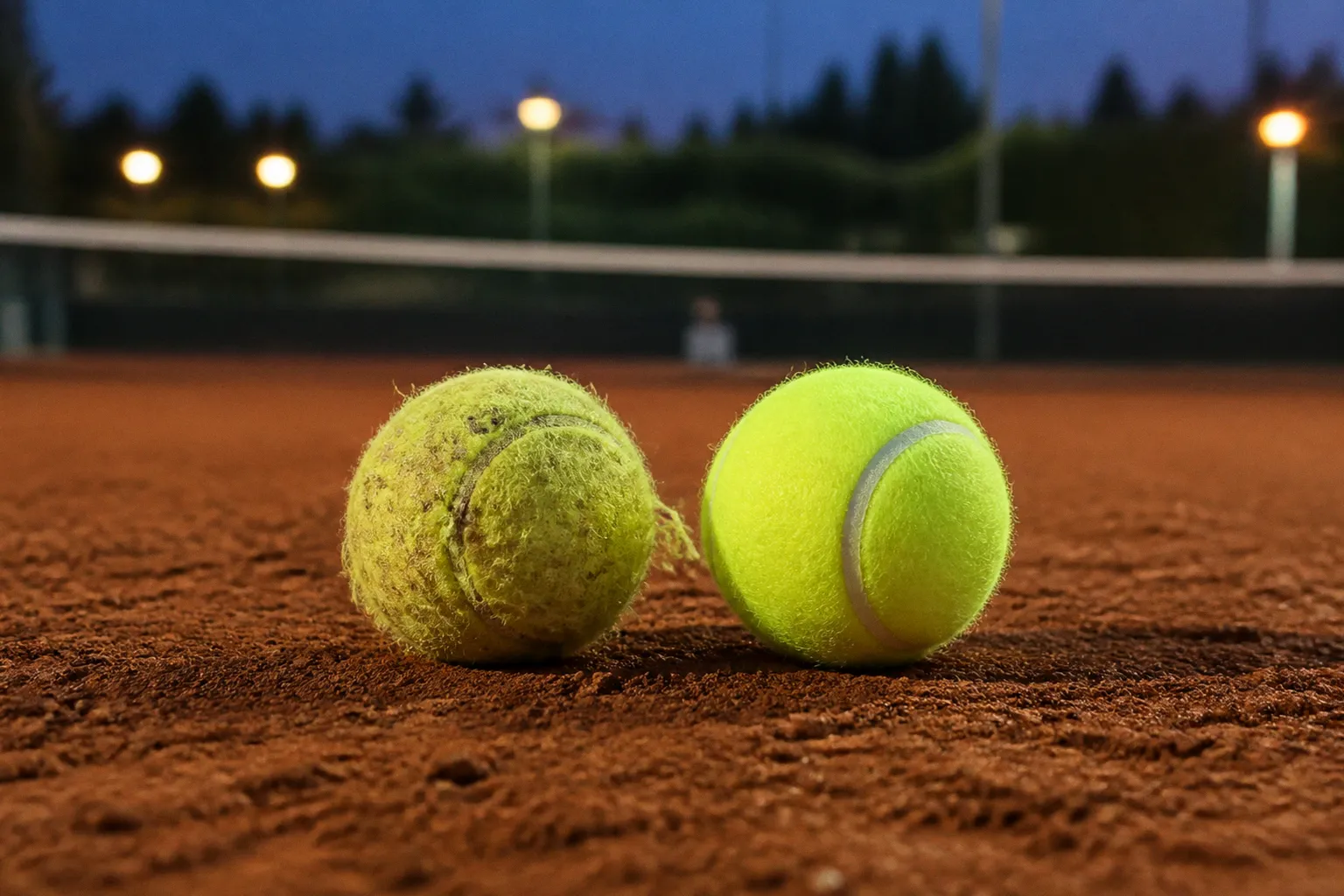
Fresh fuzz creates drag, grips the air, and helps a spinning ball bend through its flight; as that fuzz flattens, the ball leaves the strings with much the same rotation but travels on a different aerodynamic path.
That change is small enough to escape the eye and large enough to change a rally. A worn ball can separate from the air earlier and more symmetrically, reducing the Magnus lift generated by topspin. With the same topspin RPM, it may fly flatter and travel roughly 15 to 25 centimetres farther. At professional pace, that is not a cosmetic difference. It is the space between a heavy crosscourt ball dropping inside the sideline and one arriving long.
The phrase tennis ball wear spin rate change is therefore slightly misleading. Players are not simply responding to a ball that spins less. They are responding to a ball whose surface converts spin into movement less efficiently.
The aerodynamics of fuzz: why a new ball holds the air differently
The felt on a tennis ball is not decoration. It is the ball’s active aerodynamic skin.
A standard pressurized ball contains air or gas at approximately 1.8 atmospheres. That internal pressure governs much of its elasticity and rebound, but the felt governs the way the ball behaves while it is travelling through the court’s atmosphere. The two systems are related, though they should not be confused: pressure influences how the ball comes off the strings and surface, while felt influences how it moves once it is airborne.
A new ball has a pronounced, irregular nap. The individual fibres disturb the boundary layer of air around the sphere, delaying and complicating the point at which the airflow separates from its surface. In practical terms, the ball carries more aerodynamic drag. New tennis balls have a drag coefficient in the region of 0.6 to 0.7, a substantial resistance for an object travelling at serve and forehand speeds.
That resistance is part of the familiar feel of a fresh tournament ball. It does not merely slow the ball. It gives the ball a more active relationship with spin, because the rough felt allows the airflow to respond unevenly around the rotating surface. A topspin ball is not pushed downward by spin in isolation; its rotation changes the pressure and flow pattern around it, producing the Magnus effect. The felt helps make that effect pronounced.
The rough surface also explains why a new ball can feel more substantial on contact. It may grip the strings differently, particularly on a heavily brushed forehand or kick serve, while the air itself continues to resist the ball more strongly after impact. The result is a flight that feels fuller and more contained — not necessarily slower in every phase, but less willing to run through the court without consequence.
As the match advances, the fibres are compressed by repeated contact with strings, court, racket frame, and other balls. On hard courts the abrasion is direct and unforgiving; on clay, the felt also gathers dust and fine grit, which changes its texture and weight in ways players can feel even when spectators cannot. The ball becomes smoother in the aerodynamic sense, even if it looks dirtier to the eye.
The felt is a control surface. When it flattens, the player does not lose spin at the racket alone — the air stops rewarding that spin in the same way.
Magnus effect decay: why worn balls fly flatter
Topspin is valuable because it gives a player access to a steep, controlled trajectory. The racket can send the ball high over the net while rotation encourages the flight to dip back toward the court. This is one of the central bargains of modern tennis: height and speed can coexist when the ball is turning quickly enough to come down.
But topspin does not produce a fixed amount of lift or dip. The aerodynamic response depends on the ball’s speed, rotation, surface condition, and the way the air separates around it. A fresh felt surface promotes a stronger and less symmetrical interaction with the airflow. Once that surface is flattened, separation occurs earlier and in a more uniform pattern. The Magnus effect weakens.
The critical point is that the racket may still be producing the same spin rate. Professional serves can reach rotational speeds of approximately 5,500 revolutions per minute, while heavy groundstrokes can approach 4,700 RPM. Those figures describe what the player puts onto the ball, not what the ball ultimately does with that rotation. A worn ball can retain considerable spin and still fail to dip with the same urgency as a new one.
This is why a player who makes no adjustment may suddenly feel that a familiar forehand is escaping. The stroke has not necessarily broken down. The contact point may be sound, the racket path may be unchanged, and the measured spin could be close to normal. Yet the ball arrives longer because its aerodynamic skin has changed.
The extra distance — around 15 to 25 centimetres in the described conditions, with the same topspin RPM — is enough to expose a tactical weakness. A player who lives close to the baseline and uses the crosscourt angle as a safety corridor has less room than someone constructing high, deep balls through the middle. The first player may see the ball clipping the back of the court; the second may experience only a subtle reduction in margin.
The same wear can also alter the return game. A worn ball travelling flatter may come through the court with less visible dip, making it harder to judge whether a return can be struck aggressively. On the other hand, the reduction in aerodynamic drag can allow the ball to carry farther and arrive more cleanly through the court. It may feel less lively in the hand while still producing a dangerous length after the bounce.
That apparent contradiction matters. Players and commentators often use words such as heavy, lively, dead, fast, and slow as if they describe one property. They do not. A ball can feel less lively off the strings because its felt has lost structure, yet travel farther because drag has declined. It can produce less Magnus lift while still retaining a high measured spin rate. Court speed, ball pressure, temperature, humidity, and felt condition are separate variables that happen to meet inside the same rally.
New balls and worn balls in play
| Feature | New tennis ball | Worn tennis ball |
|---|---|---|
| Felt surface | Raised, irregular, aerodynamically rough | Flattened, compressed, and less disruptive to airflow |
| Drag | Higher; new balls typically have a drag coefficient around 0.6–0.7 | Reduced aerodynamic drag force as the felt wears |
| Magnus response | Stronger interaction between rotation and airflow | Weaker lift and dip from the same nominal spin |
| Ball flight | More contained, with greater trajectory resistance | Flatter and liable to carry farther |
| Tactical demand | Players can trust heavy spin to create margin | Players may need more net clearance or reduced pace |
| Perceived contact | Fuller, grippier, sometimes more substantial | Less textured and often less responsive off the racket |
The table is useful only if it is read as a set of tendencies rather than a verdict on every ball. Surface, temperature, and court material modify the result. A worn ball on a cool, slow clay court does not become tactically identical to a worn ball on a warm hard court. The physics travels with the conditions.
The nine-game cycle and the tactical meaning of a ball change
Professional tournament ball changes typically occur after the first seven games, counting the warm-up, and then every nine games thereafter. The purpose is to preserve a more consistent playing object across the match, not to create a perfectly new-ball environment from one changeover to the next.
That distinction is important. The first ball change arrives early because the initial set of balls has already absorbed the warm-up and the opening games. Subsequent intervals account for the way felt performance degrades under repeated impact. By the later stages of a set, the difference between the balls in play and the balls waiting in their canister can be tactically visible.
A ball change is therefore not a neutral interruption. It can reset the geometry of a match.
A player who has spent several games driving through a worn ball may suddenly find that the fresh replacement holds the air longer and responds more sharply to topspin. The same forehand trajectory now drops sooner. The same serve may kick more aggressively. A returner who had been standing inside the baseline may need to reconsider the amount of space available for attacking contact.
Conversely, a player who has built a lead by using high-margin spin can lose some of that advantage when the ball becomes worn. Their heavy forehand still rotates, but the ball does not receive the same aerodynamic assistance. If the opponent has been defending from well behind the baseline, the flatter, longer flight may actually help the defender turn defence into neutral court position.
This is the ball change rule’s tactical impact in miniature: it changes not only the quality of the ball but the reliability of the patterns built around it.
Several match situations reveal the effect particularly clearly:
1. A heavy crosscourt forehand becomes less safe.
The ball may clear the net at the same height and leave the racket with similar spin, but its reduced lift response can keep it in the air longer and carry it toward the baseline. Players often compensate by lowering pace, increasing net clearance, or closing the racket face slightly through the strike.
2. The serve-plus-one pattern changes its margin.
A fresh ball may reward a kick serve with a more pronounced upward-and-outward movement, while an older one can flatten the serve’s response. The server may have to choose between more spin and less speed, or accept a larger return zone in exchange for pace.
3. Short angles become harder to trust.
An angled shot depends on both lateral movement and a controlled descent. When the ball flies flatter, the angle can remain sharp but the landing point may extend beyond the intended target. The court has not become smaller; the ball has become less forgiving.
4. The return becomes a problem of depth, not just speed.
A worn ball can come off the returner’s strings without the same pronounced dip, so a compact swing may produce unexpected length. A player who normally blocks a first serve back deep may need a softer hand or a more conservative target.
5. The first two games after a change are an information phase.
Elite players are not merely feeling whether the ball is new. They are testing how much their usual trajectory survives the change. The adjustment may appear as a few safer targets, a higher contact tolerance, or a temporary refusal to attack the extreme corner.
This is one reason a match can seem to change rhythm without any visible technical collapse. The players are recalibrating against a new aerodynamic object. Their footwork, spacing, and shot selection are responding to a physical alteration that television cameras rarely explain.
Adjusting stroke mechanics when the felt loses efficiency
There is no universal correction for an old ball. The right response depends on a player’s existing racket path, contact height, court position, and tolerance for risk. A clay-court grinder and a first-strike hard-court player may confront the same wear but solve it through opposite adjustments.
The broad principle is straightforward: if the ball is flying flatter and farther, the player must restore margin somewhere. That margin can come from trajectory, speed, spin input, target selection, or court position.
1. Add height before adding more force
The first adjustment is often the least dramatic. Raising the ball’s trajectory gives it more time and distance in which to descend, offsetting the reduction in Magnus lift. This does not mean floating the ball defensively. A player can add a modest amount of net clearance while preserving a firm, penetrating contact.
The danger is to confuse height with safety automatically. A ball that is higher but under-rotated may still travel long, especially when struck from inside the baseline. The useful adjustment is a higher arc supported by enough racket-head speed and a clean upward path — not a passive lob disguised as a rally ball.
2. Change the target, not only the swing
Many corrections occur in the mind before they occur in the racket. A player may keep the same stroke but aim a little farther inside the sideline or a little shorter of the baseline. This is particularly sensible when the opponent is not threatening from the current pattern and there is no tactical need to use the full width of the court.
The change may be barely visible: a forehand aimed two feet inside the baseline rather than one, a crosscourt ball directed more through the opponent’s strike zone, or a backhand return sent deep to the middle instead of toward the narrow outside channel. These are small choices, but professional tennis is built from small choices repeated under pressure.
3. Preserve spin through contact rather than forcing it with the wrist
When the ball begins to fly, an understandable reaction is to snap the wrist harder or close the racket face abruptly. That can create a second problem. The player may increase local racket speed while losing the stable, forward-through contact that gives the shot shape.
The more reliable adjustment is usually to preserve the existing swing structure — spacing, shoulder rotation, contact in front — and allow the racket to travel with slightly more upward intent. The goal is not to manufacture a new stroke in the middle of a set. It is to make the same stroke produce a trajectory with enough clearance for the ball’s altered aerodynamic response.
For a player who already generates extreme spin, reducing pace can be more effective than attempting to increase RPM. The exact amount of adjustment varies by individual, and there is no dependable universal percentage for how much spin a particular professional must add or remove during a nine-game cycle. The ball’s flight is the information; the stroke is the answer.
4. Move forward when the ball is no longer dipping as sharply
A flatter ball can make the baseline feel more exposed, but it may also offer an opportunity. If an opponent’s heavy shot is losing some of its downward bite, taking the ball earlier can prevent it from travelling deep into the court. The adjustment is not automatically to retreat. Sometimes the correct response to a worn ball is to claim time before its longer flight becomes a problem.
This is especially relevant for strong returners. A compact block or abbreviated drive may be enough to redirect a ball that previously demanded a higher, more defensive shape. The returner must still respect the speed, but the reduced dip can make early contact more practical.
5. Use the court surface as part of the calculation
Ball wear cannot be separated from the court beneath it. Clay slows the ball through friction and produces a different bounce profile from a hard court. Grass, with its lower and more variable bounce, places greater value on first-strike timing. Hard courts provide a clearer, more stable exchange between ball speed, felt condition, and court contact, though temperature and surface pace remain influential.
On a slower surface, the longer flight of a worn ball may be absorbed by the court before it becomes a decisive depth problem. On a quicker surface, the same loss of drag can reward a flat hitter and punish a player whose margins depend on pronounced dip. The ball change is the same; the tactical expression is not.
Internal pressure, rebound, and the limits of what felt can change
The outer felt receives most of the attention in discussions of ball wear because its change is visible and its aerodynamic effects are immediate. But the pressurized interior remains essential to the ball’s identity.
At approximately 1.8 atmospheres, the air or gas inside the ball supplies the restoring force that makes the ball rebound from racket and court. As a tournament ball is struck repeatedly, its overall response can become less lively. That decline is not identical to felt wear, and it should not be folded into the same explanation. A ball can lose some rebound character while also losing aerodynamic drag through flattened felt.
For the player, however, these changes arrive together. The ball may feel less crisp at contact, yet travel farther through the air. It may leave the racket with less obvious liveliness but penetrate the court more cleanly. This is why subjective descriptions can appear contradictory without either player or commentator being wrong.
Pressure affects the moments around impact:
- A more lively ball can rebound from the strings and court with greater energy, making pace easier to generate.
- A less lively ball may feel softer or heavier, requiring the player to create more of the shot’s speed.
- Felt wear changes the ball’s airborne behaviour, influencing drag, separation, and the Magnus response.
- Court friction and bounce then determine how much of that airborne difference survives after contact with the surface.
The professional player does not isolate these variables with laboratory equipment during a changeover. They infer them from contact: the sound, the depth, the way the ball leaves the opponent’s racket, and the amount of effort required to produce a familiar trajectory. The body is an imprecise but highly experienced measuring instrument.
Data can refine that perception. Shot-tracking systems may identify changes in depth, speed, spin, and bounce location, while broadcast analysis can show whether a player’s rally ball is landing shorter or longer than earlier in the match. But data should explain the tactical adaptation rather than replace it. A graph may show that a ball is carrying farther; the player still has to decide whether the answer is a higher forehand, a safer target, earlier contact, or a different court position.
The best adjustment to an old ball is rarely a spectacular technical change. More often, it is a quiet relocation of margin — a little more air, a little less corner, a little earlier contact.
Reading the ball change from the match itself
Because tournament ball changes are scheduled rather than triggered by a visible failure, their influence can be easy to miss. The umpire announces the new balls, the exchange continues, and the scoreboard records no special event. Yet the next several games often contain evidence for anyone watching closely.
Look for a shift in how deeply players stand. A returner who had been taking the ball on the rise may take one step back, not because the serve has become better but because the new ball carries differently through the court. A baseline player may begin selecting the body or middle target more often, using court geometry to protect against a ball that is less willing to dip toward the intended corner.
Also watch the shape of the rally ball. Fresh balls can encourage players to use height and spin with confidence, particularly when the court is quick enough for the bounce to reward a heavy trajectory. As the felt wears, some players flatten out because the ball no longer provides the same return on their spin investment. Others do the reverse, adding shape precisely because the ball has begun to run long.
The important distinction is between spin production and spin efficiency. A player may still brush the ball aggressively and generate a high rotation rate. But if the worn felt produces less Magnus lift, that rotation does not create the same amount of margin. In a sport where a few centimetres decide whether a ball is playable, the efficiency of spin can matter as much as the quantity.
This also explains why two players can react differently to the same ball change. The flatter hitter, whose game is already based on direct pace and compact trajectories, may benefit from a ball that travels farther with less drag. The high-spin player may need to spend more energy restoring the shape that used to arise naturally from the ball’s surface. A player with excellent court positioning can take the altered flight early; a player who relies on time and retreat may find the ball’s extra carry uncomfortable.
The surface condition becomes a tactical event, but never an independent one. It interacts with serve placement, return depth, rally tolerance, court position, and the physical condition of the players themselves. Late in a long match, a worn ball may be only one reason a forehand begins to miss — but it can be the reason that a previously stable margin disappears.
The material reality behind the score
Tennis has always been described through human qualities: courage on break point, patience in the rally, nerve under pressure. Those descriptions remain true, but they sit on top of a material system that is constantly moving beneath the players. Court grit, atmospheric density, string tension, ball pressure, felt friction, and the changing response of the surface all participate in the outcome.
Ball wear is one of the clearest examples because it follows a visible rhythm. The first seven games and the next nine-game intervals create a quiet timetable inside the match, a succession of physical states that players must read without being told exactly what has changed. New balls offer stronger aerodynamic resistance and a more pronounced relationship between spin and flight. Worn balls flatten that relationship, reducing Magnus lift and allowing the same nominal topspin to carry farther.
The practical lesson is not that players should chase an abstract ideal spin rate. It is that spin must be interpreted through the ball that receives it. The racket supplies rotation, but the felt decides how generously the air responds. When that generosity declines, the player who notices first can protect the baseline, preserve the right trajectory, and turn a subtle equipment change into a tactical advantage.
In professional tennis, the margin is often not lost in the dramatic moment. It is lost earlier — when a ball travels a few extra centimetres, when a forehand dips a fraction less, when a returner trusts yesterday’s trajectory for one shot too long. The felt wears quietly. The match does not.