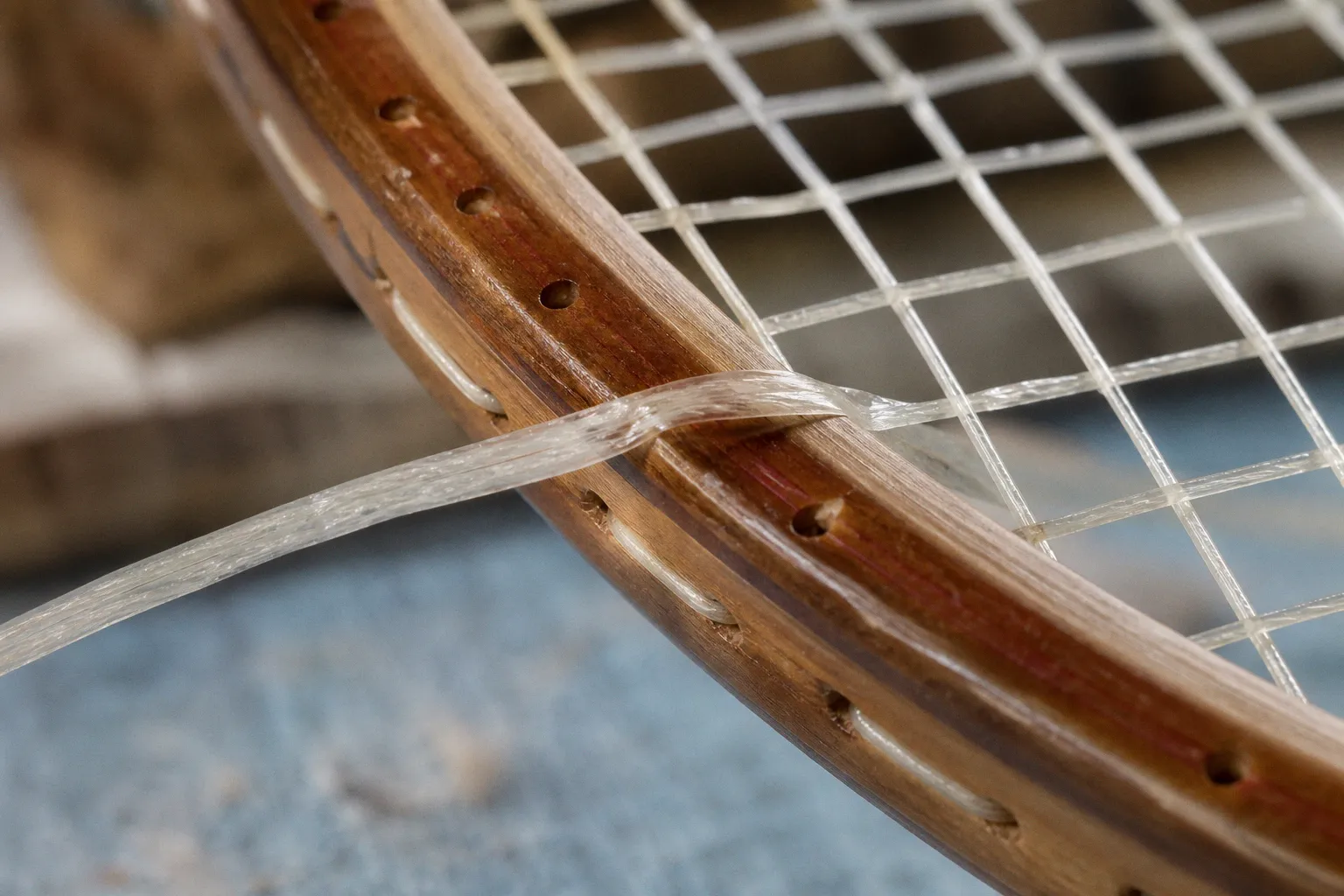
The finished string appears almost weightless—a pale, tightly wound filament crossing the racquet face in a measured grid—but its making begins with the serosa, the collagen-rich outer membrane of a cow’s small intestine, and continues through washing, slitting, twisting, tensioning, drying, curing, and protective finishing over several weeks.
That length of preparation is part of the story. A synthetic string can be extruded as an industrial polymer product; natural gut must be persuaded into consistency from an organic material whose elasticity is valuable precisely because it is not mechanically uniform in the way nylon or polyester is. The result is a string with an unusually soft response, strong tension maintenance, and a particular kind of contact with the ball—one that players often describe through feel before they describe it through numbers.
The 1875 genesis: from musical strings to the court
The history of natural gut tennis strings begins in Lyon, France, in 1875, when Pierre Babolat manufactured the first natural gut string for tennis. The material was not invented for the tennis court. Babolat’s early work grew out of the production of strings for musical instruments, where animal gut had already been valued for its combination of resilience, tensile strength, and responsiveness.
That origin matters because it places the tennis string inside a much older European craft tradition. Before racquet strings became part of an equipment catalogue—with gauges, coatings, colors, tension recommendations, and carefully differentiated product families—the material was understood through touch and behavior. It had to hold tension without becoming lifeless, flex repeatedly without immediate fracture, and transmit vibration in a way that allowed the player to sense the strike.
Early natural gut was made from sheep intestines. This is one of the details most often blurred by the old term “catgut,” which is an etymological misnomer rather than a description of the material used for tennis strings. Cats were not the source of the gut. The name belongs to a much older and uncertain linguistic history, while the actual manufacturing tradition relied on livestock intestines selected and prepared for their fibrous structure.
Babolat’s VS brand arrived in 1925, establishing a product identity that would become closely associated with high-end natural gut. By then, gut had already become more than a practical solution for stringing racquets. It had begun to define what a responsive racquet could feel like in the hand, especially as players and manufacturers learned to work with differences in diameter, tension, racquet head size, and playing conditions.
The court itself was changing as well. Grass, clay, and early hard surfaces placed different demands on movement and ball contact, while racquet construction gradually moved away from the compact wooden frames of the nineteenth century. Through all of those changes, natural gut remained valuable because it adapted to the player rather than imposing a single, rigid response.
Natural gut survived the arrival of modern materials not because it belongs to the past, but because its physical behavior remains difficult to reproduce.
The serosa secret: why beef intestines define modern feel
Modern natural gut is made primarily from the serosa—the outer membrane layer of the small intestine of cattle. This layer is prized for its high collagen content and tensile elasticity. Collagen gives the material a fibrous organization that can be separated, aligned, twisted, and dried into a resilient string while retaining a degree of natural flexibility.
The transition from sheep gut to beef gut took place in the 1950s. Cow intestines offered thicker strands and better tensile durability, making them more suitable for the increasing demands of modern racquet sports. The change was not simply a matter of supply or scale. It altered the material platform of natural gut itself, allowing manufacturers to produce strings with greater resistance to repeated impact while preserving the elastic response for which gut had become known.
One set of natural gut racquet string requires the serosa harvested from approximately two to three cows. That figure gives the product a physical gravity that is easy to forget once the string has been installed. A finished set is not a single continuous strip taken from one perfectly uniform membrane; it is the result of assembling many narrow ribbons into a stable strand.
The process begins with the intestines being cleaned and prepared, then slit into long ribbons. These ribbons are washed in chemical and sterilizing baths, removing unwanted biological material and preparing the collagen structure for further handling. The ribbons are then layered and twisted—roughly fifteen to eighteen of them in a single strand—under controlled tension.
This is where the artisanal character becomes especially clear. The material cannot simply be pushed through a machine and expected to behave like a homogenous plastic filament. The ribbons must be aligned, tensioned, and combined so that the finished string has a dependable response across its length. Small variations in the raw material have to be managed through handling, selection, and repeated stages of preparation.
The word “natural” therefore does not mean untreated. Natural gut is thoroughly processed, cleaned, sterilized, twisted, dried, and protected. Nor does it mean invulnerable. Modern strings may receive polyurethane coatings and other protective treatments, but they are not completely moisture-proof. Their organic structure remains part of both their performance and their vulnerability.
A player who notices natural gut only when it breaks is missing half of the material’s identity. Gut announces itself earlier—in the way the ball settles briefly into the string bed, in the reduced harshness of an off-center contact, and in the sense that the racquet face is returning energy without making the hand absorb all of the collision.
The Ploërmel standard: inside the three-to-six-week curing ritual
More than 90 percent of the world’s natural gut tennis strings are produced by Babolat at its dedicated site in Ploërmel, Brittany, France. That concentration is remarkable for a product often treated as a niche accessory. It means that much of the world’s remaining natural-gut tradition passes through one specialized manufacturing center, where old material knowledge is combined with industrial quality control.
The time required is equally striking. After the ribbons have been cleaned, prepared, and twisted under tension, the strands are dried in humidity-controlled rooms for as long as three to six weeks. The curing period is not a decorative pause in the process. It is central to the way the collagen structure settles and the string acquires its final mechanical properties.
The initial strand is cut to approximately 42 feet, with around two feet lost during manufacturing. That extra length allows the production process to account for trimming and handling before the final set is prepared for installation. It is a small practical detail, but it reveals how different natural gut is from the idea of a simple length of cord. The material must be coaxed into a usable form, and every stage leaves a measurable consequence.
Humidity is particularly important. The exact temperature and relative humidity parameters used in proprietary drying rooms are not publicly established in the available production descriptions, but the existence of humidity-controlled drying itself tells us what the manufacturers are managing: a biological material whose moisture content affects stability, flexibility, and durability.
This is also why natural gut has always required more care in the hands of players and stringers. A damp court, heavy ball, wet playing conditions, or careless storage can interfere with the material’s protective surface and expose the inner structure. A synthetic string may tolerate neglect with little visible change. Gut tends to keep a more direct record of its environment.
That sensitivity is often described as a weakness, and in practical terms it can be one. Yet the same organic responsiveness contributes to the string’s appeal. Natural gut does not merely resist deformation; it flexes and returns with a particular liveliness. It is a material whose strengths and limitations come from the same source.
From membrane to racquet face
The manufacturing sequence can be understood through a few essential stages:
1. Selection of the serosa — the outer membrane of the cow’s small intestine is chosen for its collagen content and tensile potential.
2. Slitting into ribbons — the prepared material is divided into long, narrow strips that can be layered and assembled.
3. Chemical washing and sterilization — baths clean the ribbons and prepare them for the mechanical stages of production.
4. Twisting under tension — roughly fifteen to eighteen ribbons are combined into a single strand, creating the structure of the finished string.
5. Controlled drying and curing — the twisted strand remains in humidity-controlled rooms for up to three to six weeks.
6. Finishing and cutting — the material receives protective treatment, is cut from an initial length of about 42 feet, and prepared for racquet installation.
The order is important. Elasticity is not added at the end like a coating or a marketing feature. It is preserved through the way the collagen fibers are handled from the beginning.
Collagen versus polymer: the physics of playability
The appeal of natural gut is often reduced to the word “feel,” but that word becomes more useful when connected to the material’s behavior. Natural gut strings are highly elastic, which allows them to deform under impact and recover efficiently. They can maintain tension unusually well compared with many synthetic alternatives, and that stability helps preserve the racquet’s original response over time.
This does not mean gut automatically produces more power in every racquet, at every tension, for every player. Equipment is a system. Frame stiffness, head size, string pattern, gauge, tension, ball type, swing speed, and contact quality all shape the result. But gut gives that system a particular softness and depth of response that players often recognize immediately.
The ball does not seem to vanish into the string bed; rather, the contact feels more coherent. There is a sense of compression without the brittle shock that can accompany a stiff monofilament. The string bed can return energy generously while still allowing the player to feel the direction and quality of the strike.
A comparison with common synthetic categories helps clarify the distinction:
| Characteristic | Natural gut | Multifilament synthetic | Polyester monofilament |
|---|---|---|---|
| Core material | Collagen-rich bovine serosa | Bundled synthetic fibers | Extruded synthetic polymer |
| Tension maintenance | Exceptional among tennis strings | Generally good, depending on construction | Often declines more noticeably over play |
| Impact response | Soft, elastic, highly responsive | Comfortable and lively | Firmer, more controlled, often more demanding |
| Touch and vibration | Rich, muted, finely differentiated | Comfortable with a softer response | Crisp, direct, and sometimes harsher |
| Moisture sensitivity | Meaningful; protective coating does not make it fully waterproof | Usually lower | Usually lower |
| Typical attraction | Elasticity, comfort, tension stability | Comfort at a lower cost | Spin potential and directional control |
Synthetic strings can reproduce individual features of natural gut. A high-quality multifilament can offer comfort and a forgiving response; a shaped polyester can provide pronounced ball rotation and predictable control. What is difficult to duplicate is the whole combination—the material’s elasticity, tension retention, softness, and subtle feedback arriving together.
That is why natural gut has remained relevant even as modern string technology has expanded. It is not simply the softest option, nor is it universally the most powerful. Its particular strength lies in preserving a stable, responsive string bed over a longer playing life than many soft synthetics can manage.
The player’s strategy changes with that stability. Touch shots can be played with less fear of a deadened response. Volleys retain a feeling of substance rather than collapsing into a hollow rebound. On serve, the string bed can provide pace without forcing the arm to absorb every gram of impact. On groundstrokes, the result depends heavily on the racquet and tension, but gut often rewards a player who varies trajectory and speed rather than striking every ball with the same mechanical violence.
The VS story and the move toward bovine strength
The history of Babolat VS gut is inseparable from the wider history of natural gut tennis strings. The VS brand, launched in 1925, helped establish a recognizable standard for a material that had previously been identified more by craft tradition than by a modern consumer label.
The later shift from sheep gut to cow gut in the 1950s was a decisive moment. Sheep intestines had supported the early development of the string, but bovine serosa offered the thicker strands and tensile durability needed for the changing game. Racquets were becoming more powerful, players were striking with greater pace, and the demands placed on the string bed were increasing.
This transition also reflects a recurring pattern in tennis equipment history: the sport modernizes not by discarding its oldest materials outright, but by refining them until they can survive a new scale of force. Natural gut did not remain unchanged. Its source material evolved, its manufacturing became more controlled, and its protective treatments improved. Yet the central principle remained the same—align collagen-rich organic fibers so that they can absorb, store, and return energy with unusual grace.
That continuity explains why gut still occupies a curious position in the modern game. It is a historical material used in contemporary competition, often alongside polyester rather than instead of it. Hybrid stringing has made this especially visible: natural gut can be paired with a firmer synthetic string to balance comfort, power, spin, and control. The combination does not erase the differences between the materials. It makes them work against and with one another across the racquet face.
The resulting racquet is not an archaeological object. It is a present-day instrument built from a conversation between industrial polymer science and an older animal-fiber craft.
The enduring mystery of natural gut is not that it feels old-fashioned; it is that a material with such an ancient origin still answers modern pace with such composure.
Why the material still belongs to tennis history
Natural gut strings carry more history than most pieces of tennis equipment. A racquet frame can be admired for its shape, a ball for its surface, a garment for its era-specific cut. Gut is harder to see, but it has participated directly in the physical grammar of the sport: the softened volley, the held serve, the dipping approach, the delicate change of pace that depends on a string bed remaining alive beneath the hand.
Its story also resists the easy division between traditional and modern. The production of natural gut is highly specialized and industrial in scale, yet it remains dependent on processes that require time, selection, tension, and careful environmental control. Its modern form is not a preserved antique. It is an updated craft product, made from bovine serosa rather than sheep gut, protected by contemporary coatings, and produced with standards that early string makers could not have imagined.
For players, that history becomes physical. It appears as tension that lasts, a response that does not immediately flatten, and a level of comfort that can change how aggressively the racquet is used. For observers of tennis culture, it offers another way to read the game—not only through champions and scorelines, but through the materials that made certain styles possible.
Natural gut does not belong to every racquet or every playing environment. Its moisture sensitivity, cost, and delicate surface demand attention. But those limitations are not evidence of obsolescence. They are reminders that performance has never been only a matter of maximum durability. Tennis has always been shaped by negotiation: between grip and slide, force and touch, friction and release, the body and the surface beneath it.
The string crossing the racquet is where many of those negotiations become audible to the hand. Natural gut remains compelling because it preserves them with an unusual clarity—through collagen, tension, and the patient passage of weeks from intestine to court.