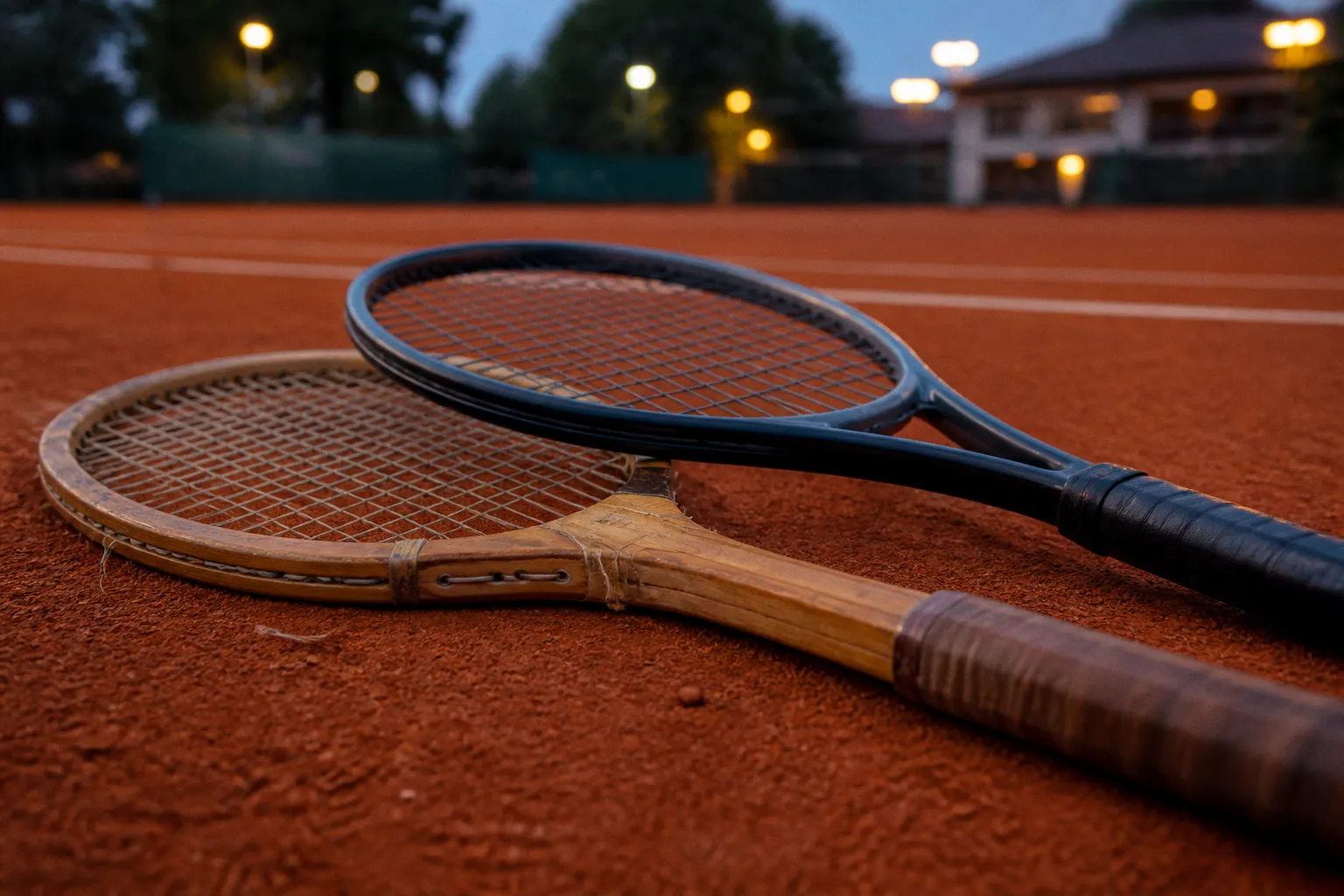
By the end of the decade, the competitive baseline had been rebuilt around graphite composite frames, larger heads, higher swing speeds, and more accessible topspin.
The equipment change was not cosmetic. A traditional wooden racket weighed roughly 400–500 grams and offered a head of approximately 65–85 square inches. A modern composite frame can reach about 250 grams. The difference altered the speed of the swing, the location of the contact point, the tolerance for technical error, and the positions from which players could attack.
The wood vs graphite rackets tennis history debate is usually presented as a dispute over taste. It is more accurately a dispute over court geometry. Wooden frames rewarded one set of solutions. Graphite frames made another set more efficient.
The weight of tradition: life with the 500-gram frame
A wooden racket was not simply a heavier version of a modern racket. Its structure imposed a different sequence of decisions.
Traditional frames were made from laminated timbers such as ash and maple. The standard shape was narrow. Vintage dimensions were approximately 9 inches across and 27 inches long. The head was small, and the sweet spot was correspondingly limited. Contact outside that area produced a clear penalty: reduced pace, unstable trajectory, and often a frame shot.
The player had to arrive at the ball with the racket face already organised. There was little margin for late preparation. The contact point could not drift far behind the body without compromising the stroke. Footwork was not an aesthetic accessory. It was the mechanism that placed the ball inside a small technical window.
That window affected court positioning.
A player using wood could not consistently defend from several metres behind the baseline and recover with a high-rpm ball. The frame did not provide enough head speed or sweet-spot tolerance to make that pattern efficient. The practical response was to take the ball earlier, shorten the backswing, use the slice, or move forward.
This did not make the game slow in every phase. It made the game more conditional. A short ball could be attacked, but the attack required a precise setup. A passing shot had to clear a narrow tactical channel. A volley was not merely a finishing stroke; it was a way to avoid extending a baseline exchange that placed increasing demands on timing.
The Dunlop Maxply Fort, associated with Rod Laver and used early in John McEnroe’s career, represents this technical environment. The Wilson Jack Kramer, used by Arthur Ashe and Billie Jean King, belongs to the same equipment logic. These rackets were not neutral tools. They directed the player toward early preparation, compact control, and a court position close enough to reduce the opponent’s available angles.
A wooden racket also made the serve-and-volley pattern structurally logical. The serve created the first advantage. The player moved forward before the returner could establish a neutral rally. At the net, the task was not to produce maximum racket-head speed. It was to present a stable face and redirect the ball into open space.
That distinction matters. The wooden racket did not create finesse by itself. It made certain forms of finesse more economical than extended high-speed baseline exchanges.
Wood did not make players more precise. It made imprecision more expensive.
The common image of wooden-era tennis often compresses several separate features into one claim: smaller rackets, flatter shots, shorter points, more touch, better footwork. The equipment explains part of that pattern. Court surfaces, training methods, string technology, tactical conventions, and player selection also mattered.
Still, the frame set the lower boundary for acceptable contact. A player could not build a reliable game around hitting late and recovering through racket speed. The error margin was visible in every exchange.
The 1983 threshold: Yannick Noah and the final wooden stand
The year 1983 is useful because it marks a competitive endpoint, not because tennis changed overnight.
Yannick Noah won the French Open with a wooden racket. Chris Evert also won a Grand Slam singles title with wood that year. These victories establish two facts that are often lost in simplified accounts of the graphite racket revolution.
First, wooden rackets were not immediately obsolete. They remained capable of producing elite results. Second, the transition was already underway while wood was still winning major tournaments.
The most accurate description is not replacement but selection pressure. Graphite frames offered a higher stiffness-to-weight ratio. They flexed less than laminated wood and transferred more of the player’s swing into ball speed. Their larger head sizes expanded the sweet spot. Their lower weight allowed higher swing speeds without requiring the same mass through the stroke.
That combination changed what a player could attempt repeatedly.
A late contact point became less destructive. A defensive swing could produce more depth. A player could move farther from the baseline and still send the ball high over the net with enough rotation to push the opponent back. The tactical map expanded backward before it expanded forward.
This is the key point in the classic vs modern tennis style comparison. Graphite did not merely create harder shots. It increased the number of court positions from which a player could remain operational.
With wood, a technically compromised ball was often a neutral or defensive ball. With graphite, the same compromise could become a heavy, deep, spinning reply. The racket did not erase the technical mistake. It reduced its immediate cost.
The 1983 results also complicate the idea that graphite simply defeated a weaker technology. The final wooden Grand Slam champions were not examples of players waiting for an outdated game to disappear. They were evidence that the older method remained viable when paired with exceptional timing, movement, and tactical discipline.
The question is therefore not whether wood could still win. It could. The question is whether it could support the volume and margin required by the emerging game.
The answer became increasingly negative.
Engineering the revolution: from laminated ash to the Max 200G
The construction process explains why the transition had tactical consequences.
Laminated wood produced a frame with substantial mass and a particular flex profile. That flex was not equivalent to control in every situation. It also absorbed part of the energy generated by the swing. The player received a more limited return on a fast motion.
Graphite composites changed the ratio between weight and stiffness. The frame could be lighter while remaining structurally rigid. The player could accelerate the racket more easily, and the ball could leave the strings at a higher speed. A larger head could be added without creating the same handling burden as a comparably enlarged wooden frame.
The Dunlop Max 200G, launched in 1980 as an injection-molded graphite model, became a benchmark during this period. John McEnroe used it. Steffi Graf used it during her 1988 Golden Slam season. Its significance lies less in its status as a single famous model than in what it demonstrated: graphite was not a laboratory experiment. It was a durable platform for elite-level control and power.
The material change altered the relationship between player input and ball output.
| Parameter | Traditional wooden frame | Graphite composite frame |
|---|---|---|
| Typical weight | Approximately 400–500 g | Modern composite frames can reach about 250 g |
| Head size | Approximately 65–85 sq in | Larger heads became practical |
| Sweet spot | Narrow and demanding | Expanded by head size and frame design |
| Frame response | Greater flex and lower energy transfer | Higher stiffness-to-weight ratio |
| Swing demand | Heavy preparation and precise timing | Higher racket-head speed with less mass |
| Tactical effect | Early contact, compact strokes, forward positioning | More topspin, deeper defence, and wider baseline options |
The table does not describe a simple movement from inferior to superior equipment. It describes a change in the cost structure of a tennis stroke.
A wooden frame asked the player to supply more stability and timing. A graphite frame supplied more stability through the construction itself. A wooden frame limited the payoff of a rushed swing. A graphite frame made that swing more productive.
This is where the phrase graphite racket revolution tennis becomes technically meaningful. The revolution was not only about power. It was about repeatability. The modern frame allowed a player to reproduce a high-speed stroke under pressure with a larger tolerance for imperfect contact.
The change also affected the serve. A lighter, stiffer frame could be accelerated more rapidly through the contact zone. That raised the potential for pace and spin. The serve could be struck with more racket-head speed while preserving a level of directional control that a smaller wooden head made more difficult to sustain.
The return changed as well. A player could block a hard serve with a larger face and send the ball back with sufficient depth to avoid immediate attack. The returner did not need to create all the pace. The frame could redirect part of the incoming speed.
This reduced the relative advantage of serve-and-volley tennis. It did not eliminate the volley. It made the first volley harder to reach and the passing shot more difficult to contain.
The geometry of change: how stiffness replaced some of the touch-based game
The tactical consequences become clearer when the court is treated as a coordinate system.
A wooden-era player generally wanted to establish the contact point in front of the body and near the baseline. The small head and heavy frame punished delay. The player’s feet had to create the stroke rather than allowing the arm to compensate after the ball had passed the ideal position.
Graphite increased the usable area of the court. A player could defend deeper. The extra time created by distance allowed more rotational loading and a larger swing path. The larger head reduced the penalty when the contact point moved away from its optimal location.
This produced the modern baseline sequence:
1. Recover several metres behind the baseline when necessary.
2. Use the extra distance to organise the swing.
3. Generate high racket-head speed.
4. Apply topspin to raise net clearance and preserve depth.
5. Recover laterally while the ball travels with greater vertical and rotational margin.
That sequence was not impossible with wood. It was inefficient. Graphite made it repeatable.
The ball’s apex also became a more important tactical variable. A higher-rpm shot could travel with a larger safety margin over the net and still drop inside the baseline. The player could create depth without relying on a flat trajectory that left little room for error.
This changed the value of court position. Being behind the baseline was no longer automatically a sign of tactical failure. It could be a stable operating position. A player with sufficient topspin could defend from depth, wait for a shorter reply, and then move forward on a more favourable ball.
The forward game became more selective. Instead of approaching because the frame and tactical system demanded it, the player approached when the ball quality justified the risk. That is a major difference.
The wooden frame favoured a relatively direct relationship between advantage and movement: serve, approach, first volley. The graphite frame supported a more elastic pattern: absorb pace, create rotation, change direction, then take the court when the opponent’s recovery position had deteriorated.
This is why calling graphite a power technology is incomplete. It was also a positioning technology.
The frame changed the distances at which a player could remain in the point. It altered the required recovery steps. It changed the acceptable height over the net. It modified the timing of the contact point. These are tactical variables, not product specifications.
Beyond the frame: did we trade finesse for raw RPMs?
The argument that modern rackets killed tennis artistry depends on a narrow definition of artistry.
If artistry means the visible dominance of flat hitting, touch volleys, low slices, short angles, and constant forward movement, then the wooden racket had a stronger institutional role. Its design made those solutions practical. The player had to solve the point with timing and placement because the frame could not always solve the contact problem.
If artistry means the ability to manipulate trajectory, spin, height, speed, and court position, then modern tennis has not removed artistry. It has made it less immediately legible. The skill is embedded in the ball’s rotation and in the player’s control of space.
A high-rpm forehand is not automatically expressive. It is a mechanical output. But the decision to use it crosscourt, the choice of apex, the depth of the landing point, and the recovery position that follows are still tactical acts. The larger frame expands the available options. It does not make the options correct.
The data available from equipment history supports a clear conclusion about the physical game. Graphite increased ball speed and playability. It permitted higher swing speeds and more topspin. It expanded head sizes and sweet spots. It reduced the penalty for off-centre contact.
The data does not support the stronger cultural claim that artistry disappeared. That claim cannot be established through frame weight, head size, or stiffness. It is an aesthetic judgement. The available evidence shows a change in the conditions under which skill was displayed.
There is also a false opposition between power and touch. Graphite did not eliminate drop shots, lobs, volleys, or changes of pace. It changed the stroke dynamics around them. A modern drop shot may be disguised behind the same preparation used for a heavy topspin drive. A modern lob can be produced from a defensive position that would have been less viable with a narrow wooden head. A volley still depends on racket-face stability, but the ball arriving at the net carries different speed and rotation.
The touch shot survives because touch is not a material property. It is a decision about pace and trajectory.
What changed was the baseline from which that decision could be made.
Graphite did not remove finesse. It moved the technical contest backward, increased the available swing speed, and made spin a primary form of control.
The cultural memory of wooden tennis remains strong because the equipment made technique visible. The small head exposed the contact point. The heavy frame exposed preparation. The low-margin stroke exposed footwork. Modern composite frames conceal part of that labour by returning more energy and accepting more variation.
That concealment can look like a reduction in skill. It is more precise to call it a redistribution of skill.
The player now has to control a faster ball with more rotation, often from a more distant position, while managing a wider set of possible trajectories. The contact window is larger in one sense and more demanding in another. A modern forehand may be easier to execute than a wooden forehand at moderate pace. It is not easy to execute against a high-quality opponent who changes direction, height, and depth under pressure.
The wooden racket legacy is not a technical instruction manual
There is a temptation to treat wooden rackets as corrective devices. Use a small head. Add weight. Relearn the slice. Recover the old game.
That approach mistakes equipment history for a prescription.
Wooden frames produced a specific tactical environment. They did not produce a superior form of tennis in every dimension. Their narrow sweet spots demanded precision, but demand is not the same as quality. Their weight limited swing speed, but limitation is not automatically control. Their flex supported certain strokes while reducing the efficiency of others.
The final Grand Slam victories of Noah and Evert in 1983 demonstrate that the older system remained effective at the highest level. The appearance and durability of graphite models such as the Max 200G demonstrate why the balance shifted. The new frames offered more speed, more playable head area, and more options for generating depth and topspin.
The transition also shows why technology debates in tennis rarely settle the matter. Every frame changes the tactical environment. The question is not whether the racket assists the player. It always does. The question is which errors it forgives and which strategies it rewards.
Wood forgave some controlled redirection because the player often entered the contact with a compact, stable motion. It punished late acceleration and off-centre contact. Graphite forgives more variation in contact and rewards higher racket-head speed. It supports defensive depth and high rotation. It also creates a faster exchange in which poor recovery can be exposed immediately.
The result is not the death of artistry. It is the end of one visible grammar of artistry.
The wooden racket’s legacy is a game built around the contact point: arrive early, stabilise the face, take the court, and make the opponent deal with limited time. The graphite racket’s legacy is a game built around the ball’s trajectory: create speed, add RPM, raise the apex, recover through distance, and attack when the geometry changes.
Both systems are precise. They measure precision differently.
The definitive conclusion is therefore narrow. Modern rackets did not kill tennis artistry. They removed the material constraints that had made one version of artistry dominant. In their place, graphite produced a faster, deeper, more forgiving, and more rotational game.
The wooden racket made the player’s technical errors visible. Graphite made the player’s tactical errors more important. That is not a disappearance of skill. It is a change in where skill is stored.