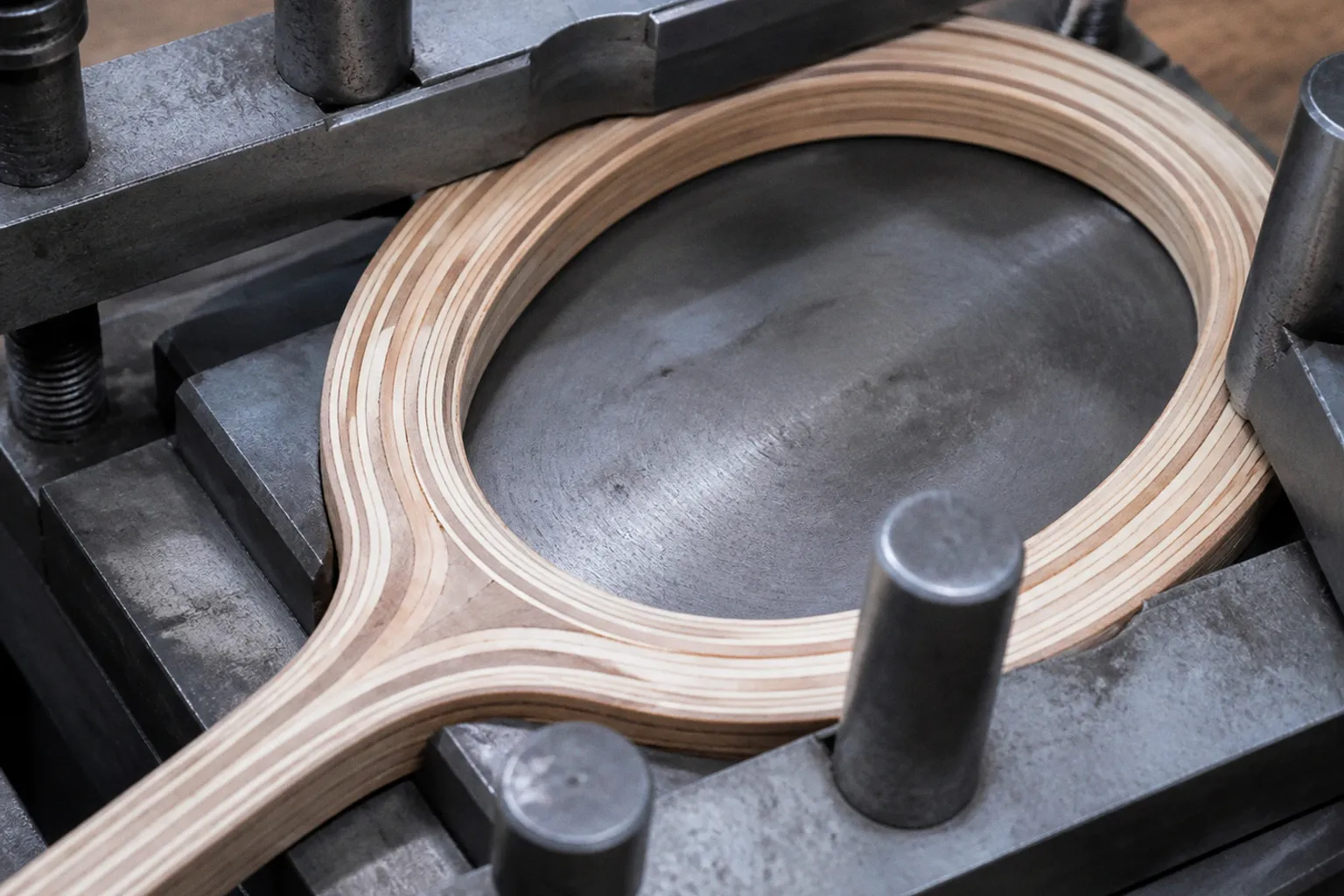
The earliest frames were made from solid ash or maple, substantial pieces of timber weighing roughly 400–500 grams, and their performance depended as much on the weather as on the player holding them. Moisture could bend the frame, loosen its structure, or leave it vulnerable to breaking under the repeated tension of gut strings and the hard, abrupt impact of a tennis ball.
The great change came when racket makers stopped asking one piece of wood to do every job. From the 1930s onward, they began building frames from thin layers—carefully selected, shaped, oriented, and bonded together with water-resistant adhesives. The result was not merely a lighter racket. It was a more deliberate instrument, one in which stiffness, resilience, balance, and feel could be tuned through the arrangement of the timber itself.
That is the central story of wooden tennis racket lamination layers: the movement from solid material to engineered structure, achieved long before graphite made the modern racket seem weightless.
From solid ash to engineered laminates
The first lawn tennis rackets appeared in the nineteenth century, after Major Walter Clopton Wingfield introduced his version of the game in 1874. Their construction belonged to the broader tradition of wooden sporting goods: a frame was shaped from a strong, workable piece of timber, then sanded, finished, and drilled for stringing. Solid ash and maple were natural choices because they offered a useful combination of strength and resilience, but the limitations of the material were always close at hand.
A solid wooden frame has no internal negotiation. If the grain contains a weakness, that weakness belongs to the whole racket. If the timber absorbs moisture unevenly, the frame can warp. If the repeated stress of string tension and ball impact exceeds the capacity of the wood, there is no second layer to restrain the first. The racket may survive for years in a dry cupboard and fail suddenly on a damp afternoon.
This vulnerability mattered because tennis was played outdoors, often on grass courts where weather was part of the working environment rather than an occasional inconvenience. A racket was carried from clubhouse to court, stored in changing conditions, and expected to retain its shape through repeated use. The problem was not only weight—although 400–500 grams placed at the end of the arm is an appreciable burden—but stability over time.
The commercially successful move toward multi-ply construction began in the 1930s, when water-repellent and weather-resistant glues made it possible to bond thin wooden veneers into a more reliable frame. Earlier adhesive methods were too susceptible to dampness. A beautifully shaped laminated racket was of little value if its layers separated after exposure to moisture.
Dunlop’s Maxply, introduced in 1931, became one of the defining examples of this new approach. Its construction used layers of Vermont ash, cherry, and hickory, bonded with water-repellent adhesive, while basswood appeared in the handle plates. The significance was not simply that several species had been used. Each layer could contribute a different quality, and the final racket could be designed as a composite object rather than accepted as the unpredictable expression of one plank.
Lamination changed the wooden racket from a shaped piece of timber into a controlled argument between different woods, grains, and directions of force.
The change was gradual, and not every racket immediately became a complicated eighteen-layer structure. Early laminated frames used fewer plies, while the most refined models of the 1940s through the 1960s could contain as many as eighteen distinct wood layers. This was the golden era of multi-ply wooden rackets—a period when construction knowledge, player expectation, and manufacturing ambition met at the throat and head of the frame.
What the layers actually did
To understand how wooden tennis rackets were made, it helps to set aside the modern assumption that more layers automatically meant more technology. The purpose of lamination was not decorative complexity. It was control.
A thin veneer behaves differently from a thick solid section. Its grain can be oriented with greater precision, and several veneers can be combined so that the weaknesses or tendencies of one layer are moderated by its neighbors. The frame’s response becomes the result of the layup—the sequence and placement of materials—rather than the temperament of a single block of wood.
In a racket, this mattered across several connected areas:
- Stiffness: The frame needed to resist excessive deformation under string tension and ball impact, while retaining enough flex to produce the characteristic wooden feel.
- Strength: Thin layers bonded together could distribute stress more effectively than a single piece with an unfavorable grain or hidden defect.
- Resilience: A well-built laminate could endure repeated shocks without behaving as a brittle, monolithic object.
- Weight distribution: Timber could be selected and placed to influence whether the racket felt head-heavy, balanced, or more maneuverable through the handle.
- Weather resistance: Adhesives and sealed surfaces helped protect the bond between layers from the moisture that had plagued earlier construction.
The head of a classic wooden racket was generally much smaller than that of a modern frame, with a typical area in the region of 65–85 square inches. That compact string bed left less room for imprecision. The player had to meet the ball with a narrower useful area, and the frame had to remain composed despite the concentration of force around the hoop.
The construction of the racket therefore involved a series of compromises. A frame that was too flexible could feel soft and unstable. One that was too stiff might transmit a harsher shock and lose the elastic response players valued. More timber could provide solidity but also increase swing weight. A lighter frame might move more quickly yet lack authority against a heavy ball.
The language of racket manufacture was consequently close to the language of court tactics. A serve-and-volley player needed a frame that could be brought forward decisively, held firm at the net, and directed a first volley without unnecessary movement. A baseliner might appreciate a more substantial, planted response, particularly on grass or slower clay. The racket did not determine the player’s style, but it entered into that style through every contact.
A simplified view of the construction choices looks like this:
| Construction feature | Practical effect | Why it mattered on court |
|---|---|---|
| Solid ash or maple | Considerable weight with vulnerability to moisture-related warping | Provided firmness but demanded careful storage and maintenance |
| Multiple thin wood veneers | Greater control over strength and flexibility | Allowed manufacturers to tune the frame rather than rely on one timber section |
| Mixed wood species | Different layers contributed different structural qualities | Helped balance resilience, stiffness, weight, and feel |
| Water-resistant adhesive | Reduced the risk of delamination and distortion | Made laminated rackets more dependable in changing outdoor conditions |
| Leather, polyamide, or glass-fibre inserts | Reinforced selected areas of the layup | Extended the possibilities of wooden construction before graphite took over |
The table is tidy; the object itself was not. Every racket still contained the irregularities of natural wood—variations in grain, density, color, and response. This is part of why vintage wood tennis racket construction remains so compelling. It belongs to an industrial age, but it never entirely escaped the material character of the forest.
The anatomy of an eighteen-ply frame
The phrase “eighteen-ply” can sound like a universal specification, but it was not. Not every wooden racket contained eighteen layers, and the exact ply count varied among manufacturers and models. The figure represents the upper end of refinement reached by certain high-quality frames during the 1940s–1960s, when laminated construction had become both technically mature and commercially important.
The layers were not simply stacked to make a thicker piece. Their placement served a purpose. Some veneers formed the main body of the head and shaft. Others reinforced the shoulders, where the racket changed direction and where stresses gathered during impact. The handle required a different kind of treatment, since it had to resist twisting while remaining comfortable and responsive in the hand.
This is why the construction of a classic racket can be read almost like a cross-section of its intended use. The hoop needed continuity and strength. The throat needed to resist distortion. The shaft had to carry force from the head into the grip without making the racket feel dead. The handle plates, including basswood in the case of the Dunlop Maxply, added structure and shaped the relationship between frame and player.
The use of multiple veneers also allowed manufacturers to work with the direction of the grain. Wood is not mechanically identical in every direction. Its behavior along the grain differs from its behavior across it, and a layered assembly could place those characteristics where they were most useful. The frame remained organic in origin but increasingly systematic in design.
For players, the consequences appeared as sensation rather than engineering vocabulary. A well-made wooden racket could feel solid without being inert, flexible without becoming vague, and quick enough at the net despite its weight. The ball seemed to remain in conversation with the strings for a fraction longer than it does on many modern frames—not because every old racket had the same response, but because the material and stringing systems created a distinct kind of contact.
That contact was unforgiving. The classic head size offered little margin, and the narrow sweet spot demanded clean preparation. A player could not depend on a broad modern hitting area to rescue a late swing. The racket rewarded timing, balance, and a willingness to meet the ball in front of the body. In this sense, the frame became part of tennis’s technical memory. It preserved a game in which precision was not an abstract virtue but a physical necessity.
There is also a quiet difference between a laminated wooden racket and a modern composite frame. Graphite allows manufacturers to shape stiffness with extraordinary freedom and consistency. A wooden laminate works through a more tactile compromise: species, grain, thickness, adhesive, pressure, and finishing all contribute to the final object. The result may be less uniform from one frame to another, yet that variability is part of its historical identity.
Ash, hickory, maple, and the feel of timber
The vintage racket wood types associated with classic frames were not selected merely for their appearance. Ash, maple, hickory, cherry, mahogany, and basswood each occupied a place in the manufacturer’s vocabulary, even when the precise recipes remained proprietary.
Ash was valued for its strength and workable resilience. In the context of racket layups, its hardness is sometimes given at approximately 1300 on the Janka scale—a useful indication of the resistance the material can offer, though not a complete description of how it will behave inside a finished frame. A wood’s performance depends on grain, moisture, thickness, bonding, and where the layer sits in the structure.
Hickory brought a reputation for toughness and shock resistance. Maple offered a dense, stable material suited to parts of the construction where solidity mattered. Cherry could contribute to the layered balance of the frame while also carrying the warm visual character associated with finely finished wood. Mahogany appeared in some combinations, and basswood was useful for lighter structural components such as handle plates.
The Dunlop Maxply’s use of Vermont ash, cherry, and hickory is revealing because it shows that the classic racket was already a designed composite. The frame’s feel did not come from one heroic timber. It came from the interaction of several layers, each helping shape the final response.
This also explains why two vintage rackets that look similar can feel markedly different. Their head dimensions may be close, yet their balance, density, layup, grip construction, and stringing can alter the experience. Even the condition of the wood matters. A frame that has spent decades in a damp environment may carry changes invisible beneath its finish. Another, carefully stored, may retain much of its original integrity.
The player felt these differences through the hand first. A wooden racket transmits information in a particularly direct way: the vibration of a mishit, the steadiness of a centered drive, the subtle torsion of a return struck late. These are not romantic additions imposed on the object by nostalgia. They are consequences of the material system.
Still, nostalgia can obscure the practical difficulty. Vintage rackets were not gentle instruments. Their smaller heads and heavier construction required technical discipline, and their performance could be compromised by age, moisture, or poor restringing. To admire a wooden racket is not to pretend that it was superior in every category. It is to recognize that it asked different questions of the player.
The hybrid era before graphite
By around 1950, manufacturers were beginning to insert non-wood materials into wooden layups. Leather appeared between wood plies, followed later by materials including polyamides, glass fibre, and eventually graphite in the broader evolution of racket construction. These additions did not instantly end the wooden era. Instead, they revealed that manufacturers were trying to preserve the familiar virtues of timber while addressing its limits.
The hybrid approach was an experiment in reinforcement. A selected insert could strengthen a vulnerable area, improve resilience, or alter the way the frame responded to impact. The purpose was not necessarily to make the racket feel modern. In many cases, it was to make the wooden structure more dependable without surrendering its established identity.
This period is important because it complicates the familiar story that tennis moved directly from wood to metal and then to graphite. The transition was more layered than that. Racket makers were already thinking in terms of composite behavior. They were testing how different materials might coexist within a frame, how the weight of wood could be managed, and how resilience might be added without losing touch.
That work prepared the ground for later developments. Once manufacturers understood the advantages of placing materials strategically rather than treating the racket as a single substance, the path toward modern composites became easier to imagine. The wooden racket was not an obsolete object waiting for technology to replace it. It was one of the places where composite engineering learned to speak.
Yet the hybrid era also preserved the cultural authority of the wooden frame. Players and audiences still recognized its profile, its sound, and its relationship to the classic technique of the game. A racket could contain a leather or polyamide insert and remain, in the meaningful sense, a wooden racket. Identity in sporting equipment is not determined only by the newest material present. It is also determined by the structure, the habits it encourages, and the era it carries with it.
The final stand: McEnroe and the end of the wooden Grand Slam
The final Grand Slam singles title won with a wooden racket came at Wimbledon in 1981, when John McEnroe used a Dunlop Maxply. The detail has the force of a closing date, but it should not be treated as a theatrical ending. Wooden rackets had already begun to give way to newer technologies, and the competitive advantages of larger heads, different materials, and more efficient energy transfer were becoming increasingly difficult to ignore.
McEnroe’s victory nevertheless fixed the Maxply in tennis history. The racket was not an antique carried onto the Centre Court for ceremony. It remained a working instrument in the hands of a player whose game depended on timing, touch, anticipation, and extraordinary control of the first exchange. Its presence connected the tournament’s modern intensity to the long period in which wood had defined the physical vocabulary of professional tennis.
That connection matters because equipment changes do not merely improve performance. They reshape technique and, over time, reshape memory. The compact wooden head reinforced a style built around early contact and precise preparation. The weight of the frame made every hurried swing more expensive. The feel of the strings encouraged a particular relationship with placement, angle, and touch. When the equipment changed, the sport’s possibilities changed with it.
A wooden racket also carried the visible evidence of its making. The layered edge, the polished grain, the leather grip, the small head, and the accumulated marks of play made it legible as an object. A modern racket can be an astonishingly refined tool, but its construction often hides behind paint and aerodynamic geometry. A laminated wooden frame shows more of its history on the surface.
That is why these rackets continue to occupy such a strong place in tennis lore. They are preserved not only because champions used them, but because they explain an older relationship between player, material, and court. The racket’s limitations were never separate from its virtues. Its weight demanded economy. Its narrow head rewarded concentration. Its timber returned the force of the ball with a sensation that was inseparable from the structure holding the strings.
The story of wooden tennis racket lamination layers is therefore not just a manufacturing history. It is a history of how tennis learned to control wood without erasing its character. The move from solid ash and maple to carefully bonded veneers made the frame lighter, more stable, and more resilient. The use of up to eighteen layers demonstrated how far that control could be taken. The arrival of leather, polyamides, glass fibre, and later graphite showed that the wooden racket was already participating in the logic of composite design.
What disappeared was not craftsmanship but a particular kind of visible craftsmanship—the kind that allowed a player to see the grain, sense the weight, and understand that a racket’s behavior began in the arrangement of its materials. The best laminated frames were engineered with remarkable sophistication, yet they never felt anonymous. They retained friction, density, tension, and the small variations that remind us tennis has always been played with objects made by hands.
That is the enduring value of the vintage wooden racket. It stands at the point where natural material became deliberate technology, and where the history of the sport can still be felt through the frame.