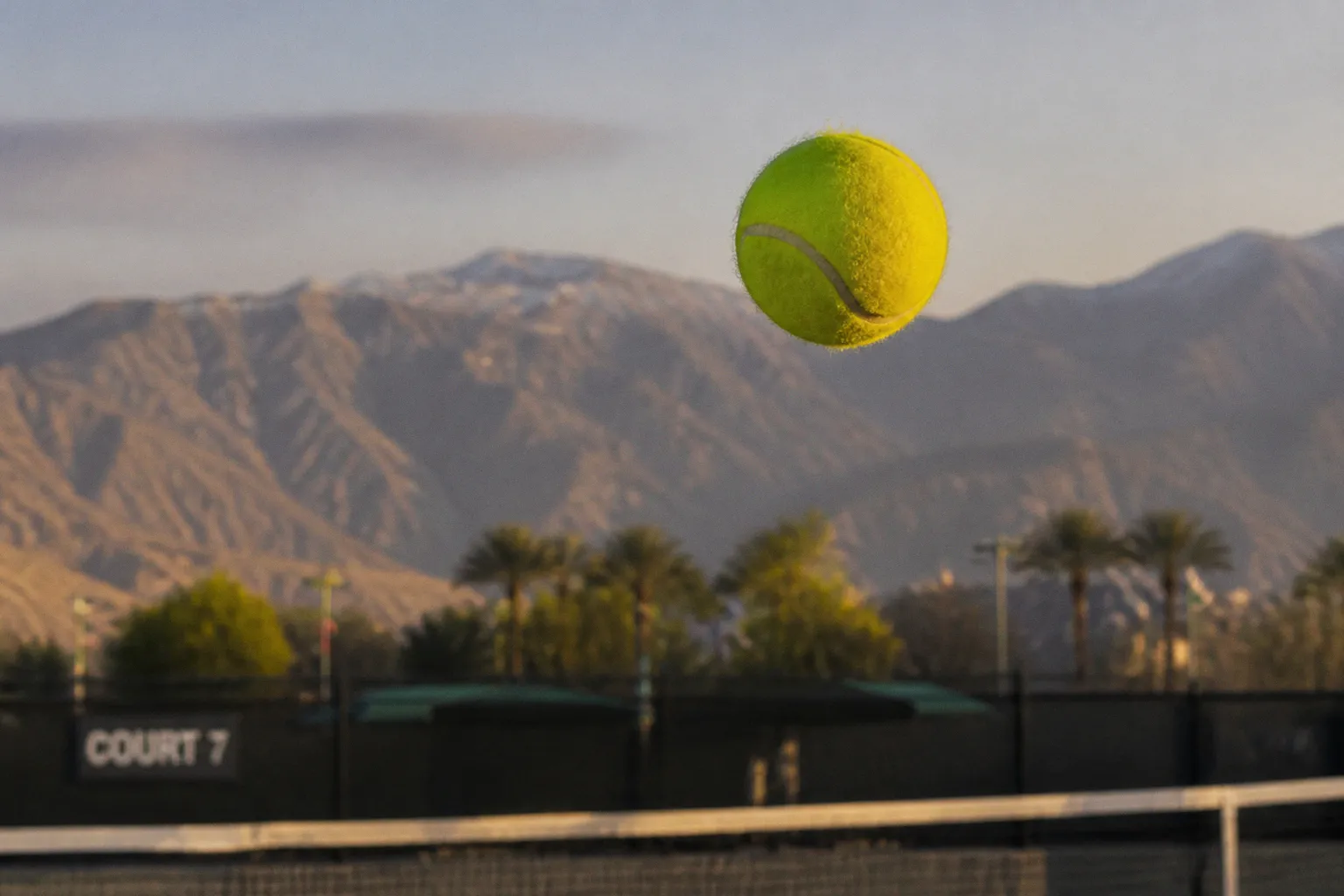
The BNP Paribas Open is played in California’s Coachella Valley, roughly 120 miles east of downtown Los Angeles, between the San Jacinto and San Bernardino mountains. The valley’s dry air reduces aerodynamic drag, allowing the ball to move more cleanly through the air, while the abrasive hard court grips the ball after the bounce and produces a high, heavy rebound.
That combination is what makes Indian Wells difficult to read from the television picture. The ball can appear quick in flight and then sit up more than expected after contact with the court. Daytime heat accelerates one part of the exchange; surface friction restrains another. By evening, the atmosphere may have changed enough that the same player’s timing, serve targets, and tolerance for height over the net all need to be recalibrated.
The Indian Wells desert conditions are not background scenery. They are part of the match.
The Coachella Valley wind tunnel
Indian Wells sits in a low desert valley framed by mountain ranges. It is not a high-altitude tournament in the conventional sense—the surrounding mountains create the visual enclosure, but the event is held near sea level in the valley itself. The relevant effect is atmospheric movement: hot air rises from the desert floor while cooler air descends from above, and the interaction can produce swirling, shifting wind.
For players, that wind rarely behaves like a clean crosscourt breeze that can be measured once and filed away. It may be quartering, changing direction as the ball climbs, or appearing most strongly above the level of the stadium bowl. A serve that leaves the racquet on one line can move slightly away from its intended corridor; a high forehand can be carried toward the sideline; a defensive lob may travel farther than its trajectory suggests before dropping sharply into the court.
The difference is especially visible in the margins. Professionals do not lose control of a rally because the ball suddenly flies ten feet away from its target. They lose a fraction of court position, arrive a fraction late, or find that a ball intended to land deep has stopped short of the baseline. In a tournament where rallies often develop from heavy, repeatable patterns, those small errors accumulate as tension.
Wind also changes the value of height. A ball struck with considerable shape may clear the net comfortably, but its upper arc exposes it to more atmospheric movement. Players who normally use a generous margin over the net can find that their safest ball is no longer entirely safe. The answer is not simply to hit flatter. A flatter ball may travel more directly through the air, but it also offers less margin when the court’s bounce is high and the opponent is able to strike from a comfortable shoulder position.
The best adjustment is usually more selective: change the direction of the ball before changing its entire geometry. A player may aim farther inside the court, accept a little less pace, or use a heavier crosscourt ball that continues to pull the opponent away even when the wind refuses to remain stable.
At Indian Wells, the first question is not whether the ball is fast or slow. It is which part of the ball’s journey is being accelerated—and which part is being resisted.
Aerodynamic drag and the illusion of speed
Dry air affects tennis ball flight through reduced aerodynamic drag. The ball does not become heavier in the desert, and it is not being propelled by some mysterious increase in atmospheric pressure. It encounters less resistance as it moves through the air, which can make the flight appear more direct and lively.
That effect matters most before the bounce. A serve can reach the receiver with a little more of its original speed. A deep forehand may penetrate the court rather than losing as much energy on its way toward the baseline. The returner has less time to organize, particularly when the server combines the conditions with a wide target, a compact motion, or a delivery aimed into the body.
This is one reason Indian Wells can reward first-strike tennis even when the surface itself is not a low-bouncing, skidding court. The ball is able to travel efficiently through the air, and that efficiency sharpens the opening shot. A player who takes the return early can prevent the server from benefiting fully from the extra pace; a player who stands too far back may discover that the additional reaction time gained by distance is consumed by the ball’s cleaner flight.
The data from qualifying on the first day of the 2026 event illustrates the serving environment, though it should not be treated as a complete explanation of it. Across 16 matches, players produced 240 aces. In the entire 2025 qualifying competition, 265 aces were recorded across 36 matches. The samples are not equivalent, and ace totals alone cannot establish that the desert air caused the difference. They do, however, fit the physical logic of a court where the ball can move rapidly through the air and where a well-located serve may reach the receiver with unusual insistence.
The returner’s position becomes a strategic decision rather than a fixed habit. Standing deep can help with the high bounce and give more space to absorb the ball, but it also grants the server more time to recover and organize the next shot. Standing close may neutralize the aerodynamic advantage, yet it exposes the returner to the ball’s speed and to the risk of mistiming a kick serve that rises sharply.
The same tension appears in baseline exchanges. A player with compact preparation may enjoy the clean flight because the ball arrives quickly but predictably. A player who relies on a long backswing or a large rotational load can feel rushed, especially when the opponent keeps the ball deep and uses the court’s natural bounce to force contact above the ideal strike zone.
Playing tennis in dry air therefore favors clarity. The player must know which shots can be accelerated safely and which ones need height, spin, or greater distance from the lines. The environment rewards aggression, but it punishes aggression that has not been given a geometric plan.
The friction paradox: why the court slows the bounce
Indian Wells is not defined by dry air alone. The hard court has its own physical personality, and it can pull the match in the opposite direction.
The court surface is described as high-friction and abrasive. That friction interacts with the felt of the tennis ball, causing it to fluff up and lose some of its clean movement after the bounce. The result is a paradox familiar to anyone who watches the tournament closely: the ball can move quickly in the air, then arrive from the court with a high, heavy, more resistant bounce.
This is the central piece of Indian Wells ball bounce physics. Air and surface do not simply add speed together. They divide the exchange between two different phases:
| Phase of the shot | Desert influence | Tactical consequence |
|---|---|---|
| Serve and flight | Reduced aerodynamic drag allows the ball to travel more freely | First-strike patterns and precise serving can become more dangerous |
| Contact with the court | Abrasive grit grips the ball and disturbs the felt | The bounce rises heavily and can reduce the opponent’s comfort |
| Extended baseline rally | High bounce creates time for some players but pushes contact upward | Players need reliable shoulder-height mechanics and patience |
| Short ball or approach | Friction can take pace off the bounce more than expected | Finishing requires better anticipation rather than simple power |
| Return game | Fast flight compresses reaction time, while the bounce offers height | Returners must choose carefully between early contact and deep positioning |
A low, skidding ball is not always the ideal weapon here. Players who thrive on taking the ball at waist height may find that the court keeps moving the contact point upward. Those who generate heavy topspin can use the bounce to make the opponent strike from an awkward height, but they must also tolerate the slower, more laborious shape of the rally that follows.
The surface asks for patience in a particular form. It is not the patience of merely keeping the ball in play. It is the patience to accept that a hard, deep shot may not produce an immediate opening because the opponent has enough height and time to defend. The opening may come two or three balls later, after the court has repeatedly forced the opponent to contact above the shoulder or retreat toward the back fence.
This is where the most accomplished players separate themselves from those who simply hit hard. They recognize that the ball’s visible speed is not the same as its tactical speed. A shot can be quick through the air and still leave the opponent with a manageable next contact if the bounce rises into the strike zone. Conversely, a ball that looks slower may be far more damaging if it lands deep, climbs steeply, and denies the opponent a comfortable point of contact.
The high-friction surface also changes the value of directional discipline. Crosscourt patterns are often safer because they provide more court length and allow the player to use spin without flirting with the sideline. Down-the-line changes can be decisive, but they require confidence that the ball will not sit up into the opponent’s hitting window. The court rewards construction—provided the construction is built around the bounce rather than imposed against it.
Thermal volatility from afternoon to night
The temperature at Indian Wells Tennis Garden can shift from around 90 degrees Fahrenheit beneath the daytime sun to approximately 55 degrees during evening sessions, with the cooler conditions bringing a dampness that is absent from the desert afternoon. That is a substantial change within a single tournament day, and it alters more than the comfort of the players.
In the heat, the ball generally feels livelier in the exchange, and the body works under greater thermal stress. Serves may be struck with confidence because the ball moves efficiently through the dry atmosphere, but the player must also manage the cost of repeated explosive movement. The court’s high bounce can make a rally physically expensive: every defensive contact may require a deep knee bend, every recovery step may be taken under the weight of hot air and bright sun.
The afternoon session tends to expose conditioning and concentration. A player who begins by overhitting may find that the accumulated cost appears later, when the feet no longer arrive early enough to handle the rising ball. The solution is rarely passive tennis. It is controlled expenditure—using the serve to create a predictable first ball, choosing when to take the return early, and avoiding unnecessary changes of direction when the opponent is already under pressure.
The evening brings a different problem. Cooler, damper air can make the ball feel less eager through the court, while the player may experience the surface as more deliberate and the bounce as easier to read. The change is not a simple switch from fast conditions to slow conditions. The court remains abrasive, and the ball still carries the memory of the day through its felt and wear. But the atmosphere no longer offers the same assistance to a flat, penetrating strike.
Night-session tennis at Indian Wells therefore favors players who can revise their expectations without dramatizing the change. A serve that won free points in the afternoon may require more placement at night. A forehand that previously rushed the opponent may need additional height and spin. The returner can sometimes move forward, but only if the cooler conditions have genuinely reduced the serve’s threat rather than merely changing its visual rhythm.
There is also a perceptual adjustment. Under evening lights, the ball’s speed is harder to judge against the dark background beyond the court. The player sees the contact point and the first part of the trajectory, then must rely on practiced recognition of spin and direction. A heavy kick serve may appear to slow in the air before rising sharply after the bounce. A flat serve may look less dramatic yet still reach the body quickly enough to jam the return.
For spectators, this is part of the tournament’s distinct atmosphere: the desert evening does not erase the heat of the day so much as reveal how much the day had been contributing. The stadium becomes cooler, but the tactical questions remain warm.
What the 2026 court-speed change tells us
The most visible numerical shift in the recent conditions came through the Court Pace Rating. On opening day in 2026, Indian Wells measured at 38.7, compared with 30.9 in 2025. That is a substantial move toward a faster rating, and it changes the way the tournament’s surface should be discussed.
A Court Pace Rating is useful as a reference point, but it is not a complete description of a match. It cannot tell us how a particular ball will respond to a particular player’s spin, how wind will affect a high crosscourt exchange, or how a court will feel after hours of play. Nor does it cancel the atmospheric complexity of the Coachella Valley. A faster measured court can still produce a high, heavy bounce when the surface has enough friction to engage the ball and roughen its felt.
The 2026 reading does, however, suggest that players could receive more reward from penetrating first shots than they did under the 2025 conditions. The change may be felt most clearly in the transition from serve to forehand, in the returner’s ability to hold position, and in the number of balls that stay deep rather than losing their force before reaching the baseline.
For a player preparing specifically for Indian Wells, the court-speed shift changes the practice priorities. The work is not simply to hit harder. It is to test how the ball behaves at different heights and distances:
1. Serve into the body and wide serve patterns should be tested separately. A faster court may make the wide serve more difficult to reach, but the high bounce can also give a strong returner time to attack if the delivery is not sufficiently angled.
2. The first forehand after the serve deserves more attention than raw ace numbers. The server may gain an advantage from the dry air, yet the decisive ball is often the next one—the shot that must combine penetration with enough margin for the abrasive surface.
3. Returns should be practiced from multiple positions. A deep return can absorb the speed and exploit the heavy bounce, while an early block can prevent the server from establishing a baseline pattern. The right choice depends on the opponent’s serve shape, not on a universal Indian Wells rule.
4. High contact points need to be treated as an attacking position. Players who regard shoulder-height balls only as defensive problems will surrender too much court. The tournament’s bounce makes it necessary to build offense from above the waist, especially on the forehand side.
5. Night-session preparation must include a change in ball response. The evening is not merely the afternoon with lower light. The temperature and dampness can alter depth, timing, and the amount of effort required to push a ball through the court.
The speed rating also helps explain why Indian Wells cannot be reduced to the familiar labels attached to hard courts. It is neither simply quick nor simply slow. Its identity is produced by the friction of the surface, the dryness of the air, the rise of the bounce, the movement of the wind, and the temperature at the hour when a match begins.
The Indian Wells court does not offer one condition to both players. It offers a moving negotiation between flight, friction, heat, and timing.
Reading the desert before the first ball
The most reliable way to interpret a match at Indian Wells is to watch the ball in stages. First, observe the serve’s passage through the air. Does it reach the receiver with unusual pace? Is the returner making contact late even when positioned well? Then watch the bounce. Does the ball rise above the shoulder, or does it skid more than expected? Finally, notice what happens to the third or fourth shot of the rally. Is depth being preserved, or is the ball losing enough energy for the opponent to step forward?
Those observations are more useful than a pre-match assumption about the tournament. A player may begin with the expectation that dry air will make every shot faster, only to discover that the high-friction surface is producing a slower, heavier rally. Another may prepare for a grinding exchange and find that the quicker 2026 court rewards a more assertive return position.
The wind deserves its own reading. Players often look at the flag or feel the breeze during the warm-up, but the important question is how the wind behaves above the court and when the ball is at its highest point. A low drive may be stable while a high topspin ball bends unexpectedly. A serve may appear unaffected from the baseline and then drift as it crosses the service box.
The tournament’s most successful competitors tend to make these assessments quietly. They do not abandon their identities at the first sign of a changing condition. A counterpuncher does not suddenly become a reckless attacker because the Court Pace Rating has risen; a server does not stop building points because the evening has cooled the air. Instead, each player adjusts the spacing between familiar actions—the depth of the return position, the height of the rally ball, the moment chosen to move forward.
That is the deeper lesson of the Indian Wells desert conditions. Physics does not dictate a single style of tennis. It changes the cost of each decision.
A flat shot may be rewarded on one point and expose the player on the next if the wind shifts. Heavy spin may produce a difficult bounce but leave the hitter vulnerable to a patient defender. A deep position may protect against the rising ball while conceding the initiative. A close return position may steal time while demanding perfect reading of the serve.
Indian Wells becomes legible only when these contradictions are held together. The ball travels quickly because the dry air offers less resistance. It slows and rises because the court grips it. The afternoon rewards physical force but taxes recovery. The night removes some of the desert’s speed without removing the surface’s friction. And the higher 2026 Court Pace Rating adds another layer, making the first strike more consequential without turning the tournament into a simple serve-and-volley exercise.
The desert is not a single condition. It is a sequence of conditions, often changing within the same match. The players who understand that sequence—who feel the friction in the bounce, the density in the evening air, and the pressure of every ball that arrives a fraction faster or higher than expected—are the ones most capable of making Indian Wells look calm. Their tennis does not defeat the environment. It learns its rhythm.