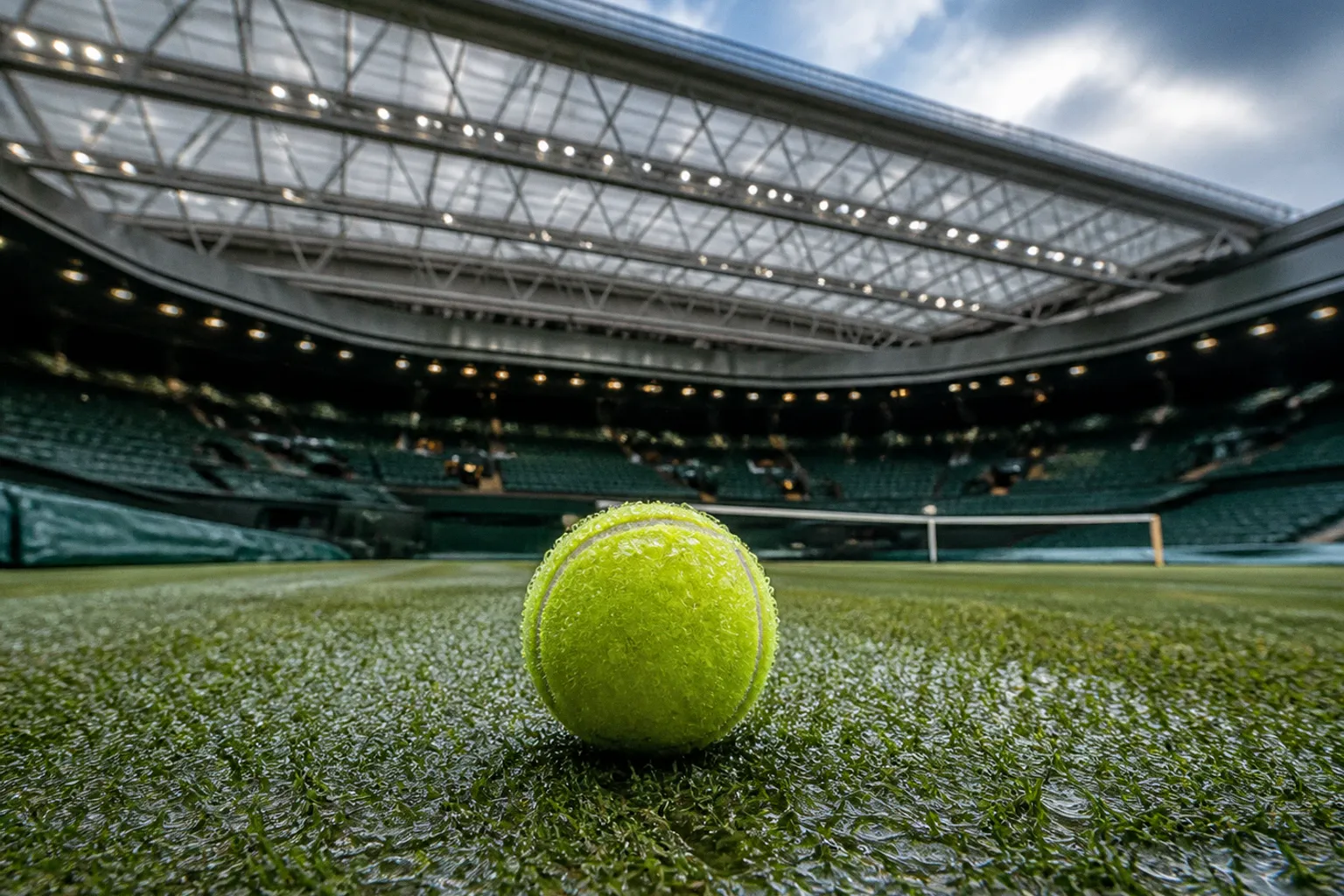
The Wimbledon roof does more than keep Centre Court dry. Once the 5,200-square-metre translucent canopy closes, the match moves into a carefully managed indoor microclimate, where wind disappears, humidity is controlled, sound is contained, and the ball may arrive at the receiver up to 5 mph slower than it would in comparable outdoor conditions.
That is the central paradox of the Wimbledon roof indoor grass microclimate effect: the court becomes more predictable, but not necessarily quicker. The grass remains the same perennial ryegrass, the lines remain in the same positions, and the dimensions of Centre Court do not change — yet the physical circumstances around every serve, return, and low-skidding exchange are altered. The roof does not turn Wimbledon into a hard court or erase the character of the turf. It changes the air through which the ball travels and the atmosphere in which the grass must survive.
For players, that difference is felt not as an abstract engineering detail but as a change in timing. A serve may lose some of its bite by the time it reaches the returner. A deep ball may be easier to read. A clean strike may still skid low, but with fewer outdoor variables disturbing its path. The match becomes less exposed to the restless movement of an open summer court — and more revealing of the players’ ability to create pressure without relying on uncertainty.
The engineering of an indoor microclimate
Centre Court’s retractable roof can close fully in less than ten minutes. That speed matters because Wimbledon has never treated rain as a minor interruption. A delay changes the temperature of the grass, the rhythm of the match, the condition of the ball, and the emotional temperature of the stadium. A roof offers continuity — but only if the space beneath it can be brought under control.
The roof itself is not the whole system. Once it has sealed the stadium, the internal environment requires further stabilisation, which takes approximately another twenty minutes. During that period, the air settles into a different pattern. Outdoor wind is removed from the equation, while temperature and moisture are regulated so that condensation does not gather on the grass surface.
The court therefore occupies an unusual position. It is an outdoor surface protected by an indoor environment, and that distinction is essential. The roof does not replace the grass. It shelters the turf from the open atmosphere while preserving the court’s low, true bounce and the frictional qualities that make Wimbledon grass recognisable.
The roof was first used for tennis in an exhibition in May 2009. Its competitive significance became clearer as players and engineers began observing how the altered atmosphere affected the ball. By the time the roof became part of the tournament’s established visual identity, it had also become part of the tactical landscape. Players were no longer simply waiting to see whether the rain would stop. They were learning to play a version of Wimbledon in which the sky had been removed from the match.
The roof does not make Wimbledon less like Wimbledon — it reveals how much of Wimbledon has always belonged to the air above the grass.
An open Centre Court is exposed to crosswinds, changes in temperature, shifting humidity, and the subtle turbulence created by the stadium itself. Under the roof, those variables are narrowed. The ball travels through a more stable environment, and the players receive a cleaner picture of what their opponents are trying to do.
That stability is not neutral. It can reward the returner, especially when the server depends on movement through the air rather than sheer pace. It can also assist a player who builds points through depth and repetition, because a predictable bounce reduces the number of accidental disruptions that might otherwise break the pattern.
Why the ball slows down under the canopy
Hawk-Eye tracking data analysed by sports engineers found that a tennis ball can be travelling up to 5 mph slower by the time it reaches the receiver under Centre Court’s closed roof than under outdoor conditions. The figure describes the ball’s arrival speed, not its speed at impact with the racket, and that distinction is important.
The roof does not make the ball faster through the air. Nor does it automatically speed up the court. The evidence points in the opposite direction: the ball loses more of its velocity before reaching the returner. The reasons are connected to the indoor atmosphere, including changes in air movement and density, while the disappearance of wind removes one of the forces that can sometimes carry or distort a shot outdoors.
A serve is especially sensitive to these changes because it begins at high speed and must cross the full width of the service box before the receiver can attack it. Even a modest reduction in arrival speed can affect the returner’s options. The receiver may have a fraction more time to establish position, identify the direction of the serve, and choose whether to block, drive, or redirect the ball.
That does not mean every serve becomes easy to return. Placement, disguise, spin, height, and the server’s ability to follow the ball forward remain decisive. A wide slice serve can still pull the receiver outside the singles line; a body serve can still jam the return; a kick serve can still change the geometry of the first exchange. What changes is the margin within which those qualities operate.
The indoor grass court speed at Wimbledon is therefore not captured by a single label such as fast or slow. The surface may still produce a low bounce and a short response window, yet the ball’s flight can become more orderly. The court’s speed is a combination of turf friction, bounce behaviour, ball velocity, and the time available to the receiver. Under the roof, one element may become less explosive while another becomes more consistent.
What the roof changes tactically
The most visible consequences appear in the first four shots of the rally:
1. The returner can read the serve more cleanly. Without outdoor wind pushing the ball laterally or altering its trajectory, the receiver has a more stable visual and physical reference.
2. The server may need to win with placement rather than raw pace. If the ball loses speed before arrival, accuracy and variation become even more valuable than a simple attempt to overpower the returner.
3. The first groundstroke can carry greater strategic weight. A player who receives a more predictable ball may be able to take the return earlier, redirect it, or make the server hit one additional shot before reaching the net.
4. The low grass bounce remains a weapon. Roof closure does not remove the surface’s basic identity. A ball can still stay beneath the ideal contact height, particularly when struck with penetration and depth.
5. Serve-and-volley tennis is not automatically erased. The roof changes the conditions, but it does not determine the winner of every tactical exchange. A player with strong first-volley technique may still benefit from the short grass response and the pressure of moving forward behind a well-placed serve.
The last point deserves restraint. It is tempting to divide roof play into simple winners and losers — baseline players helped, serve-and-volleyers harmed — but the available evidence does not support such a universal rule. Match context matters. So do player quality, score pressure, serve location, and whether the court has been used for several hours after the roof closes.
Grass, moisture, and the need for controlled air
Wimbledon’s grass has a physical structure that is easy to overlook when attention turns to the roof. The court rootzone contains approximately 20% clay loam, which helps bind the surface and supports the low, true bounce associated with the tournament. Compared with a more freely draining sand-based pitch, that composition allows the turf to retain surface moisture for longer.
That retention is useful for grass integrity, but it also makes environmental management more demanding. A court cannot simply be covered and left to warm in still, humid air. Moisture must be controlled. The surface has to remain playable without becoming slick, soft, or vulnerable to damage under the movement of professional players.
This is why the roof’s air-management system is as significant as the canopy overhead. Centre Court uses 14 air-handling units, discharging a combined airflow of 120,000 litres per second. Their purpose is not to create the kind of draught that would reproduce outdoor wind. It is to distribute and regulate the indoor atmosphere, stabilising temperature and helping prevent condensation on the grass.
The distinction is subtle but decisive. Wind is a tactical disturbance; managed airflow is a maintenance and environmental tool. The former introduces uncertainty into the ball’s path. The latter is designed to prevent the court from developing unstable conditions of its own.
When people ask how the Wimbledon roof affects play, humidity is often treated as a simple accelerator or brake. The reality is more involved. Humidity can influence the feel of the air and the behaviour of materials, but the exact contribution of indoor humidity to bounce height cannot be isolated neatly from grass wear, ball condition, temperature, and the stage of the match. It would be too strong to claim that one controlled variable explains the whole change.
What can be said with confidence is that the roof creates a different relationship between moisture and surface stability. Rain is kept away, condensation is actively managed, and the grass is protected from the immediate swings of the open weather. The result is not a frozen court, but a court whose changing conditions are more deliberate.
The court after the roof closes
The twenty-minute stabilisation period is particularly revealing. It shows that closing the roof is not an instant switch from outdoor tennis to indoor tennis. The physical environment has to settle. Temperature, humidity, airflow, and acoustic behaviour all move toward a new equilibrium.
For a match already in progress, this transition can feel like a second beginning. The players may leave the court during the rain interruption, but when they return, the essential question is not simply whether the grass is dry. It is whether the entire court has acquired a new atmosphere.
A returner who was previously negotiating a crosswind may now stand in stiller air. A server whose kick serve was receiving help from outdoor conditions may find that the ball arrives with less force. A player who built momentum through taking the ball early may appreciate the greater predictability, while another who relied on a chaotic exchange may lose an invisible source of advantage.
The most accomplished players adjust without announcing the adjustment. They alter serving targets by small degrees, take a different position on return, or accept that a ball they would normally attack will arrive with a different weight. The scoreboard does not identify these choices, but they are among the reasons roof matches can feel tactically unfamiliar even when the surface looks unchanged.
The sound of Centre Court becomes part of the contest
The roof also changes what the players and spectators hear. Acoustic studies have shown that, when Centre Court is enclosed, sound is trapped within the arena. Ball impacts reflect from the ceiling, lengthening the apparent sound of contact, while crowd noise is amplified by the enclosed space.
This is not merely theatre. Tennis depends heavily on timing, and timing is never only visual. Players hear the strike of an opponent’s racket, the pace of the crowd’s reaction, the clean difference between a heavy ball and a mistimed one. Under the roof, those sounds acquire more presence.
The impact of a serve can seem denser. A volley carries a sharper acoustic edge. The crowd’s response no longer drifts upward into the open air but rebounds through the stadium, giving each point a more enclosed pressure. For the player, this can intensify the sense that every exchange is being held inside the building rather than released into the weather.
That atmosphere is especially pronounced during long rallies and decisive games. An outdoor crowd can feel broad and dispersed, connected to the open day around the court. A closed Centre Court becomes more concentrated. The audience is closer acoustically, even when the physical seating has not moved.
This is one reason roof tennis can appear more dramatic without being more aggressive in a purely mechanical sense. The enclosure heightens the evidence of contact. The sound of the ball becomes part of the court’s texture — another form of information, another pressure on concentration.
The change also affects the visual rhythm of a match. On an open day, the light, breeze, and distant movement beyond the stands provide a constantly shifting background. Beneath the canopy, attention folds inward. The court markings, the players’ footwork, and the repeated impact of ball against racket become more dominant. Centre Court feels less like a surface placed within weather and more like a controlled chamber for examining the mechanics of tennis.
A grass court that remains itself
The most important fact about Wimbledon roof closure is also the easiest to lose: the turf does not change species. Centre Court remains planted with perennial ryegrass. The roof does not convert the court into an artificial indoor surface, and it does not grant the tournament a different kind of grass for covered play.
That continuity matters because the character of the court still begins under the players’ shoes. Grass offers a distinct relationship between friction and movement. It can produce a low bounce, reward compact preparation, and make the quality of the first strike unusually valuable. The roof modifies the atmosphere around those properties; it does not abolish them.
The rootzone’s clay-loam content helps maintain a firm, bound surface and allows the court to retain moisture longer than a more freely draining sand pitch. That material foundation remains active beneath the canopy. It helps explain why the covered court can preserve Wimbledon’s familiar bounce while the ball’s behaviour in the air becomes different.
This is where surface speed needs to be described carefully. A grass court can be quick in one sense and less quick in another. The ball may remain low after the bounce, reducing the receiver’s comfortable striking height, while losing more speed during its flight under controlled indoor conditions. The player experiences both facts in the same point.
A wide serve may not arrive with quite the same velocity, yet the low bounce can still make the return uncomfortable. A deep approach shot may sit lower than it would on a higher-bouncing surface, even though the absence of wind makes its trajectory easier to predict. A player may have more information but not necessarily more time to use it.
Under the closed roof, Wimbledon becomes less a contest against the weather than a contest against the margins — the small losses of speed, height, and space that decide whether a player can take the next ball early.
The grass also changes through use. As a tournament progresses, wear, moisture, and the accumulated movement of players influence how the surface receives the ball. Roof closure does not isolate Centre Court from that process. It protects the grass from rain and open-air disturbance, but it does not prevent the court from becoming a played surface.
That is why no description of the indoor court should be treated as permanent across an entire match or tournament. The same roof can cover a fresh court early in the championships and a more worn court later on. The atmosphere may be controlled, but the surface still records the work done upon it.
What players must solve beneath the roof
The best adaptation is rarely a dramatic tactical reinvention. It is a series of small recalibrations — the kind that can be difficult to see unless one watches the spaces between points.
A server may choose to target the body more often if the returner is getting a clearer look at wide placement. Another may use more variation in spin, accepting a slight reduction in arrival speed in exchange for a less comfortable contact point. The returner, meanwhile, may stand a little closer to the baseline, not because every serve is suddenly attackable, but because the ball is less exposed to the unpredictable movement of outdoor air.
The court also asks players to reconsider how much risk is necessary. On an open Centre Court, a competitor may accept a narrower target because the wind can help produce a cheap error from the opponent. Under the roof, that source of instability is reduced. The player must earn more of the point directly.
This may favour the competitor with the cleaner repeatable pattern — the return that consistently reaches the server’s feet, the crosscourt ball that holds its depth, the approach that arrives with enough margin to make the first volley manageable. It may also benefit the player who reads the ball early and moves efficiently, because predictability magnifies the value of good preparation.
Yet the roof does not produce a single tactical personality. A powerful server can still dominate with accurate location. An attacking baseliner can still take time away. A net player can still use the low bounce to make the first volley decisive. The canopy changes the friction between intention and outcome; it does not replace the players’ technical identities.
The more useful question is not whether the roof favours one style in the abstract. It is which parts of a player’s style depend on outdoor variation, and which parts depend on control. Players who create pressure through precision may find the enclosed conditions clarifying. Those who use height, wind, or irregularity to disrupt an opponent may need to manufacture that disruption through spin, location, and changes of rhythm.
The roof as part of Wimbledon’s modern tradition
Wimbledon’s grass tradition is often described as though tradition means resistance to engineering. Centre Court demonstrates the opposite. The tournament has preserved the material identity of grass while introducing a sophisticated system to protect play from interruption and preserve the court under demanding conditions.
The roof is therefore not an argument against tradition. It is a modern intervention inside tradition’s boundaries. The court remains grass; the rootzone still binds the surface; the bounce remains low and true; the tournament’s rhythm still depends on the peculiar seasonal life of turf. But above the court, the atmosphere can now be managed with the precision of a controlled indoor arena.
That duality gives Centre Court its particular character. It is neither simply an outdoor court with a ceiling nor an indoor court dressed in grass. It is a hybrid environment, and its interest lies in the tension between those two descriptions.
The open roof leaves the court vulnerable to the living variables of an English summer — wind, rain, changing light, and the long movement of air through the stadium. The closed roof suppresses some of those variables while intensifying others. Ball flight becomes more predictable, arrival speed can be reduced, the sound of impact grows heavier, and the crowd becomes more concentrated around the contest.
For a player, the distinction may appear in a single exchange: a serve that does not quite reach the expected pace, a return taken half a step earlier, a volley made easier by the low bounce but harder by the acoustic pressure of the arena. For the spectator, it appears as a change in texture. The match feels enclosed, deliberate, and sharply outlined.
That is the enduring lesson of the Wimbledon roof. Court conditions are never confined to the paint, the grass, or the bounce. They include the air, the sound, the moisture in the rootzone, the timing of the roof’s closure, and the quiet tactical decisions that follow. Centre Court remains faithful to its surface precisely because the tournament is willing to study everything around it.
The roof does not make grass tennis generic. It makes its mechanics easier to observe. Under the canopy, the game’s physical realities come closer to the foreground — the ball losing speed in flight, the turf holding its moisture, the crowd’s noise circling back toward the players. Wimbledon’s atmosphere changes, but its essential demand remains: create enough tension, accuracy, and courage to win the next point on a surface that never gives exactly the same answer twice.