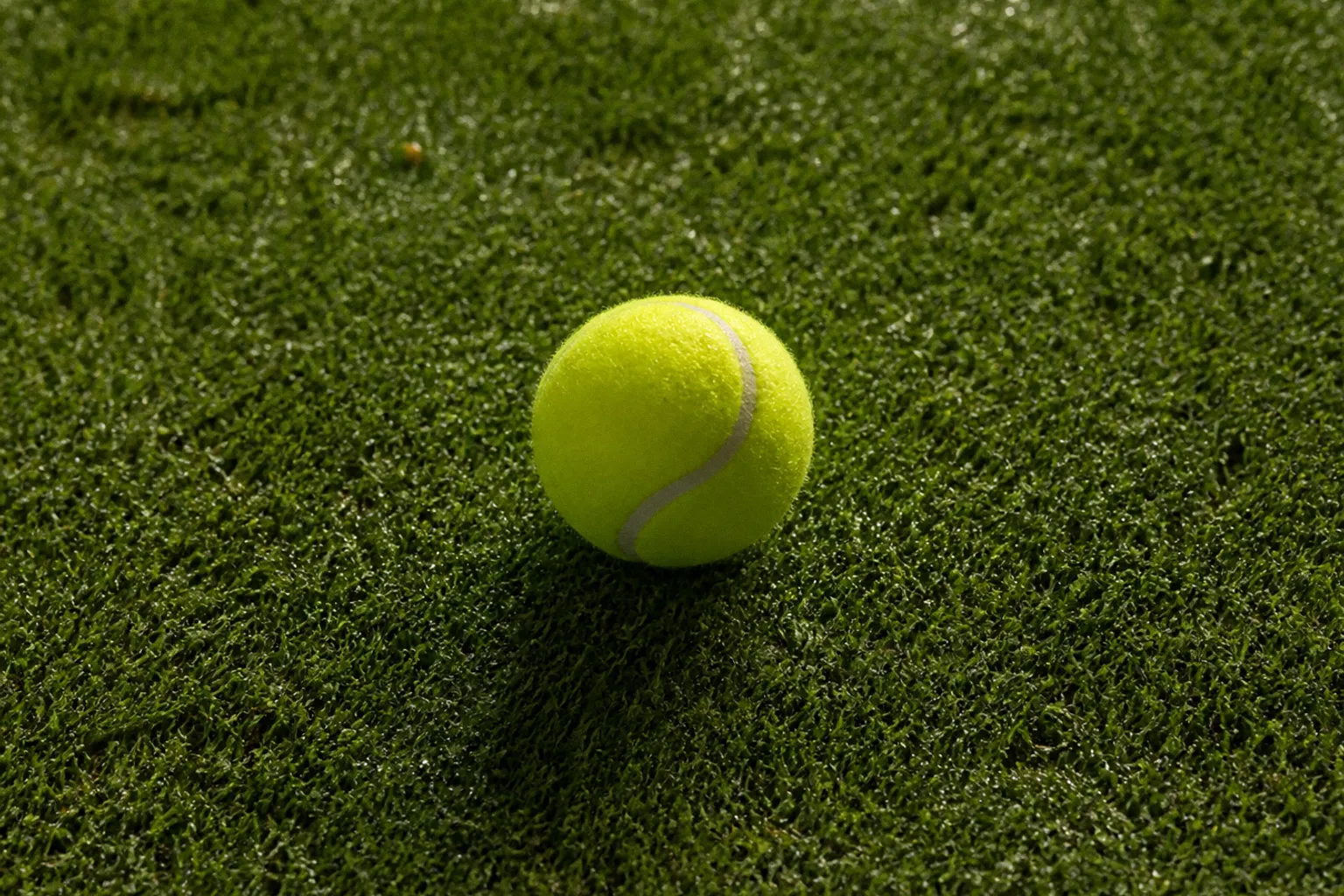
The court enters a different atmospheric regime — one with less wind, higher relative humidity, and a ball whose felt can absorb enough moisture to travel up to 5 mph slower by the time it reaches the receiver.
That is the essential point behind the Wimbledon roof closed court speed change: the surface remains grass, the lines remain the same, and the dimensions do not move, but the air around the court becomes part of the playing surface. A serve is still struck from the same baseline. A volley still has the same distance to cross. Yet the ball’s weight, drag, bounce, and response to spin begin to alter the tactical shape of the match.
Wimbledon’s Centre Court roof was first used during a live match in 2009, in the meeting between Dinara Safina and Amelie Mauresmo. Since then, the roof has become part of the tournament’s practical rhythm rather than an emergency curiosity. It protects play from rain, but it also creates a particular version of Wimbledon — one with its own climate, its own friction, and its own demands on the players.
The atmospheric shift: from open air to indoor microclimate
Outdoor grass-court tennis is never played on grass alone. Wind moves across the court, temperature changes the density of the air, and passing showers can leave the ball heavier even before the grounds team pauses the match. Wimbledon’s open Centre Court carries all of those variables in a visible way: the toss may drift, a high defensive ball may bend off its intended line, and a serve that looked perfectly shaped at contact can arrive with a slightly altered angle.
The closed roof removes the most obvious of these pressures — the wind. That sounds like a straightforward advantage for precision, but the disappearance of wind does not produce a neutral environment. It removes one layer of uncertainty while allowing another to become more influential.
During rain events in 2011, indoor relative humidity under the closed roof was recorded at 94%, compared with 58% on outside courts. The difference is not a decorative atmospheric detail. Relative humidity changes how moisture interacts with the ball, particularly with the felt covering that gives a tennis ball much of its character in flight and after the bounce.
The enclosed stadium also requires its own period of stabilization. The roof can close mechanically in approximately ten minutes, but play may need as much as thirty minutes in total before the indoor climate control has adjusted sufficiently for the match to resume. That delay is often described from the perspective of scheduling — a frustrating interruption in a packed day — but for the players it is also a transition between two court conditions.
The change is gradual in the air and abrupt in the imagination. A player who was serving in moving outdoor air may return to find the toss more predictable, while the ball itself has become less lively. A returner who had been protecting against wind-assisted movement may now read the serve more cleanly, yet face a ball that arrives with a different pace and sits up more after contact.
The surface has not been replaced. The physical conversation has.
At Wimbledon, closing the roof does not turn grass into an indoor hard court — it changes the air, and the air changes the ball.
This is why descriptions of indoor grass conditions need some restraint. The roof does not create a fast carpet court beneath Centre Court, nor does it erase the characteristics of Wimbledon grass. Instead, it makes certain features of the grass easier to read while adding moisture to the ball and removing wind from the exchange.
The physics of felt: why moisture slows the game
A tennis ball is a small, pressurized object, but its movement is governed by several interacting materials. The rubber core supplies the internal pressure and elasticity. The felt controls the surface texture, interacts with the air, and affects how the ball grips the strings and court. When the felt absorbs moisture, the ball becomes heavier and moves more slowly through the air.
The available data suggests that the difference can reach up to 5 mph by the time the ball arrives at the receiver under a closed roof. That is a maximum measured change rather than a universal correction applied to every shot, and it should not be treated as though every serve or forehand loses exactly the same amount. The effect depends on the ball’s exposure to humid air, the speed and height of the shot, the conditions inside the stadium, and the point at which the comparison is made.
Still, even a modest reduction in arrival speed can reshape a rally. Tennis is a sport of small margins expressed through high velocity. A returner who has an extra fraction of time may take the ball earlier. A server’s first strike may lose some of its free points. A forehand that would normally force a short response may instead be met at a comfortable contact height.
The closed-roof Wimbledon ball bounce is part of the same material story. Increased moisture causes the felt to absorb water, increasing the ball’s mass. The ball can therefore travel more slowly and sit up higher after bouncing. On grass, where the traditional expectation is of a comparatively low, skidding response, that additional height matters. It does not make the bounce identical to clay, and it does not abolish grass-court tennis, but it can give the receiver a more manageable strike zone.
The tactical consequence is not simply that rallies become longer. A heavier ball may still produce a short point if the player behind it can create enough pressure with placement, serve variation, or a first forehand. What changes is the value of certain choices:
- A flat first serve may lose some of its immediate penetration, making placement more valuable than raw speed.
- A kick serve can become more useful when the ball sits higher after the bounce, particularly against a returner standing close to the baseline.
- Returns struck early can become easier to organize because the ball reaches the receiver with less pace, even as the higher bounce changes the preferred contact point.
- Defensive shots may travel with less depth, placing greater pressure on the player who is trying to escape a corner.
- Net approaches can become more attractive when the ball is slower, but only if the approach shot has enough weight to prevent the opponent from taking control.
The roof therefore produces a paradox familiar to anyone who has watched enough tennis: a ball can be slower through the air and still uncomfortable after the bounce. Speed and height do not move together in a simple line. A returner may have more time to see the ball but less comfort in choosing where to meet it.
Mechanical precision: the thirty-minute transition to indoor play
The roof’s visible movement is only the first part of the change. The mechanical closure takes approximately ten minutes, but the total transition can extend to around thirty minutes while the climate inside the stadium stabilizes. That distinction matters because the court is not fully described by the moment at which the roof panels meet.
Outdoor and indoor conditions can coexist during the interruption. The grass has been exposed to the day’s temperature and moisture. The ball has already been used in open air. Players leave the court with one set of timing in their bodies and return to another. A warm-up after the delay may reveal a new level of grip, a different response from the ball, or a slightly altered relationship between the serve and the return.
There is a mental element to this transition, but it is grounded in physical detail. Players cannot simply decide to play more aggressively because the wind has gone. They must recalibrate the first movement, the height of the contact, and the amount of margin they can afford over the net. A ball that once demanded an early defensive decision may now invite an attacking swing — but if humidity has made it heavier, the same swing may not produce the depth expected.
The roof also changes what the court gives back to the player. Outdoors, wind can create uncertainty in the ball’s final approach. Indoors, the flight is cleaner. This benefits players who read pace and direction exceptionally well, especially those who like to take the ball early and redirect it. But the heavier, more moisture-laden ball can limit the reward for hitting through the court. The shot arrives more slowly, yet it may not skid away with the same authority once it lands.
A player’s adaptation may therefore appear subtle on broadcast rather than dramatic. The serve may be aimed closer to the body instead of the corner. The return position may move half a step. A forehand may be shaped with more spin to secure depth rather than struck flat for immediate penetration. The rally may contain one additional neutral ball before the point opens.
Those details are the match. The scoreboard only records their consequence.
What changes when the roof closes
| Playing factor | Open Centre Court | Closed-roof Centre Court |
|---|---|---|
| Wind | Can move the toss and alter the ball’s flight | Largely removed, producing a more stable flight path |
| Relative humidity | More directly exposed to outdoor weather | Can rise sharply inside the stadium during rain events |
| Ball felt | Less moisture absorption in drier conditions | Absorbs more moisture, increasing ball mass |
| Ball speed | Greater potential for a lively, penetrating exchange | Can be up to 5 mph slower at the receiver |
| Bounce | Grass response remains influenced by weather and ball condition | The heavier ball may sit up higher after bouncing |
| Tactical emphasis | Wind management, shape, and adjustment | Early reading, placement, spin, and control of the heavier ball |
| Transition time | No indoor stabilization required | Mechanical closure takes about 10 minutes; climate adjustment can extend the pause toward 30 minutes |
The table is useful only if it is read as a set of tendencies rather than a rigid formula. Weather is not a switch, and neither is the roof. Conditions vary across the tournament, from match to match and hour to hour. The closed roof creates a distinct environment, but not a perfectly identical one every time.
The grass beneath the dome: eight millimeters of continuity
The Centre Court roof changes the atmosphere, not the identity of the court. Wimbledon’s grass courts are maintained daily during the Championships and cut to exactly 8 millimeters. That height is part of the tournament’s physical discipline — a visible expression of the idea that the court must preserve its intended character even while the stadium around it becomes more technologically complex.
This is where the history of Wimbledon’s roof becomes more interesting than a simple story of tradition confronting engineering. The roof is often treated as a modern intrusion into an old outdoor ritual, but the court beneath it remains subject to the same exacting maintenance culture. The grass is still managed as a living, wearing surface. The ball still meets blades rather than paint or synthetic fibers. The bounce still contains the irregularity and low friction that distinguish grass from the other major tournament surfaces.
The roof does not prevent wear. It does not make every part of the court behave identically throughout the fortnight. Foot traffic, repeated service patterns, changes near the baseline, and the accumulation of play all continue to matter. What the roof does is protect the schedule and introduce a controlled atmosphere around a surface that remains inherently physical.
That combination creates a peculiar form of continuity. The grass is cut to the same height, but the ball may sit differently because the felt has absorbed more moisture. The court is still grass, but the absence of wind changes how confidently a player can commit to a target. The stadium is enclosed, but the surface retains the signs of an outdoor sport — friction, wear, and the gradual marking of repeated movement.
For a returner, these layers are not theoretical. The court’s condition is felt through the shoe at the first split step and through the racket at the first return. A player senses whether the ball is coming through cleanly, whether the bounce is staying low enough to reward early contact, and whether a defensive slice will remain low or rise into a more attackable height.
The daily 8-millimeter cut does not freeze the court in time. It gives the tournament a controlled starting language. Weather, humidity, and play then add their accents.
Tactical adjustments: how players adapt to the heavier ball
The most visible error in discussing roof tennis is to treat the change as a question of speed alone. If the ball is slower, the reasoning goes, the advantage must move automatically toward the returner and the baseline grinder. That is too simple. A slower ball can create more time, but it can also create more opportunities for a player with excellent anticipation to take control of the point.
The first adjustment concerns the serve. On an open court, a serve may earn its advantage through pace, movement in the air, or the receiver’s difficulty judging the toss against wind. Under the roof, the flight becomes more stable, which can make placement easier to read while also making the server’s intended target more precise. A delivery that relies on visual uncertainty may lose some of its disguise. A delivery that relies on location can become more effective.
The second concerns the return position. If the incoming ball is slower, standing further back may surrender the chance to take it early. Yet the higher bounce caused by a heavier ball can make a close-to-the-line position uncomfortable, particularly on a kick serve. The receiver has to decide whether the priority is time, height, or control — and those are not always available together.
The third concerns rally geometry. A player who normally opens the court with a flat cross-court forehand may find that the humid ball does not penetrate as deeply. More shape, more height, or a change of direction may be needed before the opponent is moved far enough from the centre. Conversely, the player who is comfortable absorbing pace may have less to absorb and therefore more freedom to redirect.
The fourth concerns the short ball. When the ball sits up, a player may receive more attackable opportunities, but the quality of the attack still depends on the ball’s weight. A high bounce without depth is an invitation. A high bounce that lands deep can push the opponent behind the baseline and make the next shot difficult. Under a closed roof, the challenge is often to distinguish those two balls quickly.
A useful way to think about the adaptation is through five linked decisions:
1. Read the serve before judging its speed. With wind removed, direction and spin can become easier to identify, so the receiver must be ready to attack placement rather than wait for pace to reveal itself.
2. Take the ball at the right height. A heavier ball may arrive more slowly but rise higher, making the preferred contact point less obvious. Moving forward can prevent the ball from climbing, while retreating can create space to swing.
3. Protect depth with shape. When the ball loses penetration, a player may need additional spin or a higher trajectory to keep the opponent from stepping inside the baseline.
4. Use the stable air deliberately. The absence of wind rewards confident targeting. Players can commit more fully to narrow lanes, provided they have adjusted for the altered ball response.
5. Treat the first three shots as a new pattern. Serve, return, and first groundstroke determine whether the slower ball produces a neutral rally or an attacking exchange. The roof can change that opening sequence without changing a player’s basic identity.
These are not instructions that apply identically to every competitor. A great server may welcome the predictable toss but dislike the heavier ball. A counterpuncher may enjoy the slower pace but struggle when the bounce rises into a strike zone that gives the opponent more time to drive. A net player may see a greater invitation to move forward, while also discovering that a damp ball does not pass through the court with enough speed to make the approach safe.
The roof exposes the relationship between a player’s technique and the court’s atmosphere. It does not reward one style automatically. It reveals which parts of a style depend on speed, which depend on uncertainty, and which depend on the ability to read friction and bounce before the point has properly formed.
Wimbledon’s indoor paradox
The Centre Court roof was built to make play possible when rain would otherwise stop it. That practical purpose remains the foundation of its value. But once the roof closes, Wimbledon becomes a useful demonstration of how little of tennis can be separated from its environment.
There is no single object called court speed. It is a result produced by the interaction of grass height, surface wear, ball felt, air movement, humidity, temperature, spin, and the player’s position at contact. Remove the wind and increase the moisture, and the match does not simply become faster or slower in the abstract. Its timing changes. Its bounce changes. The meaning of a well-struck ball changes.
The roof’s history also carries a lesson about tradition. Wimbledon’s identity is not protected by pretending that the conditions never evolve. The roof is now part of the tournament’s lived reality, just as the daily cut to 8 millimeters and the gradual wear of the grass are part of it. Technology has not removed the court’s physical character; it has made the relationship between atmosphere and surface more visible.
When the panels close above Centre Court, the match enters a quieter and more controlled space, but not a simpler one. The wind falls away. The humidity rises. The felt takes on moisture. The ball slows by as much as 5 mph at the receiver and may sit higher from the bounce. The players then have to rebuild their timing around those facts — not around the idea of indoor tennis, but around this particular version of Wimbledon.
That is the real roof effect. The grass remains beneath their feet, carefully cut and gradually worn, while the air asks the match to become something slightly different.