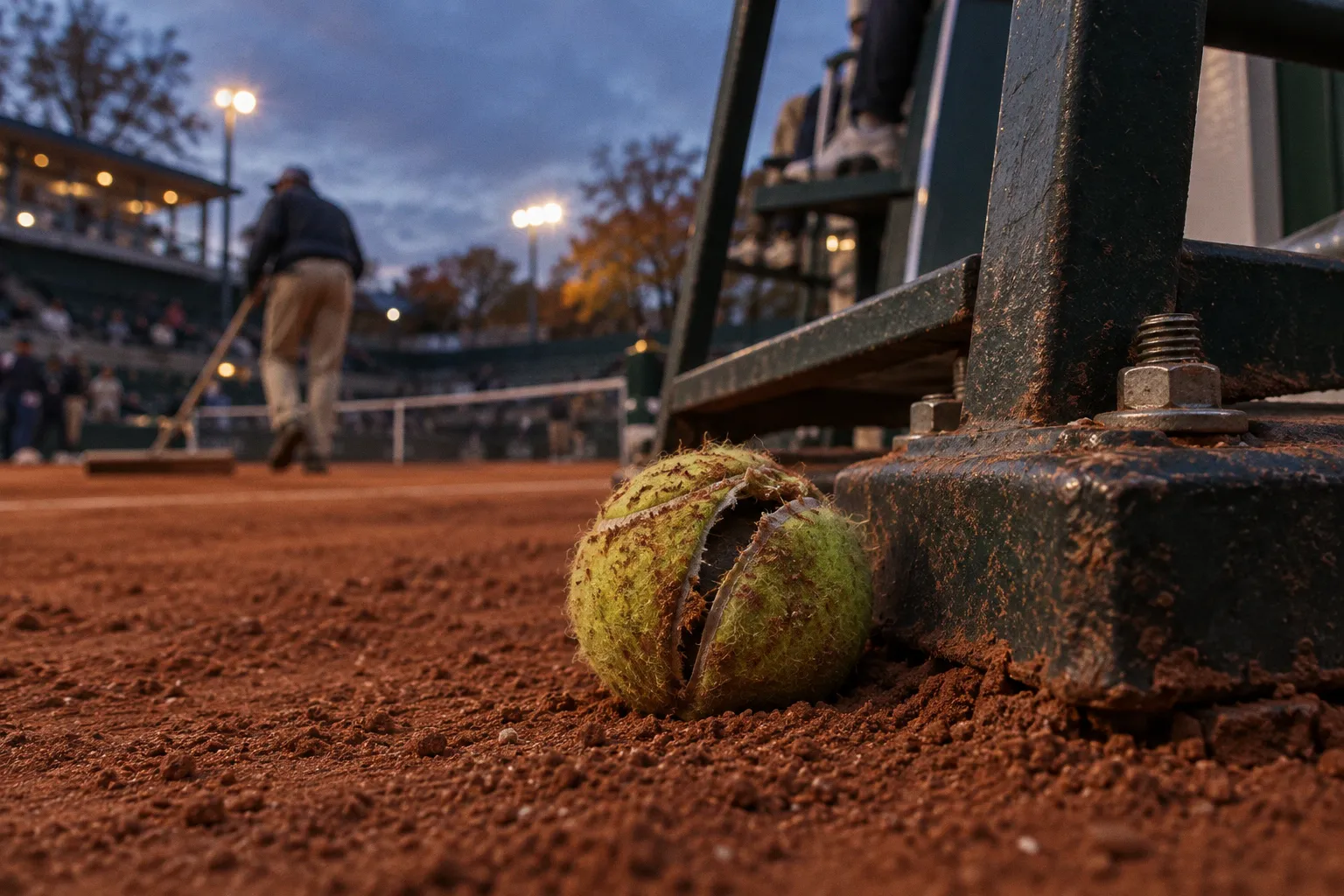
That invisible reserve is what gives the ball its first clean lift from the strings, its sharp response off the court, and the familiar sense that a well-struck shot has met something alive rather than merely rubber.
But tennis ball pressure does not remain fixed. Gas moves slowly through the rubber core even when the ball is sitting untouched in its can, and each rally adds another layer of wear to the felt and structure. The decline is gradual, almost courteous at first—which is why players often notice it not as a single failure, but as a change in the whole conversation between racket, ball, court, and air.
This is the physics behind tennis ball pressure loss over time, and it explains one of professional tennis’s most carefully observed rituals: the replacement of the balls after the first seven games, including the warm-up, and then every nine games thereafter.
The invisible leak inside the rubber core
A pressurized tennis ball is not a hollow shell filled with air in the simple sense. Its performance depends on a rubber core that contains gas under pressure, with the outer felt providing the surface interaction players feel and hear. The rubber is resilient, but it is not perfectly impermeable. Molecules of gas can migrate gradually through its material structure—a process known as permeability.
That movement continues whether the ball is being struck or resting in a tube. Mechanical impacts accelerate the visible signs of decline by compressing the core, deforming the felt, and repeatedly asking the rubber to return energy at high speed. Yet the pressure loss itself is not caused solely by play. A ball can be unused and still become softer over time because the gas continues to diffuse through the rubber matrix.
This distinction matters. A tennis ball does not suddenly become dead because it has been opened, nor does it lose all of its useful pressure after a single afternoon. Its decay is progressive, shaped by storage, temperature, impact, and the condition of the felt. The ball becomes less lively by degrees, and those degrees are enough to alter the tactics of a match long before the object looks ruined.
At room temperature, unplayed pressurized balls have been reported to lose approximately 22.4% of their pressure over one month. That figure should not be treated as a universal stopwatch for every brand, can, or storage condition—the composition of the rubber and the quality of the seal matter—but it gives the process a useful scale. The sealed can is not decorative packaging. It is part of the ball’s preservation system.
Once the can is opened, the ball is exposed to ambient pressure and begins its ordinary life. The inner pressure remains substantially higher than the atmosphere, but the difference slowly narrows. As that gap narrows, the ball returns less energy and spends slightly longer pressed against the strings. The stroke may still feel perfectly playable, yet the timing has moved.
A tennis ball rarely announces that it has gone dead; it changes the timing by fractions, and asks the player to discover the difference through the body.
The 26.7 PSI standard: how the bounce is engineered
The pressure inside a tennis ball is often discussed as though it were the entire explanation for bounce. It is not. Bounce is the result of several linked materials and forces: the gas pressure inside the core, the elastic response of the rubber, the deformation of the felt, the racket strings, the court surface, and the speed and angle of impact.
Still, internal gas pressure is the central reserve from which much of the ball’s liveliness comes. At sea level, atmospheric pressure is approximately 14.7 psi. A standard pressurized ball contains an additional 12–14 psi above that surrounding pressure, producing a total internal pressure of roughly 26.7–28.7 psi.
The distinction between gauge pressure and total pressure is more than a technical footnote. When players say a ball has 12 or 14 psi, they are generally referring to the pressure above the atmosphere. The ball is also pushing outward against the already existing atmospheric pressure. That combined figure helps explain why a small decline can be felt: the ball is not losing an abstract number, but part of the internal force that resists deformation during impact.
During a groundstroke, the ball is compressed between the strings and the court. The rubber core deforms, the gas inside is squeezed, and energy is temporarily stored in the compressed structure. As the ball leaves the racket, that energy is released through the core and the string bed. A ball with higher internal pressure tends to recover its shape more briskly; a ball with lower pressure remains on the strings for longer and returns less energy with the same crispness.
The player experiences this through several connected sensations:
- The ball leaves the racket with less immediate pace, even when the swing has not changed.
- The contact can feel heavier or more muted because the ball deforms more deeply into the string bed.
- The bounce loses some of its lift and penetration, particularly when the exchange is fast.
- Short balls may sit differently after the bounce, inviting a player to step in—or forcing a defender to create more of the pace personally.
- The sound of contact often becomes duller, though sound alone is not a reliable test of pressure.
The ball’s felt complicates the picture. Felt creates friction against the court and strings, influencing speed, spin, and the way the ball travels through the air. As it becomes worn, fluffed, damp, or compressed, the surface can alter the player’s impression of the ball even when the internal pressure has not changed by the same amount. Tennis ball felt wear and performance therefore belong in the same discussion as pressure, but they should not be confused with it.
A ball can feel slow because its felt has become heavy and rough. It can feel soft because the core has lost pressure. It can feel strangely inert because both changes have arrived together.
The ITF drop test and the threshold of playability
The International Tennis Federation’s ball standards translate the idea of a proper bounce into a controlled test. An approved ball dropped from a height of 254 cm—100 inches—onto a concrete surface must rebound to between 135 and 147 cm, or approximately 53 to 58 inches.
The test is deliberately plain. No serve, forehand, or running approach is involved. The ball is released from a known height and judged by the height of its return. That creates a common reference point for a piece of equipment whose behavior otherwise depends on too many variables: racket speed, spin, string tension, court pace, altitude, humidity, and the player’s own sense of timing.
The drop test does not reproduce a professional rally, but it captures the essential question: how much energy does the ball return after being compressed?
A ball near the lower end of the permitted range may still be perfectly suitable for play. The standard is not a dividing line between pleasure and failure. It is a manufacturing and approval range designed to keep the ball within recognizable performance limits. Once a ball’s pressure falls far enough, however, the difference becomes increasingly difficult to hide.
When internal pressure drops below approximately 9 psi, tennis balls are generally considered unsuitable for serious play. At that point, energy return has declined and the ball spends more time deforming against the strings. The player may compensate without thinking—swinging harder, opening the racket face slightly, standing farther inside the court, or taking the ball later—but compensation is not the same as consistency.
The game begins to migrate.
What changes as pressure falls
| Ball condition | Physical response | Likely effect on play |
|---|---|---|
| Fresh, properly pressurized ball | Quick recovery from deformation and strong energy return | Cleaner pace, sharper bounce, more immediate contact |
| Moderately used ball | Slower rebound and slightly longer dwell time on strings | Reduced penetration, altered timing, greater need to generate pace |
| Low-pressure ball | Noticeably diminished energy return and softer response | Shorter bounce, muted contact, less reliable depth and rhythm |
| Low-pressure ball with worn felt | Pressure loss combined with changed surface friction | Sluggish or inconsistent flight, spin response, and court interaction |
This is why players often disagree about whether a ball is “still good.” One person is judging the speed of the felt; another is feeling the softness of the core; a third is reacting to the ball’s bounce on a particular surface. The object is one ball, but the experience is a collection of forces.
The nine-game ritual in professional tennis
Professional tennis changes balls after the first seven games, including the warm-up, and then every nine games. The interval is a compromise between practicality and performance: the balls must be used long enough to avoid waste and frequent interruptions, but not so long that the rally characteristics drift too far from the conditions established at the start of the match.
The first change comes after seven games because the warm-up counts toward the life of the set of balls. Those opening minutes are not neutral. Players strike serves, return hard, and test the court with full swings before the first point is officially recorded. The balls have already undergone meaningful compression and surface friction by the time the match settles into its competitive rhythm.
After that, the replacement cycle continues every nine games. It is not a claim that every ball becomes unusable at the end of the ninth game, nor that a fresh set restores every element of the original playing environment. It is a way of limiting the accumulation of changes—pressure loss, felt wear, structural fatigue—so that neither player is forced to build tactics around a ball that has quietly moved away from the tournament standard.
The replacement also protects the credibility of the contest. Professional tennis is a sport of narrow margins. A player may construct an entire return position around the expected height and speed of the serve. A baseline exchange may depend on whether the ball rises through the strike zone or settles lower into the court. When the balls age unevenly, the problem is not simply that play becomes slower. It becomes less predictable.
There is an atmosphere to a new set of balls that experienced players recognize immediately. The felt is clean, the bounce is more distinct, and the contact has a certain tension in it. The players are not receiving a different game, exactly, but they are receiving a more stable version of the same game.
The professional ball-change rule is not ceremony for its own sake—it is an attempt to keep the court’s physical language from changing faster than the players can read it.
Why nine games rather than every few points?
Changing balls too frequently would interrupt the match and erase part of the natural material history of a rally. Tennis is not played with laboratory objects that remain identical from first point to last. The ball warms, the felt shifts, and the court itself accumulates marks. Some degree of wear belongs to the sport.
Changing them too late would allow the ball’s decay to become a tactical variable large enough to overshadow the players’ decisions. A server might gain or lose penetration as the set progressed. A defensive player might find the ball easier to absorb but more difficult to redirect. Heavy topspin could produce a different kind of pressure on an older set than on a fresh one.
The nine-game interval places the change before that drift becomes too pronounced. It is a form of environmental management—quiet, standardized, and essential.
Why tennis balls go dead even when they look intact
The phrase “dead ball” sounds final, but in practice it describes a performance condition rather than a visible defect. A ball can have clean felt, no obvious tear, and a round shape, yet still have lost enough internal pressure to change the way it behaves.
This is why visual inspection is limited. The felt tells you about the outside surface; it does not reveal the pressure within the rubber core. A ball may appear fresh after sitting in a bag for weeks, while its bounce has already softened. Conversely, a ball with visibly rough felt may retain more internal pressure than its appearance suggests, even though the damaged surface makes it play poorly.
Storage determines part of the story. Unopened cans slow the loss by preserving a pressure environment around the ball that reduces the pressure gradient across the rubber. Once the seal is broken, the ball begins exchanging pressure with the surrounding atmosphere through the slow permeability of its core. Temperature also affects the immediate feel of pressure and elasticity, although a temporary change in playing conditions is not the same as permanent gas loss.
The practical question—how long do tennis balls last?—there is no single answer that survives every court. A sealed can can preserve balls far longer than an opened can. A lightly used practice ball can remain enjoyable after its best competitive life has passed. A tournament ball must meet a much stricter idea of consistency than a ball used for casual hitting.
It is more useful to ask what role the ball is expected to perform:
1. For tournament-level practice, replace the ball when its bounce, speed, or contact feel begins to require conscious compensation. Training with a significantly softer ball can teach the wrong timing.
2. For recreational rallies, a ball may remain useful well beyond the professional replacement interval, particularly if the players are comfortable with a slower exchange.
3. For serving and technical drills, consistency matters more than cosmetic condition. A visibly old ball may be acceptable if all balls in the basket behave similarly; a mixed basket can be more disruptive.
4. For match preparation, use balls whose pressure and felt condition resemble the balls expected in competition. Otherwise, the player rehearses adjustments that may not belong to the match itself.
The central mistake is to treat “usable” and “standard” as synonyms. They are not. A ball can be usable for an afternoon and unsuitable for serious match practice at the same time.
The court decides how much decay the player feels
Pressure loss never acts alone. Its consequences are filtered through the court beneath the ball.
On a fast hard court, a lower-pressure ball may make the exchange feel more laborious because it returns less energy while still meeting a surface designed to produce a relatively direct rebound. The player who relies on first-strike tennis may notice the missing penetration immediately, especially on serve-plus-one patterns.
On clay, the ball is asked to travel through a different frictional and material environment. The surface slows the exchange, creates a higher and more variable bounce, and leaves its own dust on the felt. A ball that has lost pressure may settle into the slower rhythm more noticeably, while the worn surface can further alter the amount of spin and grip available to the player.
Grass introduces another kind of sensitivity. The bounce is already shaped by the court’s short, living surface and by the way the ball meets individual blades and patches of firmness. A ball with reduced pressure may not simply bounce lower in a uniform way; it can make the first contact feel less decisive, placing even greater importance on reading the court’s immediate response.
Atmospheric density matters as well. Temperature, humidity, altitude, and the condition of the court change how much of the ball’s behavior comes from the ball itself and how much comes from its surroundings. This is why an old ball cannot be assessed in isolation from the place where it is being used. The same set may feel merely comfortable in one environment and unmistakably dull in another.
For players, the consequences appear as tactical adjustments rather than physics lessons. A ball with less internal pressure may encourage a fuller swing, more deliberate depth, or earlier court positioning. A player who prefers to redirect pace may find less to work with. A heavy topspin hitter may still create a dangerous ball, but the result depends more heavily on racket-head speed and physical commitment.
The court does not forgive a mismatch between equipment and intention. If the player wants to rehearse explosive first-ball tennis with a ball that has already lost much of its reserve, the training session may become an exercise in manufacturing pace rather than reproducing match conditions.
Beyond the can: the quiet history of a ball
Tennis history is usually written through champions, finals, surfaces, clothing, rackets, and changes in rules. The ball appears less often as a subject in its own right, although it is one of the sport’s most intimate historical objects. Every era of professional tennis has been shaped by the way its balls met strings and courts, by the materials available to manufacturers, and by the standards used to define a legitimate bounce.
The modern pressurized ball carries that history in miniature. Its internal gas is invisible, its rubber core is hidden beneath felt, and its deterioration is mostly perceived through the hands and feet rather than the eyes. Yet the ball is constantly negotiating with the player. It asks how hard the swing must be, how early the contact should come, how much lift the court will return, and whether a defensive shot can travel deep enough to survive another exchange.
When professionals change balls after seven games and then every nine, they are acknowledging this hidden negotiation. They are not trying to eliminate material change from tennis—no rule could do that. They are placing a boundary around it, preserving a common physical reference while allowing the match to retain the texture of use.
The most useful way to understand tennis ball pressure loss over time is therefore not as a defect, but as a form of controlled decay. Pressure escapes through rubber. Felt accumulates friction. The court leaves its marks. The players adapt. At a certain point, the ball no longer gives back enough of what the stroke puts into it, and the balance of the exchange begins to shift.
That is when the can opens again, the new balls are passed around, and the game returns—briefly—to its sharper beginning.