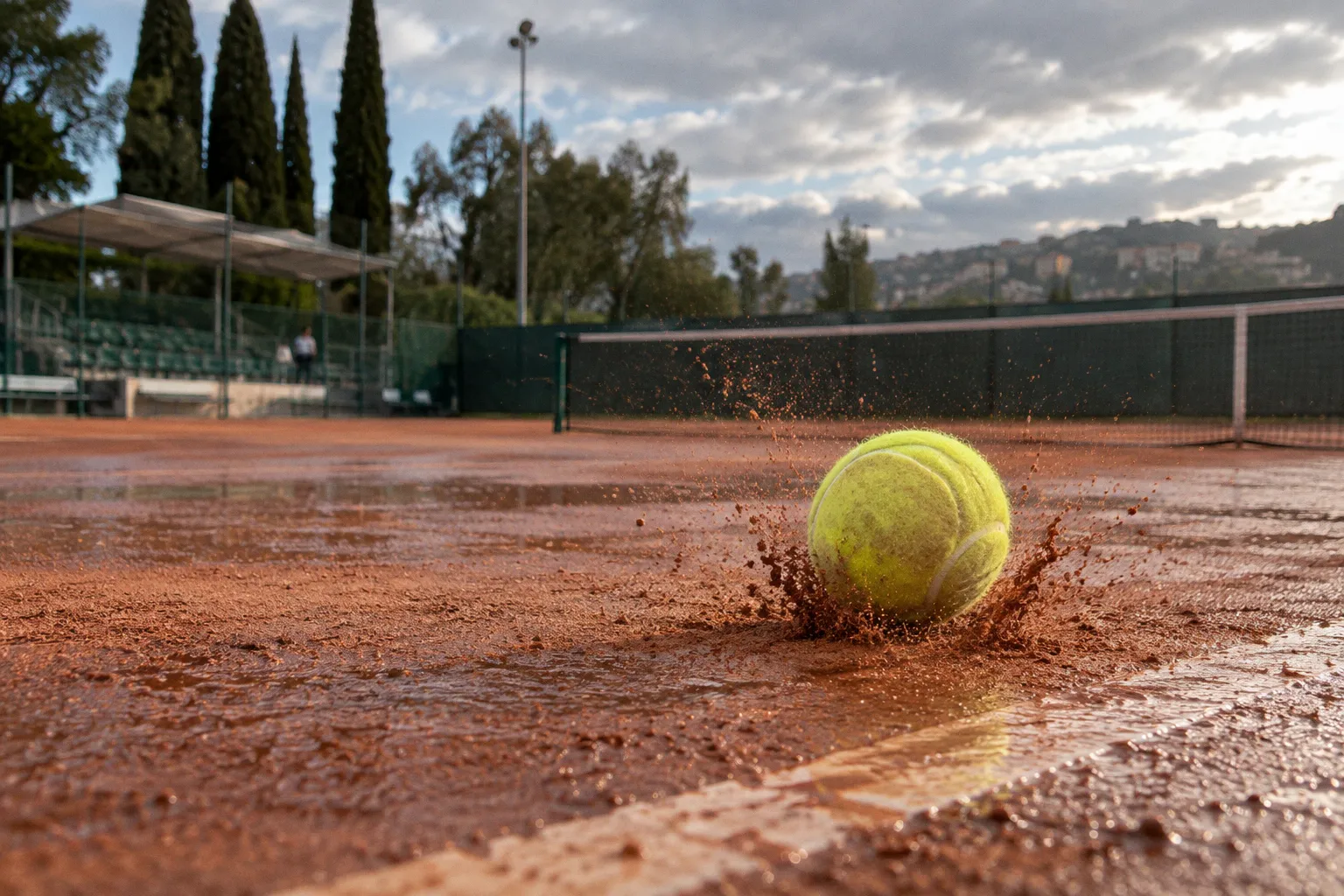
On court, their effects are not.
The same ball can leave a racket with high linear velocity, lose a different amount of speed on clay than on grass, and reach a different contact height after the bounce. The difference is not a matter of appearance. It is produced by compression, friction, pressure, and the geometry of the court-ball collision.
Tennis ball compression and court surface interaction determine the usable shape of a rally. They affect how much time a player has to reach the ball, how high the contact point rises, whether topspin converts into forward acceleration, and whether a short ball remains attackable after the bounce.
The scoreboard records the final error. It does not record the altered trajectory that created it.
The anatomy of a bounce: ITF standards and internal pressure
A tennis ball is a pressurized elastic shell. Its response is controlled by three physical components:
- the mass and diameter of the ball;
- the deformation of the rubber core and outer felt;
- the pressure differential between the interior of the ball and the surrounding air.
ITF regulations constrain the first component directly. An approved ball must weigh between 56.0 and 59.4 grams. Its diameter must remain between 6.54 and 6.86 cm. The permitted range is small because changes in mass and size alter the relationship between racket speed, ball speed, spin, and rebound.
The standard bounce test is also specific. The ball is dropped from 100 inches, or 254 cm, onto a smooth and rigid surface such as concrete or granite. The rebound must reach between 53 and 58 inches. This test provides a controlled reference. It does not reproduce a professional rally.
A live point introduces several variables absent from the laboratory procedure:
- the racket adds forward velocity and angular velocity;
- the ball approaches the court at an angle rather than vertically;
- the strings alter the deformation pattern at contact;
- the court surface can slide, grip, or absorb energy;
- the ball may be warmer, softer, or less pressurized than at the start of play.
The ball is typically pressurized to approximately 12 psi above ambient sea-level air pressure. Total internal pressure commonly sits around 27–29 psi. That pressure pushes the rubber shell outward and restores its shape after impact.
The pressure does not make the ball rigid. It makes the ball recoverable. During collision, the shell and core deform. Internal gas pressure then assists the return to the original shape. The timing matters. A ball that recovers quickly returns energy to the racket or court differently from a ball that has lost pressure and deforms more easily.
Pressure loss changes the ball’s mechanical response before it becomes visually obvious. The ball may still pass the eye test. Its surface may be intact. Yet the rebound can be lower, the forward speed can decay more quickly, and the contact can feel longer on the strings.
This is why tennis ball pressure loss has a direct impact on match conditions. The variable is not only bounce height. It is the full sequence of deformation and recovery.
The ball does not encounter a court. It encounters a court surface with a specific friction profile, restitution profile, and angle of contact.
Dynamic deformation: what happens during a 1.0-inch compression
At impact, the ball does not behave as a point mass. It becomes a temporary mechanical structure.
A hard serve or groundstroke can compress the ball by approximately 1.0 inch, or 2.54 cm. That figure should not be treated as a universal measurement for every professional shot. Dynamic compression depends on incoming velocity, racket tension, impact angle, spin, ball temperature, and the exact location of contact. But it establishes the scale of the event.
The deformation process has several stages.
1. Initial contact
The racket first contacts a small area of the felt. The felt compresses and the rubber shell begins to flatten. The ball’s centre of mass continues moving forward while the contact patch expands.
At this stage, racket-head speed is only one part of the result. The direction of the racket face, the swing path, and the incoming ball velocity determine the closing speed. A high racket-head speed against a slow ball can produce a different compression profile from the same swing against a fast incoming shot.
2. Maximum deformation
The ball reaches a temporary maximum compression. Energy is distributed across the felt, rubber, internal gas, strings, and frame. The ball is no longer spherical.
The static ITF deformation test applies an initial seating load of 3.50 lbf, or 15.57 N, followed by a test load of 18.00 lbf, or 80.07 N. This measures a repeatable mechanical property. It does not perfectly mirror the dynamic compression created by a racket moving at professional speed.
That distinction matters. Static tests are useful for controlling manufacturing tolerances. They do not provide a complete model of a 200 km/h serve or a heavy topspin forehand. The duration of impact, loading rate, spin, and tangential movement are different.
3. Recovery
The ball leaves the racket as the shell and gas pressure restore its shape. Some of the input energy returns as translational velocity. Some becomes spin. Some is lost through internal friction, felt deformation, racket deformation, and heat.
The division between forward speed and spin is tactical. A stroke with high RPM may produce a lower initial linear velocity than a flatter stroke but generate a steeper trajectory and a more aggressive post-bounce rise. The court then modifies that result again.
A useful way to describe the contact is through three independent but linked variables:
- Normal velocity: movement toward or away from the racket or court surface.
- Tangential velocity: movement parallel to the surface.
- Angular velocity: rotation around the ball’s axis.
Normal velocity controls much of the vertical rebound. Tangential velocity and surface friction influence how much forward movement survives the bounce. Angular velocity changes the direction and magnitude of the tangential interaction.
The ball does not simply bounce upward. It enters the court with a vector, deforms against the surface, and leaves with a new vector.
The friction factor: why clay and grass diverge
Court surface affects ball speed through the coefficient of sliding friction, or COF, and through the coefficient of restitution, or COR. These terms describe different parts of the collision.
COF concerns resistance to sliding. COR concerns the proportion of normal velocity retained after impact. Neither variable operates alone.
Clay generally creates higher sliding friction. It reduces horizontal speed more strongly and produces a higher bounce angle than a slippery grass surface. Grass permits more sliding and tends to keep the bounce lower. These effects are visible in rally shape, but the underlying mechanism is mechanical.
The ball’s tangential movement at impact is altered by the court’s resistance. A topspin ball arrives with forward rotation and forward velocity. If the surface grips the ball, friction acts against the relative motion between the ball and court. That interaction changes the ball’s angular and linear velocity. The result can be a higher post-bounce trajectory and more vertical separation from the court.
On grass, the lower-friction interaction permits more skidding. The ball travels farther forward with less vertical rise. The receiver has less time to set the racket below the ball because the ball remains closer to the surface while moving through the court.
The practical contrast can be summarized as follows:
| Parameter | Clay | Grass |
|---|---|---|
| Sliding friction | Higher | Lower |
| Horizontal speed loss | Greater | Lower |
| Bounce angle | Generally higher | Generally lower |
| Skid after landing | Reduced | More pronounced |
| Typical contact height | Higher after the bounce | Lower after the bounce |
| Tactical consequence | More time for vertical tracking, but higher defensive contact | Less time and lower contact, with greater value from early positioning |
Hard courts occupy a broader middle range. Their response depends on the construction, acrylic layers, base, surface texture, temperature, and maintenance. It is inaccurate to treat every hard court as mechanically identical. A slow, textured hard court can grip the ball and reduce forward speed more than a slicker installation. A faster court can preserve more pace and produce a lower, more direct exchange.
The surface does not create a player’s shot pattern. It amplifies or suppresses elements already present in the shot.
A high-RPM forehand has more surface interaction to exploit than a flat drive. A low-skidding slice can become more difficult to lift on grass because the ball remains low. A serve that produces a steep bounce gains more value on a surface that converts spin into vertical displacement.
This is also why a surface-speed label is incomplete. Pace is not a single number. It includes at least:
1. How much velocity the court removes.
2. How much forward movement remains after impact.
3. How high the ball rises.
4. How much time the receiver has before the next contact.
5. How stable the ball’s bounce is across different areas of the court.
The same measured rebound height can coexist with different horizontal behaviour. A ball may rise to a similar height while losing more or less forward speed. The receiver responds to both.
Coefficient of restitution: measuring energy loss
The coefficient of restitution describes the relative speed of separation after a collision compared with the speed of approach along the normal line of impact. In simplified form, it can be expressed as:
COR = relative separation speed ÷ relative approach speed
For a tennis ball, this is not a fixed identity. It changes with impact speed, deformation, temperature, pressure, and the surface beneath the ball.
A rigid surface does not guarantee an identical rebound. A ball may rebound differently from concrete, clay, grass, or a layered hard court because the surface changes how the ball deforms and how quickly it returns energy.
The collision can be split into normal and tangential components.
Normal interaction
The normal component acts perpendicular to the court. It controls the upward part of the rebound. Ball pressure, rubber stiffness, temperature, and surface compliance all affect energy return in this direction.
A ball with lower internal pressure tends to deform more and recover less efficiently. That can reduce rebound height and alter the timing of the ball’s recovery. The exact effect depends on the ball’s construction and the impact conditions. Pressure loss should not be reduced to a simple statement that the ball merely becomes slow.
Tangential interaction
The tangential component acts along the court. It is where friction becomes decisive.
If the ball slides, the court applies a different force from the case in which the ball grips and rolls. The change between sliding and gripping can occur during a single bounce. A ball may arrive with forward motion, engage the court, and leave with altered rotation and trajectory.
The court therefore affects not only the amount of energy retained but also the form in which that energy leaves the collision. Energy can remain as forward speed, vertical speed, or rotation. These outputs have different value to the receiver.
A high vertical rebound is not automatically a better ball for the server. If it also loses substantial forward speed, the receiver may have more time to move into position. Conversely, a low ball with high forward velocity can be difficult to intercept even when its total rebound height is modest.
Why rebound height is insufficient
A single bounce-height measurement cannot describe court pace. It omits:
- the ball’s horizontal velocity after impact;
- the change in spin rate;
- the angle of departure;
- the skid distance;
- the time to the next contact;
- the variation between fresh and worn court areas.
This is the central limitation of casual surface comparisons. Saying that one court is fast and another is slow compresses several measurements into one label. That label can be useful. It cannot explain the entire rally.
For tactical analysis, the relevant question is not whether the court is fast in isolation. It is whether the court preserves the shot properties that a particular player uses to create a short ball.
Beyond the static test: the reality of high-speed rally dynamics
Professional tennis operates outside the clean conditions of the ITF drop test.
The ball is struck at an angle. It rotates rapidly. It may be compressed against strings that are themselves moving and deforming. It then meets a court with a textured, layered, and sometimes uneven surface. The ball can also change during the match as pressure, temperature, and felt condition evolve.
The most useful breakdown is sequential.
1. Racket-ball collision
The racket determines the initial trajectory. Face angle controls launch direction. Swing path and string interaction influence spin. The impact point relative to the racket’s centre changes the effective transfer of energy.
A ball struck near the upper portion of the string bed may leave with different speed and spin from one struck near the centre. Frame stiffness, string material, tension, and pattern all contribute. These variables are real, but they do not erase the physical constraints of the ball. A racket cannot produce a stable outcome from an unstable input.
2. Flight phase
During flight, gravity and air resistance modify the trajectory. Spin changes the aerodynamic force. Topspin pulls the ball downward relative to a flat trajectory, allowing the player to swing with greater racket-head speed while keeping the ball inside the court.
The ball arrives at the court with a combination of vertical velocity, horizontal velocity, and angular velocity. The landing angle is therefore not determined by spin alone. It is the product of launch conditions and flight.
3. Court impact
The court applies a normal force and a tangential friction force. The ball deforms. The surface may compress or allow some movement beneath it. The interaction changes the ball’s speed, spin, and direction.
This is where tennis ball bounce physics becomes tactical. Two shots with the same pre-bounce speed can create different post-bounce problems if one lands with more topspin or meets a different surface texture.
4. Receiver contact
The receiver does not respond to the ball’s initial velocity. The receiver responds to the post-bounce ball. That distinction is decisive.
A shot that travels at high speed before the bounce may become manageable if the surface removes its forward component. A slower shot can remain difficult if it stays low, skids, and reaches the contact point before the receiver can establish balance.
Positioning is therefore a compensation system. Players stand farther behind the baseline when the surface produces a higher bounce and more time is available. They move forward or take the ball earlier when the bounce remains low and the horizontal component survives.
This produces different court geometries:
- On clay, the receiver often has more distance from the baseline but must manage a higher contact point and a larger vertical movement.
- On grass, the receiver may stand closer to the baseline but has less time and a lower contact point.
- On hard courts, the position depends on the relationship between court grip, ball speed, and the player’s preferred contact height.
A tactical pattern is successful when it shifts the next contact into a region where the opponent’s racket path becomes less efficient. The surface contributes by changing that region.
Temperature, pressure, and the changing ball
Temperature affects the interaction between the ball, its internal gas, and its rubber shell. Warmer conditions generally increase the ball’s liveliness, while colder conditions tend to reduce rebound and speed. The exact response depends on the ball’s construction, the ambient environment, and the court.
This is not a single-variable adjustment. Temperature can also affect the surface itself. Court materials change in stiffness and friction as conditions change. Air density alters flight resistance. Humidity can influence the felt and the perceived weight of the ball. A match played in a cool evening session is not mechanically identical to the same match in afternoon heat.
Pressure loss is similarly progressive. A pressurized ball does not switch from normal to dead at one defined point. Its response changes along a continuum. As the ball loses internal pressure, deformation can increase and energy return can decline. The player may describe the result as a heavier ball or a slower court, but the underlying cause may be a combination of ball condition and surface response.
The felt adds another variable. A new ball has a different aerodynamic and frictional profile from a worn ball. As the felt changes, the ball’s flight and court interaction can change with it. The precise live deformation of a professional ball during a Grand Slam rally is not generally available as a player-by-player measurement, so claims of exact compression values during specific points exceed the evidence.
The correct conclusion is narrower and more useful: ball condition changes the input to every tactical exchange.
Surface speed is not a property of the court alone. It is the result of a court-ball system under a defined impact condition.
What the physics predicts about performance
The mechanical model leads to several practical predictions.
First, players with high topspin benefit when the surface converts tangential motion into vertical rebound without removing all forward penetration. They can create a ball that rises above the opponent’s preferred contact zone while retaining enough weight to force a defensive reply.
Second, flat hitters gain value when the surface preserves horizontal velocity and limits the opponent’s preparation time. A lower bounce reduces the receiver’s available racket path. The shot does not need a high rebound if it arrives before the receiver can organize the contact.
Third, servers are affected by more than ace frequency. A serve’s value depends on the first bounce, the returner’s contact height, and the amount of court available for the next shot. A wide serve that produces a low, skidding return may create a different advantage from a body serve that forces a high contact point.
Fourth, defensive players are not protected by a high bounce alone. A high ball can provide time if it also loses speed. If the ball retains forward velocity, the higher trajectory may simply move the contact point upward without giving the receiver a stable setup.
Fifth, the same player can appear tactically transformed across surfaces without changing the basic stroke production. The court changes the output of the stroke. A forehand’s RPM, launch angle, and speed may remain within a familiar range, while the bounce changes the receiver’s available responses.
The data required to isolate these effects would include:
- incoming and outgoing ball velocity;
- launch and landing angles;
- RPM before and after the bounce;
- contact height;
- skid distance;
- time from bounce to racket contact;
- court-zone variation;
- ball age, temperature, and pressure condition.
Most public match data captures only part of this set. Scoreboard statistics such as aces, break points, and unforced errors are downstream results. They describe consequences. They do not identify the mechanical cause without tracking data.
The cold conclusion
Tennis ball compression and court surface interaction are not secondary details. They define the boundary conditions of professional tennis.
The ITF controls the ball’s mass, diameter, rebound, and deformation through narrow standards. The match then moves beyond those standards. A racket adds speed and spin. The ball compresses by roughly an inch under hard impact. Pressure and temperature alter recovery. The court removes, preserves, or redirects energy through its friction and restitution characteristics.
Clay increases sliding resistance and tends to produce a higher bounce angle. Grass permits more skid and preserves a lower trajectory. Hard courts occupy a variable middle ground shaped by their construction and surface condition. None of these descriptions is complete without horizontal speed, spin, and time to the next contact.
The tactical result is deterministic. A player does not receive a generic bounce. The player receives the output of a collision system. That output determines contact height, preparation time, racket path, and the probability that the next shot will be neutral, defensive, or attackable.
The court does not reward style in the abstract. It preserves some components of a stroke and suppresses others. Over a full match, that filtering process produces the final pattern of winners, errors, and points won.