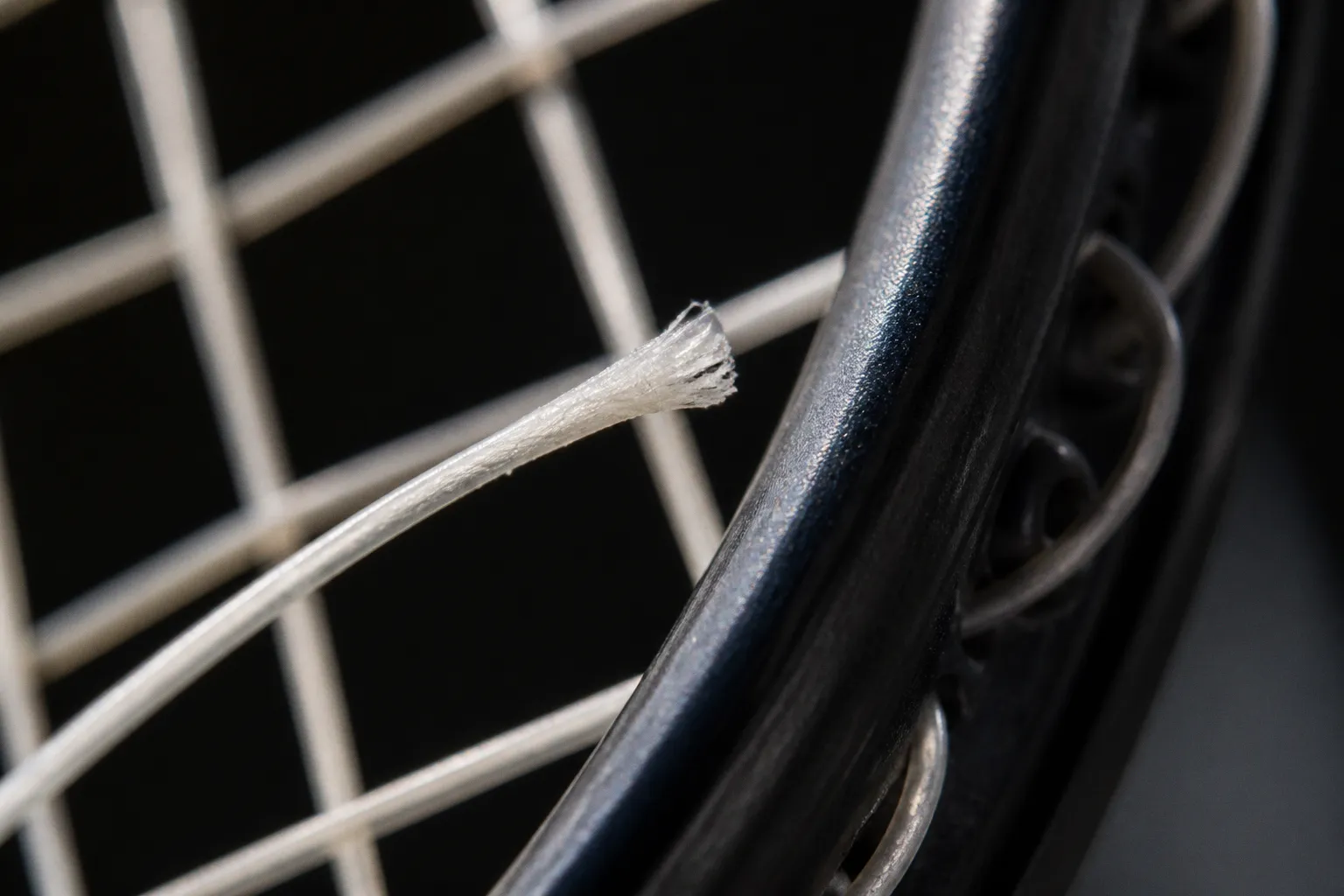
That early drop is not a manufacturing defect and not necessarily evidence of poor stringing—it is the normal consequence of a polymer under sustained load, quietly rearranging itself inside the frame.
This is why the question of tennis string tension loss during a match is more complicated than asking how many pounds disappear between the first ball and the final changeover. The racket begins changing before the warm-up, continues changing under impact, and does so unevenly depending on string material, gauge, temperature, hitting pattern, racket geometry, and the speed and force of the player. What the player feels as control, launch angle, depth, or a sudden loss of confidence is often the visible edge of a material process that began hours earlier.
The viscoelastic reality: why polyester strings never stop moving
Polyester strings are valued because they give a player a firm, predictable response under high swing speed. They resist deformation more strongly than many softer constructions, which allows a heavy topspin player to accelerate through the ball without feeling that the string bed has become a trampoline. But that resistance comes with a cost: polyester is viscoelastic, and viscoelastic materials do not hold a static load indefinitely without changing.
Two related processes are at work.
Stress relaxation describes the reduction in internal stress while a material remains stretched at roughly the same length. Creep describes the gradual increase in deformation while a load continues to act on the material. A strung racket experiences both. The strings are pulled to a reference tension, held in place by the frame, and then subjected to thousands of short, violent cycles as the ball arrives and leaves. The result is not simply a string becoming loose in one dramatic event. It is a gradual rearrangement of the polymer structure, accompanied by friction at the intersections and repeated stretching along the main and cross strings.
The reference tension printed on a stringing machine is therefore a starting condition, not a permanent identity. If a racket is strung at 52 pounds, that number describes the pull applied during installation. It does not mean that every part of the string bed will continue behaving as though it were carrying 52 pounds after a day, a week, or several hours of play.
A useful distinction is between three moments in a string’s life:
1. Installation loss occurs during and immediately after stringing, as the material settles into the frame and the string intersections stabilize.
2. Pre-play decay develops while the racket sits unused, driven largely by viscoelastic relaxation and creep.
3. Play-related loss accumulates through ball impact, off-center contact, temperature changes, string movement, and friction between the strings.
For polyester, the first stage can be substantial. A loss of up to 10% of reference tension within the first 24 hours is a practical reminder that a racket strung immediately before a match may not be delivering the response implied by its machine setting. The player may prefer that fresh, slightly sharper feel—or may find it too rigid, too low-powered, or too unforgiving. Neither response is imaginary. The string bed is changing even while it rests in the racket bag.
The tension written on the machine is an arrival point for the stringer, not a promise made to the player six weeks later.
The rate of change is not universal. String construction, gauge, pre-stretching, racket pattern, head size, and the player’s impact profile all matter. A dense 18-by-20 pattern will not present the same mechanical environment as an open 16-by-19 pattern. A thick co-polyester in a compact frame will not relax in precisely the same way as a thin polyester in a large, flexible hoop. Even two rackets with identical specifications can develop different playability if one is struck predominantly in the sweet spot and the other receives frequent contact toward the upper hoop.
This is also why a single online rule about restringing frequency rarely survives contact with a real player’s schedule. Tension loss is not just a calendar problem. It is a material and usage problem.
Static and dynamic stiffness are different kinds of truth
When players discuss a string as stiff or soft, they are usually describing a sensation at impact. Stringing laboratories and equipment specialists need a more precise vocabulary because the string bed can behave differently under slow tensioning than it does during a fast collision.
Static stiffness is the resistance of the string to elongation during a slower, controlled pull—much closer to the conditions of string installation. It helps explain how much force is required to reach a particular reference tension and how the material responds while being mounted in the frame.
Dynamic stiffness concerns rapid, high-load deformation, the kind produced when a tennis ball compresses against the strings for only a fraction of a second. This is the stiffness that most directly shapes the player’s experience of launch, depth, shock, and response under pressure. A string can appear stable under a slow pull and still exhibit a different character when it is asked to absorb and return energy at match speed.
The distinction matters because tension alone does not determine the final behavior of the racket. The string bed’s response is also shaped by:
- the material and construction of the string, from monofilament polyester to multifilament nylon or natural gut;
- the string gauge, since thinner strings generally deform more readily and can provide a livelier response;
- the racket’s head size, which changes the available string length and the effective hitting area;
- the main-and-cross pattern, where open patterns typically permit greater movement and snapback;
- the racket frame’s stiffness and flex profile;
- pre-stretching and the quality of installation;
- temperature, because polymer behavior and ball compression both shift in cold or hot conditions;
- the player’s swing speed, contact height, spin production, and frequency of off-center hits.
This is the physical reason that “higher tension equals more control” is useful only as a rough starting point. Raising tension usually reduces string-bed deflection and can lower launch, but a player who cannot comfortably accelerate through a stiffer bed may lose depth, spin, and directional confidence. Lowering tension can add power and pocketing, yet it may also send a fast forehand higher and farther than intended if the player’s technique does not provide enough control through racket-head speed and contact position.
The relationship between tension and control is therefore not a straight line. It is a moving balance between deformation, timing, energy return, and the player’s ability to reproduce the same swing when the score becomes uncomfortable.
What changes as a polyester bed relaxes?
| Racket condition | Likely mechanical change | What the player may notice |
|---|---|---|
| Freshly strung polyester | Higher initial stiffness and a sharper response | Lower launch, firmer contact, less free depth |
| After early tension relaxation | Reduced string-bed stiffness and greater deflection | More pocketing, easier depth, a livelier launch |
| After extended playability loss | Less consistent response across the bed | Unpredictable depth, weaker directional confidence, harsher or duller feel |
| Thin or heavily used polyester | Faster movement and greater loss of mechanical integrity | More string displacement, reduced snapback, shorter useful life |
| Multifilament at a comparable reference setting | Softer response with different energy and comfort characteristics | More power and comfort, often requiring tension adjustment for control |
The last row deserves care. A multifilament is not simply a polyester with less stiffness. Its fibers, elasticity, friction, and energy-return behavior create a different response profile. If a player moves from polyester to multifilament and wants to preserve a similar power-to-control balance, a common starting adjustment is to increase reference tension by about 4 pounds. That is not a universal prescription, but it reflects the additional liveliness and deformation many players encounter with the softer construction.
Quantifying the drop: from 52 pounds to 39.9
Numbers are useful here, provided they are treated as a model rather than a scoreboard. In one educational dynamic model, a polyester or co-polyester string bed installed at 52 pounds and played for four hours per week falls to an estimated 39.9 pounds after six weeks—18.1 kilograms, representing a 23.3% reduction from the reference value.
That figure is striking because it exposes the distance between installation tension and lived tension. It also needs to be read correctly. It does not mean every polyester racket reaches 39.9 pounds after six weeks, and it does not provide a universal equation for every brand, gauge, frame, or player. A string bed is not a single spring with a neat, linear decay curve. Its changes are affected by the material’s previous history, the pattern of the racket, the impact location, ambient conditions, and the way the player generates force.
Still, the model captures an important practical truth: a racket can remain intact while its playability has moved considerably away from the original setup.
That distinction between tension and playability is central. A string may continue to hold measurable tension while losing the qualities that made it useful. The player may describe the racket as dead, boardy, erratic, or strangely powerful. These words are not laboratory measurements, but they often identify a change in dynamic behavior more accurately than a single tension reading.
A professional player is particularly sensitive to this because elite strokes are built around narrow timing windows. A return struck a few inches higher on the racket face can change launch and depth; a forehand taken late can expose a string bed that no longer returns the same response at the edge of the sweet spot. At recreational speed, the player may compensate unconsciously by swinging harder or closing the racket face. At professional speed, those compensations can distort the next three shots.
This is where the phrase tennis string tension loss during match can mislead. There is no reliable universal percentage that can be assigned to a specific three-set match without a baseline calibration on that particular racket. The exact in-match decline depends on string type, duration, impact count, temperature, ball condition, and whether the player is repeatedly contacting the same central zone or loading the frame across a wider area.
The meaningful question is not whether the racket loses a precisely known number of pounds during a match. It is whether the change is large enough to alter the player’s tactical choices.
A few symptoms are especially revealing:
- The player begins protecting against long balls rather than attacking through them.
- A serve that normally clears the net with a familiar margin starts requiring a different target or spin shape.
- The return becomes difficult to direct because the launch angle feels higher on compact swings.
- The player searches for the center of the racket more urgently, suggesting that edge response has become less trustworthy.
- String movement remains visible after contact, but the strings no longer return cleanly to position, indicating a change in friction and snapback rather than tension alone.
- The player reports that the racket feels powerful in one exchange and strangely inert in the next.
These are not proof of one specific mechanical cause. Technique, fatigue, ball pressure, and weather can produce similar sensations. But when the shift appears consistently across serves, returns, and ground strokes, the string bed deserves attention.
Energy dissipation: why the ball loses more than the strings
The collision between ball and racket is brief, violent, and highly unequal in its energy losses. During impact, the tennis ball dissipates around 45% of its kinetic energy, while the strings themselves lose only about 5% of the energy they store. That difference helps explain why the string bed is not merely a passive surface and why its stiffness has such a strong influence on rebound velocity and control.
The ball deforms substantially. Its felt compresses, its rubber shell changes shape, and part of the incoming energy is not returned to the outgoing shot. The string bed also deforms, but the strings return approximately 95% of their stored elastic energy in the cited impact model. Their contribution to rebound is therefore comparatively efficient, although the final shot still depends on the frame, ball, racket-head speed, impact location, and the direction of the player’s swing.
When tension drops, the strings generally deflect more easily. That can increase pocketing and make the ball feel as though it remains on the racket slightly longer. The sensation is often described as comfort or dwell time, and for some players it produces a heavier, more penetrating ball because the player can accelerate without feeling the impact as sharply. For others, the same change raises launch and reduces the margin for error.
There is no contradiction in both responses being true. A softer string bed can give a player more access to power while demanding more precision in racket-face management. The string bed is contributing more deformation, but the player still determines the direction and trajectory of the shot through swing path, face angle, contact point, and spin.
The tension decay also changes the balance between longitudinal and lateral movement. The mains and crosses slide against each other under impact, then attempt to recover. In an open pattern, that movement may help produce snapback and spin, provided the strings still possess enough resilience and low enough inter-string friction to return efficiently. As the material ages, the strings may move without recovering as effectively. The visual result—crooked mains after a rally—is not itself a complete diagnosis, but persistent displacement combined with a dull response often signals that the bed has moved beyond its most useful playing window.
This is why a player can experience “more spin” in one phase of a string’s life and less practical spin later. Early relaxation can provide useful pocketing and movement. Later fatigue can reduce the clean return of the strings, leaving the racket feeling loose but not lively. More movement does not automatically mean more spin; movement must be paired with elastic recovery and a consistent collision.
A loose string bed is not necessarily a lively string bed. At some point, movement remains while recovery—the part that gives the shot shape—falls away.
The ball itself complicates every reading. A new ball, an older ball with lower pressure, a cold ball, and a ball warmed by long rallies do not load the string bed in the same way. Indoor and outdoor conditions can change atmospheric density, temperature, and the speed at which the collision unfolds. A player may attribute a higher launch entirely to tension loss when the ball has also become slower and less stable through the felt. Court surface matters as well: the time available for a heavy exchange on clay creates a different sequence of loading than a quick grass-court point, even though the racket and string bed remain the same physical objects.
The racket is a tactical instrument, not a fixed specification
Professional tennis is often discussed through serve percentages, break-point conversion, rally length, and shot-tracking maps. Those numbers are valuable, but they sit on top of a physical instrument that is changing during the event. The racket’s string bed is part of the tactical environment, not a neutral constant.
A player who relies on a high-margin first serve and a short first-ball pattern may want a response that keeps the launch controlled on a full swing. Another player may use a softer setup to create depth without overexerting the shoulder and forearm. A counterpuncher who absorbs pace has different needs from a player who generates nearly all speed independently. The same measured tension can therefore produce different competitive outcomes because the player’s stroke mechanics determine how much of the string bed’s behavior becomes useful and how much becomes a liability.
This is particularly visible in the return game. A return is often a compact stroke with limited preparation, especially against a fast first serve. The player cannot always create enough racket-head speed to compensate for an unpredictable launch. If the bed has relaxed beyond the player’s preferred window, the returner may begin blocking the ball more conservatively, aiming through the center of the court rather than taking the ball early toward the server’s weaker side. A small mechanical change becomes a tactical retreat.
On a second-serve return, the consequences can be different. A softer or more elastic bed may help the player lift the ball with less effort, supporting a high, deep return. But if the launch becomes too high, the returner may lose the ability to drive through the court and pressure the server’s first ground stroke. The string setup does not dictate the tactic by itself, but it shifts the available margins.
The same applies to the serve. A player who uses a high percentage of slice and kick may respond to tension decay differently from a flat server. The ball’s interaction with the strings, the angle of the racket face, and the player’s pronation all combine to determine whether a lower-stiffness bed creates useful dwell time or merely reduces directional certainty. On a fast court, a few inches of extra depth can turn an aggressive serve into a miss; on a slower court, the same added pace and height may be exactly what keeps the opponent behind the baseline.
Rather than treating tension as a preference detached from tactics, it is more useful to connect it to the shots a player must repeat under stress:
- Big first serves: often reward a response that does not launch too freely when the player accelerates hard.
- Heavy topspin forehands: can benefit from string movement and snapback, but only while the strings recover consistently.
- Compact returns: demand predictable launch and stable response across the central hitting area.
- Defensive lobs: may gain from accessible depth, although excess power can make height difficult to manage.
- Short-angle backhands: depend on precision in face angle and contact timing, making sudden changes in dynamic stiffness especially disruptive.
- Long clay-court exchanges: expose gradual fatigue in the player and the string bed alike, with hundreds of impacts accumulating before the decisive point arrives.
The cold math is not that one tension is correct and another is wrong. It is that every setup gives something and charges for it elsewhere.
Calibrating material changes without chasing a number
Changing string material is not a simple substitution. A player moving from polyester to multifilament is changing stiffness, elasticity, friction, comfort, launch, and often the amount of physical effort required to create depth. The recommended starting point of increasing reference tension by about 4 pounds when moving to multifilament is useful because it acknowledges that the softer construction may otherwise produce a noticeably more powerful response. But the number should be treated as the first adjustment in a calibration process, not as a final answer.
The same principle applies when changing from one polyester to another. Two strings may share a broad material label while differing in stiffness, coating, gauge, shape, and tension maintenance. A shaped co-poly can interact with the ball and neighboring strings differently from a smooth round monofilament. A thin string may create more movement and spin potential but reach the end of its useful playing life sooner. A thicker string can feel more stable while transmitting a firmer, less forgiving impact.
A practical calibration should begin with the player’s actual failure pattern. If the ball is consistently landing long on full swings, higher tension may help—but so might a different gauge, a denser pattern, a smoother string with more predictable snapback, or a technical adjustment to the racket face. If the player is leaving the ball short and reporting forearm fatigue, lowering tension or moving to a softer construction may restore depth without requiring the player to overhit. If the racket feels excellent for the first hour and then becomes erratic, the issue may be tension maintenance or string durability rather than the initial reference tension.
A useful record includes more than the number on the stringing ticket:
1. Record the string and gauge, not only the reference tension. A change from one polyester to another can matter as much as a change of several pounds.
2. Note the time between stringing and play. A racket used immediately after installation is not mechanically equivalent to the same racket used the next day.
3. Track the hours of play and ball type. Heavy, pressurized balls and high-impact sessions accelerate the physical workload on the bed.
4. Describe the failure in tactical terms. “Forehand launches long when taken above shoulder height” is more useful than “too powerful.”
5. Separate comfort from control. A softer response may reduce shock while increasing launch; a firmer response may sharpen direction while demanding more physical effort.
6. Compare the racket with a known reference. Without a baseline reading or a second racket prepared at the same time, a player’s memory can be influenced by conditions and scoreline.
7. Watch for the end of playability, not merely breakage. A string does not need to snap before it stops serving the player’s tactical needs.
The temptation is to chase a single ideal tension as though the racket will remain frozen once it reaches the stringing machine. That approach ignores the central fact: the racket is a changing material system. The meaningful target is a stable and repeatable response through the portion of the string’s life in which the player expects to compete.
For a professional, this may mean preparing multiple rackets so that the transition from one frame to another does not introduce an unwanted jump in launch or feel. For a club player, it may mean identifying the moment when the bed no longer supports the intended swing and restringing before the equipment begins to dictate tactics. The scale differs, but the physics does not.
What tension decay reveals about control
Control is often spoken of as though it lives inside the string bed alone. In reality, it is a partnership between the material and the player’s timing. A stiffer bed can reduce deformation and make the launch feel restrained, but it cannot rescue a late contact or an unstable racket face. A softer bed can add power and pocketing, but it does not automatically create spin or precision. Tension changes the conditions under which technique operates; it does not replace technique.
That is why the same tension drop may be welcomed by one player and rejected by another. A player with abundant racket-head speed may enjoy the additional depth created by a relaxed bed and use the extra launch to move an opponent backward. A player with a compact swing may find the same change removes the margin that kept the ball inside the baseline. A returning player may want a firm, quiet contact on first serves but a more elastic response on second-serve exchanges. There is no contradiction—only different demands placed on the same piece of equipment.
The deeper lesson from polyester string tension loss is that equipment performance has a timeline. The string bed is born at installation, changes during rest, changes again during impact, and eventually reaches a point where its physical response no longer matches the player’s tactical design. The most important measurement is not an isolated number but the relationship between that evolving response and the shots the player is trying to repeat.
Tennis is played on lines, but it is governed by margins—between a ball that dips inside the baseline and one that carries long, between a return that lands at the server’s feet and one that rises into the strike zone, between a confident swing and a protective one. String tension decay lives inside those margins. It is quiet, continuous, and easy to overlook until the racket begins asking the player to solve a different problem than the one they prepared for.
In the end, the best string setup is not the one with the most impressive number attached to it. It is the one whose changing stiffness, energy return, and feel remain compatible with the player’s real patterns of play. The machine provides the starting point. The match reveals whether the material has kept its side of the bargain.