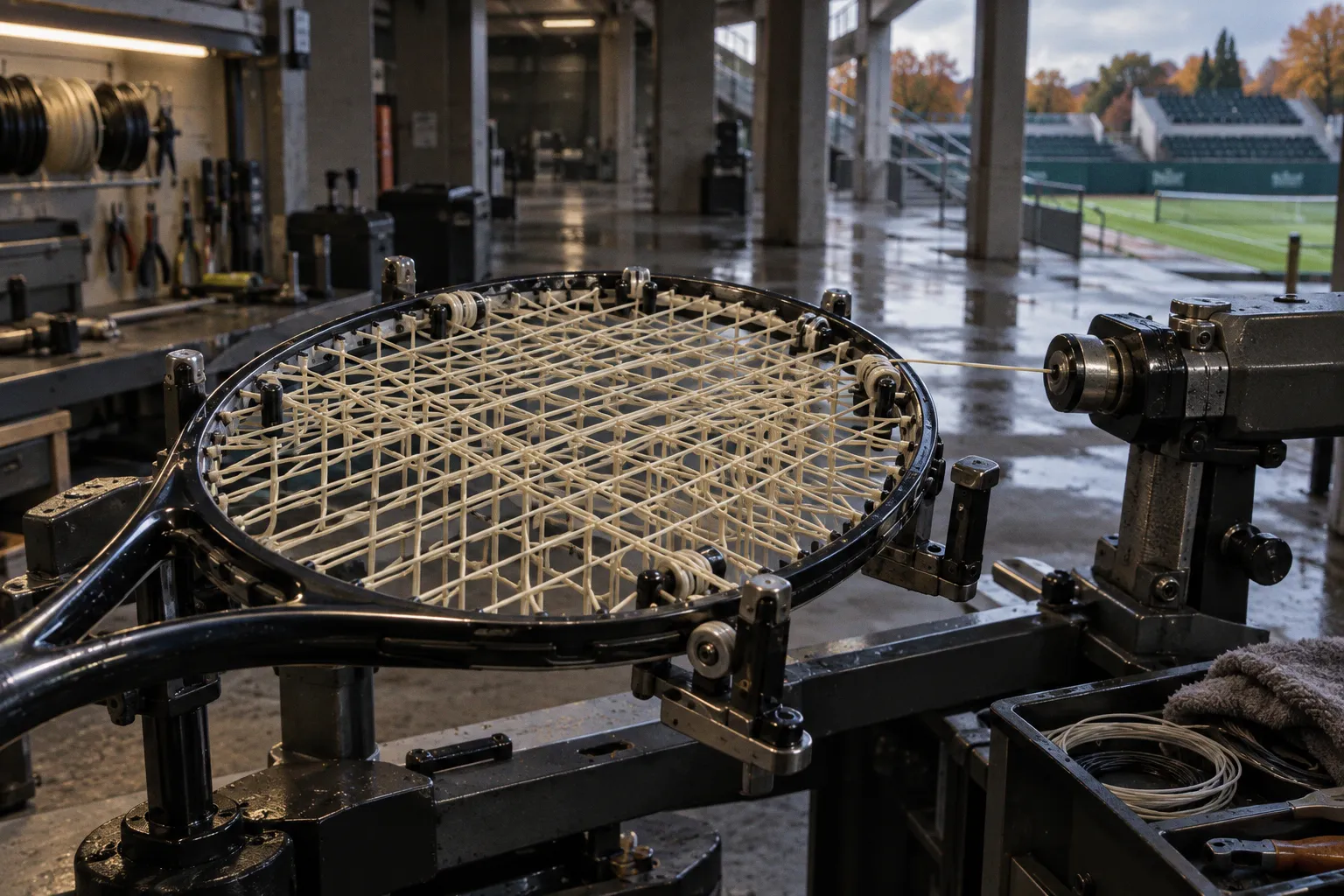
The setup was unlike a conventional stringbed, and later laboratory tests found that it could impart roughly twice as much spin on oblique impacts. By the end of October, the ITF had imposed a temporary ban on double-strung rackets; in 1978, the prohibition became permanent.
That episode still hangs over a quieter question in every equipment room: how should the strings cross? An open pattern such as 16x19 and a denser one such as 18x20 may look like small variations on the same grid. But their spacing affects string movement, launch angle, durability and the kind of trajectory a player can build into a rally. Tennis racket string patterns and spin potential are not separate subjects. They are two sides of the same piece of equipment.
The Anatomy of the Grid: Open Versus Dense Patterns
A racket’s stringbed is the lattice of mains, which run vertically, and crosses, which run horizontally. The numbers on a frame describe how many of each there are: sixteen mains and nineteen crosses in a 16x19 pattern, for example; eighteen mains and twenty crosses in an 18x20.
The count alone does not tell the whole story. The spacing between strings matters because it affects how far the mains can move sideways when a ball presses into the bed. That movement is called lateral displacement. If the main can slide and then return toward its starting position, it can help add spin to the ball. That return movement is known as snapback.
An open pattern generally gives the mains more room to move. A dense pattern limits that movement, producing a firmer, more uniform-feeling contact area. This is why players often describe an open bed as lively and a dense one as predictable. Those are tendencies, not promises: string material, tension, wear and stroke mechanics all change how the grid behaves.
| Parameter | Open pattern (e.g. 16x19) | Dense pattern (e.g. 18x20) |
|---|---|---|
| String spacing | Generally wider | Generally tighter |
| Main-string movement | More room to move sideways | More restricted |
| Snapback | Can contribute more to spin | Usually contributes less |
| Launch and trajectory | Often higher | Often flatter |
| String durability | Often shorter, depending on setup and player | Often longer, depending on setup and player |
| Directional response | Can feel more lively | Can feel more predictable |
The familiar shorthand — open for spin, dense for control — is useful, but it can become misleading if treated as a law. A dense pattern does not prevent a player from hitting heavy topspin, and an open one does not make a flat stroke suddenly climb. The grid changes the response available to the player; it does not replace the player’s technique.
There is also no single ideal spacing for every style. A player who swings through the ball with a long, fast motion may welcome the livelier launch of an open bed. Someone who takes the ball early and wants a tighter directional response may prefer the steadier feel of a denser one. Even then, a change in tension or string type can alter the balance enough to matter more than the pattern label suggests.
The grid is not a passive surface. It shapes the contact, but the player still has to give the ball its direction and rotation.
The Spaghetti Incident: When Stringing Broke the Rules
The spaghetti racket’s inventor was Werner Fischer, a German horticulturist who filed a patent for the design in 1977. Rather than weaving the strings into a single crossed plane, his setup used two parallel planes: a layer of mains and a layer of crosses that did not intersect. Small protective rollers helped hold the strings in place. With no conventional crossings to grip one another, the mains could slide laterally with unusual freedom.
That freedom was the point. In later controlled tests, engineers at Sheffield Hallam University, including Dr. Simon Goodwill and Professor Steve Haake, found that the double-strung design produced roughly twice as much spin as a conventional stringbed on oblique impacts. For a sport accustomed to the familiar friction and movement of a crossed grid, the difference was not a small adjustment. It was a different mechanical proposition.
The racket came to public attention through Ilie Nastase. Vilas, then in the middle of a long clay-court winning run, walked off during their match rather than continue against the unfamiliar setup. The episode drew the ITF’s attention, and the federation acted unusually quickly: a temporary ban followed in October 1977, with a permanent prohibition on double-strung rackets formalised in 1978.
The scope of that decision matters. The ITF targeted the double-strung spaghetti arrangement, not every string pattern that departed from a standard 16x19 or 18x20 grid. Unusual counts and experimental layouts have continued to exist within the rules. The ban closed the door on a design that separated the mains and crosses into independent planes; it did not make one conventional count the only legal way to string a racket.
That distinction is easy to lose when the spaghetti racket is remembered as a brief equipment scandal. Its legacy is less a universal prohibition than a boundary: innovation could continue, but the strings still had to fit within the sport’s rules for racket construction. The episode also sharpened a question that remains useful today: when does a change in stringing stop being a variation on the grid and start changing the nature of the racket?
Snapback and Trajectory: The Physics of Lateral Displacement
The spaghetti design made string movement unusually visible. In a conventional bed, the mains and crosses meet, and friction between them resists sideways movement. On an oblique impact, the ball pushes the mains laterally. Depending on the pattern, string material and tension, they may slide before friction slows them; as they return, that motion can contribute to the ball’s rotation.
An open layout can give the mains more room to move before they meet resistance. A dense layout generally constrains them sooner. This helps explain why open patterns are often associated with more spin potential and a higher launch, while dense patterns are associated with a flatter trajectory and a more contained directional response. But it is not a simple switch. The amount of snapback depends on whether the strings can move and return effectively, not just on how many are printed on the frame.
Trajectory, too, is a combined result. The racket face, contact point, swing path and incoming ball all matter. A player brushing up the back of the ball can create topspin with either pattern; the stringbed affects the conditions of that contact, not the basic task. A dense pattern may make a player feel more confident directing a flatter drive, while an open one may help support a higher, more heavily spun ball. Neither guarantees the shot.
It is useful to think of the pattern as part of a system rather than as a spin rating. Polyester strings, for instance, behave differently from softer strings, and tension changes the feel and response of the bed. A fresh stringbed will not behave exactly like one that has lost tension or developed notches at the crossings. The pattern sets a framework for movement; the rest of the setup determines how that framework plays out over a match.
This is why the phrase how string patterns affect ball trajectory needs a careful answer. The pattern can influence launch and spin by changing string spacing and movement, but it does not dictate a fixed arc. Players adapt their swings to their equipment, and the same racket can produce very different trajectories in different hands.
From Snauwaert to Agassi: A History of Experimental Stringing
Long before the spaghetti racket, equipment makers were testing how far they could push the geometry of the grid. The Snauwaert Hi-Ten 30, a 1970s frame made of graphite rather than wood, carried an unusually open 12x13 pattern. Its sparse layout was a striking departure from the denser beds many players associated with control.
Mark Woodforde, the Australian doubles specialist, used a custom frame with a 12x16 pattern. That kind of setup could reward a player who knew how to manage its livelier response, but it was not automatically an advantage. An open bed can offer access to spin and a high launch, yet it also asks the player to account for the ball leaving the racket with a different trajectory. The trade-off is part of the design, not a defect to be wished away.
At the dense end of the spectrum were frames such as the HEAD Radial, with a 22x23 pattern, and Andre Agassi’s customised Radical Tour OS at 20x21. Agassi’s dense bed suited a style built around taking the ball early and hitting with pace. The closer spacing offered a more contained response than an open pattern, complementing his willingness to redirect the ball from the baseline.
The contrast between these examples is not a neat march from old equipment to new. It is an argument that keeps resurfacing: should a stringbed give the player more help shaping spin, or should it keep the ball’s direction as predictable as possible? Woodforde’s open custom setup and Agassi’s dense one represent different answers, matched to different games.
That is the wider history of tennis stringing techniques. A change in the grid can look like a small specification on a frame, but players experience it as a change in timing, trajectory and confidence. The best pattern is rarely the one that wins an abstract contest between spin and control. It is the one that makes a player’s preferred ball repeatable under pressure.
The Modern Compromise: Balancing Control and Spin Potential
The 16x19 pattern has become a familiar choice in modern performance frames because it offers a useful balance. Its spacing can allow more string movement than a dense pattern, supporting spin and a higher launch, while remaining far removed from the unrestricted movement of the spaghetti design. But its popularity should not be confused with a universal verdict. It is a common compromise, not a solution for every player.
The 18x20 remains a persuasive alternative for players who want a more contained response. Flatter hitters, volleyers and players who take the ball early may value its predictable feel and potential for longer string life. On the other side, players who rely on heavy topspin or need extra margin over the net may favour a more open grid. The choice often comes down to which miss a player wants to manage: a ball that sails long, or one that lands short.
Between those familiar patterns sits a wide range of adjustments. Players can use layouts such as 16x18 or 18x19, change tension, or pair different strings in a hybrid bed, with polyester in the mains and a softer string in the crosses. Each adjustment shifts the feel rather than rewriting the laws of the game. A pattern that seems too lively might become manageable with a different tension; a dense bed that feels controlled may still lack the response a player needs.
The same logic applies at the professional level. String density and control in professional tennis are not settled by a single tour-wide preference. Players and their teams tune a racket around stroke shape, contact point, preferred trajectory and the demands of a surface. A frame may be modified not because its pattern is fashionable, but because its behaviour fits a player’s habits.
The ITF’s intervention in the spaghetti era did not freeze stringing in place. It drew a line around that specific double-strung construction, while leaving room for legal experimentation with pattern, material and tension. The modern grid remains a compromise between movement and restraint. Its details rarely make a winner on their own, but they help decide which shots a player can trust when the rally gets tight.
The grid never hits a winner. But every winner that leaves a modern racket has passed through it first.