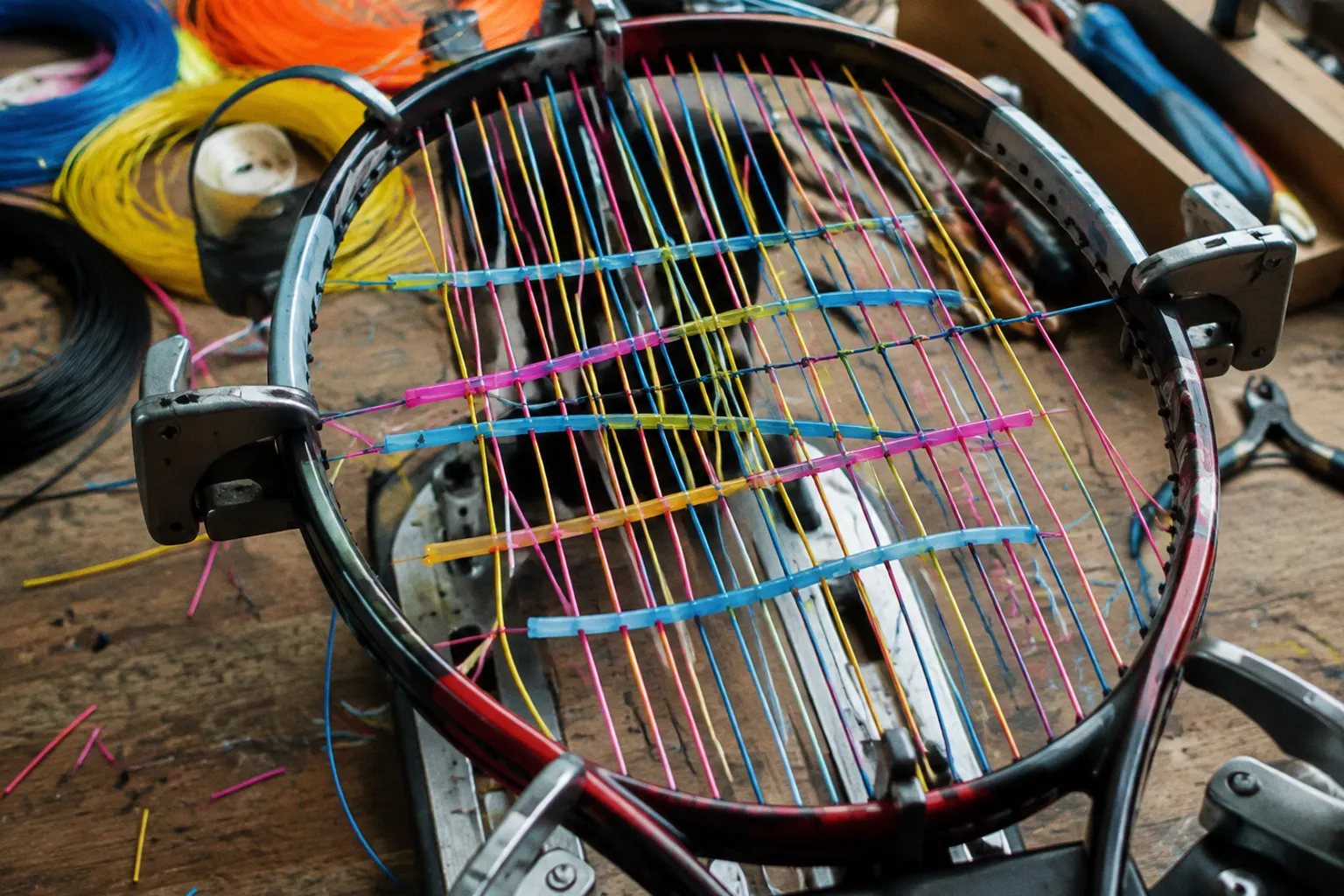
His spaghetti racket used two separate, parallel layers of main strings, only lightly connected by a handful of cross-string pairs, with plastic tubing and fishline reducing friction between the moving parts.
The result was not simply a different feel in the hand. It was a different physical event at contact. Testing by sports engineers Dr. Simon Goodwill and Professor Steve Haake found that the double-strung system could generate approximately twice the spin of a conventional string bed. In 1977, that was enough to carry a homemade racket into the spotlight, unsettle the clay-court hierarchy, and bring about one of the swiftest equipment bans in professional tennis.
The spaghetti stringing tennis ban explained in full is therefore not just a story about an eccentric racket. It is a story about what tennis permits a player to do with the ball — and what happens when the surface beneath that action begins to behave like a mechanism rather than a passive tool.
The horticulturist’s invention: Werner Fischer and the double-strung design
Werner Fischer was a West German horticulturist, not a professional racket manufacturer or a laboratory engineer working inside the established tennis industry. His solution came from a practical curiosity about friction and movement — the kind of curiosity that often appears outside the official boundaries of a sport, where familiar equipment can still look strangely unfinished.
The conventional string bed had been refined for generations, but its central principle was straightforward: one woven layer of strings, crossing at regular intervals, with enough friction between the mains and crosses to keep the pattern coherent. When the ball struck the strings, the bed deformed and then recovered. The mains could move, but their movement was restrained by the interwoven crosses and by the friction holding the grid together.
Fischer’s design separated those functions.
The spaghetti racket used two unmeshed parallel layers of vertical main strings rather than one interwoven surface. Instead of the roughly uniform web familiar to players, it relied on only five or six pairs of cross strings. Plastic tubing — the component that gave the system its memorable name, often described as macaroni — helped keep the strings apart and limited unwanted contact. Fishline was used within the construction, contributing to a string bed in which the vertical strings could slide with far less resistance.
The patent was filed in 1977, although Fischer had invented the double-strung system in 1971. That gap matters. The racket was not born as an overnight stunt designed for a single tournament. It had existed for years as an unusual technical answer to a question most players did not know they were asking: what would happen if the strings were allowed to move more freely, and if the energy of that movement could be returned to the ball in a more dramatic way?
The answer was rotation.
A conventional racket can produce heavy topspin through the relationship between swing path, racket-face angle, contact speed, and the grip between ball and strings. The string bed matters, but it is part of a larger kinetic system. Spaghetti stringing changed that system at the moment of impact. Its low-friction construction allowed the mains to slide and then snap back, creating what later descriptions called a sliding catapult effect.
That term can be misleading if it suggests extra power. The important transformation was not a straightforward increase in ball speed. Technical analysis and player reports indicate that the system primarily produced extreme spin while reducing ball velocity. The ball could leave the racket with a violent rotation — dipping, kicking, and curving with unusual severity — without becoming a faster version of an ordinary groundstroke.
For a player receiving the shot, that distinction offered little comfort. A slower ball is not necessarily an easier ball. If it arrives with a radically different rate of rotation, the bounce, timing, and racket response all become less predictable. On clay, where the ball already rises high and loses speed as it travels through the court, an extra layer of spin could alter the entire exchange.
The spaghetti racket did not make tennis faster; it made the ball behave less obediently.
The physics of the catapult: how spaghetti strings defied conventional spin
To understand why tennis banned spaghetti stringing, it helps to separate three things that are often folded together in casual equipment discussion: power, speed, and spin.
Power describes the amount of energy transferred through the shot. Speed describes how quickly the ball travels. Spin describes how rapidly the ball rotates around its axis. These qualities influence one another, but they are not interchangeable. A racket can create a ball that travels more slowly yet carries much more rotation, and that was the essential disturbance created by Fischer’s design.
In a conventional woven string bed, the mains and crosses are in continuous contact at many intersections. When the ball drags across the surface, the strings can move, but friction resists that movement. The bed behaves as a coordinated, bounded structure. It flexes and rebounds, but the strings do not slide freely across one another.
The spaghetti construction reduced that resistance. Because the main strings were arranged in separate layers and connected by only a limited number of cross-string pairs, the contact surface could move more dramatically under the ball. Plastic tubing further reduced friction and kept the layers operating independently. During a topspin swing, the ball could grip the moving strings; the strings would then displace and return, adding rotational force as they snapped back toward their original position.
The mechanics are easiest to see in the difference between a fixed woven surface and a sliding one:
| Feature | Conventional string bed | Spaghetti stringing |
|---|---|---|
| Basic construction | One interwoven layer of mains and crosses | Two parallel layers of mains with minimal cross-string connections |
| Cross strings | A regular woven pattern | Only five or six pairs of cross strings |
| Friction between strings | Relatively high at many intersections | Reduced through separation, tubing, and limited contact |
| Main-string movement | Constrained by the woven grid | Greater lateral movement and snapback |
| Primary effect | Balanced response across power, control, and spin | Exceptional spin, with reduced ball velocity |
| Player experience | Familiar timing and predictable launch | Heavy rotation, unusual bounce, and difficult adjustment |
The difference was particularly severe for opponents trying to return the ball rather than produce it. A player can prepare for pace by shortening the swing, standing farther back, or blocking the ball early. Spin asks different questions. It changes the racket-face response, pushes the ball upward or sideways after the bounce, and can make a stroke that appears comfortably within reach arrive at the strings with a completely different angle.
This was not a minor improvement in an established category. The testing by Goodwill and Haake found approximately twice the spin of a conventional string bed — a figure that explains why the racket’s impact was so immediate even though its competitive life was brief. The advantage was not evenly distributed across every stroke or surface. Its most unsettling qualities emerged when the player could use heavy rotation to control the shape of the rally, especially on clay.
Clay-court tennis already rewards the ability to create height, depth, and time through spin. The surface slows the ball and produces a higher, more elastic bounce than grass, while the longer rallies give a player repeated opportunities to make the opponent hit above the shoulder or defend from behind the baseline. A racket that amplified rotation could therefore reinforce the strategic language of clay — but with the punctuation altered.
The issue was not merely that a player could hit a heavier forehand. The entire exchange could become harder to read. The receiver’s preparation had been built around the behavior of a ball struck by a recognized racket construction. Once that expectation disappeared, the usual distinctions between skill, equipment, and surface became uncomfortable.
Michael Fishbach and the homemade racket’s arrival at the US Open
The spaghetti racket reached a wider audience through the American player Michael Fishbach, who used a homemade version at the 1977 US Open. That setting gave the invention something it had not possessed in its earlier life: a public stage, strong opponents, and an audience capable of recognizing that the strange results were not simply a matter of one player finding an attractive new frame.
Fishbach defeated top players including Stan Smith. The significance of those victories lay not only in the names attached to them, but in the visible collision between established professional technique and an object that looked improvised by comparison. The racket did not arrive with the polished authority of a major equipment launch. Its construction, with its extra layer of strings, tubing, and unconventional geometry, made the mechanism difficult to disguise.
That visibility mattered. Tennis equipment has always carried a cultural charge — wooden rackets with small heads, oversized frames, graphite composites, textured strings, protective tape, and the quiet hierarchy of what professionals are expected to use. But most changes enter the sport gradually. A new frame may be tested, endorsed, adopted by a few players, and normalized over time. Spaghetti stringing moved through the sport as an interruption.
Its power was also easy to misunderstand. Spectators might see a player producing a grotesquely dipping ball and assume that the racket was delivering greater force. In practice, the key advantage was the amount of rotation. The shot’s speed could be reduced, yet the ball’s trajectory and bounce could become much more difficult to manage. A defensive return might land short not because the opponent had been overpowered, but because the racket face had reacted to an unfamiliar spin rate.
That distinction made the racket a poor fit for the sport’s existing language of equipment fairness. Conventional rackets differed in weight, balance, head size, flex, and string tension, but they generally belonged to the same mechanical family. A player could choose a more powerful or more forgiving model without changing the fundamental relationship between ball and string bed.
The spaghetti racket changed the relationship itself.
At the US Open, the invention’s public arrival also exposed the limits of informal regulation. Tennis had rules governing the court, the ball, scoring, and player conduct, but equipment rules had not anticipated a string bed whose essential feature was the ability of its layers to move independently. The question was no longer whether the racket felt unusual. It was whether the equipment had created a new source of performance that the sport had never agreed to permit.
The answer would come quickly — but not first in New York.
Aix-en-Provence: the protest that ended Vilas’s clay-court run
On October 2, 1977, at the Raquette d’Or tournament in Aix-en-Provence, Ilie Năstase used a spaghetti-strung racket against Guillermo Vilas. The match became the defining episode in the racket’s short history because it placed the technology directly against one of the great clay-court records of the era.
Vilas had won 53 consecutive matches on clay. That streak was not an incidental statistic attached to an otherwise ordinary player. It represented a sustained command of the surface — the long rallies, the heavy topspin, the patience required to construct points through changing bounce and physical fatigue. By the time Năstase brought the spaghetti racket into the match, Vilas’s success had become part of the court’s history.
Năstase led 6–1, 7–5, and Vilas retired in protest. The result ended the 53-match streak in the official match setting, but the circumstances made the scoreline inseparable from the equipment dispute. The match was no longer remembered simply as a defeat. It became an argument about whether the defeat had been produced by tennis as the players and officials understood it, or by an instrument that had slipped outside the sport’s accepted boundaries.
The protest was not difficult to understand. A player who has spent years learning the physical grammar of clay is responding not only to an opponent’s tactics but to the court itself. The surface supplies friction, the ball supplies weight and felt, and the racket translates the swing into a familiar kind of rebound. Change one part of that relationship and the player is no longer solving the same problem.
That is why the episode remains more revealing than a simple equipment anecdote. Vilas’s streak belonged to the history of clay-court endurance, but the spaghetti racket introduced a different kind of endurance — the endurance required to adjust to a ball whose spin altered the normal timing of the point. It challenged not only the returner’s technique but the shared premise that both players were operating within the same material conditions.
The distinction between a legal innovation and an unfair one is rarely settled by aesthetics. The spaghetti racket was unusual to look at, certainly, but appearance was not the decisive issue. The problem was functional. Its construction gave spin a disproportionate mechanical advantage, and that advantage could not be understood simply as the result of a player’s hand, footwork, or tactical intelligence.
Vilas’s streak ended in a match, but the deeper rupture was between a historic surface and an unfamiliar string bed.
The timing of the official response is also important. The International Tennis Federation issued an immediate temporary ban on October 2, the same day as the Aix-en-Provence final. The ban did not take effect during the US Open, and it was not a delayed reaction to a controversy that had been quietly developing for months. The intervention followed the match that made the issue impossible to treat as a curiosity.
For a sport that generally prefers gradual adjustment — a new generation replacing an old one, a new surface rewarding a new style, a new racket becoming familiar through repeated use — the speed of the response tells its own story. Officials saw a mechanism capable of changing the competitive balance immediately, and they acted before the equipment could become ordinary through sheer repetition.
Why tennis banned spaghetti stringing
The permanent answer arrived in June 1978, when the ITF instituted rules requiring a uniform, single-layer interwoven string surface. The language of the rule addressed the construction rather than the reputation of the racket. It did not matter whether a player found the spaghetti racket elegant, ugly, clever, or homemade. What mattered was that the string bed had to conform to a common physical arrangement.
That requirement established a boundary that still feels familiar in modern tennis. Players may select different materials, tensions, gauges, patterns, and frames, but the ball must meet a string surface whose basic structure remains recognizable. The rules preserve room for equipment development while preventing the racket from becoming a separate propulsion system with a radically different interaction at contact.
There are several reasons the spaghetti design crossed that boundary.
It altered spin at the point of contact
The racket’s greatest effect was the extreme spin generated by its sliding strings. Because the ball could drag the mains and trigger their snapback with much less friction, the player gained a mechanical contribution that went beyond the ordinary range of string-bed behavior. The approximately twofold increase found in testing gave the issue a measurable basis.
It made the advantage difficult to answer through normal tactics
A powerful racket can be met with depth, positioning, or a shorter backswing. A racket that changes the rotation and bounce of the ball forces the opponent to relearn the timing of contact. That adjustment is possible in principle, but not necessarily within the conditions of a professional match, especially when the equipment is used suddenly and by a player who already possesses elite control.
It compromised the shared material language of the game
Tennis does not require every player to use identical equipment. The sport has always tolerated variation. But that variation generally exists within a common framework: one racket face, one woven string surface, one familiar relationship between friction and rebound. Spaghetti stringing created two different versions of the same court, because the ball behaved differently depending on which racket had struck it.
It produced a competitive effect disproportionate to its adoption time
New technique normally demands practice. A player who changes a forehand grip, serve motion, or return position pays for the adjustment in timing and confidence. The spaghetti racket offered an unusual shortcut: a large change in ball behavior came from the construction of the racket itself. The player still needed skill, but the equipment could create a result the opponent had not been given time to study.
This is the point at which the 1977 tennis racket ban becomes part of a larger history of regulation. Tennis officials have repeatedly had to decide whether equipment is helping players express skill or replacing too much of the skill’s work. The question appears in different forms across eras — racket size, materials, string technology, court speed, ball composition — but the underlying concern remains stable. What should belong to the player, and what should belong to the tool?
The spaghetti racket did not erase technique. Năstase still had to move, strike, and construct points. Fishbach still had to compete against experienced professionals. Yet the design amplified one component of the game so strongly that the balance between hand and instrument became difficult to defend.
The forgotten appeal of the racket
The spaghetti racket is remembered because it was banned, but the ban can obscure what was inventive about it. Fischer’s construction was not merely a prank played on the rules. It was a serious attempt to understand the racket as a dynamic object — a frame that could store, release, and redirect motion through the interaction of string, ball, and surface.
That perspective has become normal in modern equipment culture. Players and manufacturers now discuss string snapback, friction, spin potential, gauge, tension loss, and the behavior of different materials with a sophistication that would have seemed specialized in earlier decades. Contemporary string technology is not the same as Fischer’s double-layer system, and the later development of shaped and low-friction strings took place within a legal framework, but the underlying curiosity is related.
How much should the strings move? How much should they grip the ball? How much of the shot’s rotation comes from the player’s swing, and how much can be encouraged by the surface receiving that swing?
Those questions did not begin with modern polyester strings. The spaghetti racket made them visible in an unusually dramatic way.
Its cultural afterlife also comes from the contrast between its name and its consequences. The phrase sounds comic, almost culinary, while the mechanism was precise and consequential. The racket’s tubing and layered strings looked improvised, but the effect exposed a serious vulnerability in the game’s assumptions. Tennis had treated the string bed as a woven object. Fischer showed that it could be rebuilt as a set of interacting moving parts.
The episode also belongs to the lore of players who appear at the edge of the official story and briefly bend it. Werner Fischer was not a champion whose equipment became famous because of repeated victories. Michael Fishbach did not create an entire professional era around the racket. Năstase’s use of it produced a match remembered as much for the protest as for the result. The invention passed through the sport quickly, leaving behind a rule change and a handful of vivid images.
That brevity is part of its attraction. Most equipment revolutions are gradual enough that the sport can absorb them without naming the moment of transformation. Spaghetti stringing had no such quiet transition. It appeared, generated a startling competitive effect, collided with a historic winning streak, and disappeared from legal play within months.
What the ban tells us about tennis history
The history of tennis is often organized around champions, surfaces, and scorelines. Those are the visible structures of the game, the parts that can be placed neatly into records. Equipment history is more unruly. It lives in the details of friction, weight, bounce, tension, and wear — the physical conditions that players feel before spectators have words for them.
The spaghetti racket belongs to that deeper history because it demonstrated how much of tennis is governed by material relationships. A clay court is not simply a colored rectangle. It is a layer of grit under the player’s shoes, a source of drag beneath the ball, and a surface that rewards certain kinds of patience and rotation. A racket is not simply a frame with strings. It is a tensioned instrument whose smallest changes can alter the shape of a rally.
When those two systems meet, the consequences are strategic. The court encourages a particular kind of ball, and the racket determines how that ball is produced. A player who understands the relationship can build an identity around it. A player confronted with an unfamiliar relationship may find that familiar preparation no longer leads to familiar results.
That is why the ban was not an act of nostalgia for traditional rackets. The ITF was not protecting wooden frames or a fixed visual style. It was preserving a principle of comparability. Players could continue to innovate, but the innovation had to remain inside a string surface whose basic behavior was shared across the match.
The rule also left a useful historical lesson: fairness in sport does not always mean identical tools. It can mean that tools differ without changing the underlying physics of the contest beyond recognition. A heavier frame may ask for greater preparation. A different tension may reward a more precise swing. A new material may shift the balance between control and response. Those changes still belong to tennis when they remain legible within the sport’s existing mechanics.
Spaghetti stringing was difficult to read in that way. It did not merely refine an established response. It made the racket an active generator of spin through a construction that separated and multiplied the movement of the strings.
The racket that remains after the rule
The spaghetti racket vanished from legal professional tennis, but it did not vanish from the sport’s imagination. It remains one of those rare pieces of tennis lore in which a technical object, a famous player, a historic streak, and a rule change meet at exactly the same point.
Its story begins with Werner Fischer’s double-strung design in 1971 and the 1977 patent. It moves through Michael Fishbach’s homemade racket at the US Open, where victories over players including Stan Smith brought the invention into broad view. It reaches its decisive moment in Aix-en-Provence, where Năstase led Vilas 6–1, 7–5 and Vilas retired in protest, ending a 53-match clay-court winning streak. It closes with the temporary ITF ban of October 2, 1977, and the permanent prohibition of non-interwoven, double-layer stringing in June 1978.
The sequence is compact, but its implications are not. Tennis is a game of bodies operating through equipment on a surface, and the smallest alteration in that chain can travel outward into tactics, records, memory, and law. The spaghetti racket made that chain visible. It showed that the character of a match can reside not only in the player’s stroke but in the friction beneath it.
That is why this forgotten racket still deserves more than a footnote. It was not simply banned because it looked strange, nor because officials disliked an eccentric invention. It was banned because it changed the physical terms of the exchange — producing approximately twice the spin of a conventional string bed and making the ball’s behavior difficult to meet with ordinary preparation.
The sport eventually restored a common surface beneath the contest. But for a brief and turbulent moment in 1977, the strings themselves became the story.