Lead
What he produced was an object unlike any racket the professional tour had ever seen — two non-intertwining layers of main strings stretched across only five or six pairs of cross strings, the whole assembly anchored by plastic sheaths and tubing that owed less to a sports shop than to a packet of dried macaroni. By the autumn of 1977, this experimental design — soon nicknamed the spaghetti racket — had reached the highest level of the professional game, and the International Tennis Federation responded with the kind of speed rarely seen in tennis governance: an emergency temporary ban effective October 2, 1977, followed by a permanent codification of racket and stringing regulations the following year. The story of those ten months is one of the strangest chapters in equipment history, and it begins not with a metallurgist or a racket engineer but with a man whose day job was coaxing life out of soil.
The Bavarian Horticulturist and the Macaroni Strings
Werner Fischer's working life was horticulture, the slow vocabulary of growth — roots, grafting, the patience of coaxing stems into the shapes a garden requires. Tennis was his avocation, but it was the avocation of someone trained to think in materials, in tension, in the behaviour of organic structures under stress. His fascination centred not on the frame but on the string bed — how a lattice of gut or nylon deformed a ball at impact, and whether that deformation could be deliberately reshaped. He began experimenting with double-stringing concepts around 1971, sketching out configurations that bore almost no resemblance to the interwoven grid that had defined tennis rackets since the era of the wooden paddle.
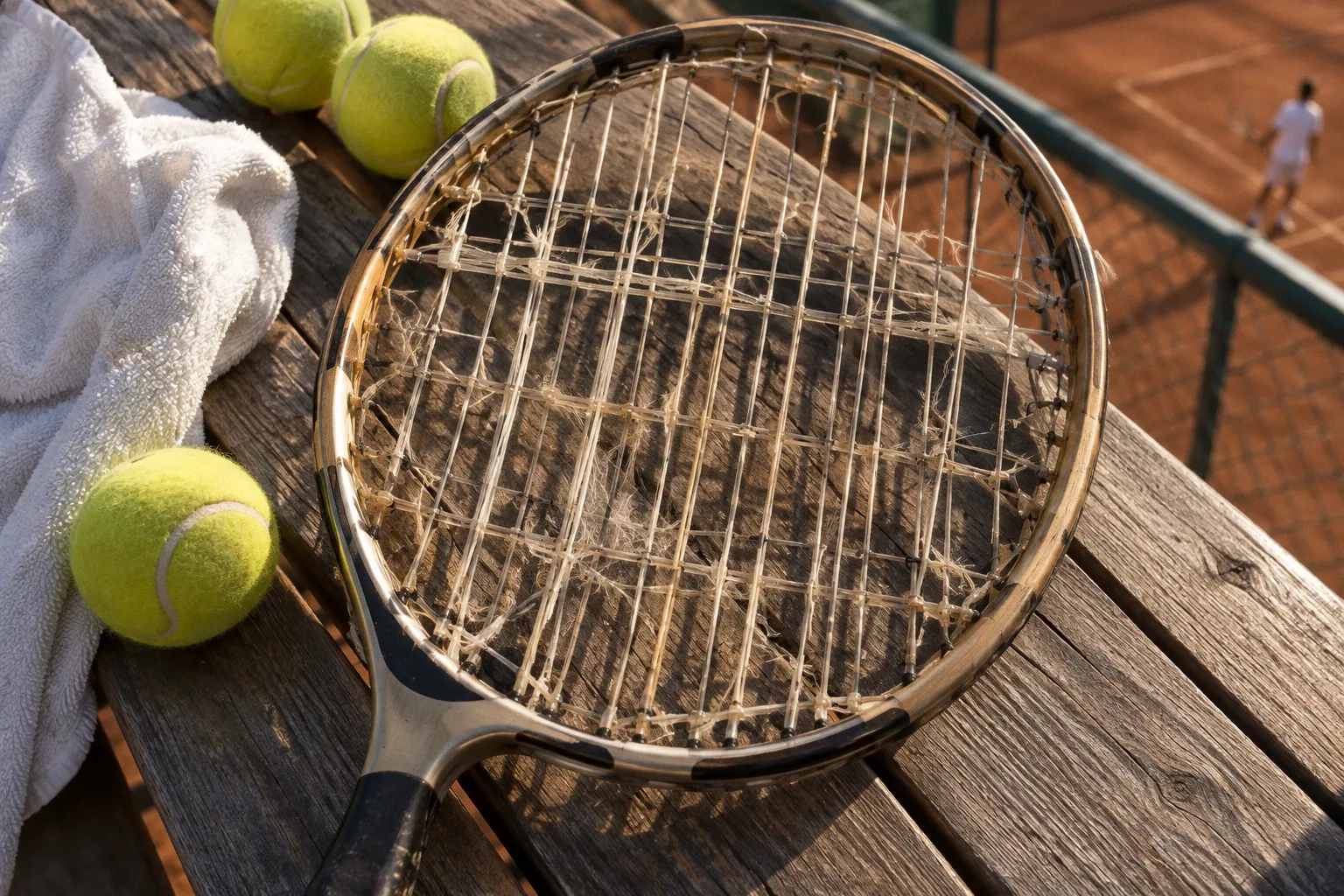
Conventional stringing, in those years, was a tight interlaced pattern — perhaps twenty main strings running vertically, intersected by a roughly equal number of cross strings running horizontally, each intersection a small knot of friction that locked the bed in place. Fischer's prototype inverted the priorities. Where conventional frames doubled up at every junction, his design kept the main strings parallel and free, layered in two non-intertwining sheets and stretched across only five or six pairs of cross strings. The cross strings became spacers and anchors rather than active deflectors. The plastic sheaths and tubing that secured the perimeter — the visual feature that earned the design its nickname — resembled pieces of dried macaroni pressed against the inside of a frame, and once mounted, the finished racket looked less like a piece of sporting equipment than like a kitchen-cupboard experiment strung onto a tournament-grade handle.
The physical logic was deceptively straightforward. By giving the main strings room to travel — to slide and recover under impact — Fischer created a bed that could grab the ball, hold it for a fraction of a second longer, and release it with controlled rotation. The cross strings, reduced to a skeletal handful, no longer braked the mains as they moved; they simply held the spacing. The plastic sheaths maintained tension at the frame's edge, but it was the unhindered horizontal play of those parallel mains that produced the racket's signature effect. A tennis ball struck on such a bed did not merely rebound — it tore across the strings, gathered enormous rotational velocity, and departed with topspin of a magnitude that conventional stringing could not match.
The US Open Upset: Mike Fishbach's Secret Weapon
The spaghetti racket arrived at the 1977 US Open in the hands of an unheralded American named Mike Fishbach, and almost immediately the design moved from the workshop to the tournament proper. Fishbach's frame was homemade — there was no factory production of these string beds in 1977, and the techniques for assembling them remained largely in Fischer's workshop and a small circle of enthusiasts who understood the layers of plastic and the precise spacing the design required. Against the sixteenth-seeded Stan Smith, Fishbach produced tennis that looked, by the standards of the day, almost unrecognisable. The ball climbed off his strings with unnatural lift, dipping viciously over a court that suddenly seemed too short for the rallies Smith had spent his career constructing. The upset was swift, and the rumour of what had caused it travelled faster than the scoreline.
What made the Fishbach moment significant was its venue. The US Open in 1977 was the showcase event of American tennis — a tournament watched as closely by coaches, manufacturers, and equipment scouts as by paying fans in the stands. The afternoon that Fishbach walked off the baseline with a victory he had no realistic business earning, every professional stringer in the sport began quietly reassessing what a string bed could do. The spaghetti racket was not an accident of manufacturing, not a malfunctioning prototype, not a one-off curiosity — it was an intentional redesign, and it worked. The lift it produced was not subtle. Players on the opposite baseline could feel it. Commentators could see it. And within weeks, the design had spread.
The Aix-en-Provence Meltdown: Ending the Vilas Streak
If Fishbach's match provided the warning, the Raquette d'Or tournament at Aix-en-Provence in October 1977 provided the crisis. Ilie Năstase arrived in southern France carrying one of Fischer's designs in his bag, and across the net stood Guillermo Vilas — the Argentine left-hander whose run on European clay had become one of the defining feats of the decade. Vilas's winning streak on the surface had reached fifty-three consecutive matches, a number that carried the weight of months of grinding, sliding, and outlasting opponents on the red dirt of Paris, Rome, and the Mediterranean clay circuit. Năstase, characteristically, saw in the spaghetti racket an opportunity for theatre as much as for tennis.
The match is remembered less for its scoreline than for the way it ended. Vilas, by the accounts of those present, retired mid-match in clear frustration, his fifty-three-match streak on clay broken not by superior tennis but by a string bed he could not solve. The topspin generated by Năstase's racket — sharp, dipping, recurring — pulled the Argentine out of the court positions his footwork depended on, and out of the rhythm that had carried him through two seasons of dominance. Vilas's retirement was a statement of surrender, and it was also a statement of facts. The string bed he had faced did something that conventional stringing did not do, and no adjustment to his game in the space of a single match could compensate.
One homemade racket ended a fifty-three-match streak on European clay. The authorities moved within weeks.
By the time Vilas walked off, the tournament's other players had already begun talking. The lift was not merely an inconvenience in the rhythm of a rally — it was a structural change in how the ball arrived at the baseline. What the ITF had been willing to treat as a fringe curiosity during the summer was now, in the dry October light of Provence, a regulatory crisis. The federation moved.
The Physics of Friction: Why the ITF Had to Intervene
After Aix-en-Provence, the International Tennis Federation could no longer treat the spaghetti racket as a curiosity to be monitored. The body turned to the only people who could settle the question of whether the design was truly producing impossible spin or simply benefiting from selective memory and tournament adrenaline: physicists. Dr. Simon Goodwill and Professor Steve Haake, working through sports engineering laboratories that studied exactly these questions, conducted controlled tests of the string bed under the impact conditions a tennis ball actually experiences in match play. The oblique hits, the glancing deflections, the brush contacts — these were the moments that mattered, because topspin lives or dies in how strings slide across a ball at an angle rather than squarely.
The results were unambiguous. The spaghetti design imparted roughly twice as much spin on the ball as a conventionally strung racket in matched conditions — a magnification factor that, applied to professional strokes already refined to the limits of human kinetics, became multiplicative rather than additive. A player who could already hit heavy topspin now hit something outside the prior vocabulary of the sport. The character of the string bed itself — sliding rather than fixed mains, recoverable after impact, a bed that elongated under load rather than braked — was the mechanism. It was the controlled friction, not the absence of friction, that produced the acceleration. Arthur Ashe, who approached the question with the analytical eye of a champion who understood the geometry of his own game, described the racket in terms that aligned with what the physics later confirmed — a string bed in which the main strings slid across the ball rather than braked it, generating topspin that conventional frames could not duplicate.
~2× the spin of a conventional frame, delivered through sliding friction that conventional stringing simply cannot replicate.
That magnification, multiplied across the tour, would have rewritten the baselines of professional tennis. Heavy topspin was already the defining motion of the modern clay-court game; the spaghetti racket promised to compress that style into a single, dense acceleration that defenders would have no time to read. The ITF understood that allowing the design to remain legal would mean watching rallies reconfigure themselves around a new physics — and that no manufacturer, and no player, would have an equal footing in adapting to it.
| Feature | Conventional stringing (1970s) | Spaghetti stringing |
|---|---|---|
| Cross-string count | ~20 pairs | 5–6 pairs |
| Mains behaviour | Interlaced and braked at every cross | Two parallel layers, sliding freely |
| Edge finish | Knots, grommets, traditional tie-offs | Plastic sheaths and tubing around frame |
| Spin production (matched oblique impact) | Baseline | ~2× baseline |
The 1978 Codification: Defining the Modern Racket
The emergency temporary ban took effect on October 2, 1977, but the ITF understood that a stopgap ruling could not hold the line indefinitely. Over the following months, the federation's rules committee set about codifying exactly what a tennis racket could be — its length, its head size, its stringing pattern, the spacing and density of its strings, and crucially, the geometry permitted between mains and crosses. The permanent ban on double-strung rackets arrived in 1978, and with it the modern definition of a tennis racket that still governs play today. What had been a fluid equipment culture, in which innovations spread through workshops and stringing rooms over years, was frozen into text.
The codification did more than outlaw a single design. It effectively closed the door on a category of experimentation — racket architecture chosen for its friction characteristics rather than its conformity to prior pattern. The legitimate evolution of the sport's equipment would now proceed through permitted avenues: the gradual introduction of larger head sizes, the slow migration from natural gut to nylon to polyester, the careful engineering of weight distribution and balance, the incremental changes in beam width and string density. Each of those transitions arrived at a pace the tour could digest. The spaghetti racket had compressed an entire equipment revolution into a single object, and the sport's governing body had no choice but to legislate in haste.
In retrospect, the episode looks less like a scandal than like an inflection point — a brief, sharp window in which a horticulturist from Bavaria pointed at a future the tour was not ready to enter. What Fischer had built in his workshop — that odd grid of parallel mains and plastic tubing, that kitchen-cupboard string bed — was not, at the moment of its construction, in violation of any specific written rule. The regulations under which the professional game had operated for generations contained no language precise enough to forbid it. The bans of 1977 and 1978 closed that legal gap and rewrote the rulebook in unambiguous terms. The sport continued, in the slower cadence it preferred, through the consensual evolution of polymer strings, head-size limits, and racket science that has shaped the game since.
Fischer's invention remains one of the most unusual footnotes in tennis equipment history — a reminder that the boundary between legal innovation and outlawed ingenuity has always been drawn, in the end, by whoever walks onto court next with a racket no one has seen before.