That is not simply a matter of athletic progress. It is also the result of what the racket allows the player to do.
The history of wood rackets vs graphite tennis is therefore more than a story about old equipment being replaced by new equipment. It is a story about changing definitions of control. The wooden racket demanded precision before power. The graphite racket made power compatible with precision. One rewarded the player who could remain inside a narrow physical margin; the other widened that margin and then raised the ceiling above it.
So did tennis lose its art? The question is tempting, but slightly wrong. Tennis did not lose art when graphite arrived. It changed the kind of mastery the sport asked for. The touch of the wooden era belonged to a smaller, more unforgiving world. The modern game has its own artistry, but it is expressed through racket-head speed, spin, recovery, geometry, and the ability to repeat difficult actions under pressure.
The Era of the Wooden Press: Crafting the Touch
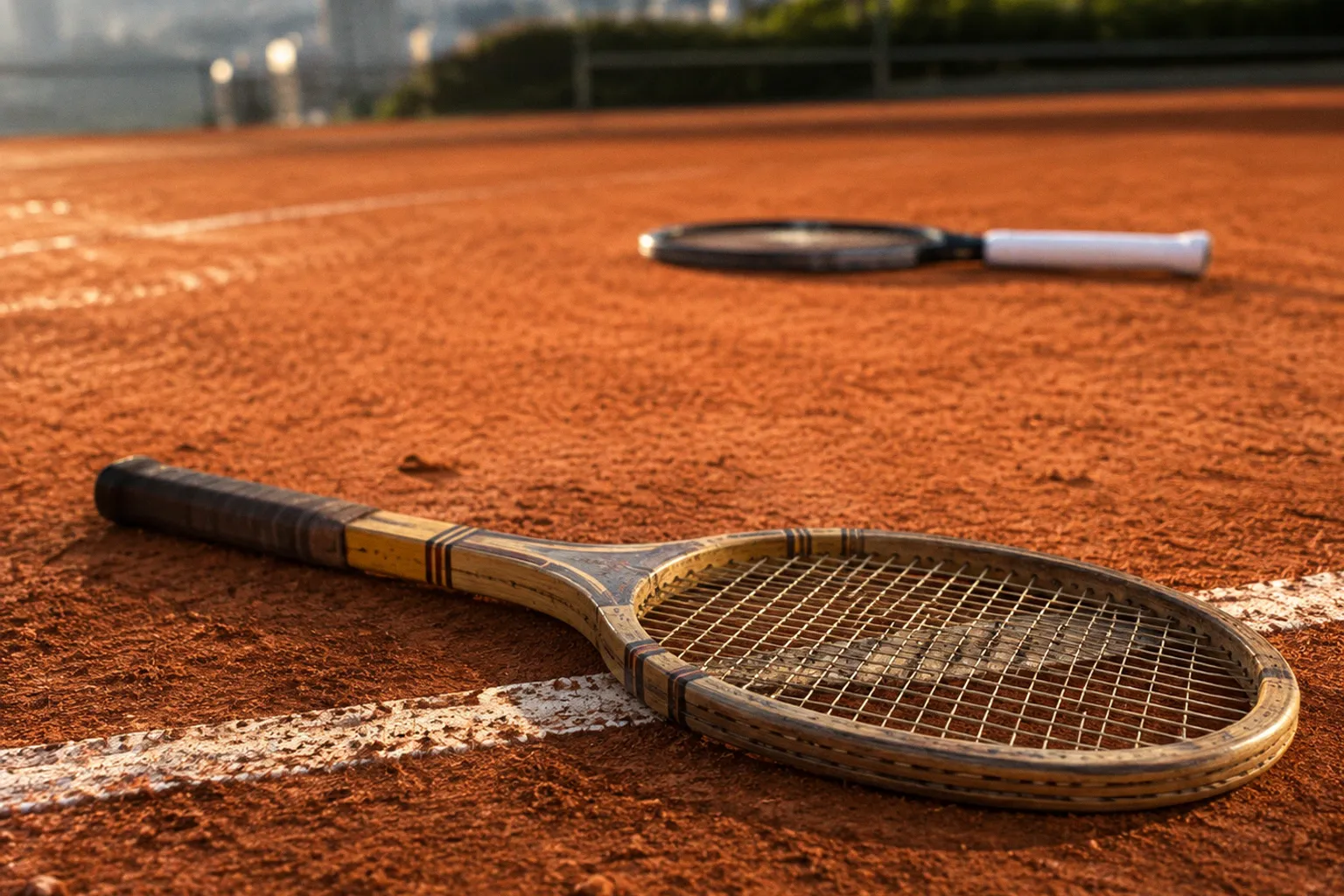
The wooden racket was an exercise in compromise. Its frame was usually made from laminated wood, often ash, maple, or related materials, and its hitting surface was much smaller than that of a modern racket. A typical wooden frame occupied roughly 65 to 85 square inches. Its weight was substantial, often somewhere in the 400-to-500-gram range, with some professional models heavier still.
That mass shaped the entire stroke. The racket did not invite a quick wrist-led movement. It demanded a complete swing, beginning with the body and flowing through the shoulder, arm, and hand. A player who tried to improvise at the last moment was not merely taking a technical risk. They were confronting the material itself.
The sweet spot was correspondingly severe. Strike the ball in the centre and the racket could feel wonderfully stable, almost inevitable. Miss that centre by a meaningful distance and the punishment arrived immediately: vibration through the handle, a loss of depth, or a ball that left the strings with no particular loyalty to the player’s intention. The frame did not disguise technical mistakes. It announced them.
This is why wooden rackets were not just pieces of sporting equipment. They were objects that required maintenance and attention. Players kept them in presses to protect the frame from warping. String tension, humidity, storage, and small changes in the wood could affect the way the racket behaved. The player had to understand the tool not as a neutral extension of the body, but as a living constraint within the game.
A wooden racket did not forgive a late decision; it made the quality of the decision visible.
The limitation created its own form of intelligence. Since generating easy pace was difficult, players learned to borrow pace from the opponent. The incoming ball became part of the stroke. Redirecting it, absorbing it, changing its height, or taking it early could be more valuable than trying to overpower it.
That environment elevated the all-court game. The serve was often a way to begin the point on favourable terms rather than an attempt to end it immediately. The approach shot carried strategic weight because the net remained a central destination. The volley was not an exotic variation reserved for a surprise attack; it was one of the main ways to finish a point.
The wooden racket also rewarded a particular relationship with balance. A player had to arrive at the ball with the body organised, the swing prepared, and the intended direction already understood. There was little room for the modern habit of rescuing a bad position with a violent rotation of the racket head. The stroke had to be built earlier.
That did not make the old game slow in every sense. Wooden-era tennis could be extremely quick, especially on grass or indoor courts. But its quickness was concentrated differently. The first exchange might be decisive because the court was fast, the ball stayed low, and the racket encouraged a flatter trajectory. The point was not necessarily long, but the margin for improvisation was narrow.
The 1967 Catalyst: When Steel Challenged Tradition
The first major disruption to the wooden monopoly came not from graphite but from steel. In 1967, Billie Jean King won the US National Championship using the Wilson T2000, a steel-frame racket with a distinctive wire-laced throat.
The significance of that victory was larger than the technical differences between one frame and another. It demonstrated that the accepted material of the sport was not sacred. A racket could be lighter, could flex differently, and could alter the timing of a stroke without making touch and placement irrelevant.
Steel did not instantly create modern tennis. The court, ball, strings, tactics, and training culture still belonged largely to the older game. But it exposed a weakness in the assumption that wooden construction represented the natural endpoint of racket design. If a different material could provide useful performance without destroying the player’s ability to feel the ball, there was no obvious reason to stop there.
The T2000 also represented an important shift in the relationship between equipment and identity. A wooden racket had traditionally been part of a recognisable visual language: laminated frame, narrow head, leather grip, natural materials, familiar proportions. Steel looked more industrial. It suggested that the racket could be engineered rather than simply refined.
The change did not arrive as a clean break. For a period, different materials coexisted. Players experimented with steel, aluminium, and early composite constructions while manufacturers looked for a combination of strength, lightness, stiffness, and acceptable feel. The transition was not a single revolution that happened overnight. It was a series of arguments conducted through frames.
That matters because the wood racket era debate is often told too neatly. The story is not that wooden rackets were pure and graphite rackets were artificial. Wooden frames were themselves the result of engineering, lamination, glue, shaping, and careful manufacturing. Graphite did not introduce technology into a natural sport. It made the technology more visible and more powerful.
The real question was what kind of technological assistance the sport would tolerate before the character of a stroke changed. Steel opened the door. Composite materials eventually walked through it.
The Graphite Revolution and the Death of the Sweet Spot
The decisive transformation came with graphite composites and the new possibilities they offered. Frames could become lighter without simply becoming weak. They could be made larger, stiffer, and more stable while remaining manageable through a full swing. The Dunlop MAX 200G, introduced in 1980 and associated with champions including John McEnroe and Steffi Graf, became one of the recognisable symbols of this transition.
The important change was not just that the racket weighed less. It was that weight could be redistributed and used more efficiently. A player could swing faster while still producing a substantial ball. The larger head created more room around the centre of the strings. The result was not perfect forgiveness, but a much wider zone in which a technically imperfect strike could still produce a useful shot.
The broad direction of the change can be seen in the equipment itself:
| Parameter | Wooden racket era | Graphite era |
|---|---|---|
| Typical frame weight | Often around 400–500 grams, sometimes more | Commonly much lighter, depending on construction and model |
| Head size | Roughly 65–85 square inches | Mid-plus and oversized heads became common |
| Miss-hit penalty | Sharp vibration and major loss of pace or direction | Greater stability and a more usable response away from centre |
| Swing pattern | Compact control, redirection, flatter trajectories | Faster racket-head speed, higher spin, more aggressive trajectories |
| Tactical emphasis | Touch, timing, approach play, volleys | Baseline pressure, recovery speed, depth, and repeatable power |
The larger head did more than make tennis easier. It enabled a different physics of the stroke.
With a modern graphite frame, a player can swing rapidly from low to high and use the strings to shape the ball with heavy topspin. The ball can clear the net with a greater margin, dip sharply into the court, and jump high after the bounce. A player can attack while sending the ball through a trajectory that would once have looked too ambitious.
That possibility changed the relationship between risk and reward. In the wooden era, a high-risk swing was often punished by the frame before the opponent had to do anything. In the graphite era, the racket can help convert a fast, slightly off-centre swing into a deep and dangerous ball. The player is free to take more chances because the equipment makes those chances less catastrophic.
This is one reason the modern game is so topspin-heavy. Topspin is not merely a stylistic preference. It is a method of controlling a fast swing. The racket moves aggressively upward, the strings grip and redirect the ball, and the resulting rotation allows the player to hit with height and pace while keeping the ball inside the court.
The modern contact point is also shaped by that equipment. Players meet the ball further in front, rotate more violently through the hips and trunk, and recover quickly enough to prepare for another heavy shot. The stroke is not necessarily more beautiful or less beautiful than a wooden-era drive. It is built around a different sequence of physical priorities.
The sweet spot did not disappear in the graphite era. It expanded. That distinction matters. The centre of the racket still offers the cleanest response, and elite players still care intensely about contact quality. But the penalty for missing the centre became less severe. The modern racket did not eliminate precision; it made precision more available under pressure.
This is where the phrase death of the wooden tennis rackets becomes misleading. Wooden frames did not die because they were incapable of producing elegant tennis. They disappeared from elite competition because their limitations placed a ceiling on the speed, spin, and recovery patterns that modern players could exploit.
The Aesthetic Cost of Baseline Aggression
The equipment shift helped move the centre of the game away from the net and towards the baseline. It did not cause that change by itself. Court surfaces, balls, conditioning, tactics, coaching, and professional competition all played a role. But graphite made the new pattern more practical and more sustainable.
A player could stand well behind the baseline, create time with a high, rotating ball, and then increase pressure without approaching the net. The point could be constructed through depth and angle rather than through an immediate advance. If the opponent defended, the attacker could keep repeating the sequence: heavy cross-court ball, recovery, change of direction, another heavy ball.
This was not simply a matter of hitting harder. It was a matter of making aggression repeatable.
A wooden racket encouraged economy because the frame exposed excess movement. The modern graphite racket supports a wider range of racket-head speeds and larger margins above the net. Players can defend with spin, attack from difficult positions, and turn a neutral ball into an offensive one without changing the basic shape of the rally.
The aesthetic cost is real, even if the word cost already contains a judgement. The older game offered a more visible variety of interruptions: the soft drop shot, the disguised chip, the low slice, the sudden approach, the improvised half-volley. These shots still exist, but they occupy a different place in the modern tactical structure. They are often used to break the rhythm of baseline pressure rather than to define the rhythm of the match.
In the wood racket era, touch was frequently the architecture of the point. In the graphite era, touch is often the change of pace inside a larger system of force.
That system can look repetitive when viewed only through its surface. Two players exchange heavy forehands, recover to position, and repeat the pattern. But the apparent repetition contains a great deal of information. Height over the net, depth, spin rate, direction, recovery distance, contact position, and the quality of the next ball all interact. A modern baseline exchange is not a refusal of artistry. It is a more mechanical-looking form of decision-making.
The difference is that the mechanics are now performed at a higher speed and with less visual ornament.
The graphite racket did not remove touch from tennis; it buried touch inside speed, spin, and recovery.
The tennis touch vs power debate often treats those qualities as opposites. They are not. A player needs touch to change direction, absorb pace, shorten the ball, or redirect a difficult return. What changed is the amount of power that the player can bring into the same exchange without losing control.
Power now creates its own kind of disguise. A heavy forehand can be directed cross-court repeatedly until the opponent begins to lean, then sent down the line with almost the same preparation. The deception does not come from a theatrical wrist movement. It comes from preserving the same body language while changing the geometry of the ball.
There is also artistry in recovery. After a powerful shot, the player must regain the court before the opponent can exploit the open space. The stroke is only half the action. The other half is the return to a position from which the next decision remains possible. Modern tennis turns the space between shots into a technical discipline.
The contrast with wood is therefore not art versus no art. It is tactile improvisation versus engineered repetition; visible softness versus controlled violence; the artistry of making less equipment do more versus the artistry of using more responsive equipment without surrendering judgement.
When the Frame Changed the Point
A racket does not determine tactics on its own, but it changes which tactics can survive contact with a strong opponent. This is the most important distinction between equipment history and equipment mythology.
A wooden frame made certain choices expensive. A player could still hit with force, but a large, fast swing demanded excellent timing. A player could still defend from deep behind the baseline, but generating a heavy ball repeatedly from that position was much harder. A player could still attempt a sharp angle, but the combination of pace, spin, and margin was less available.
Graphite lowered the cost of several modern decisions:
- Taking a bigger swing on a high ball: the larger head and lighter construction made fast racket-head speed easier to use repeatedly.
- Hitting with more net clearance: topspin allowed aggressive trajectories without requiring the ball to travel flat through a narrow window.
- Attacking from behind the baseline: depth and rotation could push the opponent back even when the attacker was not close to the court.
- Recovering after a wide shot: lighter frames and improved physical preparation made it easier to return to position before the next exchange.
- Using the same stroke defensively and offensively: a heavy, high ball could buy time or become a weapon depending on depth and placement.
These advantages did not make every modern player interchangeable. Rackets can amplify differences in technique rather than erase them. A player with poor timing does not automatically become precise with graphite. A player with exceptional feel does not lose it because the frame is larger. But the equipment changes the baseline from which those qualities operate.
This is why the graphite impact on tennis artistry is difficult to measure through highlight shots alone. The spectacular modern forehand is obvious. Less obvious is the number of decisions that make it possible: when to accelerate, how high to clear the net, how much shape to put on the ball, where to recover, and whether to repeat the pattern or change direction.
The wooden racket made the contact itself the drama. The graphite racket spreads the drama across the entire sequence.
A great wooden-era stroke could look complete at the moment the ball left the strings. A great modern stroke is often judged by what it does to the next three shots. Does it force a shorter reply? Does it remove the opponent’s preferred angle? Does it create enough time to recover? Does it hold the opponent behind the baseline? The artistry has become more relational and more strategic.
That can make it harder to recognise. We tend to romanticise visible delicacy more readily than invisible control. A soft touch at the net announces its difficulty. A heavy forehand that repeatedly lands deep and jumps above shoulder height may look like a physical fact rather than a crafted decision. Yet it is crafted all the same.
The Legacy of the Frame: Why We Still Romanticize Wood
Wooden rackets are now historical objects, teaching tools, or props in clinics devoted to the game’s past. Their appeal is not difficult to understand. They carry the texture of an older sport: leather grips, narrow heads, laminated frames, natural variation, and a direct physical connection between error and consequence.
They also make the past look more coherent than it was. The wooden era contained its own technological changes, tactical compromises, and debates about equipment. It was not a pure age before commercial influence or athletic escalation. Players were always searching for an advantage. Manufacturers were always refining materials. The sport was never frozen.
What we romanticise is often not wood itself but the visibility of limitation. A wooden racket makes the boundaries obvious. It tells the player where the safe contact is, how much acceleration the frame can tolerate, and how quickly a poor decision will become an error. Modern equipment hides more of that struggle. It gives the player room to recover from a mistake, and that room can be mistaken for a lack of skill.
But forgiveness is not the same as simplicity. A larger sweet spot allows a player to attempt more, not merely to do less. Once power and spin become accessible, opponents can use them against each other. The technical standard rises. What was once an exceptional shot becomes the minimum required to stay in the exchange.
That is the paradox at the centre of the wood racket era debate. Equipment makes certain actions easier, but it can make the whole game harder. A modern player benefits from a racket that supports speed and spin, then faces an opponent using the same support. The advantage becomes an expectation. The frame widens the possibilities, and competition immediately occupies them.
The old wooden racket demanded control of a narrow system. The graphite racket demands control of a larger and faster one. Both punish weakness. They simply expose different weaknesses.
A player from the wooden era might struggle with the pace and height of the modern ball. A modern player handed a heavy wooden frame would not automatically rediscover the lost virtues of touch. They would have to rebuild the timing, preparation, and patience that the equipment requires. Nostalgia does not transfer skill between eras.
Nor did graphite destroy the beauty of the court. It changed the scale of what can happen on it. The ball travels faster, the bounce is used more aggressively, and the player has to solve problems while moving at the edge of balance. The resulting tennis can be brutal, but brutality and elegance are not mutually exclusive.
The best modern players still understand softness. They know when to take pace away, when to use a shorter angle, when to flatten the trajectory, and when a powerful exchange has become predictable. Touch survives because the opponent’s expectation survives. If every shot is hit with the same force, the game becomes legible. Variation remains a weapon.
The phrase “lost its art” persists because every generation tends to recognise the beauty of the game it has already learned to see. Wooden tennis presents its artistry in familiar forms: the compact swing, the delicate volley, the low slice, the player balanced near the net. Modern tennis asks us to look longer and harder. Its artistry may be found in the maintenance of pressure, the management of space, and the ability to reproduce a demanding stroke when fatigue and fear are both arguing for safety.
Tennis did not lose art when it left wood behind. It traded one form of intimacy for another. The wooden racket brought the hand closer to the material and made every imperfect contact feel personal. Graphite brought the player closer to the limits of speed, rotation, and recovery.
The old racket made restraint beautiful. The new racket makes controlled excess beautiful.
That is not a decline from art. It is a change in its grammar.