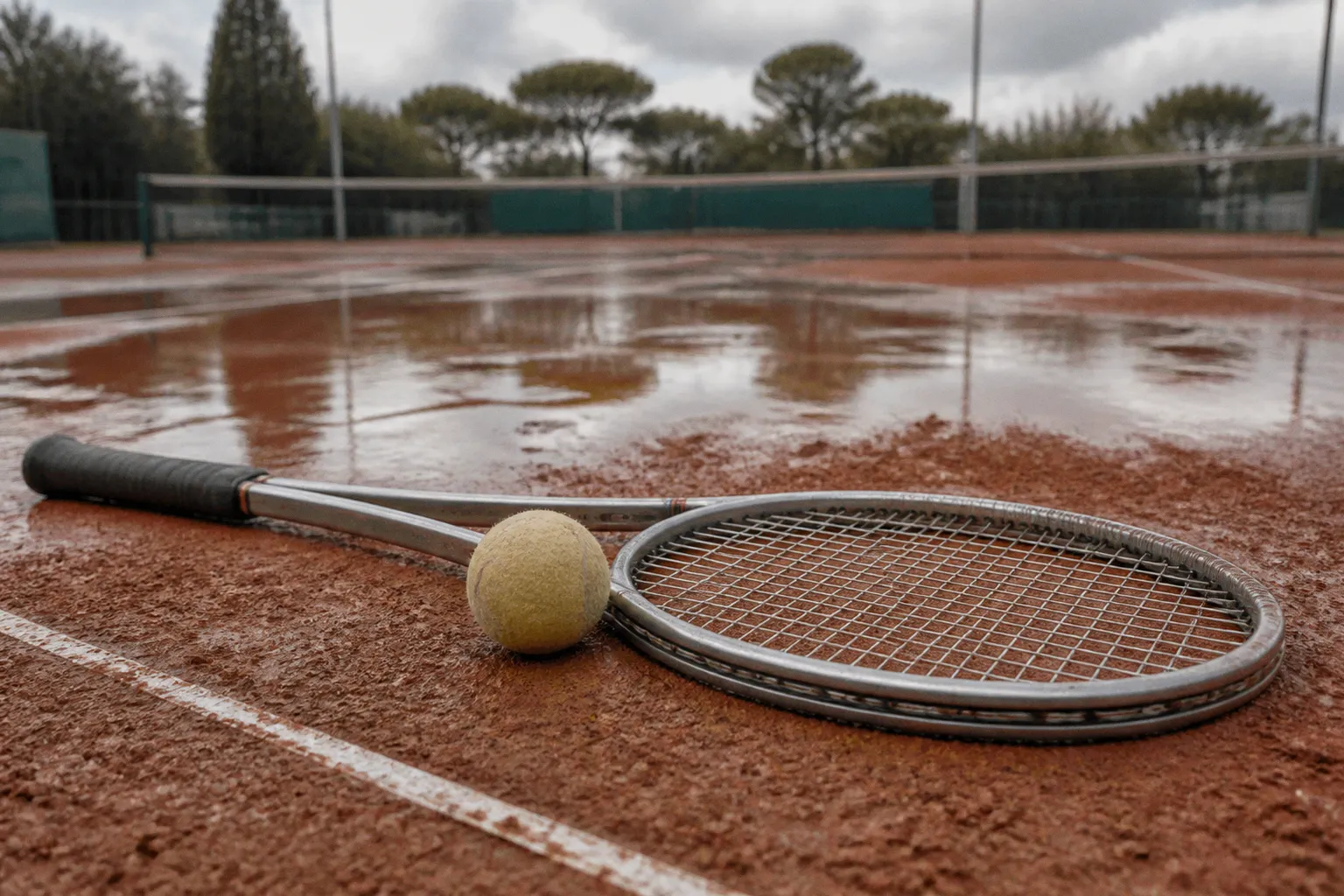
The Wilson T2000 makes that version feel too neat. Introduced in September 1967, it was heavier, more compact, and more physically demanding than the rackets that followed, yet it carried enough stiffness and authority to alter what players expected from a frame.
Its importance lies not only in the estimated two million T2000s sold between 1967 and 1984, nor in the Grand Slam victories associated with Billie Jean King and Jimmy Connors. The racket remains valuable because it exposes a tension that modern equipment can easily hide: stiffness is never simply power, and playability is never only a matter of how hard a frame sends the ball away. Every gain in energy transfer arrives with a corresponding demand for timing, contact quality, and bodily tolerance.
The T2000 was a metal racket, but its real subject is the relationship between the player and the frame.
From René Lacoste’s patent to the Wilson T2000
The design behind the T2000 began with René Lacoste, the French tennis champion whose name is now more readily associated with clothing than with engineering. Lacoste developed the metal-racket concept in the early 1960s, building on a design patented in 1953, and later licensed it to Wilson. That passage from patent to mass-produced equipment matters because the T2000 was not merely a steel alternative to a wooden racket; it was an attempt to reorganize the frame around the properties of metal.
Wooden rackets had dominated the sport for generations, and their construction imposed a particular rhythm on play. Their frames could be powerful, but they were also comparatively flexible and susceptible to changes in weight, balance, moisture, and construction quality. The player felt the frame deform and recover through impact. The racket was not passive, but neither was it brutally direct. There was a certain delay in the exchange between ball, strings, and hand.
The T2000 approached that exchange differently. Its frame was made from chromium-plated tubular stainless steel, with a circular, compact head of roughly 68 square inches. The steel was considerably stiffer than the flexible wooden frames of its era, allowing more of the collision’s energy to return to the ball rather than being absorbed by the bending of the frame. This did not make the racket universally easier. It made the consequences of contact more immediate.
The distinctive construction was visible before a ball was struck. Instead of hiding the string anchors inside a conventional frame, the T2000 used an external wire-wrap system around the outside of the head. The strings were attached through wire loops, giving the racket a mechanical, almost industrial appearance. It looked less like a polished piece of sporting furniture than a working instrument assembled around tension.
That external wire system also contributed to the racket’s most recognizable sound: a sharp metallic ping at impact. The noise was not an incidental flourish. It announced the frame’s material character every time the ball met the strings, and it helped turn the T2000 into something larger than a model name. Players did not simply see it in the hands of champions; they heard it.
The racket’s specifications reveal why the T2000 could feel so commanding and so unforgiving at once:
| Feature | Wilson T2000 | What it meant on court |
|---|---|---|
| Frame material | Tubular stainless steel | Greater stiffness than contemporary wood frames, with more direct energy transfer |
| Head size | Approximately 68 square inches | A compact hitting area that rewarded precise contact |
| Weight | Approximately 394 grams | Substantial mass through the stroke, but a serious physical burden |
| String pattern | 18 x 20 | A relatively dense pattern supporting control and a firm response |
| Stringing system | External wire-wrap anchors | Distinctive construction and the characteristic metallic impact sound |
| Balance | Often described as head-light by specification, but head-heavy in feel compared with modern rackets | Demanding handling, especially during quick exchanges |
| Flex information | Museum sheets sometimes list RA 49 | A retroactively measured figure that does not translate cleanly into modern racket testing |
That last point deserves care. The T2000 should not be described as stiff by modern graphite standards. Carbon-fiber composite rackets can be far more rigid in their shafts and overall structure. The meaningful comparison is historical: the T2000 was stiff relative to the wooden rackets surrounding it, while still possessing flex that contemporary graphite players would recognize as substantial.
The T2000 did not erase flex from tennis. It changed which part of the collision the player was asked to feel.
The physics of the ping: what steel changed
When people discuss racket stiffness, they often use the word as though it described a single, stable quality. In practice, a frame’s response includes several overlapping sensations: how much the head deforms, how quickly it returns energy, how much the shaft bends, how the racket twists when contact misses the center, and how sharply the resulting shock travels into the hand and arm.
The T2000 brought those sensations into unusually clear conflict.
Its steel frame had enough mass to add authority behind the ball. Once the racket was moving, the player could feel that mass continue through contact, particularly on flat drives and serves. A well-timed stroke could produce a heavy, penetrating ball without requiring the same kind of extreme racket-head speed demanded by lighter modern frames. The racket did some of the work by virtue of its weight and material density.
But the compact head and small sweet spot made that work conditional. A ball struck near the center could feel firm and clean. A ball struck away from it could produce torsional shock—the frame twisting around the point of contact and sending the error back through the player’s hand. The steel did not forgive a late preparation or a cramped swing merely because it supplied power. In some circumstances, it made the mistake more legible.
This is the central lesson in the steel tennis rackets history and stiffness debate. A stiffer frame can return energy efficiently, but the player still has to deliver the racket face to the ball. The frame may reduce some of the energy lost through deformation, yet it cannot enlarge the sweet spot, improve footwork, or rescue a contact point that has already collapsed.
The T2000’s approximate weight of 394 grams is equally revealing. That is a great deal of mass for a modern recreational player, especially when paired with a compact head and a demanding response on off-center contact. Yet weight is not simply a disadvantage. It can stabilize the racket against a hard incoming ball, produce depth with a shorter swing, and reward a player whose timing is already disciplined.
The price is accumulated fatigue. A heavy racket asks the shoulder, forearm, and wrist to manage more inertia during preparation and recovery. On a quiet practice exchange, that demand may feel like solidity. Across a long match, it becomes part of the tactical landscape. The player may shorten the backswing, take the ball earlier, or rely more heavily on the racket’s mass rather than attempting to manufacture every ounce of pace independently.
This is where the T2000’s playability becomes more interesting than its reputation as a museum piece. It was not playable in the same way as a contemporary 100-square-inch graphite racket. Its virtues emerged through a narrower channel: compact preparation, strong timing, and a willingness to accept a frame that delivered both ball and feedback with little cushioning.
The external wire-wrap system also shaped the physical and acoustic experience. The strings sat within a structure that looked and sounded different from a wooden racket. The ping gave each clean strike an unmistakable signature, while a poor strike could feel equally stark. The racket offered no soft anonymity. It told the player where the ball had been met.
Stiffness is relative to the era
Modern discussions can become distorted when a historical racket is assigned a single flex number and placed beside current equipment as if the scales were directly interchangeable. Museum specifications may list the T2000 at an RA flex rating of 49, but standardized modern measurements are not a transparent window into the way the frame behaved in the 1960s. Testing devices, measurement conventions, string setups, and construction materials all influence the result.
The more useful statement is also the more modest one: the T2000 was markedly stiffer than the flexible wood frames of its time, but not stiff in the way a modern carbon-fiber racket is stiff. The player experienced a metal frame that transferred impact more directly, while still receiving a level of shaft flex that would feel unusual to many contemporary players.
That distinction matters because it changes the meaning of the racket’s historical achievement. The T2000 did not arrive as a finished version of the future. It was an intermediate technology with its own compromises, and those compromises shaped the tennis played with it.
Billie Jean King and the first Grand Slam of the metal era
Billie Jean King became the first player to win a Grand Slam singles title with a non-wood racket when she won the 1967 U.S. National Championships using the Wilson T2000. The fact is often reduced to a line in equipment history, but it deserves a wider reading.
A racket becomes culturally significant when it crosses the boundary between experiment and legitimacy. Before King’s victory, a metal frame could be treated as an eccentric intrusion into a wooden tradition—a tool for curious players, perhaps, but not yet a serious instrument for the sport’s highest stages. Her title gave the technology a competitive fact that could not be dismissed as novelty.
The significance was not that the T2000 made a champion out of an otherwise ordinary player. That would misunderstand equipment entirely. King’s movement, anticipation, competitive intelligence, and technical precision were the foundation of her tennis. The racket entered that structure as an adaptation, not a replacement. Its stiffness, mass, and compact hitting area had to be integrated into her timing and patterns of play.
The victory also arrived at a moment when tennis was beginning to feel the pressure of broader change. Equipment was evolving, professional structures were shifting, and the relationship between amateur tradition and modern athletic performance was becoming increasingly unstable. A steel racket in the hands of a major champion made that instability visible.
The transition was not instantaneous. Wooden rackets remained central to professional tennis, and metal frames did not make every established technique obsolete. What changed was the horizon of possibility. Manufacturers and players could now imagine a racket built around tubing, steel, external string anchors, and a more forceful transfer of energy. The old assumptions about what a tennis frame had to be were no longer secure.
King’s achievement therefore belongs in both sporting and cultural history. It was a Grand Slam title, but it was also evidence that the material identity of the game could change without asking permission from nostalgia.
Eighteen years with Jimmy Connors
If Billie Jean King gave the T2000 an early declaration of legitimacy, Jimmy Connors made it an extension of a public competitive identity.
Connors used the Wilson T2000 for 18 years, including the period in which he won three Grand Slam titles in 1974 and his 1983 U.S. Open victory over Ivan Lendl. That length of allegiance is striking because elite tennis is rarely patient with equipment that no longer serves a player’s needs. As frames become lighter, larger, and more adaptable, the pressure to change can be immense. Connors continued with a racket that many players would regard as demanding even in its own period.
The T2000 suited the force and economy of his game. Connors was not known for treating the baseline as a distant launching point. His tennis carried a sense of compression: early contact, aggressive ball striking, and a willingness to rob opponents of time. A heavy steel frame could support that approach, particularly when the player had the strength and timing to keep the racket moving through the ball.
The racket’s small head also fit a style based on commitment. There was less room for passive preparation and less benefit from a loose, improvised swing. The player had to arrive with the face organized and the contact point under control. In return, the frame offered a dense, authoritative response that could make a compact stroke feel substantial.
This does not mean the T2000 created Connors’s technique. The direction runs the other way. Connors’s technique made the racket’s burdens manageable and its virtues visible. His success became part of the equipment’s mythology because he used the T2000 long after it might have been reasonable to regard it as outdated.
The 1983 U.S. Open victory is especially resonant in that regard. By then, the professional game had already moved further into the era of metal and composite experimentation, and the T2000 was no longer a new object. Yet Connors still carried it through a major title, demonstrating that technological succession is not the same as competitive expiration.
Connors’s T2000 was not a refusal of technology. It was a reminder that a player’s relationship with a racket can outlast the market’s idea of progress.
There is also a human element to long-term equipment loyalty that technical specifications cannot fully describe. A racket becomes familiar in the hand—the location of its balance, the speed at which it enters the hitting zone, the amount of vibration after a late contact, the sound of a centered strike. For a player who has built thousands of hours around those sensations, changing frames can mean changing timing at a level deeper than preference.
That kind of familiarity is often misunderstood as sentimentality. In professional sport, it is closer to embodied knowledge. Connors knew what the T2000 would ask of him, and he knew what it would return. The racket’s limitations were not surprises; they were part of the bargain.
The vintage metal racket and the problem of playability
The T2000 remains a point of fascination for collectors and players interested in vintage metal tennis rackets because it sits at an awkward and productive point in the history of playability. It has enough performance history to resist being dismissed as primitive, but enough physical difficulty to resist easy revival.
A modern player picking one up may notice the weight first, then the balance, then the smallness of the head. The frame does not surround the ball with the generous margin associated with contemporary equipment. The 18 x 20 pattern and compact oval head create a controlled, concentrated hitting area rather than a broad trampoline. Even before the first rally, the racket suggests that it will reward a particular kind of discipline.
The comparison with a modern graphite racket is useful if it remains specific:
| Playing quality | T2000 | Modern graphite racket |
|---|---|---|
| Power source | Frame mass and direct transfer from a relatively stiff steel structure | Combination of high frame stiffness, larger head size, lighter weight, and faster swing potential |
| Forgiveness | Limited by the compact head and small sweet spot | Generally greater, especially on defensive or off-center contact |
| Handling | Heavy and distinctive, with more inertia through preparation and recovery | Usually easier to accelerate and reposition |
| Feedback | Immediate, firm, and often sharp on mishits | Varies widely, but usually offers more vibration management and comfort options |
| Tactical reward | Early preparation, clean timing, direct ball striking | Broader range of swing styles and defensive solutions |
| Physical demand | High, particularly over long sessions | More adjustable through weight, balance, flex, and string selection |
The T2000 is therefore not a universal recommendation, and it should not be treated as a hidden shortcut to old-school power. Its historical value is more secure than its practical suitability for most present-day players. Someone accustomed to a light, oversized racket may find the steel frame slow to prepare and punishing when contact drifts toward the edge. The arm-jarring sensation on off-center hits is not a romantic detail; it is a physical property of the design.
At the same time, dismissing it as unplayable would be equally lazy. Players with strong timing can appreciate the stability and the feeling of mass behind the ball. The racket can make the connection between stroke and result unusually transparent. It does not bury the mechanics beneath a large sweet spot or a carefully engineered layer of comfort.
That transparency is part of the reason collectors preserve playable examples rather than treating them solely as display objects. The T2000 communicates its era through the hand. Its engineering choices remain present in every preparation, every vibration, and every delayed recovery after a hard shot.
The T2000’s successors and the unfinished metal experiment
Wilson did not stop with the original T2000. The company introduced the stiffer T2000 Firm Flex and pursued further metal models, including the T3000, T4000, T5000, and TX6000. These follow-up designs show that the first steel frame was not a final answer but part of a wider search for the right balance between strength, stiffness, weight, and comfort.
That search is familiar to anyone who has followed racket development over the last several decades. Each material offers advantages, but each advantage exposes a new problem. Make the frame more rigid and it may return energy more efficiently; increase the mass and it may become stable but slow; enlarge the head and it may forgive mishits while changing the timing and feel of the stroke. The engineering does not move in a straight line toward perfection. It moves through compromises.
The T2000 made those compromises unusually visible because its construction could be seen and heard. The tubular frame, wire-wrap anchors, and metallic ping gave the technology a public surface. Later materials would often conceal their complexity inside molded composites, but the underlying questions remained: how much should the frame bend, where should the weight sit, and how directly should impact be transmitted to the player?
In this sense, the T2000 belongs to the longer history of racket frame stiffness rather than to a sealed chapter called the metal era. It helped establish that frame material could influence not only durability but also tactical possibility. A racket could encourage shorter preparation, flatter trajectories, earlier contact, and a different relationship with incoming pace. Equipment became part of the language through which a player expressed time.
The frame also changed the cultural image of tennis equipment. The wooden racket had carried associations of craftsmanship, polished surfaces, and inherited form. The T2000 introduced a harder visual vocabulary—tubing, wire, steel, exposed mechanics. Its appearance suggested that tennis belonged not only to tradition but also to laboratories, factories, and the accelerating industrial culture of the late twentieth century.
Why the T2000 still matters
The Wilson T2000 remains a cultural artifact because its story is not simply about whether steel was better than wood. It is about how a sport recognizes change.
René Lacoste’s patent design supplied the beginning, Wilson’s 1967 introduction supplied the commercial form, Billie Jean King supplied an early championship validation, and Jimmy Connors supplied the long competitive afterlife. Across those stages, the racket moved from invention to product, from product to weapon, and from weapon to memory.
Its estimated production of two million units speaks to broad reach, but sales alone do not explain its staying power. Many rackets were popular and then forgotten. The T2000 survived because it is attached to players whose games remain legible in the racket itself. King’s title and Connors’s long loyalty gave the steel frame a human scale. The object is remembered not as an anonymous step in a manufacturing timeline, but as something carried into pressure, fatigue, argument, victory, and repetition.
For readers interested in steel tennis rackets history and stiffness, that is the enduring lesson. Flex is not a moral category. A flexible frame is not automatically graceful, and a stiff frame is not automatically modern. The meaningful question is how the frame distributes responsibility between the equipment and the player.
The T2000 placed considerable responsibility in the player’s hands. Its compact head demanded accuracy. Its mass demanded preparation. Its steel construction offered direct energy transfer but exposed the cost of poor contact. Its sound made every clean strike unmistakable. It was not forgiving, but it was honest in a way that modern equipment does not always need to be.
That honesty explains why the racket continues to hold the attention of historians, collectors, and players. The T2000 does not ask us to return to the past, and it should not be romanticized into a universal ideal. Its place is more interesting than that. It marks the moment when tennis equipment began to reveal, with unusual force, that the material under a player’s hand can alter not only the speed of the ball but the shape of a career.