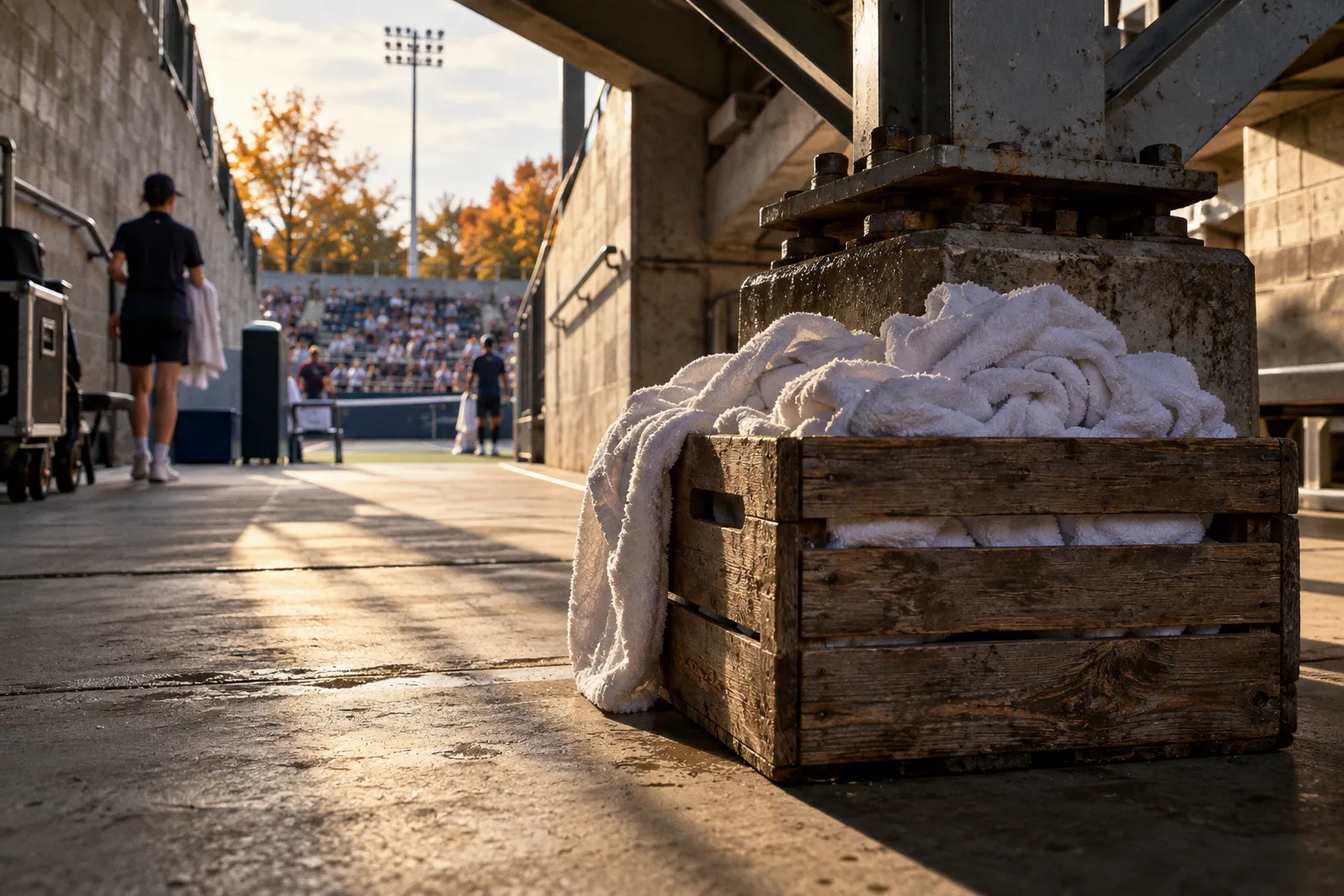
Tennis Towel Rituals: The Psychology of the Between-Point
It marks a pause in the flow of competition — a small, repeatable interval in which a player can lower the noise of the point just finished and prepare the body for the one that has not yet begun.
That pause matters because even the best players win only around 52% to 55% of the points they play across a match. The margin is not a constant feeling of control but a sequence of recoveries: after a double fault, after a missed break point, after a long rally that leaves the legs heavy and the breathing sharp. The tennis towel ritual psychology begins there — not with superstition, and not simply with hygiene, but with the physical need to return to a workable state.
The architecture of a reset: beyond sweat and hygiene
The rhythm of professional tennis is often described through its visible events: the serve, the return, the rally, the changeover. But much of the sport’s mental structure lives between those events. A player walks to the towel, wipes the face or hands, adjusts the shirt, bounces the ball, checks the strings, and settles again behind the baseline. These actions may take only a few seconds, but they divide one emotional episode from the next.
The previous point does not disappear because the player has dried their palm. The body remembers the rushed movement, the ball that clipped the tape, the opportunity lost at 30–30. What the routine offers is not erasure but containment. It gives the player a familiar sequence through which to pass before returning to the uncertainty of the next exchange.
This is why the question of why tennis players use towels cannot be answered by saying only that they are sweating. Sweat does affect performance. A damp grip can alter the security of the racket in the hand, particularly during a serve or a heavy forehand, and a player who feels moisture around the eyes or face may become distracted by a minor physical irritation. Courtside towels deal with those realities. But they also establish a reliable point of contact with the match.
The towel is soft, absorbent, and materially ordinary. That is part of its usefulness. A player cannot control the wind, the opponent’s shot selection, the crowd’s reaction, or the bounce of a worn court. They can control the order in which they dry their hands, turn toward the towel rack, adjust their clothing, and resume their position.
That sequence becomes especially valuable after an emotionally charged point. A player who has saved break point may be carrying relief into the next rally; a player who has missed an easy volley may be carrying embarrassment. Both emotions can produce the same tactical danger: a loss of attention. The routine creates a narrow passage back toward the ball.
The towel does not remove the last point — it gives the player a place to put it.
The most recognizable court habits in professional tennis are therefore not random decorations around the game. They are practical systems of regulation, built from repetition until the body knows what to do before the conscious mind has finished explaining why.
The science of ritual: cortisol, rhythm, and fine movement
Rituals are useful in sport because they reduce the number of decisions a player must make under pressure. Tennis offers no huddle, no coach speaking directly into the athlete’s ear between every point, and no long collective pause in which the team can reorganize. The player is exposed, alone with the scoreboard and the next serve.
A repeated routine supplies continuity. The point ends; the player moves through a known sequence; the next point begins. That continuity can help regulate the nervous system, particularly when the match has become physically and emotionally dense.
A 2016 study published in Frontiers in Psychology found that pre-performance rituals reduced cortisol levels by up to 18%, with a direct effect on fine motor execution. The finding is significant for tennis because the sport asks for exactness while the body is under strain. A serve is not merely a large movement of the shoulder and legs. It depends on timing, grip pressure, ball placement, balance, and the ability to make small corrections while the heart rate is elevated.
The player does not need to become calm in the ordinary sense. Calmness can even be the wrong target late in a close set. A competitor needs to become organized enough to act accurately while remaining alert to danger. Rituals help create that organization.
The between-point routine may include several elements:
1. Physical clearing. Wiping the hands, face, or neck addresses sweat but also gives the body a brief, concrete task.
2. Visual withdrawal. Turning away from the opponent and the court interrupts the immediate emotional charge of the previous rally.
3. Tactical narrowing. A player can reduce the next point to one intention — a serve location, a return target, or a preferred rally pattern.
4. Temporal control. The repeated sequence restores the player’s internal sense of timing, even when the match itself has become hurried.
5. Re-entry. The final movement back toward the baseline signals that the pause is over and attention must return to the ball.
The tennis towel is only one component of this structure, but it is a particularly visible one because it sits at the boundary between the body and the environment. It absorbs sweat, changes grip conditions, and offers a fixed object in a setting otherwise defined by movement. The court may be loud, hot, windy, or acoustically strange. The towel remains where it is expected to be.
That reliability matters more than its apparent simplicity.
Nadal and the geometry of order
Rafael Nadal made the between-point routine impossible to ignore. His shirt tug, hair adjustment, face wipe, and careful attention to the position of his bottles turned court habits into part of the public language of professional tennis. To some viewers, the sequence looked like superstition. To Nadal, it was a method of arranging the external world so that his internal state could become more ordered.
In his autobiography, Nadal rejected the idea that the habits were dependent on good luck. He explained that if they were superstition, they would not be repeated regardless of whether he won or lost. Their purpose, as he described it, was to place himself inside the match and organize his surroundings in accordance with the order he sought in his mind.
That distinction is crucial. A superstious act asks the universe for a particular result. A performance routine asks the player to return to a particular condition. The first depends on an imagined connection between an action and an outcome; the second depends on repetition, attention, and bodily familiarity.
Nadal’s habits also demonstrate how individual these routines can become. One player may rely on the towel; another may repeatedly bounce the ball before serving; another may look toward the strings, adjust a wristband, or take the same number of breaths. The external actions vary, but the underlying purpose is recognizable. Each player is building a small territory of control inside a match that offers very little control overall.
The point is not that every movement has a hidden psychological meaning. Sometimes a player is simply wiping sweat away. Sometimes a shirt is uncomfortable, the hair has fallen across the eyes, or the grip genuinely needs drying. Professional tennis should not be turned into an occult language in which every adjustment reveals a secret. The more useful reading is physical and psychological at once: the body solves a practical problem while the mind benefits from the repetition.
A notable count of Nadal’s familiar shirt-tug, hair-tuck, and face-wipe cycles reached 146 during a single five-set match at the 2022 Australian Open. The number is striking not because repetition automatically proves mental vulnerability, but because it shows how thoroughly a routine can be integrated into the movement of a match. At that level, the habit is no longer an interruption placed on top of tennis. It becomes part of the player’s way of moving through tennis.
Shot clocks and towel racks: the tug-of-war over match rhythm
Professional tennis has increasingly tried to regulate the spaces between points. The 25-second shot clock places a limit on how long a player may take before serving, transforming what was once an elastic interval into a visible part of match administration. That change has sharpened the debate around toweling, especially when a player returns to the towel after nearly every point.
The argument is not simply about speed. It concerns who controls the rhythm of the match.
A player who moves slowly toward the towel may be trying to settle the nervous system, break the opponent’s momentum, or recover physically after a long rally. An opponent may experience the same action as delay — a way of interrupting flow or refusing to let the previous point gather emotional force. Both perceptions can be sincere because tennis rhythm is not a neutral measurement. It is felt differently by the person waiting and the person recovering.
| Element of the routine | Benefit to the player | Tension it creates |
|---|---|---|
| Walking to the towel | Creates distance from the previous point and offers a predictable reset | Can appear to slow the match or test the shot-clock limit |
| Drying the hands | Restores grip comfort and confidence on serve or return | May be unnecessary from a purely hygienic perspective |
| Repeating the same sequence | Reduces decision-making under pressure | Can look like superstition or gamesmanship to spectators |
| Waiting for a ball kid | Preserves an established rhythm and human interaction | Makes timing dependent on another person’s movement |
| Using a courtside towel rack | Gives players direct control over access to the towel | Removes part of the traditional service ritual around the court |
At the 2018 Next Gen ATP Finals in Milan, tour officials trialed courtside towel racks so that players would have to collect their own towels rather than receiving them from ball kids. The experiment addressed concerns about match pace and the role of ball kids in maintaining a player’s routine. It also exposed something easy to miss: the towel system was not just a logistical arrangement. It was part of the social choreography of the court.
When the ball kid brings the towel, the player remains within a familiar pattern of dependence and service. When the player walks to the rack, the routine becomes more self-contained. The distance may be only a few steps, but those steps alter the texture of the between-point interval. A professional match is made not only from strokes and rules but also from these small exchanges of space, attention, and timing.
The courtside towel rack therefore became a symbol of a larger question: how much of a player’s private method should the modern game permit when the method affects the public rhythm of the contest?
The answer cannot be found by treating every pause as either legitimate concentration or deliberate delay. The physical conditions of a match matter. Heat, humidity, clothing, grip, and the intensity of a rally all change what a player needs between points. So does the emotional temperature. A rule that recognizes only the clock may miss the way bodies actually function under pressure.
The return of the ball kid and the human element
After the COVID-19 pandemic protocols altered many familiar court interactions, the ATP Board approved a rule update effective after Wimbledon 2024 that permitted players once again to request and receive towels from ball kids between points. The decision restored a practice that had been treated as ordinary for decades, then became conspicuous when it was removed.
The return matters because professional tennis has always balanced individual concentration with a dense network of human assistance. Ball kids collect balls, clear the court, manage towels, and help preserve the seamless rhythm spectators expect. Their work is designed to disappear into the match, but the towel makes their role unusually visible. A player’s gesture toward the corner, the quick arrival of the towel, and the return to the baseline form a small exchange that belongs to the choreography of the sport.
There is also a question of dignity in the interaction. Players are not machines moving through a timed sequence; they are bodies that perspire, tire, lose concentration, and need to recover. The ball kid’s assistance acknowledges the material reality of the match. A towel is not glamorous, but it is honest. It reminds us that elite tennis is played by people whose hands become damp, whose shirts cling, whose breathing must be brought back under control before another serve can be struck.
At the same time, the system must preserve fairness. If access to the towel becomes a way to stretch the interval beyond what the opponent can reasonably accept, the routine begins to affect competition rather than merely support performance. This is why the shot clock and the towel remain in tension. One represents the sport’s desire for visible pace; the other represents the player’s need for a repeatable physical reset.
Neither principle is trivial. A match with no rhythm becomes difficult to watch and difficult to officiate. A match that denies the body every familiar avenue of recovery misunderstands what high-level performance demands.
Why the routine survives
The enduring appeal of tennis player court habits comes from their double nature. They are practical enough to make sense and personal enough to become part of a player’s identity. The towel dries the hand, but it also divides the past from the immediate future. The bottle is placed in a certain position, but that position also confirms that the player is still inhabiting a familiar match. The ball is bounced before the serve, not to persuade fate, but to give the body one final rhythm before the most exposed action in tennis.
This is why it is misleading to group all such behavior under the broad label of tennis match superstitions. Superstition is one possible interpretation, but it is not the only one, and often not the most useful. A ritual can be a form of preparation without being a belief in magic. It can lower arousal without making a player passive. It can provide a sense of order without claiming that the world itself has become orderly.
The physical court keeps resisting that order. Clay grips the shoe and slows the ball. Grass skids and rewards early contact. Hard courts transmit heat through the feet and expose every hurried recovery. Humidity changes the weight of the air; wind interferes with the toss; a long rally leaves the forearm tight and the breathing uneven. The player’s routine exists inside those conditions, not above them.
That is what makes the towel such a revealing object in tennis. It belongs to the unglamorous layer of the game — sweat, friction, grip, fatigue, waiting — yet it also opens a view into concentration. The great points are remembered because of their drama. The small rituals explain how a player remains available for the next one.
The most durable tennis pre-serve routines are not necessarily the most elaborate. They are the ones that return the player to a known physical language when the match has become difficult to read. A towel, a breath, a glance at the strings, a measured walk back to the baseline: these actions do not guarantee the next point. They make it possible to meet that point without being entirely governed by the last.
In professional tennis, that may be as close to control as anyone gets.