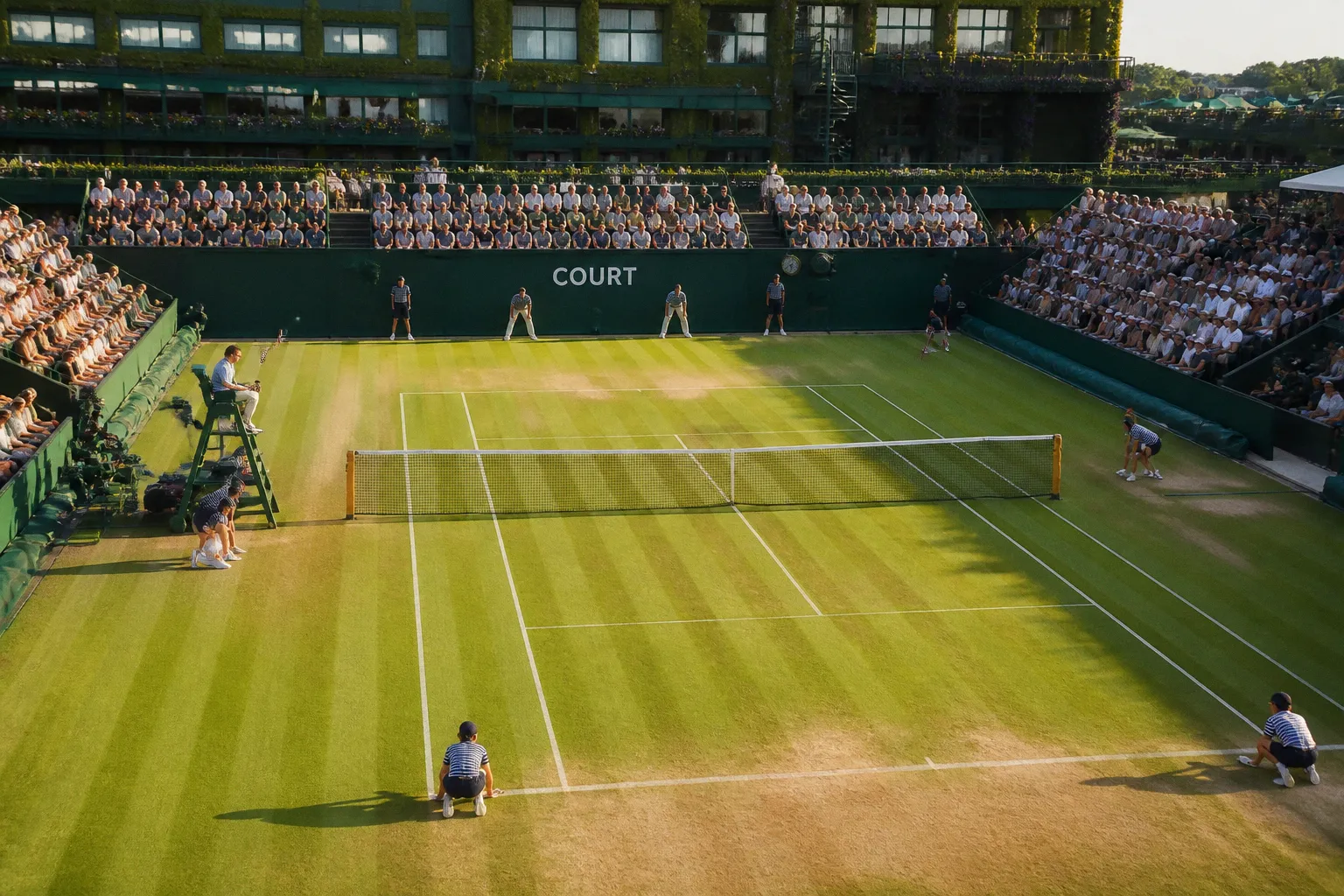
What began as an organised supply of young helpers became one of the most recognisable forms of court infrastructure in professional tennis — so familiar that spectators often stop seeing it at all.
That invisibility is part of the skill. A tennis ball kid must move quickly without appearing hurried, handle a ball without disturbing a player’s concentration, and remain perfectly still when the point begins. The work sits between athletics and stage management, governed by friction, timing, posture, court geometry, and an unusually strict respect for silence. The history of tennis ball kids is therefore also a history of how professional tennis learned to make its physical machinery disappear.
From naval charities to Centre Court
The early Wimbledon ball boys did not emerge from a formal sports academy or from a modern recruitment campaign. In the 1920s, they were provided through Shaftesbury Homes, an institution associated with Royal Navy training. From 1946 to 1966, Wimbledon’s ball boys came from Dr Barnardo’s Goldings School. Their presence reflected an older British habit of organising public life through schools, charities, military institutions, and youth programmes — a network in which discipline was taught not only as a personal virtue but as a visible social performance.
The court demanded a particular kind of discipline. A ball had to be recovered quickly, but not with theatrical urgency. A child had to understand where to stand, when to move, how to roll the ball across the grass without allowing it to drift into the path of a player, and how to become motionless once the next point was ready to begin. The work was practical, but it also carried an atmosphere of ceremony.
For decades, the role was associated almost entirely with boys. Wimbledon introduced ball girls in 1977, mixed teams appeared in 1980, and ball girls reached Centre Court for the first time in 1985. Those dates mark more than a change in staffing. They show how even the supposedly neutral details of tennis — who retrieves the ball, who occupies the edge of the court, who is trusted with the rhythm of play — can preserve the assumptions of an earlier era.
The evolution of tennis ball boys into mixed crews was not a dramatic rule change announced with the force of a new scoring system. It arrived through the gradual remaking of the court’s working population. The lines remained white, the net remained at the same height, and the points continued to be won by the players. Yet the image of the tournament changed as the people maintaining its tempo changed.
Today, Wimbledon selects approximately 280 ball boys and girls each year from around 1,400 applicants connected with roughly 30 nominated schools in South West London and Surrey. The average age is about 15. That scale matters. It means the familiar figure at the back of the court is not simply a convenient volunteer who happens to be nearby. The role is the result of a selection system, a training calendar, and a large amount of rehearsal before the public ever sees a crew working on Centre Court.
The ball kid’s achievement is not to be noticed for speed, but to make speed feel inevitable.
The anatomy of a trial
The phrase “ball kid” can sound deceptively light, almost affectionate — a child with a basket of spare balls, waiting for the next point. In practice, the selection process asks for a finely balanced physical temperament. The successful candidate must have speed, but also restraint; alertness, but also patience; confidence, but no desire to become part of the spectacle.
Wimbledon training begins in February, with sessions lasting approximately two to two and a half hours each week. Candidates are tested in fitness and speed, but physical movement is only one part of the assessment. They are also expected to demonstrate written knowledge of tennis, accurate rolling skills, and the ability to hold a motionless posture. That combination gives the role its distinctive character: it is not merely a running task, and it is not merely a ceremonial one.
A useful way to understand the selection is to separate the abilities that appear together during a match:
| Requirement | What it involves on court | Why it matters |
|---|---|---|
| Speed | Reaching a loose ball and returning to position without delay | Keeps the interval between points controlled |
| Rolling technique | Sending the ball along the court with the right pace and direction | Prevents the ball from crossing a player’s path or stopping short |
| Tennis knowledge | Understanding the score, the server’s needs, and the movement pattern of the crew | Allows decisions to be made without verbal interruption |
| Stillness | Remaining motionless once the point is about to start | Protects the player’s concentration and the visual order of the court |
| Fitness | Repeating short bursts of movement throughout a shift | Maintains accuracy as fatigue accumulates |
| Spatial awareness | Reading the position of players, officials, net, lines, and other ball kids | Prevents collisions and unnecessary movement |
The test of fitness is not the same as a sprint in a school sports field. A ball kid may need to accelerate for only a few metres, bend cleanly, change direction, and settle again within a narrow strip of grass or hard court. The movement is compact and economical. Every extra step is a small failure of geometry.
That is why training cannot be reduced to learning how to pick up a ball. The crew must develop a shared rhythm. A person stationed near the net needs to know when to send a ball towards the back of the court. A person positioned near the baseline needs to recognise which ball is needed by the server and which ball should remain in circulation. The team behaves as one working unit, even though each member is responsible for a separate patch of space.
The written element is equally revealing. Ball kids are not only expected to react to what they see; they must understand the structure of a professional match. The serving player, the score, the number of balls in circulation, and the stage of the point all affect what should happen next. Tennis knowledge turns movement into judgement.
At this level, a fraction of hesitation can be more disruptive than a slower but decisive action. The ball kid who understands the situation does not have to search for permission from the rest of the crew. The response begins before the spectator has registered the problem.
Nets and bases: the geometry beneath the ritual
Professional tennis is often described through its visible geometry — service boxes, baselines, tramlines, the rectangle of the court itself. The ball crew works within another geometry layered over that one. At Wimbledon, ball kids are generally divided into “nets” and “bases”.
The nets are positioned on either side of the net. Their primary responsibility is to retrieve balls that have come to rest in or near the net, where they cannot be reached safely or conveniently by the players. The bases work near the baseline corners, supplying balls to the server and receiving rolls from the nets. The division appears simple, but it creates a carefully timed circulation system around the players.
A ball does not simply travel from one person to another. It moves through a sequence governed by distance, angle, surface, and the position of the next point. On grass, a roll must respect the particular resistance of the court — the short, close texture, the possibility of a slight deviation, the need to keep the ball low and unobtrusive. On a hard court, the surface offers a different friction and a more predictable path, but the speed of the roll can become more pronounced. The gesture must be adjusted to the court beneath it.
This is where the physical realities of tennis become inseparable from its etiquette. A ball kid is reading the surface in the same broad sense as a player, though with a different purpose. The player reads the court for bounce, grip, and recovery. The ball kid reads it for transit — how much force is enough, how much is too much, where the ball will stop, and whether it will arrive before the server turns.
The circulation of a point
The crew’s work can be understood as a series of small decisions:
1. Locate the loose ball without creating another disturbance.
The ball kid must identify whether a ball is playable, trapped near the net, behind a player, or already being handled by another member of the crew.
2. Move through the correct lane.
The shortest route is not always the right route. A direct crossing can take a ball kid into a player’s peripheral vision or across the line of the next serve.
3. Recover the ball with controlled posture.
The body has to lower and rise without wasted movement. The gesture should be clean enough to repeat hundreds of times without losing balance or speed.
4. Return the ball through the crew’s established pattern.
The roll must be directed to the appropriate base or handed to the server according to the tournament’s routine.
5. Reset before the next point.
The final movement is often the most important: returning to the assigned position and becoming still before the players begin again.
The last step is what separates a functioning crew from a group of fast children. The court cannot remain in a state of visible preparation. Professional tennis depends on the impression that the point begins in a cleared, quiet space. The ball kids create that space repeatedly, often in less time than it takes a spectator to settle back into a seat.
There is also a psychological dimension to their positioning. Players know where the ball crew is, even when they are not looking directly at them. A badly timed movement can enter the edge of vision, and the edge of vision is part of concentration. The best crews make themselves legible without becoming prominent. Their positions are predictable, their movements economical, and their timing sufficiently precise that the players can trust the court around them.
The court has two rhythms: the visible rhythm of rallies and the quieter rhythm that prepares one rally for the next.
One hour on, one hour off
The physical cost of this precision is easy to underestimate. A professional match can last far longer than the neat duration implied by a television segment. Between points, the crew may need to perform repeated accelerations, crouches, rolls, stops, and resets while standing under heat, humidity, or the concentrated brightness of stadium lighting.
At Wimbledon, the standard rotation is one hour on court followed by one hour off court. The arrangement recognises that stillness can be tiring in its own way. Holding the body ready without fidgeting, then moving suddenly when the point ends, places a particular demand on the legs and attention. Fatigue does not always announce itself through a dramatic loss of speed. It first appears as a roll that travels too far, a recovery that takes one step too many, or a posture that begins to loosen at the wrong moment.
Training therefore has to build repetition rather than isolated performance. The candidate is not being prepared for one impressive sprint. They are learning to reproduce the same accurate movement at the beginning and end of a shift. This is a form of endurance shaped by tennis’s stop-start structure, where the body alternates between alert stillness and brief, sharp activity.
The training schedule beginning in February also gives the role a seasonal character. Candidates are prepared months before the tournament’s most visible stages, allowing the routines to settle into muscle memory. By the time the crew appears on court, the gestures should no longer look like instructions being followed. They should look like instinct.
That apparent instinct is manufactured through repetition. Ball kids practise how to stand, how to roll, how to move around one another, and how to interpret the match without breaking its concentration. The goal is not individual brilliance. It is collective reliability.
The distinction matters because the audience sees only isolated moments: a ball returned to a server, a quick recovery after a net exchange, a crew member standing at the edge of the frame. The real work is cumulative. Across a long match, the crew removes hundreds of small possibilities for delay and confusion.
The professional divide: volunteer tradition and paid labour
The major tournaments do not treat ball crew labour in exactly the same way. Wimbledon’s tradition is closely tied to nominated schools and a long-standing youth selection system. The US Open, by contrast, is the only Grand Slam tournament documented as paying its ball crew members an hourly wage. Reports place the compensation in the range of $25 to $39 per hour, depending on position and experience.
That difference changes the surrounding meaning of the role. At Wimbledon, the emphasis remains on institutional tradition, school nomination, and the passage of a tournament custom from one generation to another. Candidates are not simply drawn from an open public registration process; they come through participating partner schools in London and Surrey. The selection is therefore both athletic and communal.
The US Open’s approach presents the work more explicitly as paid event labour. Its crew has a minimum age of 14 and no upper age limit, which creates a broader range of possible experience than the predominantly teenage image associated with Wimbledon. For the 2025 tournament, 480 candidates were invited to in-person tryouts for 80 available positions — a ratio that gives some sense of how competitive the process can become when the role is treated as a sought-after professional opportunity.
Neither model makes the work casual. Payment does not remove the need for precision, and tradition does not make physical effort disappear. The difference is one of emphasis: one system presents the ball crew as part of a historic tournament culture, while the other makes its labour conditions more visible.
The comparison also raises a question that tennis has not always asked openly: what kind of work is being performed when a tournament appears effortless? The ball kid is part of the match-day workforce, whether the role is framed through school tradition, public service, or hourly employment. Their concentration supports the players, the officials, the broadcast, and the spectators. The smoothness of the event depends on bodies that are moving constantly at its edges.
That is why the US Open’s wage structure is more than a detail of recruitment. It makes visible the labour that other tournaments often present as custom. Once the work is seen clearly, its demands become clearer too — the preparation, the physical repetition, the emotional control, and the responsibility of handling a live court without intruding upon it.
The long arrival of inclusion
The introduction of ball girls at Wimbledon in 1977, followed by mixed teams in 1980 and ball girls on Centre Court in 1985, belongs to the broader history of women’s expanding presence in tennis. The shift was gradual, but its symbolism was immediate. The centre of the court was no longer supported by a single inherited image of who could perform disciplined physical work.
There is a temptation to treat inclusion as a completed chapter once mixed crews become normal. Tennis history is rarely that tidy. A tournament’s traditions are carried through uniforms, selection routes, language, and institutional habits, not just through formal announcements. Bringing girls into the role changed the visible composition of the crew, but it also tested whether the tournament’s idea of professionalism could extend beyond its earlier assumptions.
The answer is now present in the ordinary scene of a major match: boys and girls moving through the same patterns, selected for the same speed, knowledge, balance, and composure. The very normality of that scene is the result of a historical change that once required the institution to revise itself.
The ball crew’s gender history also complicates the way spectators speak about the role. The word “ball boy” remains embedded in popular language, even when the people on court form a mixed team. “Ball kid” is more accurate, but language changes more slowly than uniforms and line formations. The persistence of older terms is a small reminder that sporting culture is built from layers — official practice, inherited vocabulary, remembered images, and the new reality in front of us.
What remains constant is the standard. Whether a crew member is fourteen, fifteen, or older; whether they arrive through a school nomination or a competitive tryout; whether they work within a volunteer tradition or for an hourly wage, the court asks for the same qualities. The ball must be handled with care. The player’s attention must be protected. The movement must end before the next point begins.
Why the work stays almost invisible
Tennis spectators are trained to look at the ball, the racket, the player’s feet, and the lines. We watch the serve clock, the umpire, the coach in the stands, the weather moving across the court. The ball kids occupy a more delicate position in the visual field. They are always present, yet the match is successful when we do not think about them.
Their invisibility is not a sign that they are unimportant. It is evidence that the system is functioning. A loose ball disappears. The server receives the correct ball. The next point begins without a pause large enough to become a story. In an age when professional sport exposes almost every mechanism — biometric data, replay angles, scheduling decisions, training numbers — the ball crew still works largely through embodied knowledge and controlled repetition.
This is particularly striking at Wimbledon, where the ball kids are woven into the tournament’s public identity without becoming its protagonists. The history reaches back to the 1920s, through charitable and institutional arrangements, through the arrival of ball girls and mixed teams, and into a present selection system involving around 1,400 applicants for approximately 280 places. The numbers describe scale, but not atmosphere. Atmosphere comes from the way the crew moves: low, quick, restrained, alert to the court’s smallest changes.
Their work also preserves something that professional tennis can otherwise lose under the weight of broadcast technology and commercial speed. It reminds us that a match is not created by the players alone. It requires lines to be maintained, nets to be checked, balls to circulate, surfaces to be prepared, chairs to be positioned, and people to understand when to act and when to vanish into the background.
The ball kid stands at the meeting point between the formal rules of tennis and the physical world in which those rules are performed. A point may be recorded as an ace, a break point, or a winner, but before the next exchange can begin, the court must be restored to order. That restoration is the crew’s quiet responsibility.
The history of tennis ball kids is therefore not a decorative footnote to the major tournaments. It is the history of an essential court practice — one that has changed with institutions, labour expectations, and gender inclusion while preserving the same fundamental demand: move with precision, understand the game, and never let your work become heavier than the match itself.
In the end, their choreography is silent because it is successful. The court breathes evenly between points, the players remain inside their concentration, and the spectators follow the drama without seeing all the hands that keep it moving. That is the particular dignity of the role — not to stand outside the game, but to make the game possible.