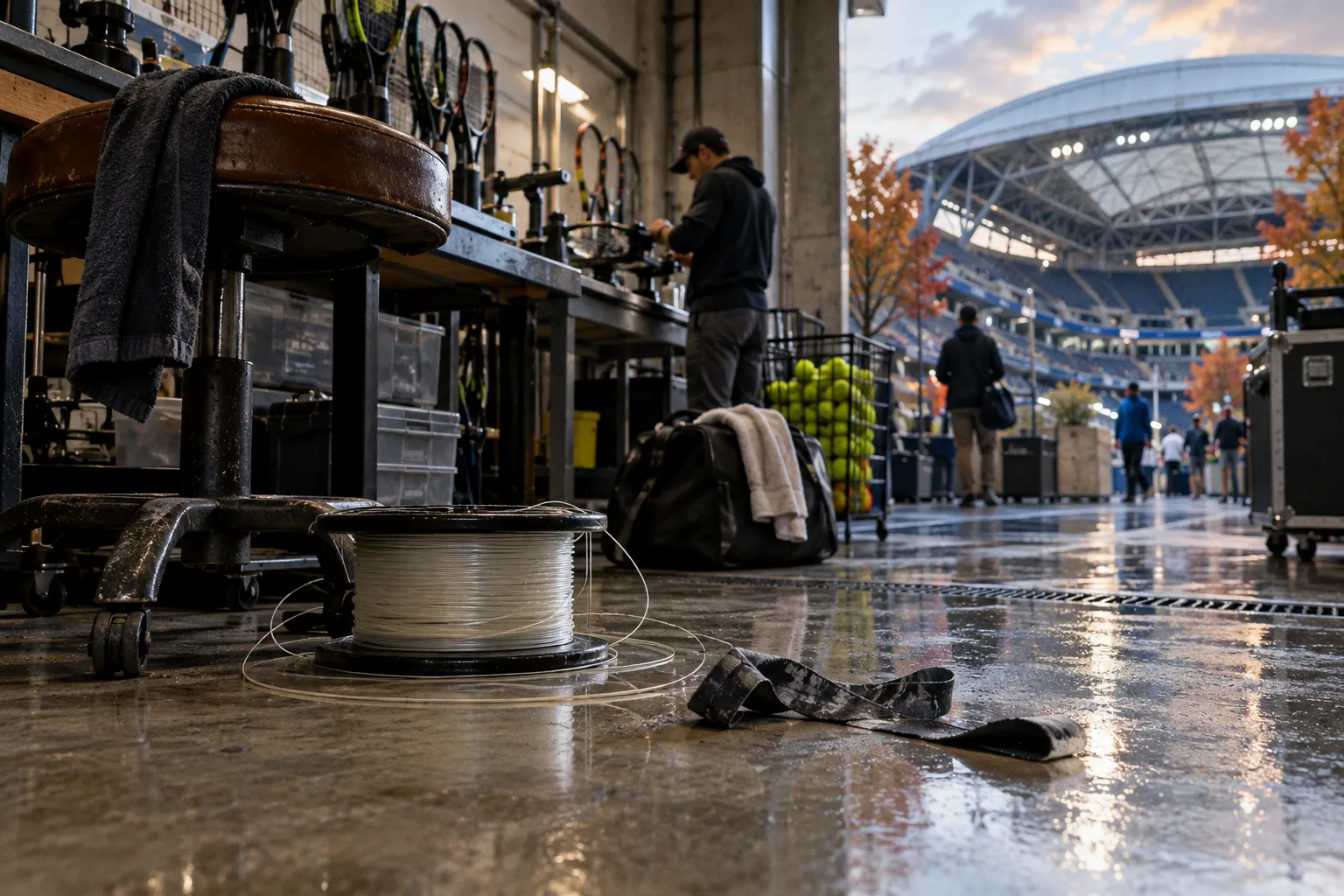
An enclosed arena does the opposite: its walls and roof return those sounds to the court, layering them into a denser field of reverberation. The difference is not cosmetic. It changes what spectators hear, what players can read, and how a tournament feels from the first ball struck to the final changeover.
The contrast between outdoor and indoor tennis tournament atmosphere is therefore less a question of loudness than of acoustic shape. A roof does not simply make a stadium noisier, and an open court is not automatically quiet. Arthur Ashe Stadium, with more than 23,000 seats, can generate enormous sound with its roof open; when that roof closes, however, the character of the noise changes, because conversation, applause, rain, and the hard report of the ball are held inside the structure rather than released into open air.
The physics of sound: open air versus enclosed arenas
Professional tennis is unusually dependent on the sound of impact. The ball does not arrive at the racket as a visual object alone. Its contact with the strings produces information: a heavy, compressed thud may suggest a driven ball with substantial pace, while a sharper or lighter strike can reveal a different combination of spin, timing, and racket speed. Players do not consciously translate every sound into a technical calculation, but over years of competition they develop an auditory sense of the exchange.
In an outdoor stadium, sound waves travel upward and outward. Some are absorbed by seating, clothing, bodies, banners, and the irregular surfaces of the venue; much of the remaining energy disperses into the open air. The result is not silence but separation. A line judge’s call, the bounce of the ball, a player’s footwork, and the shifting response of the crowd tend to occupy more distinct acoustic spaces.
This is why an open-air tennis court can feel expansive even when the stands are full. The stadium has boundaries, but the sound field is less completely sealed. Wind may interrupt that order, carrying crowd noise across the court or making one side of the arena feel more exposed than the other. Heat and humidity can also alter the atmosphere, while rain introduces a second layer of sound that competes directly with the match.
Indoor tennis arenas create a more concentrated environment. Sound reflects from the roof, walls, concourses, and structural surfaces before reaching the listener, and those reflections can overlap with the original impact. Crowd chatter does not simply fade into the background; it lingers, returning as a soft, continuous pressure. Applause becomes thicker. A collective reaction can seem to arrive from every direction at once.
The distinction can be summarized like this:
| Feature | Open-air stadium | Enclosed or roof-closed arena |
|---|---|---|
| Sound movement | Energy disperses upward and outward | Sound reflects from walls and roof |
| Ball-strike clarity | Often more separated from general crowd noise | Can be masked by reverberation and sustained chatter |
| Weather influence | Wind, heat, humidity, and rain remain part of play | Conditions are more controlled, though heat and humidity may persist |
| Crowd response | Broad, expansive, sometimes uneven across the stands | Dense, immediate, and structurally amplified |
| Player feedback | More natural distinction between impacts and ambient sound | Greater acoustic intensity, with possible loss of detail |
| Tournament identity | Closely tied to season and local weather | More consistent, concentrated, and engineered |
A typical outdoor tennis baseline may sit around 45 decibels in ordinary conditions, but that figure should not be mistaken for a universal description of a professional stadium. The sound level rises dramatically with attendance, the importance of the match, and the architecture of the bowl. What matters most to the player is often not the absolute volume but the relationship between the ball’s impact and everything surrounding it.
An open stadium lets the match breathe acoustically; an enclosed arena makes every sound remain part of the match.
Arthur Ashe and the transformation of a familiar stadium
The roof added to Arthur Ashe Stadium, which debuted in 2016 at a reported cost of $150 million, provides one of the clearest examples of how venue architecture can alter tennis without changing the court itself. The stadium was already among the loudest and most imposing settings in the sport. Its scale, crowd density, and New York energy gave the US Open a particular acoustic force. The retractable roof introduced another condition: the possibility of turning a vast outdoor bowl into a partially enclosed arena while competition continued.
When the roof is closed, the sound of the stadium acquires a different density. Spectator conversation and movement are no longer released as readily into the sky. Applause presses against the underside of the structure and returns to the seating bowl. If rain is striking the roof, that sound becomes a continuous overhead presence rather than a distant interruption. The match is still being played on the same court, beneath the same tournament branding, but the sensory boundaries have shifted.
For spectators, the change can be immediate. An open Ashe Stadium has the atmospheric reach of a major outdoor event: the surrounding city, the changing light, the heat rising from the court, and the crowd’s response all seem to belong to the occasion. With the roof closed, the arena feels more self-contained. The audience becomes a single acoustic body, and the players appear to be competing inside a chamber of expectation.
For the players, the adjustment is more technical. Loud reverberated chatter can muffle the sound of the ball striking the strings, and heavy rain on the roof can create a persistent acoustic layer that is difficult to ignore. The player who uses sound to sense the weight and quality of a shot may find that information less cleanly delivered. This does not mean that a roof makes tennis impossible to read, nor that every roof-closed match produces the same effect. The acoustics depend on the roof’s position, the crowd, the weather, the venue’s surfaces, and the rhythm of the match itself.
The roof also exposes a tension within modern tournament design. Grand Slam tennis has traditionally drawn much of its identity from exposure—to sunlight at the Australian Open, to the damp earth of Roland-Garros, to Wimbledon’s seasonal coolness, and to the hot evening air of New York. A retractable roof protects the schedule and the athlete, but it can also interrupt the environmental continuity that makes a tournament feel rooted in its place.
That interruption is not necessarily a flaw. It is simply a change in the contract between venue and match. The stadium becomes more reliable, but less entirely subject to the day outside it.
The player’s sensory toolkit
A professional player receives information through the whole body. Vision tracks the opponent’s preparation and the ball’s trajectory. The feet register the court’s grip and the timing of the split step. The shoulders and forearm absorb the collision with the ball. The ears contribute as well, particularly in the brief interval after the opponent’s contact and before the ball reaches the other side.
The sound of a racket strike can help establish the shot’s character before the eye has fully processed its flight. A player is not listening for a single isolated note; the useful signal sits inside the exchange of bounce, impact, shoe squeak, breathing, and crowd response. On a quiet practice court, these elements are easy to separate. In a Grand Slam stadium, they become a moving hierarchy.
Open-air conditions often allow the strike to retain a certain edge. The sound travels away from the court instead of accumulating entirely around it, and this can make the ball’s pace feel more legible. The player still has to contend with wind, uneven crowd noise, and the visual distractions of a changing sky, but the acoustic field may be less compressed.
Indoor conditions offer a different advantage: consistency. Without wind, the player can read the ball’s path more confidently, and without rain interruptions the rhythm of the match is more stable. The venue may also provide a more even background level, particularly when acoustic treatments have been carefully designed. Yet an enclosed space can make the crowd more present, not less. Every reaction occupies the arena for longer, and the cumulative effect may alter concentration.
This becomes especially noticeable in matches with extreme rhythm changes. A long baseline exchange produces one kind of soundscape: repeated impacts, sliding or squeaking movement, and a crowd waiting for the first opening. A fast serving performance creates another, with abrupt strikes separated by short pockets of anticipation. In a reverberant arena, those pockets may never become fully quiet. The previous point lingers in the structure as the next one begins.
Players adapt in practical ways:
1. They rely more heavily on visual preparation when acoustic detail is obscured. The opponent’s racket path, shoulder rotation, and toss become even more important when crowd reverberation makes the ball strike harder to isolate.
2. They adjust their internal timing rather than waiting for perfect sound. A closed arena may not provide the same clarity of contact as an open court, so experienced players trust the combined evidence of movement, bounce, and trajectory.
3. They treat crowd noise as part of the competitive environment. The issue is not simply whether the audience is loud, but whether its sound is dispersed, sustained, sudden, or returned by the roof and walls.
4. They use the court surface as a second form of feedback. The sound of a shoe gripping hard court is different from the softened movement of clay, and grass produces its own sense of restraint and release. Acoustics never operate separately from the surface beneath the player.
That final point matters because stadium sound can easily be mistaken for court speed. Closing a roof does not instantly convert an outdoor court into a faster indoor hard court. Playing speed remains principally connected to the surface construction, coating, ball behavior, temperature, and moisture. The roof changes the sensory and environmental conditions around the court, but it is not a simple speed switch.
Climate control versus acoustic integrity
The modern stadium is asked to solve several competing problems at once. It must protect players from dangerous heat, prevent rain from destroying the schedule, provide spectators with a reliable experience, and preserve the distinctive identity of an outdoor tournament. The roof is a response to the first three demands, but it inevitably reshapes the fourth.
At the US Open, tournament officials introduced a policy in 2023 allowing partial closure of the Arthur Ashe roof during extreme heat, defined in the available tournament reporting as temperatures above 90°F, or 32°C, combined with high humidity. The purpose was protective rather than theatrical: shade can reduce direct exposure, and roof management can help address the risk of heat illness.
Yet partial closure is acoustically meaningful even when the roof is not fully sealed. The geometry of the structure changes. Some sound that would have dispersed into the air is reflected back toward the stands and court. The audience may become more audible, while the players experience a different balance between environmental noise and the sound of contact.
This is one of the more interesting realities of tennis architecture: a measure designed for thermal comfort can affect concentration, communication, and atmosphere. Heat is not an abstract statistic for a player moving through a three-hour match. It changes the grip, the breathing pattern, the length of recovery between points, and the accumulation of fatigue. But sound is also physical. It fills space, persists after its source has stopped, and shapes the amount of effort required to remain mentally present.
An open-air match exposes both athletes to a common set of variables, though not always evenly. One end may sit in direct sunlight while the other remains shaded. Wind may turn a high toss into a negotiation. Humidity can make the ball feel heavier and the court atmosphere more saturated. The crowd hears these conditions in the pauses—the delayed response after a difficult serve, the scrape of movement, the exhalation at the end of a long rally.
A roof reduces some of that volatility. It creates a stronger sense of enclosure and often a more predictable schedule, but the match may lose some of its visible and audible connection with the season. The Australian Open’s heat, Wimbledon’s weather-conscious rituals, and Roland-Garros’s clay-bound atmosphere are not merely marketing themes. They are part of how each event is physically understood.
The best venues do not pretend that protection and authenticity are identical. They manage the compromise openly through design, scheduling, shade, ventilation, and roof policy. The result is not a return to untouched outdoor tennis, but a more careful attempt to preserve competition inside increasingly demanding conditions.
The roof protects the match from the weather, but it also asks the match to live inside the building.
Engineering silence inside the arena
Indoor venues do not simply accept reverberation as an unavoidable consequence of enclosure. They use materials and geometry to shape it. Wall panels, ceiling baffles, acoustic inserts, and other absorptive treatments can reduce the energy of reflected sound, preventing the arena from becoming a hard acoustic box in which every impact continues to circulate.
This engineering is particularly important in tennis because the desired sound is not silence. A completely dead arena would remove much of the sport’s presence. The objective is controlled separation: enough absorption to preserve the clarity of the ball and player movement, enough reflection to give the crowd a sense of collective scale, and enough responsiveness for the venue to feel alive without becoming indistinct.
The challenge is complicated by the different frequencies produced during a match. A racket strike is brief and concentrated. A crowd is broad and sustained. Footwork creates a lower, more irregular layer, while announcements, music, and applause occupy their own acoustic ranges. Materials that absorb one kind of sound may not behave the same way with another, and the seating bowl itself can distribute noise unevenly.
Venue architecture also determines where sound gathers. A low ceiling may return impact quickly, while large open concourses can create delayed reflections. Curved surfaces may focus energy toward particular sections of the court or stands. The placement of seats, screens, hospitality areas, and structural supports all contribute to the final experience.
For spectators, this means that two indoor arenas can feel entirely different even when both are described simply as enclosed. One may produce a crisp, almost intimate sound in which every rally seems close. Another may generate a heavy wash of crowd noise, with the ball’s impact buried inside a long tail of reflection. The indoor tennis arena sensory experience is therefore not a single category but a range of acoustic decisions.
The same is true of roof-closed outdoor stadiums. Their original design may have prioritized openness, natural ventilation, and a large external bowl rather than the precise control expected from a purpose-built indoor facility. When a retractable roof is added, the building gains flexibility but does not necessarily become acoustically equivalent to an indoor arena designed from the beginning.
That distinction helps explain why Arthur Ashe feels different from a fully enclosed tournament hall. Its scale is monumental, its crowd is vast, and its roof is part of a larger stadium system rather than the ceiling of a compact indoor court. The resulting sound can be powerful, but not necessarily clean. The structure amplifies the sense of occasion while complicating the player’s auditory field.
What spectators hear—and what tournaments preserve
Spectators often describe an outdoor court through its edges: the wind behind the baseline, a plane passing beyond the stadium, the distant traffic of a city, the changing temperature after sunset. These sounds do not weaken the event. They place it. They make the match part of a particular day and location rather than a contest occurring inside an interchangeable container.
Indoor tennis produces a different intimacy. The audience is drawn closer to the technical fabric of the match—the compression of the ball, the sharpness of the serve, the squeak of a pivot, the collective intake of breath before a break point. Because the sound remains within the arena, the spectators may feel more directly involved in each exchange. A small reaction can travel through the structure and become part of the next point’s tension.
There is no universal winner between the two environments. The appropriate comparison depends on what one values in the sport.
| If the priority is… | Open-air venue tends to offer… | Enclosed venue tends to offer… |
|---|---|---|
| Connection to place | Weather, daylight, city sound, and seasonal identity | A concentrated architectural identity |
| Match reliability | Greater exposure to interruptions | More dependable scheduling and conditions |
| Acoustic spaciousness | More separation and outward dissipation | Stronger reflection and crowd presence |
| Tactical consistency | More environmental variables | Fewer wind-related variables |
| Spectator intensity | A broad event atmosphere | A compressed, immediate collective response |
| Historical continuity | A closer relationship to traditional outdoor tennis | A modern interpretation of tournament control |
The atmosphere of a tournament is built from these balances. Wimbledon’s grass is not only a playing surface; it carries a particular sound underfoot and a particular relationship with weather. Roland-Garros’s clay softens movement and gives the crowd a different rhythm of anticipation. The US Open’s night sessions depend on more than floodlights and schedule—they rely on the sense that the city remains present around the court, even when a roof alters how that presence is heard.
For a true tennis spectator, architecture is never background for long. It enters the match through the player’s preparation, the crowd’s timing, the echo after a winning shot, and the way fatigue becomes visible under heat or shelter. A venue teaches the audience how to listen.
The modern court as a negotiated environment
The most revealing way to understand outdoor versus indoor tennis tournament atmosphere is to stop treating the roof as a simple division between natural and artificial conditions. Every professional venue is already constructed, calibrated, and managed. Court coatings, lighting, seating geometry, roof mechanisms, ventilation, sound treatment, and tournament policies all influence what the match becomes.
An open-air stadium provides exposure, but exposure is not purity. It brings wind, heat, rain, humidity, uneven shade, and a sound field that can expand beyond the building. An enclosed arena provides control, but control is not neutrality. It concentrates the crowd, reflects the ball, and changes the way the player’s senses organize the point.
The most successful architecture respects both sides of that reality. It protects the athlete without erasing the conditions that give the tournament its character. It manages reverberation without flattening the crowd’s force. It offers shelter without making every venue feel acoustically identical.
In the end, the sound of tennis is not just the noise made by a ball and racket. It is the relationship between impact and space—the amount of air around a point, the speed at which an audience response returns, the persistence of rain against a roof, and the small physical signals that help a player understand what has happened before the ball reaches the other side.
That is why stadium acoustics in professional tennis deserve attention. They reveal the court as a living environment, shaped by material, weather, engineering, and memory. Open air gives the match room to disperse. Enclosure gives it pressure. Between those two conditions, every tournament finds its particular voice.