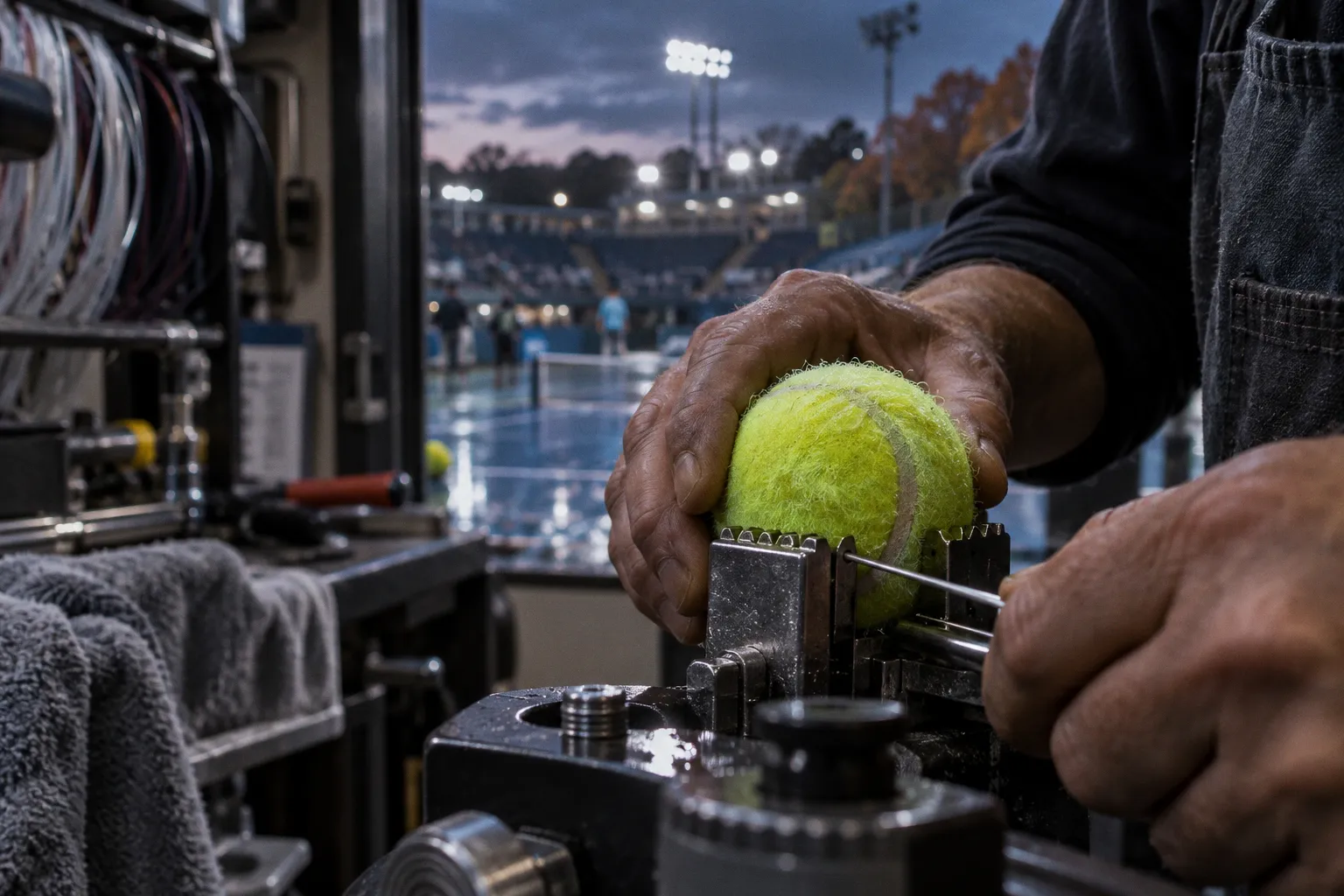
It is a change in the playing environment, and the shift begins with the air around the court.
As the tennis court temperature at night falls, the pressurized ball loses some of its internal elasticity. Cooler air creates more aerodynamic drag. Moisture gathers in the felt, adding weight and softening the rebound, while on clay the surface itself can absorb enough dampness to increase friction beneath the players’ feet and the ball’s first bounce. None of these effects operates in isolation. Together, they create the distinct physics of night session tennis court conditions—often slower, heavier, and more demanding than the same court would feel in the afternoon.
The thermodynamics of the evening ball: why pressure drops
A tennis ball is not an inert object waiting to be struck. Its behavior is governed by the pressure held inside its rubber shell, by the resilience of that shell, by the felt stretched over it, and by the temperature of every material involved. When the air cools, the ball becomes less lively in a way that is immediately recognizable to a player, even if the change is too subtle to announce itself in the scoreboard.
A pressurized ball contains air at a pressure higher than the atmosphere outside it. As temperature falls, the gas inside contracts and its pressure decreases. The rubber core responds with less stored energy, so the ball returns less forcefully from the strings and from the court. The result is a lower bounce, a slower departure from the racket, and a ball that seems to remain in the striking zone for a fraction longer—though that apparent extra time comes at the cost of penetration.
The difference is especially noticeable when a warm afternoon gives way to a cooler night. The court may retain some heat, particularly where the surface has been exposed to direct sunlight, but the ball travels repeatedly through the surrounding air and is handled by players whose rackets and strings are also responding to the changing temperature. The system is cooling from several directions at once.
This is why the same racket setup can feel different across two sessions on the same court. A string bed that seemed crisp and responsive earlier in the day may appear more muted after sunset. A ball that previously jumped high through the court may begin to sit lower. The player does not need a thermometer to register the change; the hands receive it through the frame, the timing, and the resistance of the ball at contact.
The effect does not mean that every night match becomes slow in the same way. Court construction, ball brand, string tension, roof configuration, wind exposure, and the temperature retained by the stadium all matter. Yet the direction of the physical change is consistent: lower temperature reduces the internal pressure and elasticity of a pressurized tennis ball.
The evening ball does not simply travel more slowly—it arrives with less stored energy, and that changes what a player can ask from the court.
The difference between the air inside the ball and the air outside it is useful here. Internal pressure affects the ball’s ability to deform and recover. External temperature affects how quickly it moves through the atmosphere and how the felt behaves when the ball strikes the court. A night session combines these influences before tactics even enter the conversation.
Aerodynamic drag: the invisible wall of cooler air
The phrase “humid night air” is often used as though humidity makes the atmosphere physically heavier. In fluid-dynamic terms, that is not correct. Water vapor has a molecular weight of roughly 18, lighter than nitrogen at about 28 and oxygen at about 32, so adding water vapor to air slightly reduces its density. Between completely dry and fully saturated air at 21°C, the change in air density is under 1 percent—too small, by itself, to explain the heavy conditions players describe.
The more consequential atmospheric change is temperature.
Cooler air is denser than warmer air, and a denser atmosphere offers greater resistance to a moving tennis ball. Every serve, return, topspin forehand, and high defensive lob must push through that resistance. The effect is not dramatic in the manner of a sudden gust, but professional tennis is built from margins: a few kilometers per hour lost from a serve, a ball landing a little shorter, a topspin shot failing to clear the opponent’s shoulder with the same violence.
Night match ball speed changes are therefore not caused by humidity alone. They arise from the combined influence of cooler air, reduced ball pressure, and, as the session progresses, moisture on the felt. The ball’s flight becomes less efficient, especially on shots that depend on speed and depth rather than on a steep angle or heavy rotation.
A flatter ball can lose some of its directness. A serve that normally rushes through the returner’s hitting zone may offer a fraction more time to read and redirect. A drive struck with modest margin may land safely but fail to push the opponent back. The server still has the advantage of height and first strike, but the quality of that advantage changes.
Spin behaves differently. Topspin helps a player create a steep trajectory and a sharp downward drop, but its effectiveness depends on the ball retaining enough energy after the bounce to accelerate through the court. When the ball is cooler, dampened, and moving through denser air, the shot may still kick, yet the forward penetration can diminish. The opponent may receive a ball that rises but does not force the same hurried response.
This is one reason night tennis can appear tactically more patient even when both players are striking aggressively. The court has not become passive. It has become more exacting. The player must build points with an awareness that a first attack may not finish the exchange, and that a ball placed deep to the middle can be more valuable than a spectacular angle that loses its pace before reaching the opponent.
The relationship between speed and rebound is also nonlinear. A tennis ball struck harder deforms more significantly, and its rebound characteristics change with impact speed. A commonly cited comparison places the rebound coefficient near 0.8 at an impact speed of 3 m/s and around 0.6 at 20 m/s. The precise number varies with the ball, surface, temperature, and test conditions, but the underlying point matters: the ball’s response is not a simple matter of “harder hit equals proportionally faster rebound.” Material deformation absorbs part of the energy, and cooler conditions can make that exchange feel even less generous.
The felt factor: when moisture becomes part of the ball
The felt is not decoration. It is a working outer layer that shapes the ball’s flight, affects its interaction with the strings, and determines how the ball grips the court. In a dry afternoon session, the felt remains relatively light and resilient. As evening moisture accumulates, the fibers can absorb water, expand, and become less aerodynamically clean.
That is the physical basis behind the humidity impact on tennis ball bounce. The direct effect of humid air on density is slight, but dampness on the felt is real. A wet or dew-laden ball can become heavier, and its fuzzy surface presents greater resistance as it moves through the air. The ball also loses some of its liveliness after contact, producing a rebound that feels lower and more subdued.
The change often announces itself first in the rally ball. Serves remain powerful because they begin with a large transfer of racket-head speed, but the second and third shots may no longer travel through the court with the same authority. The ball seems to collect resistance as the point unfolds. It is not literally slowing at every stage in a visible line; rather, the player receives less reward for the same physical effort.
A damp ball can also feel different on the strings. The felt interacts with the string bed for a short but consequential moment, and moisture can alter the sensation of bite and release. Players who rely on a precise combination of racket-head speed and vertical brushing may find that the ball leaves with a heavier, duller response. Others may welcome the additional control, particularly on a fast hard court where a little loss of pace can make a rally more manageable.
This does not produce a universal advantage. A heavy ball can favor the player who constructs points patiently, but it can also burden the player who must defend. Defensive shots require length, and length requires energy. If the ball loses speed and the player’s contact point drifts backward, the result can be a short reply that invites another attack.
The progression is often gradual rather than theatrical:
1. The ball loses some internal pressure as it cools, reducing its bounce and the liveliness of its response from the strings.
2. The surrounding air becomes cooler and denser, increasing drag during flight.
3. Moisture gathers in the felt, adding weight and increasing the resistance created by the fuzzy outer surface.
4. The rebound becomes more muted, so the ball travels through the court with less penetration after contact.
5. Players adjust their margins, choosing height, depth, and shape with greater care.
At the highest level, the ball is changed frequently, but fresh balls do not eliminate the environmental effect. They may restore the ball’s original surface condition for a time, yet the new ball immediately enters the same cooler and more humid air. The replacement is fresher, not immune.
Surface friction and the clay-court nighttime shift
On a hard court, the night-session effect is dominated by the ball and the air, though the surface temperature and moisture condition still matter. Acrylic courts are built as layered systems, and their response depends on texture, pace classification, grit, paint composition, and the way the court retains or releases heat. Without standardized measurements for every individual venue, it is not possible to assign one universal nighttime friction change to all hard courts.
Clay offers a more visible transformation because the playing surface is granular and moisture-sensitive. The court is not merely a colored plane beneath the players; it is a layer of loose particles whose friction, compactness, and slide behavior change as the atmosphere becomes damp. At night, ambient moisture can be absorbed by the clay, increasing resistance beneath the shoe and changing how the ball loses speed after its bounce.
The dew point effect on tennis court surface is therefore experienced through movement as much as through ball flight. A player who normally slides into a wide forehand may find the approach less forgiving. The foot can still move through the shot, but the timing of the release changes. A slightly damp court may provide more grip in one situation and more uncertainty in another, depending on how evenly the moisture is distributed and how much the surface has been worked during the match.
The ball’s interaction with clay is equally important. A dry clay court allows a heavily spun ball to bite, rise, and continue forward with a particular combination of vertical lift and lateral disturbance. When the surface takes on moisture, friction increases and the ball can lose more of its forward momentum upon landing. The bounce may become slower and more physically demanding, even while the ball retains a pronounced upward component.
That distinction matters. Slower does not mean easier. A ball that arrives with less speed may give the receiver more time, but it can also rise into a comfortable strike zone and demand another long exchange. On damp clay, a player may have time to reach the ball yet still struggle to drive it beyond the opponent’s defensive range. The point becomes a contest of repeated pressure rather than one decisive acceleration.
Movement patterns adjust accordingly. Players may use more height over the net, accept longer exchanges, and favor crosscourt trajectories that create distance before the final change of direction. Short angles can become more dangerous if the surface makes recovery laborious, but they also require enough pace and spin to avoid floating into the opponent’s reach. The margins narrow in a different way than they do on a fast court.
The relationship between surface and air is what makes night clay distinctive. A cooler ball in denser air already travels with reduced pace. Add a damp felt and a more frictional surface, and the player must generate penetration through several layers of resistance. The strongest shot is not always the hardest-hit shot; it is the one that retains enough depth and shape after all those losses have taken their share.
Beyond the lights: how players read the evening
Players rarely respond to night conditions by making one dramatic tactical decision. The adjustments are distributed through the match—in the height of the serve toss, the shape of the second serve, the choice between a flatter drive and a heavier ball, and the willingness to play one more neutral shot before pressing forward.
A server may seek greater placement rather than pure speed. If the ball is not moving as quickly through the air, the returner may have more time to set the feet, so the server’s target becomes more important. The body serve, the wide serve, and the serve into the hip can all gain value because the point begins with geometry instead of velocity alone.
The returner, meanwhile, may step forward on a slower ball, but not automatically. A lower-bouncing night ball can reward early contact, yet moisture on the felt can make the ball feel heavier on the racket. The returner has to distinguish between a ball that is slow enough to attack and one that is merely difficult to move, especially when the server’s kick serve still rises above the shoulder.
In rallies, depth becomes a form of insurance. A ball struck with generous net clearance and enough rotation can survive the cooler conditions better than a low-risk-looking flat shot that loses its pace and lands short. Players may also use the center of the court more often, not because the middle is inherently offensive, but because it reduces the opponent’s angle while preserving enough length to prevent an immediate counterattack.
The evening favors awareness of sequence. The first heavy forehand may not produce a weak reply. The second may widen the court. The third may finally create the opening. That pattern is familiar on any surface, but night conditions make it more pronounced because the ball gives back less energy at each stage.
At the same time, no player should treat the session as automatically slow. Stadium design can preserve warmth. A roof can alter ventilation and atmospheric density. Artificial lighting changes visibility, but the lights themselves do not explain the ball’s behavior in the simplistic sense of making the court hot or cold. Wind, the exposed position of the arena, the retained heat of the surface, and the progression of the match all contribute to what the players feel.
This is why the US Open evening session atmosphere cannot be reduced to a single formula. The iconic night setting changes the audience’s perception of the match, but the actual conditions are assembled from more ordinary forces: cooling air, a ball losing internal pressure, felt absorbing moisture, and the court responding to the same slow movement of temperature that begins after sunset everywhere.
Night tennis is not defined by darkness; it is defined by accumulation—the small losses of bounce, speed, and grip that become tactically meaningful over a long match.
The court after sunset
The most revealing way to understand night session tennis court conditions is to stop looking for one dominant cause. Humidity is not a magic switch, and the phrase “heavy air” is too imprecise to describe what happens. The atmosphere becomes cooler and denser; the ball’s internal pressure falls; the felt can take on moisture and weight; and, on clay, the surface can become more resistant as dampness settles into its granular structure.
Each change is modest on its own. Together, they alter the negotiation between player, ball, and court.
A fast player may need to build one additional shot before expecting the finish. A defender may find that the ball offers less help in reaching the back of the court. A clay-court specialist may welcome the added friction but discover that the same friction makes recovery more demanding. A returner may have more time to read the serve while receiving a ball that is heavier and less forgiving at contact.
The evening session, then, is not simply a match played later. It is a different physical conversation. The players still bring the same strokes, patterns, and instincts, but the court asks those skills to travel through more resistance. That is why the best night matches often feel so deliberate beneath the noise of the stadium: every strike has to account for what the air, the felt, and the surface will take away.