The roof debuted in August 2016 with a promise that was simple and commercially irresistible: tennis would no longer have to bow to the forecast.
What the renderings could not show was the stadium’s microclimate. Close the roof on a humid September afternoon and Arthur Ashe no longer behaves like an open-air arena. It becomes a different kind of room: warmer, quieter, less exposed to moving air. The structure built to control the environment can make the conditions feel more oppressive for the two people standing at the baseline, dressed in polyester and working at maximum intensity for three or five hours.
The roof does not create heat out of nowhere. It changes how heat, moisture and air movement behave once the bowl is closed. That distinction matters. Arthur Ashe Stadium has air-circulation systems, and the precise rate of air exchange at court level is not publicly clear. But circulation is not the same thing as a steady outdoor breeze, and it is not necessarily the same thing as delivering cool, dry air to the players.
The result is the familiar complaint attached to the US Open closed roof: sweat, heavy air and the sense that the court has become a sauna.
The $150 Million Paradox: Engineering vs. Environment
Arthur Ashe Stadium was never conceived as a conventional indoor arena. It is an open-air bowl with seating for more than 23,000 people, built for a tournament whose identity has always been tied to late-summer New York: hard courts, bright light, wind, heat and the occasional interruption from a storm.
The retractable roof solved one very specific problem. It allowed the tournament to protect the court from rain and keep matches moving when the weather would previously have forced a delay. That is a major operational advantage. It protects the schedule, the television window and the spectators who have paid to watch a particular match at a particular time.
But a roof is not an environmental reset button. Once it closes, the stadium still contains the same players, spectators, lighting, court surface and structural materials. The outdoor air is no longer interacting with the bowl in the same way, and the natural movement that players associate with an open court can be reduced or redirected.
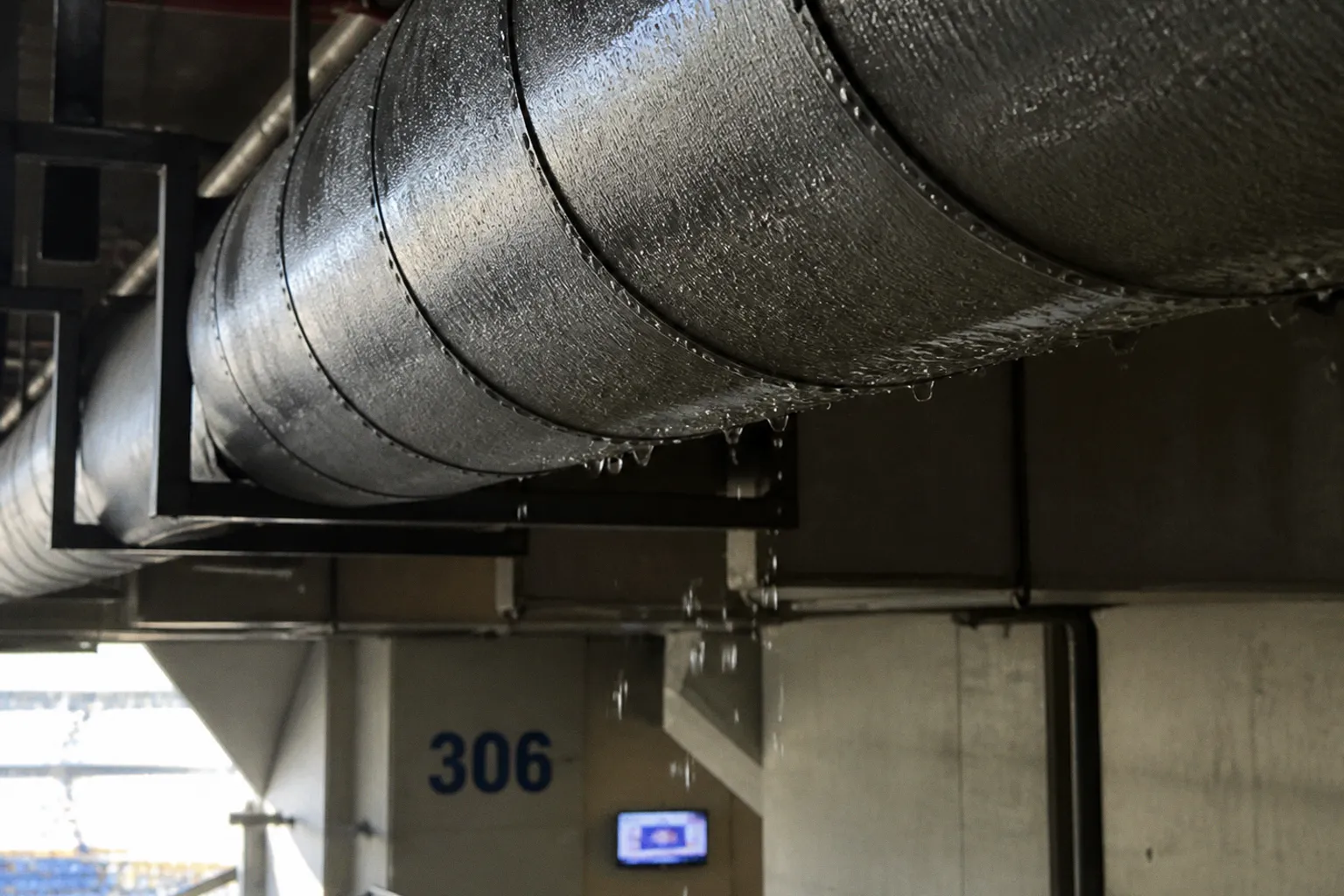
The stadium does have mechanical systems for circulating and managing air. They help address conditions inside the roofed structure, including the risk of condensation and the comfort of people seated throughout the bowl. What cannot be assumed is that those systems function like a full indoor-arena HVAC installation designed to maintain a cool, dry, uniform environment at baseline height.
That is the central engineering paradox. A system can circulate air without producing the kind of perceptible movement that makes a player feel less trapped. It can control moisture in one part of the building without making the air at court level feel fresh. It can prevent water from forming on the roof structure without reproducing the environmental conditions of an open stadium.
On a 90°F day with high relative humidity — conditions that are entirely plausible during the US Open — closing the roof removes or limits one of the most valuable forms of relief: the unpredictable but continuous exchange of outdoor air. The exact court-level air flow under the roof is difficult to assess from the stands, and public descriptions do not establish a simple picture of air being either completely stagnant or efficiently replaced. The experience lies somewhere less dramatic and more complicated: the building is ventilated, but the players may still feel that the air is not moving where it matters.
A roof designed to solve one problem can expose another. Rain goes away. So does some of the air that made the court feel open.
This is why the $150 million figure matters less as a price tag than as a symbol of the project’s priorities. The roof was an extraordinary investment in continuity. It was not necessarily an equally comprehensive investment in recreating an outdoor climate after closure. Those are different engineering tasks, and the second is much harder to see in a promotional video.
The Sauna Effect: Why Court-Level Air Stagnates
Open-air tennis is never perfectly uniform. One end of the court can feel different from the other. The sun moves. The seating bowl casts shadows. Wind changes direction. A player can serve into a headwind in one game and find the ball carrying more freely a few minutes later.
Those variables are inconvenient, but they are also part of the physical language of the sport. Air movement carries warmth and moisture away from the surface of the body. Even a light breeze can change how sweat feels on the skin and how quickly clothing becomes uncomfortable. The player is still hot, but the heat is not experienced as a fixed layer around the court.
With the roof closed, the building becomes more internally dependent. Heat comes from the court, the lighting, the spectators and the effort of the players themselves. Some of that heat rises; some remains in the lower bowl; some is redistributed by mechanical circulation. The important point is not that the stadium becomes a sealed container with no ventilation at all. It is that the air exchange and air movement experienced at court level may be much less useful to a player than the open-air flow available when the roof is retracted.
That is the core of the arthur ashe stadium air flow problem. The player does not experience a technical specification. They experience whether a damp shirt begins to dry, whether the air moves across the face between points, whether breathing feels ordinary or laboured, and whether the heat seems to accumulate as the match progresses.
Relative humidity is part of the explanation, but it needs to be described accurately. A reading around 70 percent is high and can make hot conditions feel substantially more oppressive. It does not mean that the air is saturated or incapable of accepting more moisture. Sweat can still evaporate. The difficulty is that evaporation becomes less efficient as humidity rises, especially when air movement is limited and the body is producing heat faster than the surrounding conditions can carry it away.
That distinction may sound technical, but it changes the argument. The problem is not that the body’s cooling system suddenly switches off. It is that the system has to work harder, while the player is running, stopping, serving and repeating explosive movements for hours. A shirt stays wet longer. Skin feels clammy. Cooling between points becomes less effective. The athlete spends more of the match managing discomfort that would be less intrusive in drier or more mobile air.
The sauna comparison survives without the exaggerated physics. Arthur Ashe is not literally a Finnish sauna, and the roof is not a hermetic lid. But the combination of heat, elevated humidity, limited perceived air movement and a packed stadium can create a sauna-like experience at court level. For a spectator, the same building may feel warm. For a player, it becomes an active performance variable.
There is also a difference between temperature in the building and temperature on the body. Two courts can show similar readings while feeling very different. Radiant heat from the surface and surrounding structure matters. So does the speed at which sweat evaporates. So does whether the air is moving across the player or simply circulating somewhere higher in the bowl. This is why a single number cannot fully describe the ashe stadium microclimate.
The players noticed because they are the measurement instruments that matter most. Their bodies register the interaction of heat and humidity continuously, not once an hour from a weather station.
From Rain Shield to Heat Trap: The 2018 Turning Point
The 2018 US Open was the moment when the discomfort under the closed roof became difficult to treat as a minor engineering footnote. A stretch of late-summer heat and humidity brought the issue into public view, and several prominent players described conditions that sounded less like a protected tennis court than an enclosed heat chamber.
Novak Djokovic was reported to have changed shirts repeatedly during a match, with the number reaching as high as ten. The number is striking, but it should not be turned into false precision. Ten shirts across a five-set match does not mean one change every forty-five minutes. The length of a five-set match varies widely, and shirt changes are not evenly spaced: a player may change several times during a particularly difficult passage, or at ends and breaks when changing is practical. The useful point is simpler. His clothing was becoming saturated often enough that changing shirts became part of managing the match.
That detail captures the human cost of the closed roof better than a general statement about discomfort. Tennis players already manage grip, shoes, strings, towels, hydration and temperature. In heavy conditions, clothing becomes another piece of equipment. A wet shirt can cling to the torso, add distraction and make the player feel that every point is being played inside the same accumulated layer of heat.
Roger Federer and John Isner also drew attention to the effect of the roof and the lack of relief from moving air. Isner, who is approximately 6 feet 10 inches tall, was discussing conditions from the perspective of a very large athlete working through long points and repeated service games. There is no need to attribute an unsupported physiological claim to him. His height alone is relevant to the practical reality of heat management: more body to move, more clothing affected by sweat, and a particular physical presence on a court where the air can feel heavy.
The 2018 complaints mattered because they exposed the gap between weather protection and environmental comfort. Officials could not simply treat the problem as a rain delay in reverse. Opening the roof during rain would defeat its primary function, while retrofitting an entirely new air-management system during a tournament was not realistic. Moving matches would affect the schedule, the broadcast plan and the spectators already in the stadium.
None of this means the roof was a design failure in every respect. It did what it was built to do. The problem is that its success in protecting the court from rain did not automatically guarantee good playing conditions when the roof was closed in hot, humid weather.
That is the uncomfortable distinction the tournament had to confront. Reliability for the schedule and comfort for the players are related, but they are not interchangeable.
The Human Cost: Managing Ten Shirts per Match
The shirt-change story is useful because it turns an abstract complaint into a sequence of physical decisions. A player’s grip becomes less secure. A towel break takes on greater importance. The player checks the strings, wipes the forearm, changes the shirt and returns to the baseline with a small part of their attention still fixed on the conditions.
At Grand Slam level, these small interruptions matter. A player is constantly solving several problems at once:
- keeping the racket handle dry enough to trust on a full swing;
- maintaining footwork when the body feels heavier and recovery takes longer;
- drinking enough to replace fluid without creating another source of discomfort;
- deciding whether a shirt change is worth the time and disruption;
- preserving concentration while the match becomes physically less predictable.
None of these decisions automatically determines the result. Heat does not erase technique or tactics. But difficult conditions alter the cost of every action. A long rally takes more out of the body. Recovery between points becomes more valuable. A player who usually attacks early may choose safer patterns because the physical price of another extended exchange is too high.
This is where the closed roof affects the match without dictating it. The roof does not give one player a special stroke. It changes the environment in which every stroke has to be produced.
Heat stress also consumes attention. Elite tennis requires pattern recognition, emotional control and constant tactical revision. The player must notice whether an opponent is protecting a backhand, serving wider from the deuce court or standing farther behind the baseline. If the body is struggling to cool itself, some of that mental bandwidth is redirected toward basic regulation: breathing, drinking, wiping sweat, changing clothing and trying to feel normal again.
The tactical consequences can be subtle. A server may choose a larger margin rather than chase a second-serve target. A returner may stand farther back to avoid taking on a rushed first strike. A baseliner may shorten points not because the opponent has changed but because the cost of another long exchange has become unacceptable. These are still tennis decisions, but they are made inside a different physical economy.
The conditions affect both sides, of course. There is no simple injustice in which the roof punishes one player and protects the other. The competitive question is who absorbs the environment more efficiently. One player may have a more economical movement pattern. Another may shorten points with the serve. A third may recover better between games. The result can turn on the difference between two bodies responding to the same building.
That is what makes the issue more complicated than a complaint about comfort. The roof can change the kind of match that is available. An open court may reward variation, movement and the ability to use changing wind. A closed court with heavy air may reward efficiency, compact patterns and the player who can maintain quality while spending less energy.
The roof does not change who plays. It changes what kind of match is possible.
There is a psychological cost as well. A player can prepare for heat, but preparation does not make the conditions irrelevant. Once the athlete believes that the air is not moving and the clothing will not dry, every difficult game confirms the impression. The building becomes part of the opponent’s presence. Players talk about it in press conferences because the venue is not a neutral background when it changes the physical terms of the contest.
That does not make every criticism a technical verdict. Players describe sensation, not airflow measurements. Their experience is essential evidence of the problem, but it does not by itself establish exactly how the stadium’s ventilation system operates. The honest conclusion sits between those two facts: the roofed environment can feel oppressive at court level, and the precise mechanical explanation is more complicated than saying that no air is circulating.
Shifting Policies: The 2023 Partial Closure Compromise
By 2023, the tournament’s approach appeared to be shifting from a simple rain-protection model toward a more flexible response to extreme heat. Reports about partial roof closure suggested that sections of the structure could be deployed to provide shade even when full weather protection was not required.
That is a meaningful change in emphasis. The roof would no longer be understood only as an all-or-nothing device — open for ordinary play, closed for rain. It could also be used to reduce direct solar exposure on the court and in parts of the lower bowl when heat made shade itself valuable.
The logic is straightforward. Less direct sunlight can reduce radiant heat reaching the surface and the surrounding structure. That may make the court feel less punishing, particularly during the hottest part of the day. It may also give players and spectators a more stable environment before the match begins.
But shade is not the same as ventilation. Partial closure may reduce solar gain without recreating the air movement of an open stadium. It may improve one part of the microclimate while leaving another largely unchanged. A player can be protected from direct sun and still experience high humidity, wet clothing and limited relief between points.
This is why the policy should be seen as a compromise rather than a complete answer to the closed roof tennis court humidity problem. It addresses exposure. It does not necessarily solve the question of how air at court level is exchanged, cooled or dried. Nor should it be described as a universal schedule rule. Its use depends on tournament operations, weather conditions and decisions made at the time.
The distinction between full closure, partial closure and an open roof matters because each setting produces a different combination of variables:
| Roof position | Main benefit | Remaining concern |
|---|---|---|
| Open | Maximum connection with outdoor air and natural variation | Rain, direct sun and changing wind can disrupt play |
| Fully closed | Reliable protection from rain and a more controlled schedule | Heat and humidity may feel more oppressive, especially if court-level air movement is limited |
| Partially deployed | Reduced direct solar exposure while retaining some connection with the outside | Shade does not guarantee effective cooling or a perceptible breeze |
The engineering answer to the most severe version of the problem would involve more than adding shade. It would require reliable, targeted management of air temperature, humidity and movement where the players actually stand. That is technically demanding in a large stadium designed around retractable architecture, spectator comfort and broadcast requirements. It would also be expensive and disruptive to retrofit.
The tournament therefore has an incentive to use measures that are available without rebuilding the arena. Adjusting roof position, managing timing where possible, monitoring heat and allowing players more opportunities to reset can all reduce the burden. None of those measures changes the underlying fact that a roofed open-air stadium is an awkward hybrid: too large to behave like a small indoor court, but too enclosed to deliver the same relief as an open one.
Ten Years On, the Building Is Part of the Match
The roof debuted in 2016. By August 2026, it has been in operation for approximately ten years, long enough for its advantages and limitations to become part of the tournament’s identity. The issue is no longer whether the roof can protect a match from rain. It clearly can. The more interesting question is what happens to the match when protection from rain also changes the air around the players.
There is a temptation to treat the structure as scenery: a spectacular piece of architecture above the court, useful when the forecast turns bad and invisible when it does not. That framing no longer works. The closed roof affects sound, light, shade, perceived air movement and the way heat accumulates in the bowl. It is not a player, but it is a competitive condition.
The best players adjust because they always adjust. They change shirts more often. They shorten warm-ups when conditions demand it. They hydrate carefully, simplify patterns and accept that part of their competitive range may be spent managing the building. Adaptation is one of the defining skills of professional tennis.
But adaptation should not be confused with proof that the conditions are harmless. A player can compete successfully in a difficult environment while still being placed under a burden that has little to do with the opponent. The fact that both players face the same court does not make the roof irrelevant. It simply turns environmental management into another form of competition.
The US Open has always tested heat, stamina and concentration. Under a closed roof, it can test something more specific: the ability to play high-stakes tennis in a large, humid bowl where the air may not move in the way an outdoor player expects. The decisive advantage may go to the athlete whose game is most economical, whose recovery is most efficient or whose body handles the ashe stadium microclimate with the least disruption.
That is not necessarily a flaw in the tournament. Sport has always included conditions that reward certain styles and expose certain weaknesses. Wind changes tennis at Wimbledon. Clay changes the value of patience at Roland-Garros. Heat has always been part of Melbourne and New York.
The problem is the gap between the building’s public purpose and its private effect. The roof was introduced as a way to make the tournament more dependable. For the players, dependability is not only the absence of rain. It is also knowing that the environment will remain playable when the structure closes around them.
Arthur Ashe Stadium does not become a literal sealed terrarium when the roof is deployed. Its systems circulate air, and the exact court-level exchange cannot be reduced to a slogan. But the closed roof can still produce a heavy, humid and unusually enclosed experience, especially during hot weather. That is enough to explain why the venue feels like a sauna without exaggerating the engineering.
The roof solved the weather problem. It did not eliminate weather from the match. It moved the problem inside, where the players have to feel every degree of heat, every wet shirt and every missing breath of outdoor air.