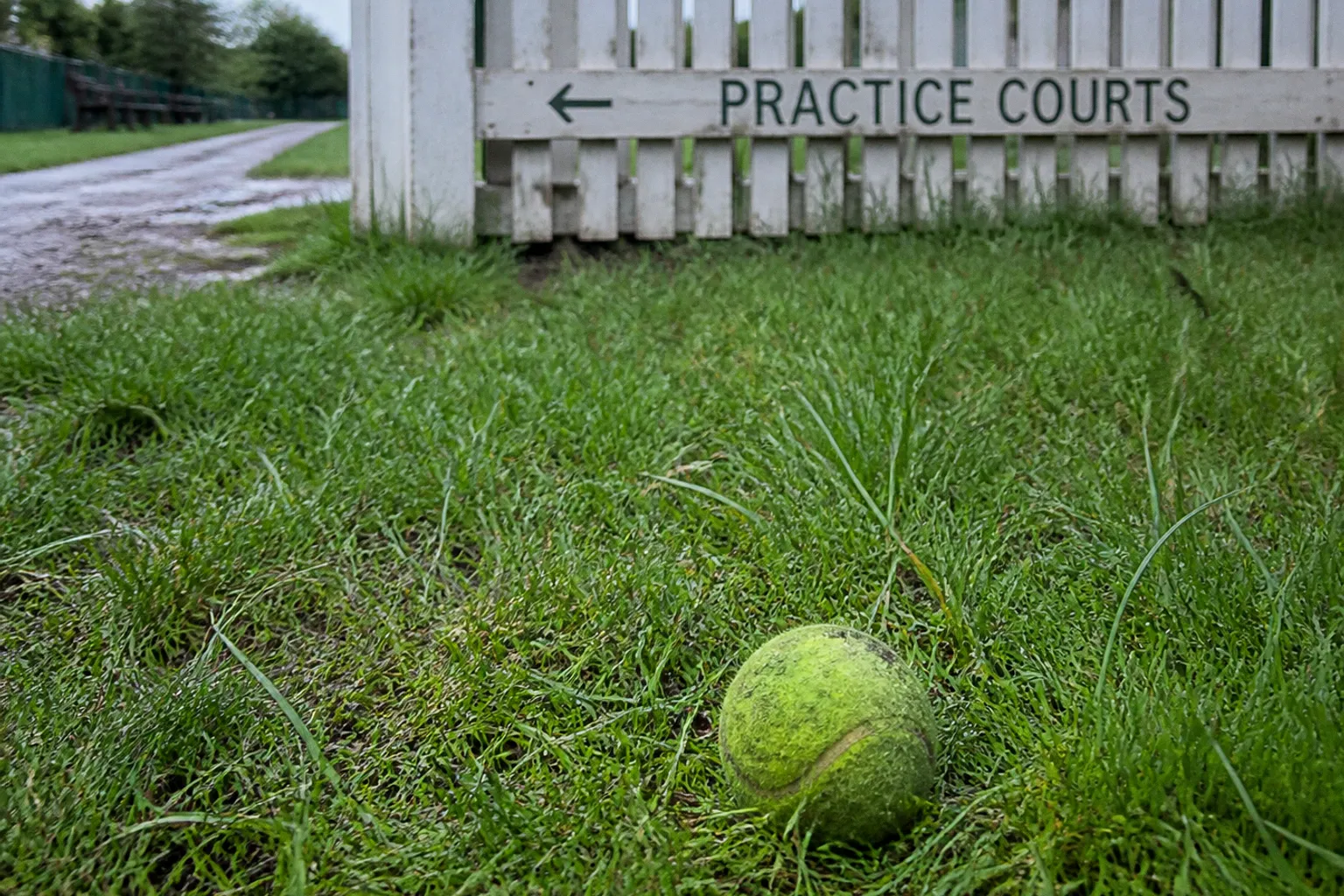
Every match is played under the pressure of elimination, on a surface that rewards first contact, punishes hesitation and gives even a modest change in weather a physical presence.
The qualifying competition does not take place inside the All England Lawn Tennis Club on Church Road. It is staged roughly three miles—about five kilometres—away, at the Wimbledon Qualifying and Community Sports Centre in Roehampton, a venue formerly known as the Bank of England Sports Centre. That distance matters less on a map than it does in the imagination. The players are close to Wimbledon, close enough to feel its gravity, but not yet inside the polished theatre of the Championships.
Here, the wimbledon qualifying roehampton grass courts carry a different kind of tension. They are open to the weather, close to the spectators and stripped of much of the ceremonial distance that surrounds the main draw. The tournament is still Wimbledon qualifying, but Roehampton lets you see the machinery underneath the tradition—the worn soles, the hurried recoveries, the nervous service games and the quiet calculation required to survive three consecutive rounds.
The qualifying draw is a small tournament with no soft edges
A place in the Wimbledon main draw is not earned through a single dramatic victory at Roehampton. It requires three wins in succession, each one played as a direct test of a player’s ability to preserve his or her game under accumulating strain.
There are 16 qualifying places in the gentlemen’s singles draw and 16 in the ladies’ singles draw. With 128 players in each field, the route is not simply about being better than an opponent on one afternoon. It is about making the same decisions correctly across three matches, often while the body is still adjusting to the surface and the mind is resisting the pressure of the next round.
The structure creates a particular kind of violence in the draw—not physical violence, but compression. There is no space for a player to lose a close match and continue through a forgiving schedule. A poor opening set can become a tournament-ending deficit. A long first-round contest can leave the winner carrying fatigue into the next match before the grass has had time to settle beneath the feet.
The qualifying tournament asks a player to manage several competing demands:
- The first strike must be reliable. On grass, the returner often has less time to organise the body, especially when the serve stays low and skids through the court. A return that would be merely cautious on clay can become an invitation on a fast lawn.
- The movement must be economical. Grass does not always reward dramatic recovery steps. Sudden changes of direction, low contact points and uncertain footing can turn an otherwise routine defensive exchange into a technical emergency.
- The service game must carry emotional weight. Holding serve is not only a matter of points won; it is a way of controlling the rhythm of the match and avoiding repeated exposure to awkward low returns.
- The player must accept imperfect tennis. Grass produces points that feel unfinished—short exchanges, clipped volleys, half-slides, hurried approaches. A competitor who insists on building every rally in the manner of a clay-court match may find the surface constantly interrupting the plan.
That is why a qualifier who looks temporarily brilliant can still be vulnerable. The first match may be decided by serve and return; the second by movement and recovery; the third by the player’s ability to remain technically clear when the opportunity is visible and the body is beginning to resist it.
At Roehampton, qualifying is not a waiting room for Wimbledon. It is Wimbledon’s first serious examination.
The draw also changes the emotional scale of the day. On the main grounds, a match can be one event among many, surrounded by crowds, ceremonies and the familiar visual language of a major championship. At Roehampton, a player’s entire professional season may seem to gather around a single court. There are fewer layers between the competitor and the consequence. A double fault is heard. A failed volley has nowhere to disappear.
What the grass asks from a player
Grass is often described as fast, but speed is only part of the story. The more revealing quality is its friction—or the lack of it—and the way that friction changes the relationship between the ball, the racket and the player’s feet.
A well-struck serve can move through a grass court before the returner has fully settled into the exchange. The bounce tends to stay lower than on clay, and the ball may skid rather than rise comfortably into the hitter’s preferred strike zone. This changes the geometry of the point. A player who normally uses height and time to establish control must now find control earlier, often with a shorter backswing and a willingness to take the ball before it has completely declared its direction.
The surface also exposes indecision. On clay, a player can sometimes slide into a defensive position or recover after a late adjustment. On grass, the same delay may produce a cramped contact, a reaching forehand or a defensive slice struck from beneath the ball. The result is not always spectacular; more often, it is a small technical compromise that becomes the starting point of a lost point.
The best grass-court players are not necessarily the ones who attack on every ball. They are the ones who understand where the court is offering a brief advantage and who can convert that advantage without overplaying. A low ball may call for a slice rather than a full-blooded drive. A short return may be enough to move forward, but the approach must be placed with care because the first volley can arrive below the ideal height. A serve into the body may be more valuable than a faster serve to the corner if it prevents the returner from opening the racket face.
This is the practical meaning of the phrase Wimbledon qualifiers grass court speed. It is not simply that points are shorter or serves are more important. Speed changes the amount of time available for interpretation. The player must read the ball earlier, prepare earlier and decide earlier—while still retaining enough patience to avoid mistaking urgency for aggression.
Roehampton and Church Road: proximity without sameness
The difference between Roehampton and Wimbledon grass is easy to oversimplify. Both venues belong to the same broad lawn-tennis tradition, and both are managed within the Wimbledon ecosystem, but the qualifying site is not the Centre Court complex transplanted a few miles away.
Roehampton operates as its own tournament environment, with its own scale, sightlines and atmosphere. The grass at any venue is shaped by preparation, weather, usage and the stage of the competition. Without detailed comparative bounce or court-speed measurements, it would be misleading to announce a precise technical difference between Roehampton and Wimbledon grass. What can be observed is the difference in how the surfaces are encountered.
| Feature | Roehampton qualifying | Wimbledon main grounds |
|---|---|---|
| Location | Wimbledon Qualifying and Community Sports Centre in Roehampton | All England Lawn Tennis Club on Church Road |
| Tournament role | Three-round singles qualifying competition | Main Championships, including the singles draws |
| Venue scale | 18 match courts, 8 practice courts and an 808-seat Show Court | A larger championship complex with the tournament’s most recognisable show courts |
| Spectator experience | Open grassy areas, picnic tables and lawn chairs close to the action | Formal grounds, stadiums and the established rituals of the Championships |
| Competitive atmosphere | Immediate, exposed and elimination-focused | More ceremonial, layered and publicly staged |
| Relationship to Wimbledon | Approximately three miles, or five kilometres, from AELTC Church Road | The central venue of the Championships |
The distinction is therefore not a simple ranking of one lawn against another. It is a question of context. At Roehampton, the court is encountered without the same architectural and ceremonial buffer. The grass seems less like a surface placed inside an institution and more like the central material of the institution itself—something being tested in front of you.
The atmosphere is intimate because the ground is open
The Roehampton tennis tournament atmosphere begins with the absence of certain barriers. The venue has 18 match courts and eight practice courts, which creates a density of tennis that is difficult to replicate at a major stadium complex. Players are not hidden behind a succession of corridors and restricted zones. The day has a more legible rhythm: a match begins, another court fills, a practice session takes place nearby, and the entire qualifying field seems to move through the same patch of grass.
The Show Court seats 808 spectators, enough to give a match shape without making it feel remote. Elsewhere, spectators can watch from open grassy areas, picnic tables or lawn chairs. That arrangement changes the quality of attention. You may follow one contest for a set, then hear the shift of applause from another court and realise that a different player has just reached match point. The audience is not gathered into a single controlled stream; it is distributed across the grounds, listening and looking in several directions at once.
This is especially valuable in qualifying because the matches often carry a particular kind of uncertainty. A former junior standout may be trying to recover a ranking. A seasoned tour player may be defending a final opportunity to enter the tournament through the draw. A young competitor with little experience on grass may discover that a technically awkward opponent is more dangerous than a higher-ranked name. Without the protective narrative of the main draw, the contest has to make its own meaning.
The intimacy also makes the physical labour more visible. On a distant stadium court, the mechanics of movement can become part of the spectacle. At Roehampton, they are difficult to ignore. You see how often a player checks the footing before committing to a wide ball. You notice the slight delay before a returner steps forward. You hear the difference between a clean serve and one that catches the frame. The court is not background scenery; it is an active condition of every decision.
The former Bank of England Sports Centre gives the setting an additional layer of institutional history, but its present role is practical. It is now officially managed by the All England Lawn Tennis Club as the Wimbledon Qualifying and Community Sports Centre. That change in name reflects a change in responsibility and purpose, yet the venue retains a more open, community-sports character than the formal grounds on Church Road.
The intimacy of Roehampton is not a reduction of Wimbledon’s scale; it is a way of seeing what that scale is built upon.
A player’s week is shaped by surface, schedule and uncertainty
Qualifying traditionally takes place in late June, close enough to the Championships for the grass to become a daily question rather than a distant seasonal idea. The timing creates a narrow corridor in the calendar. Players arrive with the surface still fresh in the legs, but not always with a long period of preparation behind them. The transition from clay-court season can be especially demanding because clay encourages a different relationship with time, distance and recovery.
On clay, a player may build a point through depth and height, using the court’s slower response to create several layers of pressure. Grass asks for a sharper economy. The serve and first ball matter enormously, but so does the ability to finish a point without making the finishing shot larger than necessary. A player who has spent weeks constructing rallies may need to trust a more abbreviated pattern: serve, first forehand, move forward; or return low, take the next ball early, keep the opponent from lifting the exchange.
The weather enters this adjustment without needing dramatic conditions. Humidity can make the air feel dense and the surface less predictable in the player’s perception. Sunlight changes the visual clarity of the ball. Dampness alters the feel underfoot and the confidence with which a player can attack a wide ball. Even a quiet shift in temperature can affect how quickly the ball comes through the court and how comfortable the body feels in a low stance.
These are not details that can be cleanly separated from tactics. Court speed is experienced through the body. A player may decide to take the return earlier because the ball is not rising. A server may choose a different target because the opponent is standing closer. A competitor who normally slides into recovery may shorten the movement and use small adjustment steps instead. The tactical plan is always being revised by the material beneath it.
For a qualifier, the most dangerous mistake is often not a spectacular tactical error but a refusal to revise. The grass does not reward loyalty to a game plan that belonged to another surface. It asks the player to recognise what is happening now—to the bounce, to the body, to the opponent’s position—and to respond before the point has moved beyond reach.
The ground is expanding, but its character is part of the question
The future of Roehampton is connected to wider plans for the area. The Lawn Tennis Association and the All England Lawn Tennis Club have explored proposals that could eventually create up to 36 outdoor courts across grass, clay and hard surfaces. The proposal is significant because it frames Roehampton not merely as a temporary home for qualifying, but as a broader tennis centre with a more extensive year-round function.
Expansion could provide greater capacity for training, community use and tournament operations. It could also strengthen the connection between elite tennis and the everyday sporting life of the area. Yet every enlargement raises a question that cannot be answered through court numbers alone: what should remain recognisable about the place?
Roehampton’s value lies partly in its lack of polish. The open lawns, the short distances between courts and the ability to watch matches from a chair or picnic table give the qualifying week its distinctive texture. If the site becomes more formal or more heavily engineered, it may gain logistical strength while losing some of the rawness that makes it meaningful to spectators.
That does not mean a qualifying venue should be frozen in time. Grass courts require maintenance, staffing and investment, and players need proper practice facilities. The challenge is to expand without turning the prelude into a smaller imitation of the main event. Roehampton does not need to compete with Church Road on ceremony. Its strength is that it reveals another side of the Wimbledon tradition—less decorated, more exposed and closer to the ordinary work of becoming a champion.
The proposed mixture of grass, clay and hard courts is especially interesting in this respect. It would acknowledge that the modern tennis calendar is built across surfaces, while the qualifying week remains fixed in the immediate logic of grass. The venue could become a place where different forms of tennis coexist, but the Wimbledon connection would still depend on preserving the integrity of the lawn courts and the atmosphere around them.
£15 changes the distance between spectator and tournament
Spectator entry to the Wimbledon Qualifying competition at Roehampton has been priced at £15, a figure that places the experience at a markedly different point from the formal economy of the main Championships. The significance is not only financial. It changes who can come, how long they can stay and what kind of attention they can bring to the day.
A ticket at that level allows qualifying to function as a genuine entry point into professional tennis rather than a remote extension of the main event. The visitor can see several courts, move between matches and observe players before their names become familiar to the wider tournament audience. There is no requirement to treat the day as a single grand appointment. The experience can remain flexible, exploratory and close to the ground.
That accessibility also suits the nature of qualifying. The competition is full of unfinished stories, and the spectator is not always told in advance which one deserves the greatest attention. You may watch a match because the rally patterns are compelling, because one player is serving with unusual precision or simply because the contest on the nearest court has reached a tense stage. The value is in being present before the narrative has been polished.
The main Wimbledon grounds are designed to make tennis feel monumental. Roehampton makes it feel immediate. Both experiences are valuable, but they serve different purposes. One gives the sport its grand public image; the other lets you study its mechanisms at close range.
Why the prelude deserves its own place in Wimbledon’s history
The word qualifying can sound administrative, as though the matches are merely a gate through which the real tournament must pass. Roehampton corrects that misunderstanding. The players are not rehearsing Wimbledon. They are competing for access to it, and the standard of concentration required is often severe precisely because the reward is so close.
The venue also preserves something essential about lawn tennis. Before the banners, the stadium acoustics and the formal entrances, there is the court itself: a rectangle of grass, a net, a ball that stays lower than expected and a player forced to make decisions in less time than comfort would prefer. The environment is beautiful, but its beauty is never separate from friction. The grass can be elegant and unforgiving in the same point.
That is why the wimbledon qualifying roehampton grass courts deserve attention beyond the draw sheet. They show how tradition is sustained—not through ceremony alone, but through repeated physical work. Courts must be prepared. Players must adapt. Spectators must come close enough to notice the details. A tournament’s identity lives in these conditions as much as in its champions.
Roehampton sits only a few miles from Church Road, yet it occupies a different emotional register. It is near Wimbledon without pretending to be the Centre Court experience. Its open lawns and compact court network give the qualifying week a rare transparency, allowing the spectator to follow the struggle before success has been confirmed.
The best way to understand the place is to resist calling it a lesser Wimbledon. It is the tournament’s raw prelude—a concentrated passage of grass, weather, fatigue and possibility. Three rounds stand between 128 players and 16 main-draw places on each side. By the time the survivors arrive at SW19, much of the drama will have been absorbed into the official story. At Roehampton, you can still see where that story begins.