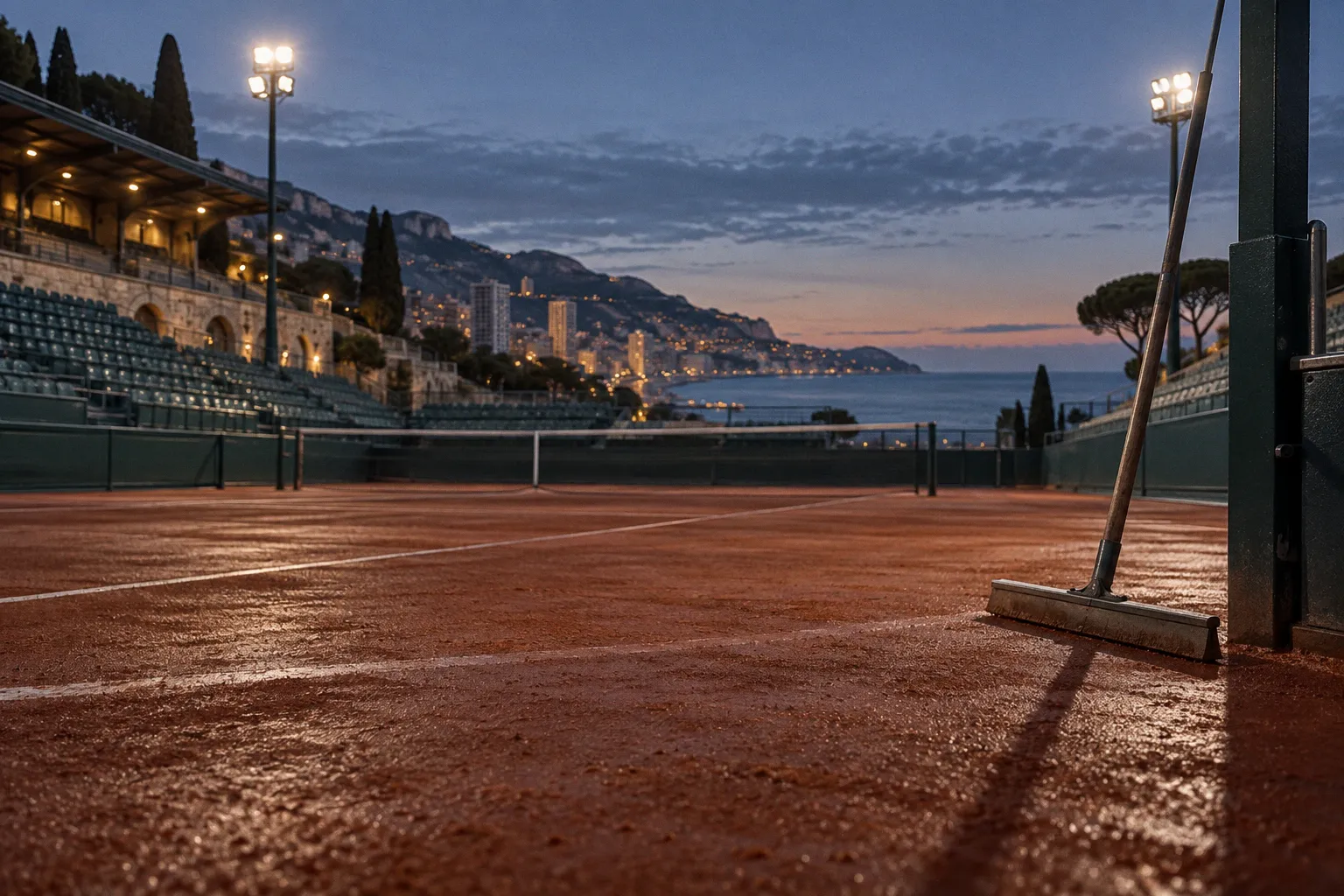
That contrast is easy to miss when both events are described simply as clay-court tournaments, yet it reaches directly into the flight of the ball: atmospheric pressure, temperature, humidity, and the condition of the court combine to decide whether a forehand arrives with lift and penetration or settles into a slower, heavier exchange.
The Monte Carlo clay court bounce characteristics are therefore not fixed. They move through the day with the weather. In warm sunshine, when temperatures reach around 25°C or higher, the surface dries, the ball grips the clay more cleanly, and topspin can produce the high, vigorous bounce associated with European red clay. When April temperatures fall below 20°C, especially beneath overcast skies or in coastal dampness, the same court becomes more resistant. Moisture gathers in the surface, the felt of the ball fluffs, and the bounce drops — lower, slower, and more physically demanding.
That shift is not a matter of atmosphere in the decorative sense. It is court physics, and at Monte Carlo the physics are unusually exposed.
The physics of sea-level clay: why Monte Carlo defies Madrid’s speed
Altitude is one of the quiet forces that separates clay venues. At higher elevation, the air is thinner, creating less resistance as the ball travels. The result is a livelier ball — more speed through the court, a sharper response off the racket, and less time for an opponent to organize the next shot. Madrid, at more than 650 metres above sea level, is the familiar European example of this principle.
Monte Carlo sits almost at sea level. The 19-metre elevation of the Monte-Carlo Country Club means denser air and greater atmospheric resistance than at Madrid. The ball does not simply fly forward with the same ease. It loses more energy in transit, and the rally acquires a different kind of friction — not only between ball and string bed, but between the ball and the air itself.
This is one reason why the Monte Carlo Masters court surface analysis cannot be reduced to the colour or nominal category of the court. Clay is not a single playing condition. Its pace depends on the material underfoot, the preparation of the top layer, the temperature, the saturation of the surface, and the air through which the ball must travel.
At Monte Carlo, sea-level conditions tend to suppress the easy acceleration that players may find at a high-altitude venue. A flat strike that would penetrate more decisively elsewhere can arrive with less weight. A serve that appears cleanly struck may not carry through the court in the same way. A player who normally builds points by taking the ball early may find that the reward for that aggression has been reduced — not eliminated, but made more expensive.
The difference is especially important because clay already lengthens the exchange. The surface absorbs part of the impact, allows the ball to leave a visible mark, and gives a defender the possibility of sliding into position. Add dense air and a cool spring afternoon, and the court asks for yet another layer of work. The ball must be accelerated, but the conditions do not volunteer that acceleration.
At Monte Carlo, the court is not merely slow or fast — it is responsive to the air, and the air changes the meaning of every clean strike.
This is why comparisons between Monte Carlo and Madrid need care. Saying that both tournaments belong to the clay season tells us very little about how the ball will behave. The altitude difference alone changes the resistance around the ball, while the timing of the tournaments introduces another variable: Monte Carlo is played in April, when Mediterranean weather can move quickly between warm sunlight, cloud cover, and coastal dampness.
A player arriving with a strategy designed for a lively, high-bouncing clay court may discover that the first adjustment is not tactical in the narrow sense. It is physical. The racket must travel faster. The legs must keep working through the longer rally. The player must create pace rather than assume the court will help carry it.
The humidity factor: how damp air fluffs the felt and slows the game
Humidity affects the match in several connected ways. Moisture can enter the clay surface, reducing the crispness of the bounce. It can also affect the felt covering of the tennis ball, causing it to become fuller and more absorbent. A fluffed ball meets the air with more drag and tends to lose some of its liveliness after repeated impact.
The change is subtle at first. The ball may still appear perfectly playable; it may still rise high enough for a player to swing comfortably over it. But the sensation at contact is different. The ball does not leave the strings with the same clean urgency. The topspin forehand, which normally bends down into the court and then climbs aggressively from the clay, can become heavier without becoming more dangerous. The shot has revolutions, but fewer of those revolutions are converted into immediate penetration.
Coastal humidity is particularly relevant at the Monte-Carlo Country Club because the venue is close to the Mediterranean and the tournament is held during a season when temperatures are not consistently high. Warm air can dry the court and restore some of its liveliness. Cooler maritime conditions do the opposite. The surface holds moisture; the ball becomes less willing to travel; rallies gather weight.
This is the Mediterranean climate effect on tennis courts in its most practical form. It does not mean that sea air always makes the ball bounce higher, nor that the Riviera climate automatically creates a fast court. The direction of the effect depends on the balance between warmth and moisture.
| Condition | Court response | Ball behaviour | Tactical consequence |
|---|---|---|---|
| Warm, sunny weather around 25°C or higher | Clay dries and becomes more receptive to topspin | Higher, livelier bounce with more visible kick | Players can use shape and height to push opponents back |
| Cool weather below 20°C | Surface remains damp and absorbs more energy | Lower, heavier bounce with reduced penetration | Players must generate more pace and tolerate longer exchanges |
| Overcast coastal conditions | Less solar drying and greater surface moisture | Ball feels fuller and travels with more drag | Short balls become harder to produce, especially from defensive positions |
| Changing conditions through the day | Court response shifts rather than remaining constant | Bounce and speed can alter between sessions | Players must recalibrate racket speed, contact height, and rally tolerance |
Humidity also changes the emotional rhythm of a match. On a lively court, a player can feel rewarded for stepping in: the ball comes through the strike zone with enough energy to make the risk worthwhile. On a damp court, the same decision may produce a ball that sits shorter than expected or loses its force before reaching the opponent. The player has not necessarily misread the tactical situation; the material conditions have changed the value of the shot.
This is where experienced clay-court players become visibly patient. They do not only watch the opponent’s position. They observe the ball after it lands, the depth of the skid, the way the felt looks after several games, and whether the surface is leaving a dry or darkened mark. Those details tell them whether the court is giving energy back or taking it away.
The 20°C divide between heavy and lively conditions
The most useful practical threshold in Monte Carlo is the divide between conditions below 20°C and those around 25°C or higher. It should not be treated as a mechanical switch — tennis courts do not change character at one exact number — but it describes the difference between two recognizable versions of the venue.
Below 20°C, particularly when the sky is overcast or the coastal air is damp, the bounce becomes lower and the court plays heavy. The clay has less opportunity to dry. Impact energy is absorbed more readily, and the ball’s felt becomes less compact. The resulting rally is not necessarily short of movement; it is short of free speed.
The difference matters most on the second bounce and in the middle of the court. A player may expect a heavy topspin ball to climb above the shoulder, yet find that it arrives lower and more directly into the hitting zone. That can sound like an advantage for the receiver, but it is not so simple. Because the ball is slower and heavier, the opponent has more time to recover, and the attacker must produce the next acceleration under conditions that are already demanding.
When the temperature rises toward 25°C or above, the surface dries more quickly. The clay begins to return a more familiar spring to the ball. Topspin grips the surface with greater effect, and the bounce becomes higher and more forceful. This is the version of Monte Carlo that can resemble the broader expectations of a Mediterranean clay tournament: long points, open court geometry, and a ball that climbs sharply enough to pull a player away from the baseline.
Yet the transformation is not only about pace. A higher bounce alters contact height. It can push a player’s racket preparation upward, stretch the hitting shoulder, and create more room for the attacker to use angle. A lower bounce compresses the exchange, bringing the ball into a flatter and often more awkward contact zone. The best tactical choice is therefore not simply to strike harder, but to recognize which version of the court has arrived.
The evening shift is particularly important for anyone watching a late session. As the sun weakens, the court loses the drying force that helped maintain a livelier bounce. If the air is already cool or humid, the surface can become heavier as the session progresses. The change may not be dramatic from one game to the next, but over a long match it accumulates. A rally that began with a manageable tempo may gradually require more racket-head speed, more leg drive, and more patience around the baseline.
That is why the same player can appear to lose penetration without making an obvious technical error. The conditions have taken away part of the shot’s natural assistance. A forehand that landed deep in the afternoon may begin to sit shorter. A serve that produced a weak reply earlier may now be met more comfortably. The match has not abandoned its tactical logic, but the physical price of executing it has risen.
The limestone foundation beneath the crushed brick
The visible red of the Monte Carlo court is only the uppermost expression of a layered construction. The standard top layer consists of roughly 2 millimetres of fine crushed brick or clay laid over a limestone foundation. That thin surface is where the ball leaves its mark, where a player’s shoe searches for grip, and where moisture changes the immediate response of the court.
A few millimetres can carry an extraordinary amount of responsibility. The top layer determines how readily the surface accepts topspin, how the ball departs after impact, and how easily a player can slide into a wide defensive position. Beneath it, the limestone foundation provides the stable body of the court. The two layers work together: the foundation gives structure, while the fine crushed material supplies the friction and visible texture associated with clay.
This construction also explains why court maintenance is inseparable from match conditions. A clay surface cannot be understood as a permanent red plane. It is groomed, watered, brushed, and affected by traffic. The distribution of the fine material influences how consistently the court responds from one area to another. The baseline may carry a different degree of wear from the service boxes; the centre of the court may receive repeated footwork while the outer lanes remain less disturbed.
Weather then acts on this prepared material. Moisture does not simply sit on top of an inert surface. It changes the interaction between ball, clay, and shoe. A damp top layer becomes more yielding and less immediately energetic. A dry layer allows the ball to bite more sharply, while the player receives a clearer response from the surface beneath the foot.
This is part of why the Monte Carlo Country Club surface speed cannot be assigned a single label. The same court may feel different depending on the hour, the cloud cover, and the accumulated moisture. The traditional language of fast clay or slow clay remains useful as a broad description, but it conceals the court’s daily movement.
The historical context adds another layer. Crushed terracotta powder was developed in the French Riviera in 1890 by William Renshaw, and the material has remained connected to the region’s clay-court identity. That history is not an ornamental footnote. It helps explain why the surface is experienced as both engineered and local — a court made through specific materials, shaped by a particular climate, and preserved through a tournament calendar that places it in the unsettled weather of April.
Tactical adjustments: generating pace when the court refuses to give it back
The first tactical adjustment on heavy Monte Carlo clay is to stop confusing time with penetration. A player may have enough time to prepare, yet still struggle to make the ball travel through the court. That distinction matters. The opponent can be pushed back by height and depth, but a shot that arrives without weight may give the defender every opportunity to reset.
Players therefore need to create pace with greater precision. The legs become central because the body must stay behind the ball through a longer, heavier contact. Racket-head speed matters, but so does the ability to maintain balance when the court does not provide a firm, immediate response. A rushed swing tends to produce a shorter ball; an over-forced swing can break down under the burden of trying to manufacture speed.
Several adjustments become especially valuable:
1. Use height before seeking the line. A higher trajectory gives the ball more time to travel deep and allows topspin to work on the surface, particularly when the court is beginning to dry. On a heavy day, height can be a way of building pressure rather than surrendering initiative.
2. Accept longer acceleration patterns. The first heavy forehand may not finish the point. Players must be prepared to strike the next ball with the same commitment, because the court can absorb the initial impact and return a manageable reply.
3. Attack the opponent’s movement, not only the open space. When the surface slows the ball, a clean winner becomes harder to produce from neutral positions. Angles, changes of direction, and repeated movement can be more effective than a single attempt to flatten the rally.
4. Treat the serve as the beginning of construction. A serve that does not travel through the court with maximum force still has value if it produces a short return or shifts the receiver’s position. The next shot must be planned with the expectation that the serve may not end the exchange.
5. Reassess contact height as conditions evolve. If the bounce lowers in cooler, damper air, players may need to bend more deeply and strike with a different racket path. When the surface dries and the ball begins to climb, the same swing may need to be managed from a higher contact point.
6. Protect the body through the long exchanges. Heavy clay increases the physical demand of every aggressive shot, but it also makes defence more forgiving. The player who spends energy attacking without sufficient margin may discover that the court has turned the match into an endurance test.
The most revealing contests at Monte Carlo often emerge from this negotiation between intention and resistance. One player wants to take the ball early and shorten the point; the court insists on another exchange. Another player wants to defend deep and wait; the slower conditions give them time, but the high-quality topspin still threatens to pull them out of position. Neither strategy exists outside the surface. Each is shaped by the court’s capacity to hold, slow, or return energy.
There is also a psychological adjustment. On a lively clay court, an attacker can feel the reward immediately — the ball jumps, the opponent retreats, and the geometry opens. On damp Monte Carlo clay, the reward may be delayed. A deep ball becomes valuable because it creates the next opportunity, not because it produces an instant reaction. The player must remain committed to the pattern even when the scoreboard does not immediately show the effect.
Why Monte Carlo feels unlike any simple category
The phrase why clay courts play differently in Monaco has a straightforward answer, although the experience on court is more layered: the conditions combine sea-level air, Mediterranean humidity, April temperatures, and a fine clay surface over limestone. Each factor modifies the others.
The 19-metre elevation creates denser air than the high-altitude clay of Madrid. Damp conditions can saturate the court and enlarge the felt of the ball, increasing drag and reducing the bounce. Temperatures below 20°C tend to produce the heavier, lower version of the court, while warmth around 25°C or higher allows the surface to dry and the topspin response to rise. The result is not one permanent Monte Carlo speed, but a range of court identities that can appear within the same tournament day.
That range is what makes the venue so demanding to read. A player cannot arrive with a tactical plan designed only from reputation. The court must be interpreted in real time — through the sound of the ball, the depth of the skid, the mark left in the clay, and the amount of effort required to drive a shot beyond the opponent’s comfortable contact zone.
Monte Carlo’s atmosphere is therefore not separate from its tennis. It is the tennis. The air enters the rally, the moisture enters the ball, the temperature enters the surface, and the surface enters the player’s legs. What looks from a distance like a familiar red clay court becomes, under changing Mediterranean conditions, a moving physical problem.
The most accurate way to understand the Monte Carlo clay court bounce characteristics is to watch for that movement rather than search for a single label. In warm, dry conditions, the court can reward shape, height, and aggressive topspin. In cool, damp weather, it asks for patience, sustained racket-head speed, and the discipline to build pressure without expecting immediate penetration.
That is the particular lesson of the Monte-Carlo Country Club: the court does not merely host the match. It participates in it — quietly, materially, and without ever giving the same answer twice.