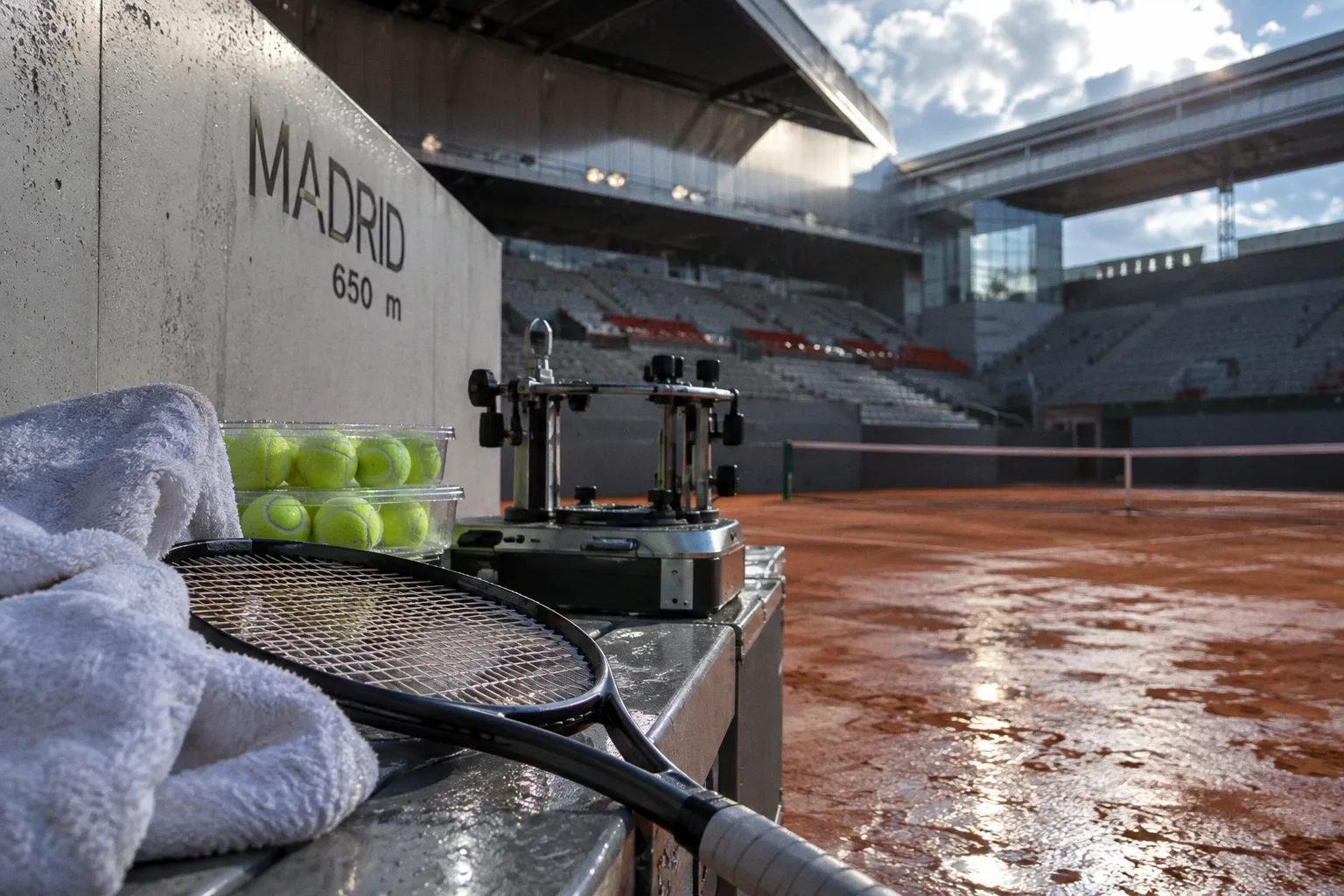
That difference is not a footnote in the tournament guide — it is the first physical fact behind Madrid’s distinctive speed.
At altitude, the air is thinner and offers less drag. The ball moves through it with less resistance, arrives sooner, and tends to rebound higher. Madrid’s comparatively dry conditions reinforce that effect, while the venue’s retractable roofs can remove wind and ambient moisture altogether when they are closed. The result is a clay court that retains the familiar sliding and abrasion of the surface but gives greater assistance to the first strike, the serve, and the flatter groundstroke.
This is why Madrid often feels less like a slow examination of patience and more like a compressed contest of timing. The rallies are still built on clay-court principles, but the court gives aggressive players a narrower window in which to dictate — and a greater reward when they do.
The altitude is the central difference
The simplest answer to why Madrid Open clay plays so fast is also the most important: the tournament is played high above the conditions associated with most major European clay events.
The altitude of La Caja Mágica changes the air through which every serve, return, forehand, and defensive lob must travel. At sea level, the ball encounters denser air and loses more energy as it moves. In Madrid, reduced atmospheric drag allows it to travel more freely. The difference is not that the clay suddenly becomes a hard court, nor that Madrid’s red surface is made from some fundamentally different substance. The ball is moving faster because the environment around the court is different.
That distinction matters. Discussions of court speed often become too attached to the surface itself, as if a tournament can be understood by naming the material under the players’ shoes. On clay, however, the interaction between surface, air, temperature, humidity, and ball behaviour is unusually visible. A ball can still grip and mark the court while moving through the air with a speed that changes the shape of the point.
Madrid’s elevation is dramatically higher than that of its main clay-season comparisons:
| Tournament | Approximate venue altitude | What the altitude means for play |
|---|---|---|
| Mutua Madrid Open | 650–657 metres | Thinner air, less drag, faster flight, higher bounce |
| Italian Open, Rome | About 25 metres | Denser sea-level air, more resistance and a heavier-feeling flight |
| Roland Garros, Paris | About 40 metres | Sea-level clay conditions with greater atmospheric drag |
| Monte-Carlo Masters | About 19 metres | Low-altitude conditions, with the ball generally travelling through denser air |
These numbers do not produce an identical match every year, because weather and court preparation still matter. They do, however, establish the atmospheric baseline. Madrid begins with a physical advantage for speed before a player has struck a single ball.
Madrid’s clay is not fast because it has stopped being clay; it is fast because clay is being played in thinner air.
Why the ball feels different even when the court looks familiar
A tennis court can look almost unchanged from one tournament to the next — the same red colour, the same white lines, the same sliding footwork — while the ball behaves with a different kind of tension. In Madrid, the first visible clue is often the bounce.
The higher bounce comes from the same broad combination of altitude and atmospheric conditions that accelerates the ball in flight. The ball arrives with more pace, and after contact with the court it rises into a more comfortable striking zone for players who can take it early or attack from above the shoulder. That can help powerful forehands, especially when they are struck with a relatively flat trajectory rather than a very high, looping arc.
On traditional sea-level clay, a heavy topspin ball can spend more time in the opponent’s court and in the opponent’s calculations. The surface slows the exchange, the air adds resistance, and the point often develops through several changes of height and direction. In Madrid, the same ball may travel deeper and arrive with greater urgency. A player who is standing a step too far back can find that the court has not merely offered the opponent more pace — it has shortened the time available to respond.
This changes the value of several technical qualities:
- Serve placement becomes more damaging. The serve does not need to be an unreturnable missile to create advantage. A well-placed delivery can reach the returner with enough speed to produce a short reply.
- First-ball aggression carries more weight. The forehand after the serve, or the first backhand taken inside the baseline, can determine the geometry of the rally before the clay has had time to slow it down.
- Flat hitting becomes more practical. Lower-margin strokes remain dangerous, but the altitude can make a firm, direct ball more effective than it would be in heavier sea-level conditions.
- Depth matters immediately. A ball that lands near the baseline and rises high can push the opponent away from the court, opening space for the next shot.
- Defensive time is reduced. Clay still permits recovery and sliding, but the defender may have less time to turn a stretched position into a neutral one.
This is why Madrid can reward players whose usual advantage comes from power, serve quality, and early contact. It does not erase the importance of movement or spin — those remain central to any clay-court match — but it changes the exchange rate between defence and attack.
Madrid versus Rome and Paris: the same season, different pressure
The contrast with Rome and Paris is not simply that Madrid is quicker and the other tournaments are slower. The more useful distinction is how each environment distributes time.
In Rome, the low-altitude atmosphere gives the ball more resistance. A heavy forehand can lose some of its pace as it crosses the court, and a defender may have a fraction more time to read the direction, set the feet, and absorb the shot. The bounce remains important, but the rally often carries a greater sense of weight. Players can work through patterns with more visible patience — changing height, testing the backhand, drawing the opponent wide, and waiting for the opening to appear.
Paris, while not identical to Rome, belongs to the same broad physical family. Roland Garros is also close to sea level, and the ball does not receive Madrid’s atmospheric assistance. The court rewards construction: depth, spin, balance, and the ability to remain composed through long passages in which the winner is not yet available. A powerful shot can still dominate, but the attacker must often create the opening more carefully.
Madrid compresses that process. The aggressive player can reach the decisive phase earlier because the ball holds more of its speed. A return that would normally begin a long neutral exchange may become an immediate counterattack. A forehand directed into the open court may arrive before the opponent has completed recovery. A short ball is punished not only because it is short, but because the altitude helps the attacking stroke travel through the court with less loss.
The difference is particularly visible in the relationship between serve and return. On slower clay, even a strong first serve may lead into a point that still requires patient construction. In Madrid, the serve can function more like the opening blow on a faster surface. It may create a weaker return, and the next shot can then be struck from a position that would not be available so consistently in Rome or Paris.
But the conditions do not simply favour one style in every match. A player who relies on extreme topspin may find that the higher bounce gives the ball more discomfort for the opponent — especially on the backhand side — while the faster flight increases the reward for that shape. A defender with exceptional anticipation can also benefit, because reading the point early becomes more valuable when the ball is travelling quickly. Madrid is not a tournament without rallies. It is a tournament in which the cost of being late is higher.
The court surface still matters — just not by itself
There is a temptation to describe Madrid as a fast clay court and leave the explanation there. That label is useful, but incomplete. The speed is produced by a compound environment: red clay, altitude, air density, moisture, temperature, wind, roof position, and the way players arrive from one tournament to the next.
The clay still creates friction underfoot and beneath the ball. Players slide into the shot, recover through a controlled braking movement, and use the surface to shape angles that would be more difficult on grass or a hard court. The ball still leaves a mark, still grips the court in a way that affects spin, and still asks players to move with a different rhythm from the one demanded by faster hard courts.
What changes is the balance between that surface friction and the air above it.
The surface can slow the ball after the bounce, but the thinner air allows the ball to reach the bounce more quickly and with greater residual energy. A player therefore experiences two competing physical messages at once: the feet are negotiating clay, while the ball is behaving with unusual urgency. That combination is one reason Madrid feels distinctive rather than simply fast.
The venue itself adds another layer. La Caja Mágica’s retractable roofs can remove wind and ambient moisture when closed. Wind introduces uncertainty — it alters the ball’s path, disrupts timing, and can reward players who manage changing conditions rather than simply striking harder. Moisture can make the air feel heavier and the court play more slowly. When the roof closes, some of that atmospheric resistance disappears, and the match can become cleaner, quicker, and more direct.
This does not mean every roof-closed match follows the same pattern. Temperature, ball condition, court preparation, and the timing of the session all remain relevant. It does mean that Madrid has an architectural mechanism capable of reducing some of the natural friction around the court. The stadium is not a neutral shell. It can help define the conditions in which the match unfolds.
How players adjust their equipment and tactics
Professional players do not approach Madrid as if they were arriving at an interchangeable clay tournament. The environment changes the margin between a controlled strike and a ball that runs away from the player, so equipment and preparation become part of the tactical response.
One common adjustment is string tension. Players routinely increase tension in Madrid to regain control in thinner air. The purpose is not to make the racquet universally more powerful or more precise; it is to prevent the faster conditions from turning a full swing into an unpredictable launch. Higher tension can help a player keep the ball inside the intended trajectory when the court is already supplying additional pace.
The correct adjustment depends on the player’s racquet, string, swing speed, spin production, and normal contact point. There is no single Madrid setting that applies to an entire field. A naturally flat hitter may need more help containing the ball, while a heavy topspin player may be more concerned with preserving shape without allowing the bounce to become too high or too long.
Tactically, the most useful adaptations are often visible from the opening games:
1. Return positions become more deliberate. Standing too far back can surrender the advantage of Madrid’s speed, but standing too close can leave the returner exposed to the high bounce and rushed contact. The best position depends on whether the player intends to block, swing, or take the ball on the rise.
2. The first two shots gain importance. Serve-plus-one patterns and return-plus-one patterns are particularly valuable because a small advantage in timing can become a large positional advantage by the next exchange.
3. Defensive height must be chosen carefully. A high ball can buy time, but in Madrid it may also sit in the opponent’s preferred strike zone. The defender has to distinguish between a ball that resets the rally and one that merely offers a comfortable attack.
4. Depth is often safer than raw angle. The faster air can make an aggressive angle tempting, but a deep ball that reaches the back of the court may create more pressure with less risk.
5. Short balls are punished sooner. On slower clay, a player may occasionally survive a ball that lands short because the opponent needs another shot to finish the pattern. In Madrid, the attacking player can often take the ball earlier and strike through the opening.
6. Movement must account for the bounce, not only the speed. Players who retreat expecting a low, slow clay-court trajectory may find the ball rising into their body. The adjustment is not simply to move faster, but to read the height earlier.
These are not separate tricks. They are responses to the same physical fact: Madrid reduces the time available for a player to move from recognition to decision to contact.
In Madrid, the clay still asks you to slide, but the air asks you to decide sooner.
Why big servers and flat hitters can gain more than usual
Clay has traditionally been described as a surface that diminishes the serve. The returner has more time, the ball loses pace, and the server must usually build the point rather than end it immediately. Madrid complicates that familiar account.
A serve at 650–657 metres above sea level travels through thinner air, and the reduction in drag can increase its practical effect. The serve may not become more reliable simply because it is faster; speed without placement can still be returned. But a delivery directed toward the body, the outside corner, or the backhand side can create a more difficult first contact than it would in Rome or Paris.
Big servers benefit because their strongest weapon retains more of its force. Flat hitters benefit because the ball can move through the court before the opponent has time to turn the point into a long defensive sequence. Players who take the ball early also gain an advantage, since the higher bounce can be met at a comfortable height while the opponent is still trying to recover.
The conditions can therefore narrow the stylistic gap between a clay specialist and an aggressive all-court player. A traditional clay-court expert may still own the superior sliding technique, patience, and point construction, but the high-altitude setting gives the attacker more chances to prevent those strengths from taking over. Instead of being drawn into a long sequence of heavy exchanges, the clay specialist may be forced to defend the first strike more often.
That is not the same as saying Madrid favours only power. A player who can combine spin with depth, absorb pace, and change direction early may be even more effective than a pure hitter. The best Madrid competitors tend to understand that acceleration must be attached to structure. A fast ball without margin is still a liability. The court offers speed, but it does not remove the need for judgment.
The roof, the weather, and the changing feel of the session
Madrid’s physical identity can shift within the same tournament because weather conditions are part of the court.
A dry day generally supports a faster ball flight and a more immediate bounce. Wind can interrupt that rhythm, adding movement and uncertainty that make clean striking more difficult. Moisture, whether in the air or on the playing environment, can reduce the sense of lightness around the ball. Under a closed retractable roof, the match may lose some of the wind and ambient moisture that would otherwise complicate the trajectory.
This makes session-to-session comparison difficult. A night match under a roof should not automatically be treated as equivalent to an afternoon match played in open air. The tournament’s altitude remains constant, but the atmospheric density experienced by the players is not the whole story. The court’s sensory and tactical identity comes from the interaction of multiple conditions.
For viewers, the difference can sometimes be recognised in the rhythm of the points. When the court is playing quickly, the returner appears to have less time even when the serve is not enormous. The ball reaches the baseline before the defender is fully organised. A rally that begins with conventional clay-court shape suddenly becomes a contest of compact swings and early contact.
When the conditions are more complicated, the point may slow without becoming genuinely slow. Players take more care with height and margin. The wind can make a flat ball less dependable, while a heavy spin trajectory may provide greater security. The match becomes less about raw acceleration and more about choosing when acceleration is possible.
That is one of the pleasures of watching Madrid closely. The tournament does not present speed as a fixed number. It presents speed as an atmosphere — something that can be felt in the timing of the return, the height of the bounce, the space between the ball and the lines, and the amount of court a player can safely give away.
Madrid’s place in the clay-court calendar
The Madrid Open’s position in the European clay season gives its conditions particular significance. Players are not encountering high-altitude clay in isolation; they are moving between tournaments whose surfaces look similar but whose physical demands can be sharply different.
A competitor who has developed a successful rhythm in Monte-Carlo or Rome may arrive in Madrid and discover that the same swing produces a different ball. The forehand may travel deeper. The serve may earn more free points. The defensive lob may not create as much time. The player’s contact point, return position, and string tension all become part of a broader process of recalibration.
Then comes the reverse adjustment. A player who has found a clean, aggressive pattern in Madrid must later return to conditions in which the ball moves through denser air and the opponent has more time to defend. The lesson learned in Madrid cannot simply be carried unchanged into Paris. Timing, height, and patience need to be redistributed.
This is why surface labels are most useful when treated as beginnings rather than conclusions. Saying that Madrid is clay tells us about movement, friction, and the possibility of sliding. Saying that it is high-altitude clay tells us why those features coexist with a faster ball, a higher bounce, and greater rewards for early aggression.
The tournament’s history at La Caja Mágica, where the Madrid Open moved in 2009, is inseparable from that setting. The venue gave the event a permanent physical character — not merely a place to host matches, but a court environment that players have had to learn as part of the modern clay calendar.
What to watch when comparing Madrid with Rome or Paris
The clearest way to understand the Madrid versus Rome clay conditions is to watch for the moments when the atmosphere changes the player’s available choices.
Look first at the return. Does the returner have time to swing fully, or is the contact becoming a compact defensive block? Does a serve that appears manageable still create a short reply? Does the returner stand far behind the baseline and use time, or move forward to prevent the server from owning the next ball?
Then watch the height of the exchange. In Paris and Rome, a heavy topspin rally can push both players into a pattern of depth, recovery, and gradual pressure. In Madrid, the bounce may rise more sharply, but the ball also gets to the striking zone sooner. The player who takes it early can turn the height into an advantage; the player who waits may find the same bounce awkward and rushed.
Finally, pay attention to the third shot. The third shot often reveals the tournament’s true speed better than the serve itself. If the server can step into a forehand and attack immediately, Madrid is doing much of its work through the thinner air. If the returner can redirect the first ball and take control, the match may still be governed by clay-court construction — but under a faster clock.
A useful viewing guide is to track these details:
- how far behind the baseline the returner stands;
- whether the server can attack with the first forehand;
- how often players take the ball on the rise;
- whether defensive lobs create time or sit up for a strike;
- how much topspin is needed to keep the ball deep;
- whether the roof or wind is changing the reliability of flat shots;
- how quickly a neutral rally becomes an attacking pattern.
These observations reveal more than a general impression that Madrid is quick. They show precisely where the extra speed enters the point.
The answer, without reducing the court to one number
Madrid clay plays faster than Rome and Paris primarily because of altitude. At roughly 650–657 metres above sea level, La Caja Mágica gives the ball thinner air, less atmospheric drag, a quicker flight, and a higher bounce. The dry climate can reinforce that behaviour, while the retractable roofs can remove wind and ambient moisture when closed.
The clay itself remains clay. Players still slide, shape points with spin, and rely on the surface for movement and recovery. But the surrounding atmosphere changes how much time those clay-court habits have to operate. Serve and return become more urgent, flat hitting becomes more valuable, and the first attacking ball can carry greater consequence.
That is the real character of Madrid: not a clay court pretending to be something else, but a clay court placed in conditions that reveal how deeply tennis depends on the air above the surface. At Roland Garros and in Rome, the ball must work harder to cross the court. In Madrid, it arrives with more of its tension intact — and every player must decide what to do with that extra speed before the court has time to soften it.