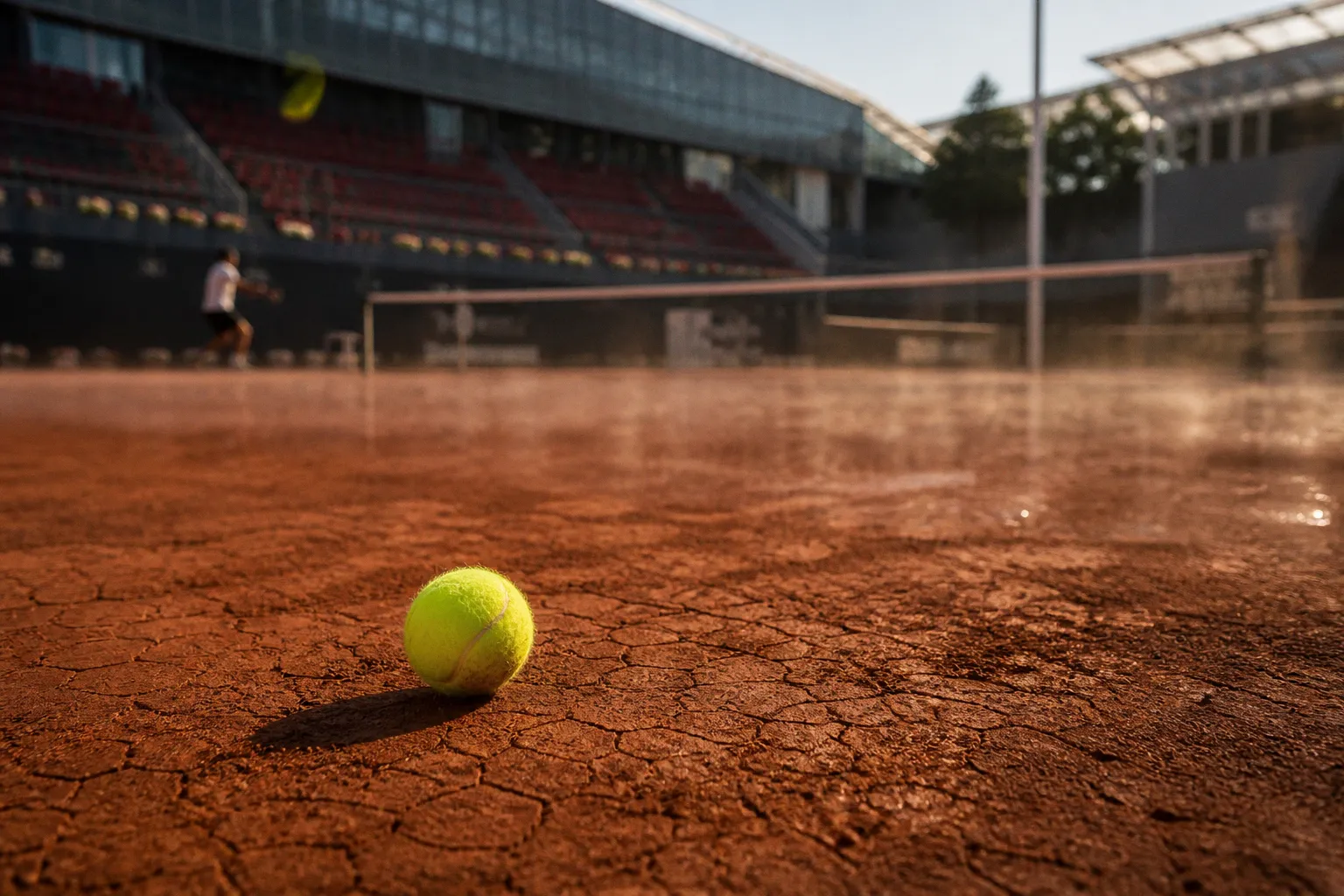
It appears in the ball’s passage through the air — in the reduced drag, the quicker travel, and the higher, more urgent bounce after contact with the red surface.
That is the central madrid clay court altitude effect: Madrid remains clay, but it is not the same clay-court problem found at Monte Carlo or Roland Garros. The surface still rewards balance, rotation, and the ability to defend from deep behind the baseline, yet the altitude changes the time available to do those things. A player who arrives expecting the long, patient geometry of traditional European clay may discover that the first two shots have already decided the shape of the point.
The physics of the Caja Mágica: why 667 metres changes everything
The Mutua Madrid Open is played at the Caja Mágica, in a city whose elevation places it well above the other great clay destinations on the calendar. Monte Carlo sits at roughly 19 metres above sea level; Roland Garros is also close to sea level by comparison. Madrid’s courts therefore occupy a different atmospheric setting before a player has struck a single ball.
At higher elevation, air density is lower. A tennis ball moving through thinner air encounters less resistance, which allows it to travel more quickly and retain more of its pace. The effect is especially visible on serves, flat forehands, and aggressive returns — shots that arrive with less of the atmospheric braking players are accustomed to elsewhere.
The ball also tends to jump higher after landing. That higher rebound is not simply a gift to the server or the attacker; it changes the height at which the opponent must make contact, and therefore changes the technical demands of the next shot. A heavy topspin forehand can rise into a particularly uncomfortable zone, while a flatter strike may penetrate the court before a defender has time to settle.
The Madrid open tennis conditions are therefore a combination of surface and atmosphere. Clay supplies friction under the player’s feet and slows the ball after the bounce, but altitude partially offsets the traditional slowness of the surface. The result is a court that can look familiar from the stands while behaving with a sharper, more elastic rhythm.
That distinction matters because the tactical identity of clay is often described too broadly. Clay is not one speed, one bounce, or one style. Its character depends on the composition and moisture of the court, the weather, the ball, the altitude, and the way those elements interact with a player’s technique. Madrid belongs to the clay-court family, but it is one of its more restless members.
Madrid does not remove the clay-court battle — it compresses it, giving the first strike more authority and the defender less time to recover.
The altitude should not be exaggerated into an alpine endurance story. The significant change is aerodynamic: the ball moves differently, and its trajectory asks different questions. The physical effort of playing a best-of-three or best-of-five match remains considerable, but the defining adjustment is not that players suddenly struggle to breathe. It is that the ball reaches them sooner, rises differently, and can escape the strings with more force.
Equipment adjustments: managing power before it becomes disorder
At sea level, a player may be able to swing freely and rely on the air, the court, and the spin of the ball to keep an aggressive game within acceptable margins. In Madrid, that same setup can become difficult to manage. A forehand that normally drops inside the baseline may carry long. A serve that usually curves into the body may travel through the service box with less shape than intended. A return struck with a full swing can become an invitation rather than a response.
This is where equipment becomes part of tactics rather than a separate technical conversation. Players may adjust string tension to gain greater control in the faster conditions. Increasing tension can reduce the trampoline effect of the string bed, helping an aggressive player keep the ball from launching too freely. It does not make the racket powerful or powerless in isolation; it changes how predictable the response feels at the point of contact.
The adjustment is never universal. A player who depends on easy depth may not want to take too much life out of the racket. Someone who generates enormous racquet-head speed and heavy rotation may prefer a firmer response, while another player may preserve a lower tension because the extra pocketing helps create shape and margin. The meaningful question is not whether higher tension is inherently better, but whether the racket gives the player a controllable relationship with the Madrid ball.
Several equipment decisions can sit inside that relationship:
- String tension: A firmer string bed can help contain shots that otherwise fly through the court, particularly for players who already produce substantial pace.
- String profile and material: The way a string grips and releases the ball affects spin, launch angle, and directional control. At altitude, a small change in launch behaviour can become tactically significant.
- Racket weight and balance: Stability matters when the ball arrives quickly, especially on blocked returns and defensive contact taken close to the body.
- Ball management: Players must learn during practice how much the ball accelerates off their own strings and how sharply it rises after the bounce, rather than relying only on expectations formed at previous tournaments.
The important point is that equipment cannot rescue a confused game plan. A player may tighten the strings and still lose control if the swing remains designed for slower, more forgiving exchanges. The racket can moderate the conditions, but it cannot remove them.
Madrid rewards a setup that lets a player strike decisively without turning every attack into a gamble. That balance is delicate. Too much control can leave the ball short, allowing an opponent to step forward and use the altitude against them. Too much free power can produce a match filled with unforced errors, each one amplified by the speed of the court.
The death of the grind — or the reinvention of the clay-court rally
The old image of clay-court tennis is built around attrition: heavy spin, long exchanges, repeated changes of direction, and the patient construction of an opening. Those elements remain present in Madrid, but the conditions make the traditional twenty-shot rally less necessary and sometimes less available.
A point can still become a physical examination. A defender who absorbs the first attack may force the opponent to hit one more ball, and one more after that. Yet the value of the opening strike is greater. A strong serve followed by a forehand, or a deep return followed by an immediate step inside the baseline, can establish control before the rally develops its familiar clay-court length.
This changes the meaning of patience. In slower conditions, patience may mean accepting a long exchange and waiting for the opponent’s shape to deteriorate. In Madrid, patience can mean resisting the temptation to overhit the first ball while still recognising that delay has a cost. The player must be patient within a shorter tactical window.
The high altitude clay court tactics that emerge from this environment are not simply a collection of aggressive gestures. They are built around timing:
1. Protect the first contact.
The serve and return become even more valuable because a fast ball can produce a weak reply before either player has established a rhythm. A returner who blocks the ball deep may gain more than one who searches immediately for a spectacular angle.
2. Take the ball before it rises too far.
The bounce can climb into a difficult hitting zone, particularly when an opponent uses heavy topspin. Moving forward and contacting the ball earlier can prevent the rally from becoming a series of defensive shoulder-height swings.
3. Use height with purpose.
A high, spinning ball is not automatically defensive. In Madrid, it can push an opponent backward and create space, but the player must understand that the resulting reply may also travel faster. Height is a tool for changing court position, not a guarantee of safety.
4. Change direction only when the court is open.
Because the ball moves quickly, a cross-court exchange can suddenly turn into a down-the-line opportunity. But the same speed makes a poorly chosen change of direction expensive. The attacker has less time to recover if the shot misses its intended depth.
5. Recover for the next strike, not merely the last one.
On clay, sliding recovery has always been central. In Madrid, the player must recover with particular economy because the next ball may arrive before the body has fully reset. A technically beautiful slide that leaves the player upright but late is still a tactical failure.
This is why the phrase “fast clay” can be misleading. Madrid does not become a hard court painted red. The player still needs the movement patterns of clay — the ability to decelerate, slide, open the hips, and defend through awkward positions. What changes is the time available to use those skills.
A long rally in Madrid can feel different from a long rally in Paris. There may be fewer exchanges, but each exchange carries more consequence. The ball is not merely being returned; it is being managed before its pace and rebound force the next decision.
Reading the Caja Mágica court speed from the baseline
Court speed is often discussed as if it were a fixed property, like the dimensions of the court. In practice, it is a lived condition. The same surface can feel different depending on the weather, the ball, the hour of the match, and the style of the two players.
At the Caja Mágica, the altitude gives the ball a faster passage through the air, while the clay continues to create a sliding, abrasive relationship between the player and the court. A player’s first task is to separate those two sensations. The ball may be moving quickly even when the feet are negotiating friction. The court may offer enough grip for a controlled slide while the bounce still launches the ball beyond the comfortable strike zone.
That is where the architecture of movement becomes visible. A player standing too far behind the baseline may have enough time to see the ball but not enough authority over the point. By the time the ball reaches the preferred contact height, the opponent has recovered and the opening has closed. A player standing too close may take the ball early but expose the body to a higher level of risk, particularly against topspin that jumps into the chest or shoulder.
The ideal position is not a single line on the court. It shifts with the opponent’s serve, the height of the bounce, and the quality of the player’s own contact. Against a heavy server, a returner may need to shorten the swing and prioritise a compact block. Against a player who relies on spin and shape, stepping forward can prevent the ball from becoming unmanageable. Against a flat hitter, the higher Madrid bounce can sometimes create an opportunity to redirect pace rather than manufacture it.
The tactical reading can be organised around a few practical contrasts:
| Match condition | Likely tactical demand | Common danger |
|---|---|---|
| Fast serve through the court | Compact return, early preparation, immediate recovery | Overswinging and leaving the return short |
| High topspin bounce | Earlier contact or controlled retreat | Taking the ball late at an uncomfortable height |
| Aggressive first forehand | Protect the open court and anticipate the next direction | Winning the first exchange but losing the recovery |
| Long cross-court exchange | Change height and position before changing direction | Forcing a low-percentage line too soon |
| Defensive phase | Use depth and shape to buy time | Assuming a high ball is safe merely because it is high |
This is also why practice sessions in Madrid matter so much. Players are not only calibrating their strokes; they are building a new sense of distance. The ball reaches the back of the court with a different urgency. The bounce occupies a different vertical space. The contact point that felt natural in Monte Carlo may feel late in Madrid, while a swing that was too conservative elsewhere may suddenly become effective.
The Madrid baseline is not a place to stand; it is a moving negotiation between bounce height, air resistance, and the next shot.
The blue clay legacy: when visibility could not compensate for instability
Madrid’s relationship with court conditions has a particularly memorable chapter. In 2012, the tournament introduced blue clay courts, an experiment that was intended to improve visual contrast for television and spectators. The colour was striking, but the surface drew severe criticism from leading players, including Rafael Nadal and Novak Djokovic, who objected to its unusual slipperiness.
The controversy was not about aesthetics alone. On clay, movement is inseparable from trust. Players need to know how the foot will engage with the surface when they plant for a forehand, brake before a wide ball, or slide into a defensive position. If the court does not provide a reliable relationship between shoe and clay, the entire tactical structure becomes unstable.
A player can tolerate a fast court. A player can adapt to a high bounce. What becomes much more difficult is a surface that changes the expected result of ordinary movement. The issue is not merely that one might slip; it is that hesitation enters every step before the slip occurs. The body begins to protect itself, and that protection arrives as shorter strides, delayed preparation, and less commitment to the ball.
The blue-clay episode remains relevant because it demonstrates how many layers make up a tournament’s identity. Surface colour is visible, but surface behaviour is decisive. A court’s prestige does not exempt it from practical scrutiny, and innovation in tennis has to survive the physical demands of the players who use it.
Madrid returned to red clay, but the lesson endured. A court is not defined only by its material label. It is defined by the confidence it gives the athlete — by whether the player can move with intent, trust the bounce, and release the racket without wondering whether the ground will answer as expected.
Why Madrid favours the aggressive server
The conditions at altitude do not guarantee victory for a big server, and clay still offers a strong returner opportunities to extend the point. But the environment increases the value of serve-led patterns. A well-placed serve can travel with greater urgency, and the next forehand may arrive before the returner has established a stable defensive position.
The advantage is most pronounced when the server understands placement rather than relying only on speed. A wide serve can pull the returner away from the court; a body serve can jam the compact swing required in fast conditions; a serve into the backhand can create a predictable reply for the first attacking forehand. The point is not to finish immediately. It is to make the first response increasingly narrow.
For the returner, the answer is often not to attack every second serve or chase a perfect block. It is to deny the server an easy pattern. That may mean returning through the middle to reduce angles, accepting a less aggressive contact in exchange for depth, or taking the ball early enough to prevent the server from stepping forward. A return that looks modest on the scoreboard can be tactically excellent if it keeps the server from receiving the next ball at full comfort.
This is where Madrid’s court speed separates aggressive players who understand risk from those who merely increase force. The successful attacker does not confuse fast conditions with permission to swing at everything. They use the environment to shorten the point selectively — serve, return, first forehand, forward movement — while preserving enough margin to survive the occasional defensive exchange.
The best Madrid patterns often have a compressed elegance. There is less time between intention and consequence. A player serves to the body, receives a floating return, and strikes into the open court before the rally has acquired its usual clay-court depth. Or a returner blocks a heavy serve down the middle, absorbs the first forehand, and then uses the opponent’s hurried recovery to turn defence into offence.
That is why the tournament can reveal a slightly different version of a clay-court specialist. A player accustomed to winning through accumulation must learn to close space earlier. A powerful attacker must learn to control the additional pace. A defender must decide whether retreat creates time or simply gives the opponent a larger target.
The Madrid Open altitude does not erase the history of clay tennis. It edits its timing. It asks players to carry the discipline of the surface into an atmosphere that rewards earlier decisions, sharper preparation, and greater respect for the first two shots.
Madrid remains a tournament of friction — between shoe and clay, racket and ball, patience and urgency. Its elevation gives that friction a faster pulse. The players who adapt best are not necessarily those who hit the hardest or stand the farthest forward, but those who understand exactly when the court has offered them time, and when it has already taken it away.