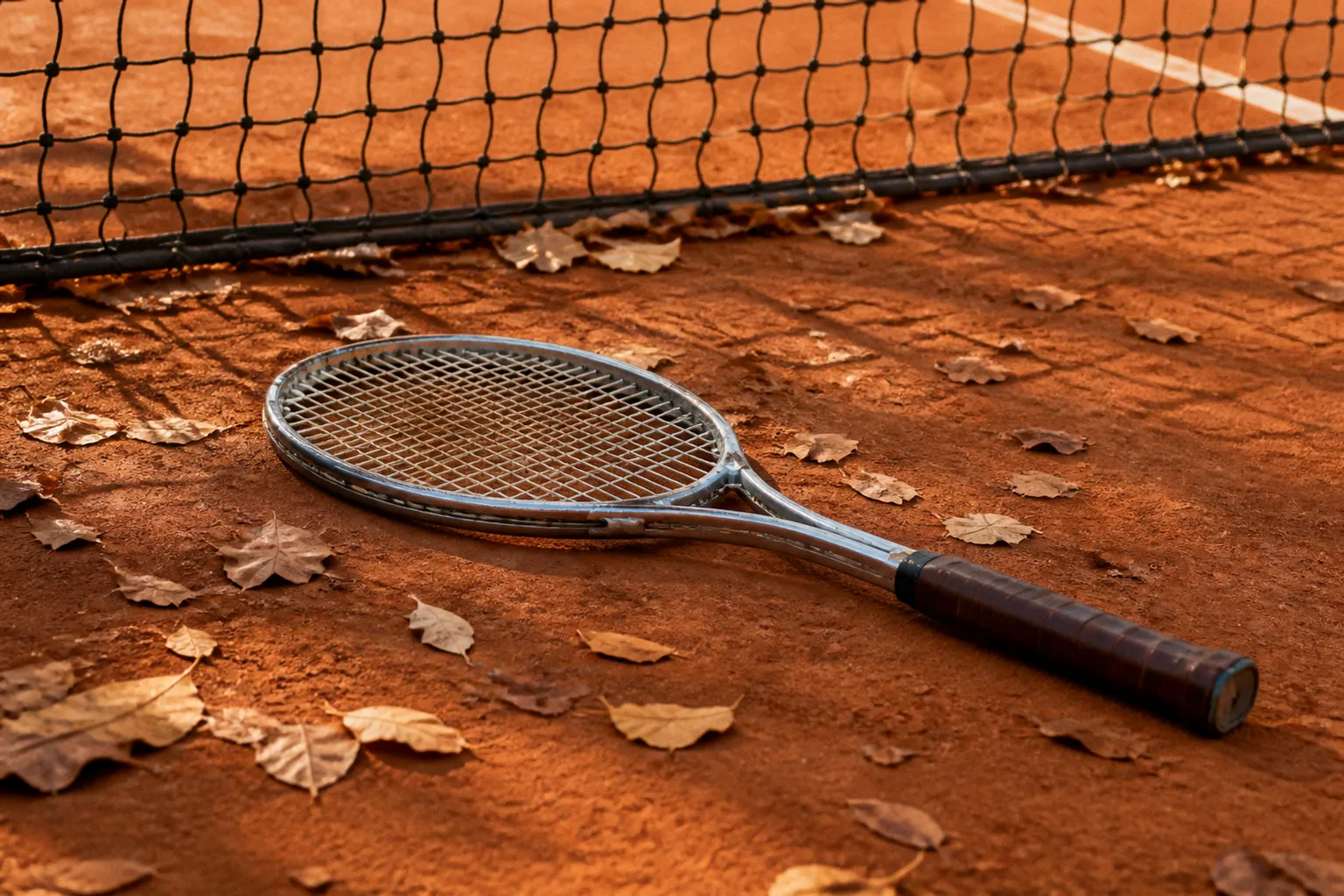
For eighteen years, Jimmy Connors wielded a steel frame through one of the most dramatic equipment revolutions in tennis history, and the cost of that stubbornness is the kind of question the sport still will not answer cleanly.
This is not a story about a racket that failed. It is a story about a man who refused to let a tool that defined him become a relic — even when everyone else on tour had already conceded that the metal age was over.
The easy version of the story is that Connors was loyal. The more interesting version is that loyalty became a competitive philosophy. The T2000 did not merely sit in his hand; it told him what kind of player he was allowed to be. Small-headed, unforgiving, loud on contact, and incapable of hiding a technical mistake, it made every clean strike feel like an act of will. Connors did not ask the racket to make the game easier. He asked it to make the game honest.
The Lacoste Patent: Engineering the Metal Revolution
The mythology credits Jimmy Connors with the T2000 the way people credit their grandfather with a family business he merely inherited. He did not build it. He did not even find it. The steel frame was the engineering brainchild of René Lacoste — the French champion from the 1920s whose crocodile-logo polo shirt, born from a friend’s offhand bet, became one of the most durable fashion brands on earth.
The same Lacoste, decades later and now working as an inventor, developed the design in the early 1960s and patented a metallic racket frame. He licensed that design to Wilson. Wilson launched the T2000 in September 1967.
That timeline matters. The T2000 was not an idea that appeared suddenly and rushed from the patent office onto the professional circuit in a matter of weeks. Lacoste had been developing the concept years before Wilson put the model into production. The racket arrived in 1967 as the commercial expression of an engineering project that had already taken shape.
The distinction may sound minor, but equipment history is full of myths created by compressed timelines. A new racket is rarely born on the day a company announces it. Materials have to be tested, manufacturing problems solved, and a design made repeatable enough to survive outside a workshop. The T2000 represented a gradual move away from the assumptions built into traditional wooden frames.
That transition mattered because metal was not simply a new material. It changed what a racket could be. Wood frames had shaped the visual and physical grammar of tennis for generations: layered construction, narrow heads, familiar flex, and a relationship between frame and stringbed that players learned almost by inheritance. Lacoste’s design challenged that grammar with a hollow steel structure and a distinctive stringing system. The racket was not trying to imitate wood more efficiently. It was offering another idea of stability, impact, and control.
The irony here is rich, and worth sitting with: the American who made the T2000 his signature weapon was swinging a frame designed by a French champion who played his tennis in flannels a generation earlier. Connors turned the racket into an attitude. But the architecture — the thin, harsh, percussive feedback, the sound of steel on ball — was somebody else’s idea of how the game should feel.
Billie Jean King got there first, in the literal sense. She became the first player to win a Grand Slam title with a metal racket, taking the 1967 U.S. Championships with the T2000 in her hands. Connors was still a teenager at the time, somewhere in the Midwest working on the groundstrokes that would later carry him to the top of the game. He was watching, even if he did not yet know what he was watching.
The T2000 was therefore already a proven professional instrument when Connors made it his own. He did not discover a secret model hidden in a shop. He took a racket with a specific engineering identity and supplied the part no patent could create: a recognisable human style.
That distinction matters. Equipment history is often told as if players simply select the best available tool and then reveal its potential. In reality, the relationship runs both ways. A racket can encourage a certain swing, reward a certain contact point, and narrow the range of errors a player is willing to tolerate. Connors was not just using the T2000. Over time, he and the racket became a single technical problem that he had solved better than anyone else.
1974 and the Zenith of the Steel Frame
By the time Connors arrived on tour, the T2000 had done the work of becoming legitimate. He did not adopt a novelty. He adopted a weapon and made it his personality.
The 1974 season is the kind of year statisticians print on T-shirts. Connors won three of the four majors — the Australian Open, Wimbledon, and the U.S. Open — and posted a match record of 93–4 across the calendar. He did it with a frame most of his contemporaries had already abandoned or never picked up. The T2000, in his hands, was not a tennis racket. It was a thesis: I will outwork you, outhit you, and outlast you, and what equipment I am using is none of your business.
The T2000 was not a tennis racket in Connors’ hands. It was a thesis — and he wrote it with every shot.
There is a temptation, in tennis writing, to treat this as heroic. It is more useful — and more accurate — to treat it as psychological. Connors did not have Borg’s topspin. He did not have McEnroe’s touch at the net. He did not have Vilas’s grinding left-handed consistency. What he had was a racket whose small 70-square-inch head demanded precision, and a temperament that converted that demand into a controlled, almost gleeful violence.
The steel punished errors the way an older relative punishes them — immediately, silently, and with no forgiveness. Connors, who never much cared about being forgiven anyway, flourished inside that feedback loop.
His game was built around taking time away. He struck early, redirected pace, and made contact with the kind of abbreviated conviction that left little room for decorative movement. The T2000 suited that temperament because it did not invite a long conversation with the ball. It rewarded the player who arrived on time and paid for every lapse.
There was also a visual advantage to the partnership, even if visual advantage is not something that appears in a racket specification. Connors’ strokes looked compressed and violent. The T2000 looked narrow, metallic, almost unfinished beside the larger frames that would soon dominate the sport. Together they created an image of resistance: the player who seemed to be hitting through the racket rather than merely with it.
The connection between player and frame became especially powerful because Connors won so much with it. A less successful player might have been told that the racket was limiting him. Connors had the results to turn limitation into evidence of superiority. Every victory seemed to confirm that he had understood something the rest of the tour had missed.
But success can trap a player inside a method. When a racket helps produce a defining style, changing it is not like changing shoes or adjusting string tension. It means disturbing the timing, the sound, the physical expectations of impact, and perhaps the private explanation a player has for his own success. The T2000 had become part of Connors’ answer to the question of why he won.
That is why the phrase “Connors steel racket transition” describes more than a change in equipment. It describes a change in the relationship between a champion and the explanation he had built around himself. The frame was part of the story he told through his tennis: no concessions, no easy power, no request for permission.
The Anatomy of a Relic: 70 Square Inches of Wire and Steel
Let’s get technical for a moment, because the T2000’s engineering is genuinely stranger than most fans realise.
The defining feature was its external wire string-anchor system. Where a conventional racket holds its strings within the frame itself — throat, head, integrated yoke — the T2000 strung its strings to a separate loop of wire running around the perimeter. The result was a stringbed that responded like almost nothing else on tour: a rigid metal frame, a more flexible string plane, and a feedback loop that old players remember as immediate and distinctive.
The wire system was not a decorative flourish. It was central to the racket’s identity. It helped separate the sensation of the strings from the sensation of the frame, producing a combination that could feel both harsh and unusually communicative. The player received information quickly: centre contact, edge contact, late contact, framed contact. The racket did not blur those categories for comfort.
You always knew, frame by frame, where the ball had been on the stringbed. The T2000 told you the truth about your own shot.
That truth was not always pleasant. A modern oversized frame can give a player a little forgiveness at the edge of the hitting area. The T2000 gave much less of it. The centre of the racket remained the place where the frame made sense; outside it, the player felt the cost immediately in the hand and heard it in the contact. A mishit was not softened into a merely imperfect ball. It announced itself.
The 70-square-inch head was the other number that mattered. Small even by mid-1970s standards. Already on the wrong side of history by 1980. By the time Wilson discontinued the T2000 in 1984 — after selling roughly two million units across its production lifecycle — the head size alone made the frame a curio. Modern graphite rackets were moving through larger head dimensions, and the launch angles and forgiveness they produced were reshaping baseline tennis from the ground up.
The comparison was not simply between steel and graphite. It was between two different ideas of what a player should be allowed to get away with.
| Parameter | Wilson T2000 | Emerging graphite frames |
|---|---|---|
| Head size | About 70 square inches | Often roughly 85–95 square inches in the early transition |
| Frame material | Stainless steel | Graphite composite |
| String anchor | External wire loop | More integrated frame construction |
| Sweet spot | Small and demanding | Larger and more tolerant |
| Feedback feel | Stiff, immediate, percussive | Generally softer and more dampened |
| Error margin | Required precise contact | Offered more help on imperfect contact |
The table makes the transition look tidy. It was not tidy in a player’s hand.
A graphite racket could feel lighter, more forgiving, and more naturally suited to the evolving baseline game, but those advantages came with unfamiliar sensations. The flex was different. The balance was different. The ball seemed to leave the strings by another set of rules. A player accustomed to reading the T2000’s immediate response might interpret a softer graphite frame not as comfort but as vagueness.
Connors did not switch because the T2000 suited his game mechanically in every respect. He stayed with it because the steel gave him a feedback relationship with the ball that he trusted more than the promise of a newer frame. Switching meant starting over with a racket that felt less like an extension of his hand and more like an argument he had not yet learned to make.
There was a practical burden as well. The smaller head did not automatically prevent Connors from hitting the ball hard, but it made his precision more necessary. His margin over the net could not be separated from his timing. The racket was demanding in a way that aligned with his personality and with the public image he had built. It also meant that the cost of age, fatigue, and slightly slower preparation could accumulate point by point.
This is where the phrase “racket mistake” becomes too simple. The T2000 was not a mistake at the beginning of Connors’ career. It was not even obviously a mistake at its peak. The mistake, if there was one, lay in assuming that a tool perfectly matched to one phase of his tennis would remain perfectly matched as the sport changed around him.
Defying the Graphite Wave: Winning Against the Modern Era
Here is where the lazy version of the T2000 story falls apart, and where a sceptical reader should pay attention.
The conventional narrative goes like this: Connors stubbornly held onto his steel racket while the rest of the tour moved to graphite, and the sport passed him by. That version is partly true and mostly lazy. Connors won the 1982 U.S. Open. He won the 1983 U.S. Open. He beat Ivan Lendl — yes, Ivan Lendl, the canonical graphite-era baseliner — in the finals of both tournaments. He was still swinging the T2000.
Wilson would stop making the racket in 1984.
Connors was carrying a weapon at the end of its manufacturing life into Grand Slam finals against players whose rackets represented a newer design philosophy, and he was winning. That fact does not prove that the T2000 was optimal. It proves something more interesting: optimal equipment is not the same thing as usable equipment, and usable equipment is not the same thing as a player’s identity.
So the T2000 was not a museum piece he refused to put down. In Connors’ hands, into the early 1980s, it remained a championship-calibre weapon against the best players on earth.
The 1982 final against Lendl is the cleanest answer to anyone who treats the steel racket as an automatic handicap. Connors’ advantage was not that the T2000 magically produced better tennis. It was that he knew exactly how to extract his tennis from it. He could take the ball early, keep exchanges uncomfortable, and turn the racket’s narrow precision into a form of pressure. The frame was old; the timing was not.
The 1983 victory made the point harder to dismiss. Connors was no longer simply a champion preserving an established arrangement. He was using a steel frame to defeat the representative of the equipment and tactical future that was supposedly making him obsolete.
The steel racket did not make Connors modern. It made his refusal to become modern competitive.
But the attrition was real, and it was psychological as much as mechanical. Connors’ legs were slower. His endurance over long matches was no longer the brute-force advantage it had been at twenty-one. A new generation — Lendl, Wilander, Becker, and eventually Edberg and Chang — was growing up with rackets that offered different forms of help and supported a heavier, more rotational baseline game. Connors, with his 70-square-inch steel frame, was hitting the same ball he had always hit into a sport increasingly built to absorb it.
The unraveling was not that he could not win. It was that winning had become more expensive. Every point required the same total commitment that used to overwhelm opponents — and now the same commitment only got him to even.
That is the cognitive load nobody talks about: not simply the racket, but the mental budget required to keep choosing the same tool when the rest of the world has moved to better ones.
A player can compensate for a small head with footwork, preparation, and discipline. A champion can compensate for it for years. What becomes harder is compensating while the rest of the field learns to attack the very areas where the old equipment offers less help. A larger graphite frame did not make Lendl inevitable, and it did not make Connors helpless. It did, however, lower the cost of a certain kind of aggression for the players coming after him.
Connors had to create his pace through contact. The emerging generation could more easily create shape, height, and rotation while keeping the ball deep. The difference was not visible in every rally, but it was visible in the amount of work required to reproduce the same pressure. The steel racket made Connors’ game possible. It did not make the game cheap.
This is the part of Wilson T2000 tennis history that gets lost when the racket is reduced to a prop. Equipment does not replace technique, and it does not determine a champion’s ceiling by itself. But it changes the price of certain decisions. The T2000 charged Connors for every late preparation, every imperfect contact, and every attempt to manufacture pace from a defensive position. He was willing to pay that price longer than almost anyone else.
The Final Transition: Why the T2000 Era Had to End
By 1986, Connors had made the switch to a graphite frame. The timing says everything about the man. He did not switch to win Wimbledon. He did not switch to reclaim the No. 1 ranking. He switched because he was still on tour, still grinding, and the tool he had trusted for two decades had become an obstacle disguised as a friend.
The decision was not an admission that every previous victory had been achieved with the wrong equipment. Nor was it proof that graphite had suddenly become a magic solution. It was a recognition that the context had changed. A frame that once made Connors’ strengths feel inevitable was now asking him to spend too much energy defending its weaknesses.
A transition that comes late in a career is rarely clean. The player has to learn a new contact point without losing the old instincts that made him dangerous. A different head shape alters the visual picture before the swing. A different balance changes how quickly the racket comes through. A different response from the stringbed changes the moment at which confidence either arrives or disappears.
For Connors, the challenge was not learning that graphite could provide more help. He already knew that. The challenge was accepting help without allowing it to soften the identity of his tennis.
There is a temptation — and tennis writing has never fully resisted it — to frame the T2000 years as heroic. The man and his racket against the modern world. That framing is wrong in a way worth naming out loud. Heroism implies a cost worth paying. The cost Connors paid was not only the titles he did not win; historians should stop pretending they can count those, because nobody knows. The cost was the slow grind of showing up each season with a frame that made every match harder than it needed to be, and calling that stubbornness.
Loyalty to a tool is admirable until the tool starts charging interest.
So was the Jimmy Connors Wilson T2000 racket mistake real?
Yes, but only if the question is asked carefully. It was not a mistake to use the racket when it gave him a competitive language nobody else could reproduce. It was not a mistake to trust a frame through the seasons in which that trust produced major titles, impossible comebacks, and one of the most recognisable styles in tennis. A champion is not required to abandon a successful method simply because a newer method is fashionable.
The mistake was waiting until the distinction between identity and equipment became too difficult to separate.
Connors had turned the T2000 into evidence of his independence. That made switching feel like surrender, even when it was merely adaptation. But tennis is not sentimental about evidence. The ball does not care whether a racket carries a champion’s history. It responds to timing, contact, speed, spin, and placement. Once the sport changed the demands of those exchanges, the old frame could no longer be protected by reputation.
The graphite transition in tennis history was not a morality play in which steel represented courage and graphite represented convenience. It was a shift in what the racket could contribute to the shot. Larger heads and newer composite constructions did not make players automatically better, but they allowed them to produce certain kinds of depth, shape, and pace with a wider margin for error. Over a long season, that margin becomes a form of stamina.
Connors understood this eventually. The switch did not erase the T2000 years. If anything, it clarified them. He had not been using the racket because he was unaware of change. He had been using it because, for a long time, the advantages of familiarity and control outweighed the advantages of modern design. That calculation remained rational until it did not.
This is also why the question “why did Connors use the T2000?” has no single answer. He used it because it was his weapon, because he knew its limits, because its feel matched his compact aggression, because his greatest victories made it difficult to challenge, and because changing a racket at the highest level carries a cost that outsiders tend to underestimate. He also kept using it because the racket had become part of the pressure he put on opponents. They were not only facing Connors. They were facing the fact that he could beat them with the equipment they believed had already become obsolete.
That psychological advantage was real. So was the physical disadvantage.
In the end, the T2000 held Connors back in the same way a familiar technique can hold back any great player: not by making success impossible, but by making adaptation feel like betrayal. The racket gave him a voice. It also kept him speaking in an accent the sport was gradually learning not to understand.
That is the real lesson of the steel frame. The best equipment is not always the newest equipment, and the most loyal choice is not always the bravest one. Connors became immortal with the T2000 because he refused to let its limitations define the limits of his tennis. Later, the same refusal narrowed the room in which he could keep winning.
The racket was never simply a mistake. It was a brilliant solution that outlived the problem it had been built to solve.