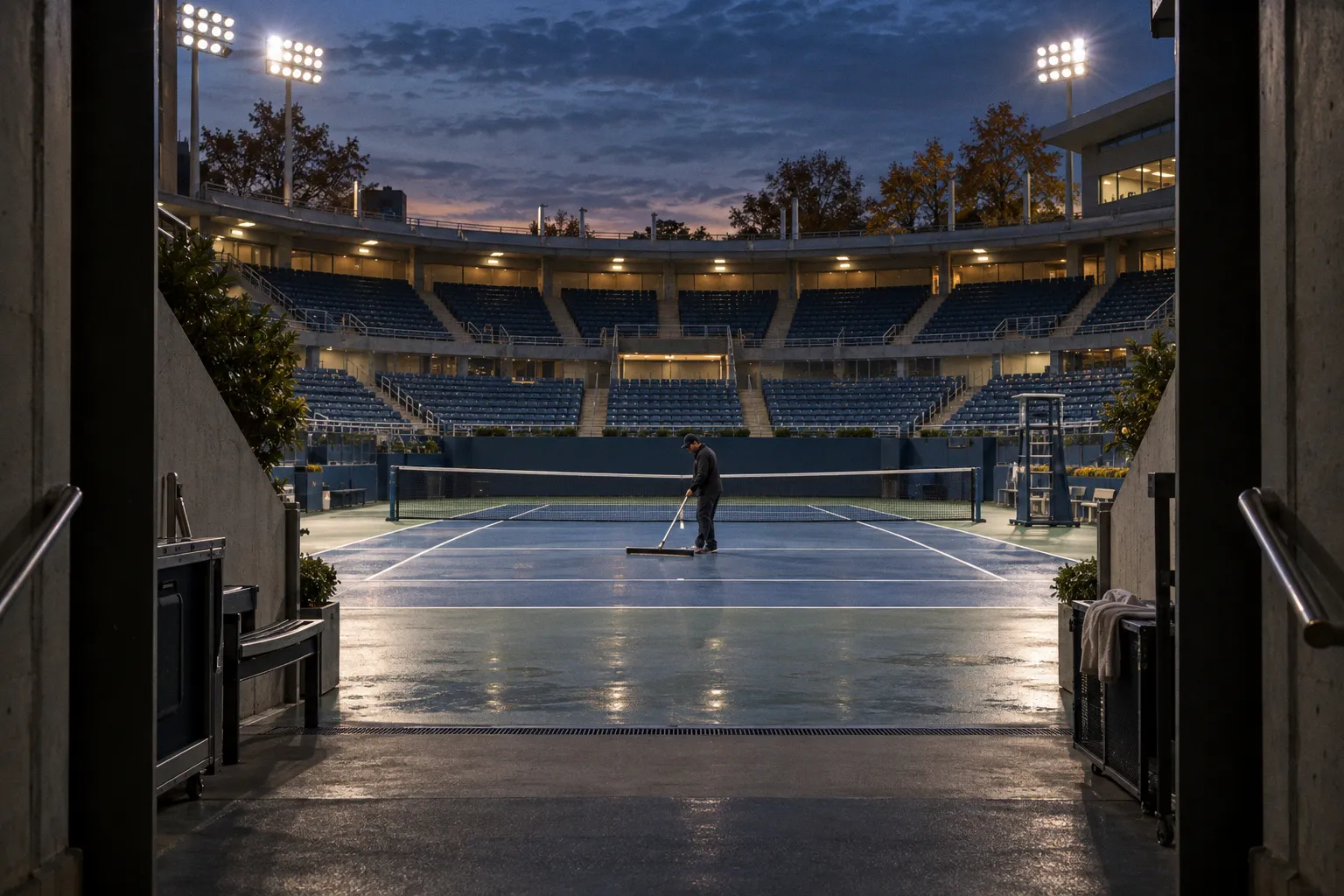
Heat expands the gas inside it, thins the surrounding air, and encourages a higher bounce with a quicker flight; after sunset, cooler and denser air takes some of that liveliness away, while the felt can gather enough moisture to make the ball heavier and less willing to leave the strings.
That is the first fact to hold onto when comparing day versus night session tennis conditions. The court may have the same dimensions, the lines may be painted with the same precision, and the players may be wearing the same shoes—but the physical contest has shifted. At a Grand Slam, where a match can move from bright afternoon hard court to a floodlit evening in the space of one round, the atmosphere is not scenery. It is part of the draw.
The physics of expansion: why daytime heat accelerates the game
The most immediate difference between a daytime and a nighttime session is temperature. A warm afternoon changes the tennis ball before either player has made a tactical decision. As the air inside the ball warms, its pressure rises. The ball comes off the strings with greater energy, travels through less dense air, and tends to rebound more sharply from the court.
The effect is not a simple command to “play faster.” It changes the timing of almost everything.
A player returning serve has less room to organize the feet. A forehand struck with heavy topspin may jump higher and reach the opponent sooner. A defensive lob can carry farther than expected, while a short-angle attempt may find the sideline before the player has fully recovered for the next ball. The same swing path, applied with the same racket, can produce a different tactical result because the ball has acquired a slightly different physical temperament.
Professional tennis balls must remain within the International Tennis Federation’s official range: between 2.57 and 2.70 inches in diameter, and between 1.975 and 2.095 ounces in weight. Those limits define the object, but they do not freeze its behavior. Temperature, air density, and moisture continue to work on the ball once it leaves the can.
The daytime court adds another layer. Forecasts describe the air temperature, but the hard surface under direct sun can become considerably hotter than the number displayed by a weather app. That radiating heat affects the players’ legs, their grip on the court, and the rate at which fatigue accumulates. It also changes the sensation of the bounce: not because the court suddenly becomes a different material, but because the ball reaches it with different speed and pressure, while the player receiving it is operating under greater physical strain.
The result is a form of acceleration that can be easy to misread. A match may look more aggressive in the afternoon, but the advantage is not automatically with the biggest hitter. Players who take the ball early can exploit the quick conditions, particularly if they are comfortable redirecting pace. Yet the same speed can punish a player whose preparation is slightly late. On a hard court, where the bounce is already relatively predictable, a warmer session can compress the time available between the bounce and contact until anticipation matters as much as raw power.
For servers, daytime heat can sharpen the reward for first-strike tennis. A ball that travels faster through thinner air may make a flat serve more difficult to control but more dangerous when it lands cleanly. The returner, meanwhile, may be tempted to stand farther back to buy time, conceding the court and giving the server a clearer first ball. That trade is one of the quiet tactical signatures of hot afternoon tennis: more speed at the front of the point, and often more space behind the baseline.
The evening shift: air density and the heavy-ball phenomenon
When the lights come on, the court does not become slow by decree. The change is gradual, and its character depends on the venue, the surface, the wind, the humidity, and how quickly the temperature falls. Still, cooler evening air is denser than hot afternoon air, and that density offers greater resistance to the ball’s flight. At the same time, the gas inside the ball contracts as it cools, reducing internal pressure.
The player experiences this not as a lesson in thermodynamics but as a ball that seems to stay on the strings a fraction longer and arrive with more weight. The bounce is lower; the ball can feel less eager through the court. A rally that was being decided by the first two strokes in the afternoon may require an additional exchange at night.
This is the source of the familiar “heavy ball” description. It does not mean that every ball has gained a measurable amount of mass simply because the sun has gone down. Rather, the combination of lower internal pressure, denser air, and possible moisture in the felt changes how the ball moves and how it responds to impact. The racket has to do more work. The player has to shape the shot with greater conviction.
That can favor a different kind of authority. A player who creates depth through racket-head speed and topspin may find the evening conditions more forgiving, because the slower flight gives the ball time to arc and land deep without rushing through the court. A returner may be able to stand closer to the baseline, take the ball earlier, and prevent the server from turning a modest advantage into an open court.
But a heavy evening ball can also expose technical weaknesses. A player who relies on a compact swing and a clean, flat strike may discover that the ball is not penetrating as it did a few hours earlier. The solution is not necessarily to swing harder. Often it is to move the feet more decisively, create greater racket-head speed, and accept that height over the net has to be generated rather than borrowed from the conditions.
| Match variable | Day session | Night session |
|---|---|---|
| Air temperature | Warmer, often with direct solar heating of the court | Cooler, with a gradual drop after sunset |
| Air density | Lower, allowing the ball to travel more freely | Higher, creating more resistance in flight |
| Ball pressure | Gas expands, contributing to a livelier bounce and faster flight | Gas contracts, contributing to a lower, heavier response |
| Bounce | Often higher and quicker | Often lower and less explosive |
| Felt condition | Usually drier unless weather is unusually damp | More exposed to evening moisture and dew |
| Tactical emphasis | Early contact, first-strike patterns, managing accelerated pace | Penetration, patience, footwork, and constructing points through denser air |
| Physical burden | Heat on the body and court, greater concern over endurance | Cooler conditions may aid endurance, though long matches still accumulate fatigue |
The table is only a map. Grand Slam courts do not obey a single script, and a dry, windy night can play very differently from a still, humid one. Yet the comparison captures why players and coaches treat session assignment as a competitive condition rather than a scheduling detail.
The evening ball is not merely slower; it asks the player to supply more of the pace that the afternoon air provided for free.
Humidity and the felt: the moisture that changes the hand
Humidity is often discussed imprecisely in tennis. It is not correct to say that humid air is denser than dry air—in fact, water vapor makes air less dense. The practical problem comes elsewhere, in the ball’s felt.
A tennis ball’s outer covering is not decorative. It is the material that grips the strings, interacts with the court, and controls how the ball behaves during a topspin-heavy exchange. When the felt absorbs moisture, the ball can become heavier and slower. It may feel less clean at contact, and its response to spin can become more laborious. The player still sees the same yellow surface, but the texture beneath the fingers and racket has changed.
This is particularly significant in night sessions, when cooler temperatures and rising relative humidity can leave the ball carrying more moisture than it did in the dry heat of the afternoon. The change may be subtle at first. A serve that once skidded through the court begins to sit slightly. A crosscourt forehand that normally pulls the opponent wide loses a little of its bite. The point does not collapse into a different sport, but its margins become less generous.
The impact of humidity on tennis ball speed is therefore best understood as a combined effect. Moisture in the felt adds weight and slows the ball, while the cooler atmosphere increases density and lowers internal pressure. Neither factor needs to be dramatic on its own to become tactically meaningful over a long match. Tennis is a sport of repeated contacts—hundreds of them in a demanding contest—and a small change in the response of the ball can reshape the rhythm of an entire set.
The player who adjusts well usually does three things:
1. Creates more shape over the net. A lower, heavier ball may require a fuller topspin trajectory rather than a flat attempt to drive through the court.
2. Moves through contact instead of waiting for the ball to do the work. When the ball loses some of its natural liveliness, passive preparation produces short replies.
3. Reassesses the return position. Standing close can still be correct against a slower serve, but the returner has to recognize whether the ball is arriving slowly yet carrying weight, or simply sitting up for attack.
The best professionals do not necessarily announce these adjustments. They change the height of the toss, the length of the backswing, the position of the feet, or the target by a few inches. From the stands, it may look like a player has become more patient. At court level, the more accurate description is often that the player has accepted the new friction of the evening.
Beyond the baseline: heat, endurance, and the unequal cost of a daytime match
The daytime tennis court is not only a faster environment; it is a more expensive one for the body. Direct sun and heated hard-court material can push surface temperatures well above the ambient forecast. The player pays for that heat through elevated cardiovascular strain, faster dehydration, and a diminished ability to recover between points.
The consequences are not evenly distributed across the draw. A top seed with a short, efficient service motion and a history of closing matches quickly may be able to manage a hot session differently from a qualifier whose path depends on extended baseline exchanges. Players coming through qualifying may already have accumulated matches and travel fatigue. For them, a severe afternoon can turn a small physical disadvantage into a decisive one by the third set.
This is where the relationship between conditions and strategy becomes most visible. In extreme heat, the sensible plan is not always the most spectacular plan. A player may shorten points with first-strike patterns, but that approach also carries the risk of unforced errors if the ball is jumping and the body is tiring. Another player may use higher-margin targets and accept longer rallies, relying on superior movement—but that can be just as costly when the court surface is radiating heat through the shoes.
The daytime tennis court temperature effects are therefore tactical as well as medical. Heat changes the price of every choice:
- A long rally costs more than it did in the opening games.
- A failed attack creates a longer recovery problem than a neutral ball.
- A wide defensive movement can leave the legs slow for the next shot.
- A second serve struck without enough shape may become a direct invitation in faster air.
- A player who spends too much energy chasing low-percentage winners may have nothing left when the ball becomes heavier late in the match.
Officials have increasingly treated these conditions through heat policies rather than leaving every decision to informal judgment. The WTA introduced an excessive heat policy in 1992 that included a 10-minute break under specified conditions. At the US Open, the USTA introduced an extreme heat policy in 2018 that allowed a 10-minute break, and in 2024 it integrated wet-bulb globe temperature readings at regular intervals on site.
Wet-bulb globe temperature—WBGT—matters because it combines more than air temperature. It accounts for heat, humidity, radiant heat, and wind, producing a more useful picture of what the body is actually enduring. A WBGT reading of 30.1°C is associated with Grand Slam cooling-break provisions, while the ATP Tour has identified 32.2°C as a match-suspension threshold under its updated heat policy. These figures should not be treated as a universal rule for every major tournament: Grand Slams govern their own procedures, and tournament referees retain authority over how conditions are managed.
The existence of a policy does not make the environment predictable. A match may remain playable by regulation and still be physically punishing. Nor does a cooler night guarantee comfort. A long match under lights can produce its own accumulation of strain, especially when humidity makes the air feel close and the ball grows progressively heavier.
When the environment dictates the match
The most revealing comparison between day and night is not which session is universally faster. It is how each session alters the player’s available solutions.
In hot daytime conditions, the point may be decided by who can control acceleration without being pulled apart by it. The server has greater reward for pace, but the returner can use the speed against them. A clean block return can redirect a ball that would be difficult to generate independently. A player with precise timing can look devastating, while a player who needs a long preparation may spend the entire match arriving late.
At night, the contest often moves toward construction. The ball may not penetrate as readily, and a player must earn depth through the legs and the racket rather than relying on the atmosphere. Topspin becomes a way of preserving margin and forcing the opponent to strike from uncomfortable height. The returner may take more responsibility for creating the first attack because the serve no longer carries quite the same natural danger.
This does not mean that night tennis is automatically slower in every stadium, or that day tennis always rewards aggression. Court speed, ball brand, roof status, wind, surface wear, and individual matchups can overrule the broad pattern. A fast indoor-style hard court under a closed roof may remain exceptionally lively at night. A windy afternoon can disrupt timing more severely than a calm evening. Clay introduces its own vocabulary of grip, slide, and changing bounce, while grass can preserve a low skid even as the air cools.
Still, the environmental variables are legible if you watch for the right details. Pay attention to where the returner stands after the first few games. Notice whether the server is earning free points or merely starting the rally. Watch the height of the crosscourt forehand and the depth of the defensive reply. If players begin taking larger swings to produce the same penetration, the ball has probably become more demanding. If rallies are ending earlier despite cautious tactics, the heat and speed may be amplifying the first strike.
The session also affects the psychology of risk. In the afternoon, a player may feel that a neutral ball is dangerous because the opponent can turn it into a winner quickly. At night, the same neutral ball can become an opportunity to press, because the slower conditions provide more time to build the attack. A match may therefore appear to change character without either player changing their basic identity. The atmosphere has altered the value of their habits.
At a major tournament, the draw assigns an opponent—but the session assigns a second one, made of heat, density, friction, and time.
Reading the Grand Slam day after dark
Every major tournament has its own atmospheric identity because its daily schedule interacts with its geography and architecture. The hard courts of the US Open can become punishing under afternoon sun, while the night session carries a different tension as the air cools and the stadium lights take over. The Australian Open places heat and recovery at the center of the conversation, particularly when long rallies meet intense solar exposure. Roland Garros is governed by clay’s slower grip and the changing texture of the surface, yet evening moisture can still affect the felt and the effort required to drive through the court. Wimbledon’s grass supplies its own low, skidding logic, making small differences in timing especially visible.
The stadium itself matters. Open-air courts allow the ball to respond to broad changes in temperature and wind. A roof can reduce some variables while amplifying others, trapping heat or altering air movement and artificial light. The architecture around a court can create pockets of stillness, reflected heat, or shadow. Even the transition from daylight to floodlights can influence visual comfort, particularly when the player must track a high toss against a changing background.
This is why experienced viewers read a session assignment as part of the competitive story. A player who prefers the day may be responding to more than personal routine. They may trust their ability to take the ball early in warmer air, or believe that their physicality will be rewarded before the evening slows the court. A player who prefers the night may value a heavier ball, longer exchanges, and the lower visual glare of a floodlit stadium. Neither preference is a superstition when it is supported by a coherent tactical profile.
The challenge is that conditions can move during a match. An afternoon contest may begin in direct sun and finish beneath a lower temperature, particularly if it stretches toward evening. A night match may start with residual heat in the court and end in denser, cooler air. Players do not receive a clean laboratory setting. They receive a moving environment, and the most accomplished among them adjust before the scoreboard makes the need obvious.
For anyone studying professional tennis match environmental variables, the central lesson is simple but not simplistic: the ball is a physical object, and the court is an active system. Temperature changes pressure. Air density changes flight. Humidity changes the felt. Radiant heat changes the body. The player’s strategy is built inside those conditions, not placed on top of them afterward.
Day versus night session tennis conditions are therefore not a question of atmosphere around the match. They are conditions within the match. The afternoon rewards those who can organize speed and survive the heat; the evening rewards those who can manufacture penetration and remain patient when the ball loses some of its free energy. The best players do not fight the air as though it were an inconvenience. They read it, feel its friction through the strings and soles, and let it refine the choices that decide the point.