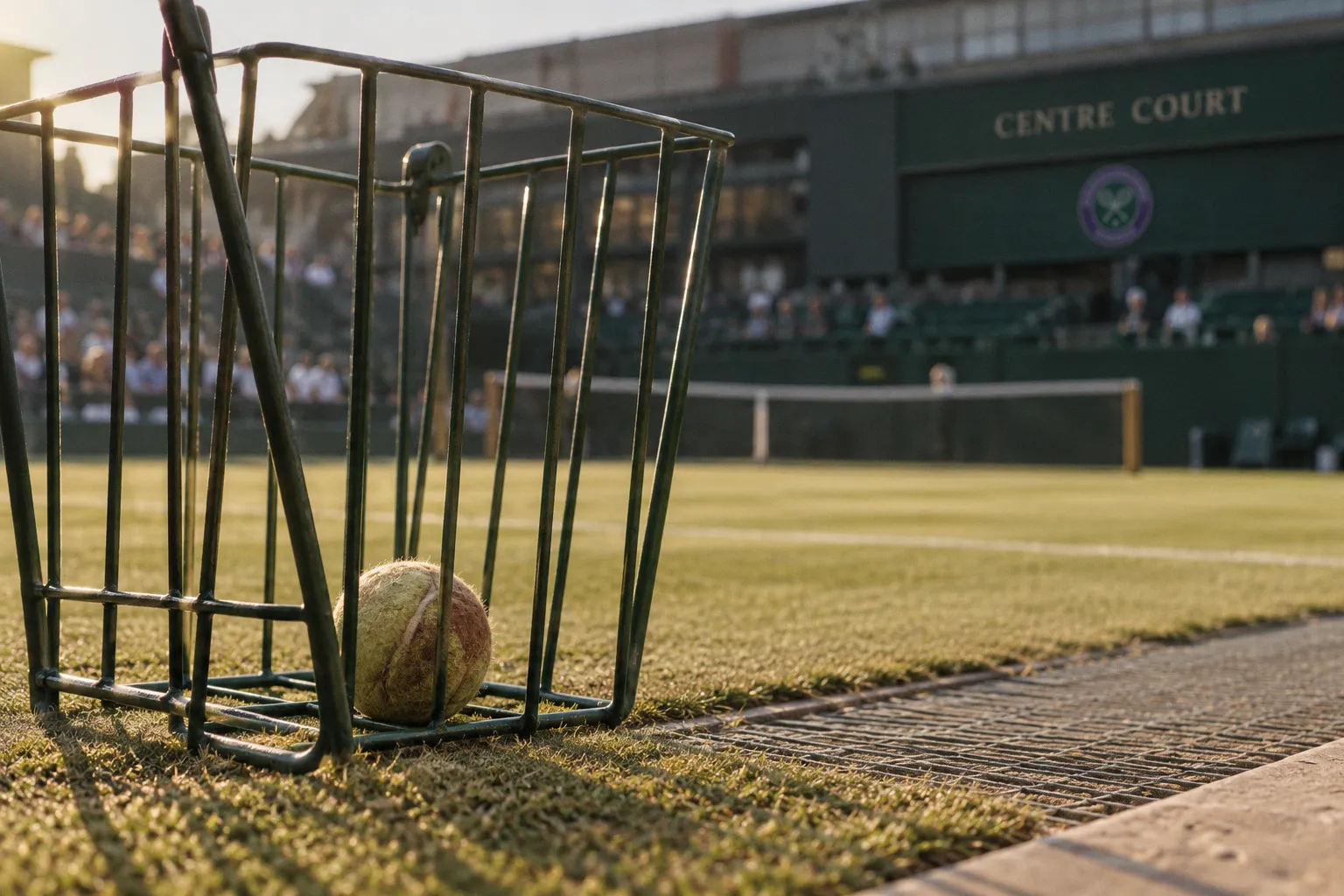
The number is small enough to miss from the upper stands of Centre Court, and most spectators do miss it. Yet the roughly two hundred and eighty teenagers who work the courts each Championships have trained, drilled, and tested against that ceiling since February. The lineage behind their craft begins not with tennis at all, but with the British naval training institutions of the 1920s — orphanages originally established to prepare young men for service at sea.
The modern ball kid is easy to overlook because the role is designed to remove itself from the spectacle. The best movement is the movement nobody notices: a ball arrives before the server asks for it, a crouching figure leaves the playing area without entering the players’ line of sight, a loose ball vanishes between points. Professional tennis depends on this quiet choreography, even if its records have no column for it.
From Naval Discipline to the Grass Courts: The Origins of Retrieval
The earliest ball boys at Wimbledon were not, in any conventional sense, tennis people. They were boys of the Shaftesbury Homes — a training charity whose origins lay in preparing young men for service in the Royal Navy. The institution took in children from some of the most difficult circumstances of late-Victorian and Edwardian Britain, fed and schooled them, and, above all, disciplined them. In the 1920s and 1930s, its senior students found a summer posting on the grass courts of the All England Club. The arrangement was administrative rather than ceremonial: the boys were paid a small wage, expected to be punctual, and required to learn enough of the game never to interfere with a rally in progress.
That last requirement mattered more than any knowledge of tactics. A ball boy did not need to understand why a player had chosen a particular serve or how a point was being constructed. He needed to know when not to move, where to stand, and how to respond once the point was over. The work was a form of disciplined attention, translated from one institution to another.
The handover came after the Second World War. From 1946 until 1966, Dr. Barnardo’s homes — another British welfare institution with roots stretching back to the nineteenth century — supplied Wimbledon’s ball boys. The substitution was bureaucratic rather than philosophical. Both charities drew from the same well of structured training, the same expectation that a teenager stationed behind a baseline would know how to be still, how to move only when summoned, and how to keep his eyes on the court without becoming part of the match.
Naval precision, put to work on a lawn.
What carried over from sea to grass was not the uniforms but the quality of attention. A ball boy trained at Dr. Barnardo’s in the 1950s was, in essence, still being prepared for watch duty: long minutes of patient observation punctuated by a single, decisive movement when the moment arrived. That habit, drilled in classrooms and dormitories long before the boys ever saw a Centre Court crowd, is the muscle that still moves the modern ball kid along the tramlines.
The institutional supply eventually faded, replaced by what we now recognise as the modern school-based selection programme. The old connection nevertheless explains something about the role’s character. Wimbledon did not begin by treating ball retrieval as a casual service job. It inherited a model in which punctuality, restraint, appearance, and obedience to a shared routine were part of the work itself. The silent figure crouched at the net today is the distant descendant of a child being trained, in another century, for service on a very different kind of deck.
The Gender Shift: Breaking the All-Male Tradition at Wimbledon
For almost half a century, the only silhouettes visible along the Wimbledon baselines were male. The Shaftesbury and Barnardo’s arrangements had set the template, and the template held through the interwar period, post-war austerity, and the early years of the Open Era. A single gender populated the deep corners and the net posts, indistinguishable in uniform and expected to meet the same standard of stillness.
That tradition began to give way in the late 1970s, slowly and with the institutional caution one expects from a club founded in 1868. The first ball girls appeared at Wimbledon in 1977. Three years later, in 1980, mixed teams of ball boys and ball girls made their debut. The change was small in appearance but significant in meaning: the work was no longer being presented as an exclusively male form of court discipline.
The final piece of that integration came in 1985, when ball girls were first selected to work Centre Court. That decision made the new arrangement impossible to ignore. The tournament’s most watched court was now being tended by young men and young women sharing the same rotation, the same code of stillness, and the same three-inch roll.
The change did not require a new philosophy of movement. Ball girls were not given a softer version of the job, nor were the existing standards relaxed. The significance was precisely that the same expectations could be applied across a mixed group: quick reactions without visible panic, physical readiness without fidgeting, and the ability to occupy a public space while appearing almost absent from it.
Wimbledon’s gender transition was gradual because Wimbledon’s culture has always been gradualist. The club changes slowly, often by absorbing a new practice into an old ritual rather than announcing a complete break with the past. Across the Atlantic, the US Open took a different approach to its workforce. While Wimbledon restricts its ball crew to teenagers drawn from nominated partner schools, the US Open places no upper age limit on its applicants, provided they meet the minimum age of fourteen.
That administrative difference produces a different population on the baselines of Flushing Meadows: an adult-mixed crew, drawn from a wider pool and gated by a minimum age rather than a school-based pathway. The contrast is not simply a question of progress versus tradition. It is a contrast between two ideas of what court assistance should be: a tightly cultivated youth programme on one side, and a more open, longer-career pool on the other.
| Standard | Wimbledon | US Open |
|---|---|---|
| Source of recruits | Nominated partner schools only | Open applications |
| Minimum age | Mid-teens through a school-based intake | 14 years |
| Upper age limit | Set by the school programme | No upper limit |
| Mixed-gender crews | Phased in between 1977 and 1985 | Mixed from the early years |
| Court emphasis | Grass-court stillness and uniform movement | Hard-court agility and broader entry |
The comparison also shows why the phrase “ball kid” can conceal different working cultures. The basic task is universal — retrieve, return, disappear — but the route into the role and the age of the people performing it shape the atmosphere around the court. At Wimbledon, the teenager is part of a longstanding institutional pipeline. At the US Open, the role can be a temporary job, a seasonal return, or a second chance to take part in a major tournament after leaving school.
The Geometry of Service: Mastering the Three-Inch Roll
Of all the standards the modern ball kid is held to, none is more quoted — and few are more visible on television — than Wimbledon’s three-inch rule. A ball rolled along the base of the net must rise no more than three inches off the grass, a ceiling so tight that a small change in the angle of the hand or the speed of the release can send it above the allowed limit. It is a number that reads as arbitrary on paper and looks like a finely tuned instrument in the hands of a trained teenager.
The rule is not a horticultural theory disguised as court etiquette. It is a practical standard of consistency. Wimbledon trains its ball kids to keep rolls below three inches so that the ball’s movement remains controlled, repeatable, and unobtrusive. The low roll is part of the tournament’s visual language: the ball should travel efficiently to its destination without becoming a new event between points.
Three inches is not a measurement of height so much as a measure of control: the ball arrives, and the match continues.
The mechanics of the roll are more intricate than they appear. A ball kid crouched at the net post must judge the angle of approach, the pressure applied by the thumb and forefinger, the speed of the release, and the position of the receiving player. On courts where line judges were still part of Wimbledon’s on-court operation, the movement also had to respect the officials’ working space. Since Wimbledon introduced electronic line calling on its match courts from 2025, that particular calculation has changed, but the wider principle remains: every movement around the court must be made without distracting from the point that has just ended or the one about to begin.
The aim is not to throw the ball but to escort it. The hand stays low; the release is gentle; the ball travels with enough pace to reach the server but not enough to bounce or veer into another working lane. There is no room for flourish. The goal is disappearance — the ball arriving as if the air itself had placed it.
That simplicity is deceptive. A strong throw can be learned quickly; a controlled roll has to be calibrated to the surface, the distance, the posture of the receiver, and the demands of the moment. The ball kid must also recognise when a roll is inappropriate. Some exchanges call for an underarm throw, some for a ball placed directly into a player’s hand, and some for no movement at all. Court etiquette is not a collection of isolated tricks. It is the ability to choose the least disruptive action.
What the training actually teaches
The technical side of the job rests on several habits that are easy to miss from the stands:
- Low release: the hand stays close to the ground so the ball remains below Wimbledon’s three-inch standard.
- Measured pace: the ball must reach the correct player without forcing them to step out of position.
- Clean recovery: after delivering a ball, the ball kid returns to the assigned place without crossing a player’s eyeline.
- Controlled stillness: readiness is maintained through posture and attention, not visible movement.
- Situational judgment: the same action is not suitable for every point, court position, or player request.
None of these skills is dramatic on its own. Together, they create the impression that the court is operating by itself.
Selection and Sacrifice: The Competitive Path to the Grand Slam Stage
The funnel that produces Wimbledon’s ball kids is, in miniature, one of the most selective youth pipelines in British sport. Of approximately fourteen hundred applicants — drawn almost exclusively from nominated secondary schools across the south of England — only around two hundred and eighty are retained. The acceptance rate hovers near twenty per cent, and the process continues beyond the first selection: some candidates fall away during the training months rather than at the interview stage.
The retained cohort averages fifteen years of age. They are still children in almost every legal sense — too young to drive, too young to vote, old enough to memorise the difference between a fault and a let, and to learn across a single summer how to move along the tramlines of Centre Court without entering a player’s eyeline.
They are teenagers being trained to be invisible. The cost of that invisibility is a level of self-supervision — a quiet, attentive grit — that few other first jobs require. The pressure is not the pressure of a scoreboard. It is the pressure of making no unnecessary mistake in a setting where thousands of people, and millions more watching remotely, can see the consequences of a badly timed movement.
Training begins in February at the AELTC Community Tennis Centre in Raynes Park, a few miles southwest of the All England Club itself. Sessions run weekly, each two to two-and-a-half hours long, and continue through rain, exam season, and the long school holidays until the first Monday of the Championships.
The curriculum is built around three connected demands:
1. Rules knowledge: candidates learn the laws of tennis, the local customs of the All England Club, the dress code, posture standards, and the rules governing interaction with players, officials, and spectators.
2. Physical reliability: training develops endurance, balance, agility, and the particular form of calf and leg strength required to crouch at a net post, move sharply, and recover without losing composure.
3. Ball-feeding mechanics: rolls, underarm throws, quiet retreats, and the three-inch ceiling are repeated under the watch of senior trainers until the gesture stops being a conscious calculation and becomes a dependable response.
There is also a fourth lesson that is harder to put into a training schedule: the candidate must learn how to read a court. Where are the players looking? Which ball is live for the next exchange? Is the server asking for one ball or two? Has a loose ball reached the correct collection point? Can the ball kid move now, or would waiting for another second make the action safer?
The training therefore turns tennis into a language of signals. A raised hand, a glance toward the net post, a player’s position behind the baseline, or the end of a particular routine can determine what happens next. The ball kid is not simply reacting to the ball. They are interpreting the court.
To stand inside that final two hundred and eighty is to have survived a quieter, less visible version of an Olympic trial. The teenagers who arrive at the All England Club on the morning of the first Monday are not there because the work is casual or the hours are short. They are there because, in their corner of southern England, they were among the most attentive, disciplined, and physically reliable candidates available.
The Invisible Choreography: Life Inside the One-Hour Rotation
Once the Championships begin, the labour of the ball kids is organised into a rotation so orderly that it appears, to a television viewer, almost imperceptible. Between Centre Court and No. 1 Court, Wimbledon runs roughly six teams of six — thirty-six young people rotating through the tournament’s two flagship courts — and each member follows the same cycle: one hour on court, one hour off court, repeated through the day until the final point has been played.
The visible work is straightforward. Crouch at the net post. Retrieve balls between points. Roll or toss a ball to the server. Step back into a neutral position. Remain still.
The invisible work is far more demanding. During the on-court hour, every muscle is held in a state of low-grade readiness: eyes tracking the ball, knees slightly bent, hands positioned for a sprint that may or may not arrive. The ball kid must remain alert without looking tense, prepared without anticipating so visibly that the preparation itself becomes a distraction.
During the off-court hour, the ball kid rests, hydrates, reviews the next rotation’s positions, and resets posture and concentration for another stint at the net. Recovery is part of the job rather than a reward after it. A tired ball kid does not merely move more slowly; they lose the fine control on which the whole system depends. The ball may arrive too high, a retreat may cut across a player’s vision, or a moment of uncertainty may become visible to the crowd.
One hour on, one hour off: a rhythm that turns thirty-six teenagers into a single, invisible body along the baselines of Centre Court.
The rotation also distributes responsibility. No individual ball kid needs to perform every task continuously, but every member of the group must understand the whole pattern. A team works because its members know where the others should be, when a position is about to change, and how to cover a gap without making the adjustment visible.
This is why the role is closer to choreography than collection. The ball kid at the net post is only one part of a moving arrangement that includes the players, the chair umpire, the officials, the server’s routine, and the flow of the match itself. The work succeeds when all of those elements remain separate. The ball kid helps the court function without claiming any of its attention.
What this rotation produces, over a fortnight, is a kind of bodily endurance that rarely enters the tournament’s official record. A ball kid working through to the men’s final will have spent perhaps sixteen to twenty hours in motion across the two weeks — crouched, sprinted, balanced on uneven grass, jolted back to attention by a server’s grunt, and absorbed the loudest sound in tennis without visibly reacting.
None of this is recorded in the post-match statistics. None of it enters the on-court interview. But without it, neither the statistics nor the interview would have happened in quite the same way. The match needs a background system that can absorb interruptions before they become interruptions.
The history of the role ultimately describes the slow conversion of a borrowed discipline into a purpose-built one. Naval attention, on loan at first, became tennis attention, refined across a century into a craft with its own testing standards, its own rotation, and its own three-inch ceiling of control.
The ball kid at the net post today is no longer an apprentice sailor. They are something the sport built, slowly and on purpose, for itself: a young court assistant trained to make precision look natural, and to let the drama belong entirely to the players.