Wimbledon Grass: The Hidden Science of the World’s Finest Courts
Those figures sound like groundskeeping details, but they describe something much larger: the physical system that determines how a serve leaves the strings, how sharply a player can change direction, and how the court gradually acquires the harder, more exposed character that defines the second week.
The green surface visible on television is only the uppermost layer of that system. The grass provides traction and protects the soil; the soil governs the bounce. Moisture, compaction, wear, weather, and the daily rhythm of mowing all work together beneath the players’ feet. Wimbledon’s court conditions are therefore not simply a matter of appearance. They are the result of a year-round attempt to hold several competing demands in balance — durability, firmness, consistency, recovery, and the unmistakable response of lawn tennis.
The 100% Ryegrass Revolution: Engineering Durability
Wimbledon’s first championship was played in 1877, when lawn tennis was still establishing many of the traditions that would later become inseparable from the sport. The grass courts of that era were not engineered according to the same standards as the modern tournament surface, nor could they be expected to survive the concentrated movement of professional tennis as it is played today.
The contemporary court begins with a much more deliberate choice of plant. Since 2001, Wimbledon’s courts have been sown with 100 per cent perennial ryegrass. Before that change, the turf consisted of a mixture of 70 per cent ryegrass and 30 per cent creeping red fescue. The move was made to improve the durability of the sward — the interlocking cover of grass plants that protects the soil and allows the court to remain playable under intense foot traffic.
That distinction matters. A professional grass court is not merely a lawn cut short. It is a living surface asked to tolerate repeated acceleration, braking, lunging, pivoting, and recovery steps, often in the same narrow areas of the baseline and service boxes. Every slide or abrupt stop places friction into the turf. Every serve-and-volley approach compresses the ground in a slightly different pattern. Over the course of a tournament, those small stresses become a map of the match.
Perennial ryegrass is valued here for its ability to withstand that punishment. Its role is not to create a decorative green carpet but to maintain enough density and resilience for the underlying soil to remain protected and the ball response to stay credible. The court must still look like grass, but appearance is the least demanding part of the assignment.
The seed itself is handled at a scale that reveals the industrial side of this apparently pastoral surface. Wimbledon uses more than nine tons of grass seed annually to renovate and overseed its championship and practice courts. That figure does not describe a single last-minute preparation before the tournament. It belongs to a continuous cycle of recovery, repair, establishment, and renewal — a programme in which the courts are treated as a collection of living athletic instruments.
There are 18 championship grass courts and 20 practice grass courts, each exposed to a different pattern of use and weather. The competition courts receive the greatest public attention, but the practice courts are part of the same ecosystem. They absorb training sessions, warm-ups, and the daily movement of players preparing for the draw. Together, they require a degree of consistency that cannot be achieved by tending only the most famous courts.
Wimbledon’s grass is not designed to remain untouched. It is designed to survive contact with elite tennis without losing the character of grass.
The 2001 change is sometimes presented as part of the story of Wimbledon becoming slower, more baseline-oriented, or more similar to other major tournaments. That interpretation goes beyond what the documented groundskeeping rationale supports. The stated purpose of the switch was durability, not an attempt to alter the perceived speed of play. The important point is more precise: the turf needed to withstand modern professional movement, and the ryegrass system was selected for that physical demand.
The 8mm Standard: Balancing Traction and Plant Survival
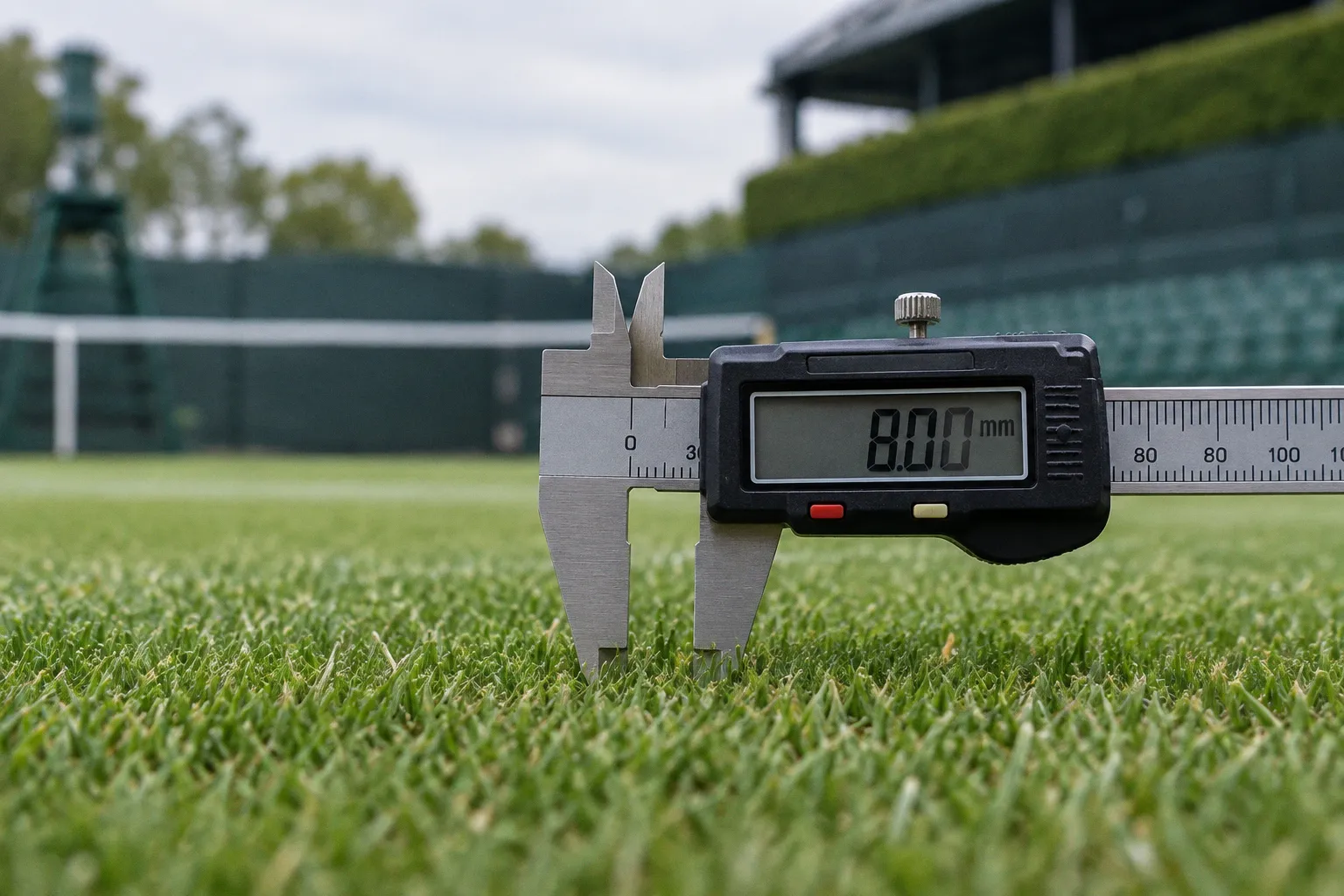
Grass height is one of the most visible variables in the preparation of a court, yet it is also one of the easiest to misunderstand. Since 1995, Wimbledon’s playing grass has been maintained at 8 millimetres. That exact height is a compromise between several demands that pull in different directions.
Longer grass may offer more plant material and a different visual density, but excessive height can affect traction, ball interaction, and the plant’s ability to tolerate the pressures of tournament play. Grass cut too aggressively, meanwhile, loses some of its capacity to recover and may expose the soil beneath it. The 8mm standard sits between those extremes, giving the court a controlled, resilient playing cover.
During the tournament, the courts are cut daily. This is not cosmetic tidying for television cameras. Mowing helps maintain a consistent playing height across a surface that is being worn unevenly from one session to the next. The work also demands timing and restraint: the turf has to be kept uniform without being placed under unnecessary stress.
In winter, the grass is allowed to stand taller, at approximately 13 millimetres. That seasonal difference reflects the fact that the court is not always in competition mode. The longer cut supports the plant during the colder, quieter part of the year, when the priority is recovery and establishment rather than a precise match surface.
The 8mm playing height must also be understood alongside the movement of the players. Grass-court tennis rewards a different relationship with the ground from clay or hard court tennis. On clay, a player can often prepare for a controlled slide and use the loose surface as part of the stopping process. On grass, traction is more immediate, but it can also be less forgiving when the turf is damp, worn, or disturbed. The first step becomes especially important, and the body must stay organised through a sequence of rapid, low-friction adjustments.
A grass court therefore influences strategy before a point has developed. A player who takes the ball early may be exploiting not only a lower or more variable bounce but also the chance to shorten the opponent’s time before either player has to make a large movement. A player who stays deeper must be prepared for a court that may become firmer and more exposed as the tournament progresses. The physical environment shapes the tactical choices, even when the television image makes the surface look perfectly uniform.
Soil Composition: Why the Ground Matters More Than the Blades
The central fact in understanding Wimbledon’s bounce is that the ball response is governed mainly by the soil, not by the length or density of the grass blades.
The court’s hard, dry soil provides the foundation for the bounce. Its profile contains approximately 21–23 per cent clay according to some descriptions, with the broader reported range reaching roughly 25 per cent. That clay content forms part of a carefully controlled topsoil structure designed to support the turf while producing a firm and consistent playing base.
This is where the material reality of the court becomes particularly important. Grass can influence how a shoe grips and how the surface protects itself, but the ball does not bounce from a soft cushion of blades. It reaches the ground, compresses against the soil profile, and returns according to the firmness and moisture conditions beneath the turf.
As the soil dries and compacts, the court becomes harder. The change is not a simple transformation from one surface type into another, and it does not mean that every court behaves identically at every moment. Rather, the underlying firmness can shift during the fortnight, producing a surface that feels subtly different in the second week from the one encountered at the opening of the championships.
Measured surface hardness has been described at approximately 200 gravities on the first day, increasing toward about 250 gravities over the fortnight. Those figures are useful not because they turn the tournament into a laboratory report, but because they give shape to something players and spectators often notice intuitively: the tournament has a physical progression.
Early-round grass may retain more of its protective cover and may respond with a particular combination of grip, softness, and pace. Later, repeated foot traffic and controlled drying leave the soil firmer and the worn areas more exposed. The court’s personality develops through use.
| Court element | What is controlled | Why it matters in play |
|---|---|---|
| Grass species | 100% perennial ryegrass since 2001 | Improves durability under repeated professional footwork |
| Playing height | Precisely 8mm during the competition | Balances traction, bounce consistency, and plant survival |
| Winter height | Approximately 13mm | Allows the turf to recover and remain robust outside the tournament |
| Soil profile | Roughly 21–25% clay in the topsoil mix | Helps create the firm base that governs ball bounce |
| Moisture | Watering restricted from June as conditions allow | Encourages the soil to dry and firm before and during play |
| Surface hardness | Around 200 gravities at the start, rising toward 250 | Reflects the court’s gradual physical change across the fortnight |
The practical consequence is that “fast grass” is not a complete explanation. Speed is produced by the relationship between the soil, the bounce, the ball, the weather, and the player’s ability to move through the point. A court can reward an aggressive first strike not because the grass is simply slippery, but because the ball arrives with a particular height and timing, while the player has less space to recover after a wide or short exchange.
That is why the same serve can feel tactically different at Wimbledon from one round to the next. The basic geometry remains unchanged, but the friction underfoot and the firmness beneath the ball continue to evolve.
The Tournament Lifecycle: From June Drying to Daily Maintenance
Wimbledon’s preparation does not begin when the tournament draw is released. The active playing season for the grass courts runs from May to September, but the tournament itself depends on a much longer cycle of cultivation and recovery.
By June, watering is restricted to allow the soil to dry out and firm up for competition. This is a controlled adjustment, not neglect. A grass court that remains too wet may lose firmness, suffer under foot traffic, and produce less reliable traction. A court that is managed toward a drier, harder state is better able to support the type of play expected at the championships.
Weather remains part of the equation. Rain can soften the soil and interrupt the carefully established relationship between the turf and the ground beneath it. Dry conditions can increase firmness but also place stress on the plants. The grounds team must respond to the conditions without chasing momentary perfection, because a living surface cannot be reset as easily as a manufactured one.
Once the tournament is under way, the work becomes a quiet sequence of small interventions:
1. The grass is cut daily to maintain the 8mm playing standard and reduce variation across the court.
2. Wear is monitored closely, particularly in the areas where serves, returns, approaches, and defensive changes of direction concentrate player movement.
3. Moisture is managed with restraint, allowing the court to retain the firmness required for competition while protecting the turf from unnecessary stress.
4. The surface is assessed as a system, not by colour alone; density, soil condition, traction, and recovery all matter.
5. Renovation continues beyond the tournament, with overseeding and repair preparing the courts for the next season rather than treating Wimbledon as a single annual event.
This rhythm helps explain why the court can change without being considered inconsistent. Consistency does not mean freezing every physical variable. It means managing the variables within a controlled range so that the court remains recognisably the same kind of surface as it responds to use and weather.
The tournament’s visual calm can obscure the amount of work involved. A court that appears almost effortless from the stands has been shaped by soil control, mowing schedules, seed selection, recovery planning, and close attention to the effect of thousands of footsteps. The more successful the preparation, the less visible the intervention becomes.
That is part of the strange achievement of Wimbledon’s groundskeeping. The court must feel natural enough to preserve the tradition of lawn tennis, yet precise enough to withstand one of the most demanding sporting events in the world.
The STRI Trials: Testing Turf Against Professional Footwork
Before a grass variety is trusted with the demands of championship tennis, it must survive testing that goes well beyond whether it grows attractively in a field.
Grass court candidates undergo multi-year trials led by the Sports Turf Research Institute in Yorkshire. These trials assess how the turf responds to wear, including wear generated by machinery designed to simulate the movement patterns of tennis players. The point is not to reproduce every movement of every athlete, but to create a repeatable form of stress that reveals how well a grass variety tolerates repeated traffic.
That is a crucial distinction. A plant can grow vigorously and still fail as a tennis surface. It may thin too quickly, recover unevenly, or allow the soil beneath it to become exposed in high-use areas. It may look healthy under ordinary conditions but lack the structural resilience required when players repeatedly push off from the same zones.
The trials are therefore an examination of the whole court environment. The grass must remain sufficiently dense. The soil must remain protected. The surface must retain a credible level of traction. The response must not deteriorate sharply after a small number of intense sessions. And all of this has to be achieved within the seasonal constraints of a British grass-growing cycle.
The exact commercial cultivar blend used in any particular modern year is not publicly specified in full. That restraint is sensible: turf science at this level depends on careful breeding, local adaptation, and long-term observation, not on a simple public recipe that can be copied line by line.
What can be understood clearly is the philosophy behind the testing. Wimbledon does not select grass because it is the fastest, greenest, or most visually uniform in isolation. It selects a turf system that can bear the concentrated friction of professional tennis while preserving the physical identity of the court.
The great Wimbledon surface is built by asking a living plant to behave with the reliability of engineered material.
That reliability is never absolute. No grass court remains untouched by weather or play. The aim is not to eliminate change but to make change gradual, legible, and compatible with the tournament’s demands. In this sense, the court is both prepared and allowed to develop. It begins with a carefully established condition, then absorbs the fortnight’s tennis and reveals the consequences in its firmness, wear patterns, and shifting response.
Why Wimbledon Grass Still Matters to the Game
The historical importance of Wimbledon’s grass is often discussed through tradition — white clothing, the old club setting, the seasonal return to south-west London. Those details matter, but the court’s authority comes from something more tangible. Grass changes the mechanics of tennis.
The low, sometimes irregular bounce asks players to read the ball earlier. The surface rewards a compact exchange of movement and timing. A serve can become more valuable because the returner has less time to organise. An approach shot carries greater threat when the opponent must change direction quickly on a surface where stopping and pushing off are materially different from clay.
The grass also places demands on the body that do not appear in the scoreline. Players must adapt their footwork without overcommitting. They must stay balanced through short, rapid movements. They must trust the first step while remaining ready for a ball that may skid, sit lower, or travel through the court with greater urgency.
Those demands are not created by the blades alone. They arise from the combined condition of the turf, the soil, the weather, and the wear accumulated across the tournament. That is why the preparation of the court is inseparable from the tactics seen on it.
The grass court surface evolution at Wimbledon is therefore not a story of tradition resisting science. It is a story of tradition surviving through science. The 100 per cent ryegrass mix, the 8mm playing height, the clay-rich soil profile, the drying programme, the daily mowing, and the long testing process all exist to preserve something recognisable: a court whose material character asks different questions of the players.
The hidden science does not diminish the romance of Wimbledon. It gives that romance a structure. Beneath the immaculate green is a carefully managed negotiation between plant biology and professional force — between the fragility of turf and the repeated violence of elite movement.
When the final is played, the court has already changed from the one that opened the fortnight. Its soil is firmer, its worn areas more telling, its grass marked by the passage of the tournament. That is not a flaw in the surface. It is the record of the tennis itself.
And this may be the most honest reason Wimbledon grass remains distinctive. It is not merely a stage prepared for the game. It is a participant in the game — living, compacting, drying, recovering, and gradually revealing how much tennis has passed across it.