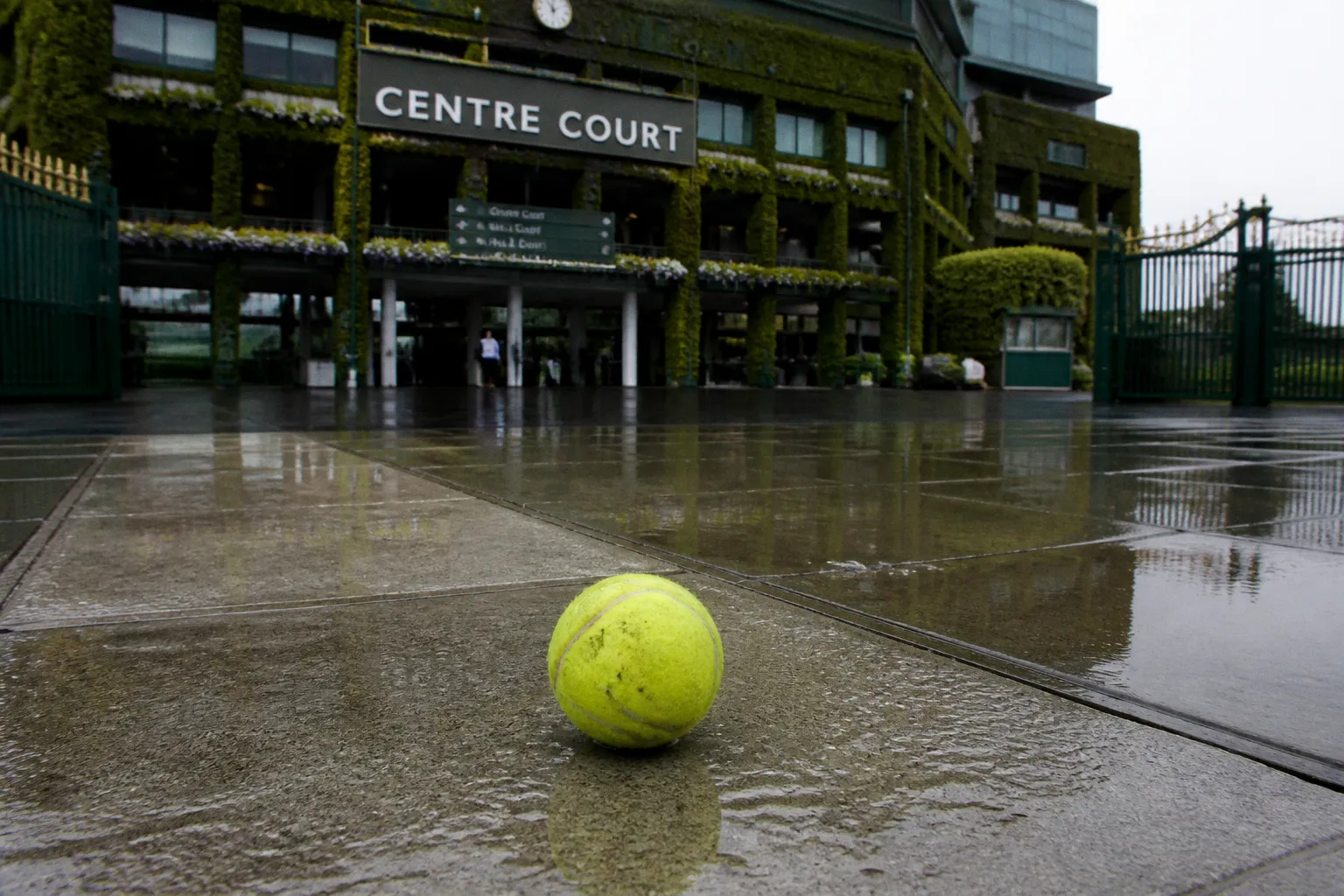
The critical anomaly appeared at Wimbledon in 1967. Four color broadcast cameras were deployed for BBC2’s coverage. On the grass, the traditional white ball merged with two other white elements in the frame: the baseline markings and the glare produced by the court surface. For spectators in the stands, the ball remained visible. For viewers at home, the image was less stable.
That distinction changed the object.
The yellow tennis ball history television transition is therefore not primarily a story about equipment design. It is a story about the court being reformatted for a second audience. The ball had to remain trackable after passing through a camera, a broadcast signal, a television screen, and the limitations of human vision at distance. The final color was selected as a visibility solution.
The result is now treated as part of tennis itself. It is not. It is a broadcast standard that became a sporting convention.
The white ball failed inside the television frame
Before the 1970s, tennis balls were traditionally white or black. The choice depended partly on the court surface and the need for spectators to distinguish the ball during play. This was a practical arrangement. It was not a fixed law of the sport.
The first major Wimbledon championship was held in 1877. Wimbledon was televised for the first time in 1937. Those two dates describe different versions of the event. The first belongs to a sport observed from the perimeter of a grass court. The second belongs to a sport translated into a sequence of images.
The translation introduced a new set of variables.
A tennis ball does not occupy a fixed position. It crosses the court at high velocity, changes direction after contact, and may rotate rapidly around its axis. On a grass court, the ball travels against a background that is mostly green, but the television frame also contains white court lines, player clothing, advertising surfaces, and reflected light. A white ball can be visible in the stands while becoming indistinct on a broadcast image.
This is not a contradiction. Visibility is dependent on contrast, distance, background, frame rate, and the quality of the image. The spectator watches the ball against a large physical field. The television viewer receives a compressed rectangle in which the ball may occupy only a small number of pixels.
The problem was particularly severe on grass. A white baseline does not simply mark the court. It creates a visual continuation of the ball’s own surface. When a shot travels near the line, the ball and its path can become difficult to separate. The issue is not that the ball disappears completely. It is that the eye loses a clean contact point between object and background.
For tennis, that matters at every stage of the rally. The viewer needs to identify:
- the ball’s position before contact;
- the height of the ball over the net;
- the depth of the bounce;
- the direction after racket impact;
- the relationship between the ball and the court lines.
A broadcast image that weakens any of these signals changes the perceived quality of the match. It makes the exchange look slower or less precise than it is. It also makes officiating and replay more difficult, although the early color transition was driven primarily by visibility for the television audience.
The white ball was not defective. It was being used in a new optical environment.
The yellow ball was not a performance upgrade. It was an image-correction device that became permanent.
David Attenborough identified the broadcast problem
In 1967, Sir David Attenborough was controller of BBC2. His role at Wimbledon was not that of a ball manufacturer or a laboratory researcher. He was involved in the broadcast experiment that brought color television to the tournament.
The BBC used four color broadcast cameras. This was a technical change with a direct consequence for the court. Color television did not merely add information. It exposed the limits of the existing visual hierarchy.
White clothing, white lines, pale surfaces, and the white ball occupied overlapping areas of the image. The green grass provided contrast in theory, but the television image was not viewed under laboratory conditions. It was seen through a screen, often with limited definition and variable brightness. The ball’s path had to be followed continuously, not located after the fact.
Attenborough suggested that a fluorescent ball color could solve the problem. That suggestion did not amount to the invention of the yellow tennis ball. It identified the requirement that the ball should separate from the court and the broadcast image more efficiently.
The distinction matters. Sporting history often compresses a chain of institutional decisions into the name of one visible figure. In this case, Attenborough provided the broadcast impetus. The later physical standard came through research and regulation.
The issue was also not confined to color television. A ball that performed well on a color screen still had to remain distinguishable on black-and-white television. Tennis was not yet operating in a single technical media environment. Broadcasters and viewers used different forms of display.
That created a narrow design problem. The new color had to produce sufficient contrast on grass and other court backgrounds while retaining a clear tonal difference when rendered without color.
The solution was not based on aesthetic preference. It was based on discrimination by the eye.
Why optic yellow was selected
The International Tennis Federation conducted extensive research in the late 1960s. The target was not simply a bright ball. It was a shade that would create reliable visual contrast in both color and black-and-white television broadcasts.
The selected fluorescent shade was named optic yellow.
The term describes a technical choice rather than a generic color category. Many yellow surfaces would not produce the same result. A ball must be visible during movement, under changing light, and against several backgrounds. It must also retain a recognizable outline after broadcast processing.
A television camera records luminance and color information. The human eye then reconstructs the object from differences in brightness and hue. Fluorescent coloring increases the ball’s visual separation from a green court, but the relevant advantage is not simply that the ball looks brighter. The advantage is that its edge and trajectory are easier to identify.
This is a tracking problem.
A player does not need to perceive the complete surface of the ball. The player needs to locate the ball early enough to set the racket, select a contact point, and control the next shot. The television viewer faces a similar requirement in passive form. The rally is intelligible only if the eye can maintain the ball’s position through flight, bounce, and contact.
Optic yellow was determined to provide the best available contrast across color and black-and-white television. The conclusion was functional. The color was accepted because it improved the transmission of information.
The important change was therefore not from “traditional” to “modern” in a broad cultural sense. It was from one visibility standard to another.
| Variable | White tennis ball | Optic yellow tennis ball |
|---|---|---|
| Grass-court contrast | Can merge with white lines and highlights | Separates more clearly from green grass and white markings |
| Color television | Vulnerable to glare and background overlap | Designed for stronger visual contrast |
| Black-and-white television | Depends heavily on tonal separation | Selected to remain distinguishable without color information |
| Spectator tradition | Established before television became dominant | Initially perceived as a technical departure |
| Regulatory status | Still permitted under ITF rules | Officially permitted from 1972 and later became standard in major events |
The table also exposes a common error. Optic yellow replaced white as the dominant tournament choice, but white balls were not banned by the ITF. The regulations continue to permit both white and yellow balls.
The yellow tennis ball did not win because the white ball was declared invalid. It won because the broadcast environment rewarded it.
The 1972 ITF decision changed the equipment standard
In 1972, the ITF amended its regulations to allow optic yellow tennis balls alongside traditional white balls in tournament play. This is the answer to the question, when did tennis balls become yellow, but it requires qualification.
They did not become yellow everywhere in 1972.
The decision created legal permission. It did not impose immediate uniform adoption. Individual tournaments retained their own preferences, and the most visible tournament in the sport resisted the change.
The distinction between authorization and adoption is central to equipment history. A governing body can define an available standard. It cannot instantly replace the material culture of every tournament. Players, officials, broadcasters, organizers, and audiences all have to accept the object.
The ITF decision also did not alter the essential physical function of the ball. The ball still had to meet requirements for size, mass, rebound, and construction. Its color was one component of a larger specification.
Modern ITF-approved regulation balls must have:
- a mass of 56.0 to 59.4 grams;
- a diameter of 6.54 to 6.86 centimeters;
- pressurized internal air at approximately 12 psi, or 80 kPa, above ambient sea-level pressure.
These figures define the object more precisely than its color does. A yellow ball that fails the mass or diameter range is not a compliant tournament ball. A white ball within the approved specification remains legal under the rules.
That point is absent from most popular accounts because color is visible and pressure is not. Yet pressure changes the ball’s response to racket impact and court contact. Diameter affects the apparent size of the target and the aerodynamic profile. Mass influences the exchange between racket head speed and outgoing ball speed. Optic yellow changes visibility. It does not replace the mechanical specification.
The 1972 decision was thus a narrow regulatory adjustment with a wide cultural effect. It altered what audiences expected to see. Once enough tournaments adopted the new color, the yellow ball stopped looking like an intervention and started looking like the natural form of the equipment.
That is how technical changes disappear into tradition.
Wimbledon kept the white ball until 1986
Wimbledon remained with white tennis balls for fourteen years after the ITF approved optic yellow. The tournament adopted yellow balls officially in 1986.
This delay is often presented as a quaint act of institutional resistance. The simpler explanation is that Wimbledon had a different relationship with its visual identity. The grass court, the white clothing, and the white ball belonged to a coherent presentation that predated the color broadcast problem. The tournament was not only selecting an object for optical efficiency. It was maintaining a controlled image of the event.
That image had consequences for the history of tennis balls. Wimbledon’s authority meant that its choice carried more weight than the choice of an ordinary tournament. As long as Wimbledon used white balls, the white ball retained symbolic legitimacy even after optic yellow had been approved.
The tournament’s resistance also demonstrates that visibility is not an absolute value. The ball was visible enough for live spectators and officials. The question was whether it was optimal for television. Wimbledon could accept the cost of an inferior broadcast contrast for a period because the event’s identity was organized around older visual conventions.
By 1986, the balance had changed. Color television was no longer an experimental medium at Wimbledon. It was the primary way many viewers encountered the tournament. The broadcast image had become part of the event’s practical infrastructure, not an external record of it.
The change in ball color therefore marked more than an equipment update. It acknowledged that professional tennis had two courts:
1. the physical court occupied by players and officials;
2. the mediated court constructed by cameras and screens.
The second court had become too important to ignore.
The ball’s color changed the viewer’s reading of play
Optic yellow did not change the rules of tennis. It changed the rate at which information reached the viewer.
A clear ball trajectory makes several tactical features easier to read. The audience can distinguish a dipping forehand from a flatter drive. It can see whether a serve is moving toward the body or the outside channel. It can identify the bounce height before the player makes contact. These are not abstract improvements. They are the basic components of match comprehension.
A ball that is difficult to track creates false narratives. The viewer may attribute an error to poor timing when the actual difficulty came from a late visual pickup. A return may look passive because the ball’s speed is hard to judge on screen. A short ball may appear to have been deliberately placed when the broadcast image only revealed its depth after the bounce.
Tennis analysis depends on the visible sequence of events. Position, contact, trajectory, and recovery form a chain. If the ball is not consistently legible, the chain is broken.
This is particularly relevant to older footage. Matches from the white-ball era are often discussed as if their slower or less precise appearance reflects the players’ technical level. Some of that impression belongs to the recording conditions. Film stock, camera placement, broadcast definition, court lighting, and ball color all affect the apparent speed and clarity of a rally.
The comparison must be controlled. A modern optic yellow ball on high-definition video is not visually equivalent to a white ball on an older broadcast. The modern image presents the court with stronger contrast and more stable object tracking. It can make historic tennis appear less dynamic than it was.
That does not mean the ball color explains every difference between eras. Racket materials, string construction, court preparation, player conditioning, serve technique, and return positioning all matter. The point is narrower: the visual evidence is not neutral.
The transition from white to yellow altered the record through which the sport is remembered.
The rule change was written in 1972. The visual culture of tennis changed only after the camera became the dominant spectator.
Why the yellow ball became invisible as history
The yellow tennis ball now appears inevitable because every current broadcast reinforces it. A viewer sees the ball against blue hard courts, red clay, and green grass. The color functions as a stable reference point. It is treated as part of the definition of tennis.
That stability is misleading.
Sporting equipment often becomes naturalized after a technical problem has been solved. The solution disappears. No one watching a contemporary match is expected to think about the limitations of 1960s color broadcasting, the relationship between luminance and court markings, or the need for contrast on black-and-white televisions.
The same process affected rackets, court surfaces, net technology, and camera systems. Each change is first treated as a practical intervention. Later, it becomes part of the period’s style. The optic yellow ball crossed that boundary.
There is also a cultural cost to the disappearance of the original problem. The shift is frequently described as if tennis simply decided that yellow looked better. That explanation is too weak. It removes the engineering sequence:
- color cameras exposed the weakness of the white ball in the broadcast frame;
- a fluorescent color was proposed as a visibility solution;
- the ITF researched contrast across different television formats;
- optic yellow was approved in 1972;
- Wimbledon delayed adoption until 1986;
- the new color became the default through repeated use.
The sequence contains no mystery. It contains a media system adjusting the sport to its own requirements.
This is why the phrase “yellow tennis ball history television transition” is more accurate than a simple history of equipment color. Television did not merely document the shift. It caused the shift, defined the performance requirement, and then normalized the result.
The modern ball is a compromise, not a visual ideal
The optic yellow ball is highly visible, but no ball is equally legible in every environment. The court background changes. Light changes. Camera exposure changes. The surface affects the contrast around the bounce. A ball may stand out clearly against clay and behave differently in the visual field on grass or a dark hard court.
The color is therefore not a universal solution. It is a standardized compromise that performs sufficiently well across the range of professional conditions.
The physical limits remain exact. The permitted diameter is 6.54 to 6.86 centimeters. The permitted mass is 56.0 to 59.4 grams. Those ranges allow manufacturing variation while keeping the ball within a controlled mechanical envelope. The internal pressure determines how the ball responds when compressed against the strings, the court, and the racket frame.
Visibility and mechanics are connected. A ball that is easy to see but outside the mechanical tolerance would distort play. A mechanically compliant ball that cannot be tracked by the audience would damage the broadcast. Professional equipment sits between those demands.
The historical change also shows why a color cannot be evaluated outside its delivery system. Optic yellow is not valuable because yellow is inherently superior to white. It is valuable because the sport’s dominant viewing conditions made its contrast useful.
If tennis had remained primarily a live spectator sport, the change might have been slower or less complete. If television technology had developed differently, another color might have been selected. The ball’s current appearance is the result of an interaction between court design, broadcast equipment, regulation, and institutional preference.
That interaction is the actual subject of the history.
The definitive legacy of the optic yellow ball
The transition from white to optic yellow was complete in practical terms by the time Wimbledon adopted the color in 1986. The ITF had already authorized it fourteen years earlier. The delay did not prevent the change. It gave the change a longer period in which to remain visible as a choice.
The ball did not make tennis faster. It did not create higher spin rates. It did not improve a player’s contact point or reduce unforced error margins. It improved the transmission of the rally from court to screen.
That was enough.
The modern tennis ball is defined by exact physical tolerances, but its most culturally important feature was selected outside the player’s immediate mechanical needs. Optic yellow was designed for the camera, validated through research, approved by a governing body, resisted by Wimbledon, and finally absorbed into the visual grammar of the sport.
The conclusion is direct. Tennis balls became yellow because professional tennis became a broadcast object. The color was not an ornament added to an established game. It was an adaptation to the court that viewers could see.